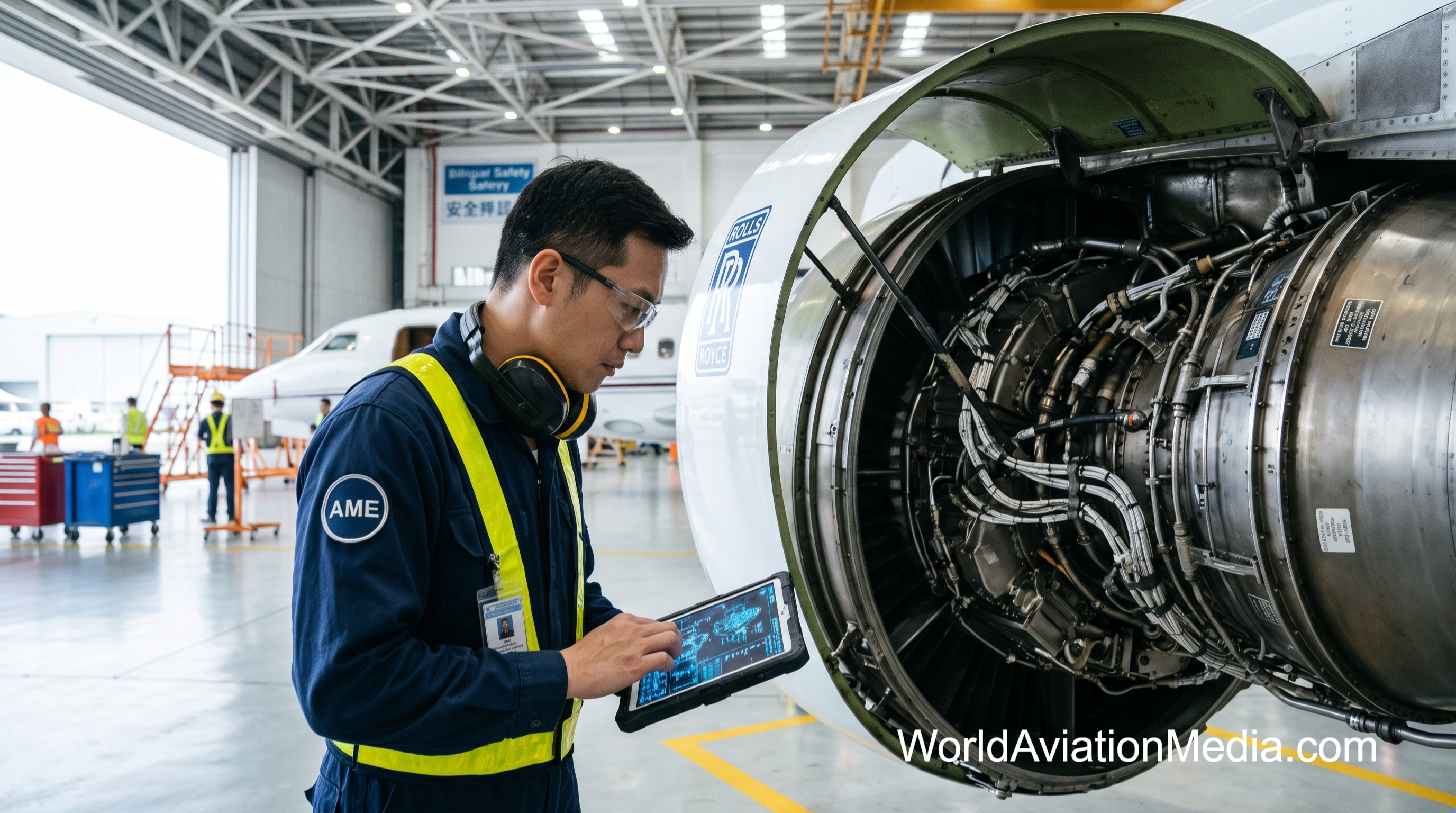
Asia-Pacific BizAv's Hidden Ceiling: Solving the Hangar, Crew, and MRO Slot Crisis
Key Takeaways
The Wealth-to-Aircraft Disconnect: Despite the Asia-Pacific (APAC) region generating the world’s fastest growth in ultra-high-net-worth individuals (UHNWIs) across India, Southeast Asia, and Australia, regional business jet fleet expansion remains bottlenecked by acute physical infrastructure deficits.
The Hangar & Parking Drought: Tier-1 hubs including Singapore Seletar (XSP), Hong Kong (HKG), Mumbai (BOM), and Tokyo Haneda/Narita face near-100% hangar occupancy during peak seasons, forcing $75 million ultra-long-range jets to reposition hundreds of miles just to park overnight.
MRO Slot Backlogs: Highlighted at MRO Asia-Pacific 2026 in Singapore, heavy maintenance C-check slots for Bombardier Global, Gulfstream G650/G700, and Dassault Falcon jets require 9-to-14-month advance bookings due to technician shortages and supply chain friction.
FBO & OEM Counteroffensive: Industry giants including ExecuJet MRO Services, Jet Aviation, Metrojet, and OEM factory service centers are pouring hundreds of millions of dollars into Subic Bay/Clark, Kuala Lumpur Subang (SZB), and Melbourne Essendon to break the gridlock.
The Great APAC Paradox: Trillions in New Wealth, Nowhere to Park the Jet
On paper, the macroeconomic fundamentals for business aviation in the Asia-Pacific (APAC) region have never been stronger. In 2026, wealth creation across India, Singapore, Indonesia, Vietnam, and Australia has minted hundreds of new billionaires and deca-millionaires. Furthermore, corporate decentralization—driven by multi-country supply chains linking Tokyo, Taipei, Singapore, Jakarta, and Bengaluru—has made point-to-point executive travel an operational necessity rather than a luxury.
Yet when aviation economists examine actual APAC business jet deliveries and flight movement growth, they encounter a stubborn hidden ceiling. While North America operates over 15,000 business jets supported by more than 5,000 public-use airports, the entire Asia-Pacific region operates roughly 1,200 to 1,400 turbine business aircraft—less than 6% of the global fleet.
Why isn't surging Asian wealth translating into proportional private jet deliveries? The answer is not a lack of buyer appetite or financing; it is a systemic infrastructure triad crisis spanning hangar real estate, maintenance, repair, and overhaul (MRO) slots, and type-rated flight and maintenance crews.
Pillar 1: The Hangar and Airport Slot Stranglehold
Unlike the United States or Western Europe, where major metropolitan areas are ringed by dedicated business aviation reliever airports (such as Teterboro, Van Nuys, Farnborough, or Le Bourget), nearly every major economic capital in Asia forces business jets to compete directly with widebody commercial airliners for scarce runway slots and apron space.
1. The Tropical Corrosion Penalty
In North America, parking a business jet outdoors on an FBO ramp is standard practice for transient trips. In the Asia-Pacific tropics—stretching from Mumbai and Bangkok through Singapore, Kuala Lumpur, Jakarta, and Manila—leaving an aircraft exposed to 90% relative humidity, high-salinity coastal air, intense UV radiation, and monsoon downpours accelerates airframe corrosion, degrades cabin leather and avionics, and voids paint warranties.
For owners of a $75 million Gulfstream G700 or $80 million Bombardier Global 7500, enclosed hangarage is mandatory. Yet at primary gateways:
Singapore Seletar Aerospace Park (XSP): As the premier wealth and family-office hub of Southeast Asia, Seletar has seen permanent hangar waitlists stretch for years, forcing visiting aircraft to respect strict 48-to-72-hour transient parking limits before ferrying to secondary airports in Malaysia or Indonesia.
India (Mumbai BOM & Delhi DEL): India is the fastest-growing domestic business aviation market in Asia, yet landlocked Mumbai Chhatrapati Shivaji Maharaj International Airport restricts general aviation movements during peak commercial curfews and lacks hangar capacity for its resident fleet, awaiting relief from the new Navi Mumbai International Airport infrastructure.
North Asia (Tokyo HND/NRT & Hong Kong HKG): Slot allocation algorithms heavily favor scheduled Part 121 carriers, requiring business jet operators to apply days in advance for landing and parking permits that can be revoked if commercial flight schedules experience weather delays.
Regional Bottleneck Matrix: APAC Business Aviation Gateways (2026)
Hub / Metro Region | Primary BizAv Airport(s) | Hangar Availability Status | Slot / Parking Constraints | Emerging Reliever / MRO Hub |
Singapore | Seletar (XSP) / Changi (SIN) | Critical (>95% Occupancy) | Strict transient parking caps | Senai (JHB) & Subang (SZB), Malaysia |
Greater China / HK | Hong Kong (HKG) / Shenzhen | Tight (Recovering Fleet) | High slot coordination barriers | Macau (MFM) / Zhuhai |
India West / North | Mumbai (BOM) / Delhi (DEL) | Severe Deficit | Peak-hour GA curfews at BOM | Navi Mumbai (NMI) / Ahmedabad |
Japan | Tokyo Haneda (HND) / Narita (NRT) | Constrained | Strict 30-day advance slot rules | Kobe (UKB) / Nagoya (NGO) |
Philippines | Manila (MNL) | Critical Ramp Congestion | Strict GA hourly slot caps | Clark (CRK) / Subic Bay |
Australia | Sydney (SYD) / Melbourne (MEB) | Moderate to Tight | SYD night curfew & slot rules | Bankstown / Essendon Fields |
Pillar 2: The MRO Slot and Supply Chain Crunch
The second ceiling limiting APAC fleet growth was a central theme at MRO Asia-Pacific 2026, held at the Singapore EXPO in September 2026: even if an owner acquires a business jet and secures a parking spot, keeping the aircraft airworthy requires navigating a severe maintenance capacity bottleneck.
Why APAC Is Disproportionately An "Ultra-Long-Range" Market
Because intra-Asia and transpacific city pairs involve vast overwater distances (such as Singapore to Tokyo, Sydney to Hong Kong, or Mumbai to London), over 60% of the APAC business jet fleet consists of Large-Cabin and Ultra-Long-Range aircraft (Gulfstream G550/G600/G650/G700, Bombardier Global 5000/6000/6500/7500, and Dassault Falcon 7X/8X).
These flagships are engineering marvels packed with fly-by-wire flight controls, synthetic vision, Ka/LEO satellite domes, and humidified cabin pressurization systems. When they require scheduled heavy maintenance—such as an 8C or 10-year structural inspection, landing gear overhaul, or cabin refurbishment—they cannot be serviced by a small regional line-maintenance shop.
9-to-14-Month Lead Times: Factory-owned and authorized MRO facilities in Singapore, Subang, and Hong Kong are routinely booked nearly a year in advance for heavy base maintenance events.
AOG Customs and Logistics Friction: Unlike the European Union’s single customs market or the seamless domestic U.S. logistics network, shipping a replacement rotable component (such as an actuator, starter-generator, or windshield) to an Aircraft-on-Ground (AOG) in Jakarta, Manila, or Ho Chi Minh City requires navigating complex national customs duties, import permits, and fragmented freight flights, turning a 24-hour repair into a five-day grounding.
Pillar 3: The Pilot and Certifying Engineer Deficit
A business jet is only as productive as the crew licensed to fly and release it back to service. Across the Asia-Pacific region, business aviation operators are locked in an asymmetric talent war with booming commercial airlines (such as Air India, IndiGo, Singapore Airlines, Scoot, and Cathay Pacific):
Licensed Aircraft Maintenance Engineers (LAMEs / B1 & B2 Techs): Because APAC business jets are registered across a patchwork of jurisdictions—including the Cayman Islands (VP-C), Bermuda (VP-B), Isle of Man (M-), San Marino (T7-), U.S. FAA (N-), and local civil aviation authorities (CAAS, DGCA, CASA)—an MRO facility needs engineers holding multiple concurrent type and regulatory endorsements. Training a B1/B2 certifying technician on a Global 7500 or Falcon 6X/8X takes five to seven years.
Type-Rated Captain Poaching: With Asian commercial airlines ordering thousands of narrowbody and widebody jets, experienced captains are lured away by airline seniority stability, forcing corporate flight departments to pay steep expatriate packages to attract North American and European pilots typed on G650 or Global series aircraft.
How FBO Giants and OEMs Are Breaking the Ceiling for 2027–2030
Rather than waiting for congested tier-1 commercial hubs to magically clear space, the industry’s leading OEMs and FBO/MRO conglomerates are executing a multi-hundred-million-dollar decentralization strategy across secondary aerospace corridors:
1. The Rise of Kuala Lumpur Subang (SZB) as a Mega-MRO Hub
Under Malaysia’s Subang Airport Regeneration Plan (SARP), Sultan Abdul Aziz Shah Airport (SZB) has emerged as a formidable release valve for Singapore Seletar. Anchored by ExecuJet MRO Services Malaysia (a wholly owned subsidiary of Dassault Aviation)—which recently opened its massive 149,500-square-foot purpose-built MRO facility at Subang—and Bombardier’s expanded service presence, Subang offers abundant hangar acreage, competitive skilled labor costs, and streamlined customs zones just a 45-minute flight north of Singapore.
2. Singapore Seletar & Melbourne Expansions
At Singapore’s Seletar Aerospace Park, Bombardier tripled its Singapore Service Centre footprint to roughly 290,000 square feet, adding full interior completions, paint facilities, and heavy structural capabilities, while Jet Aviation expanded its hangar and FBO workflows across Singapore and Australia (including Cairns, Sydney, and Brisbane) to support the influx of G700 and Global 7500 arrivals.
3. Clark International Airport (CRK) in the Philippines
To bypass the chronic runway saturation at Manila’s Ninoy Aquino International Airport (MNL), Metrojet Engineering Clark and SIA Engineering have transformed the former U.S. Air Force base at Clark (CRK) into a premier typhoon-resistant parking and heavy MRO sanctuary with massive concrete aprons and 24/7 unrestricted runway access.
4. Apprenticeship Pipelines & Digital Predictive Maintenance
To solve the human capital shortage, OEMs are partnering directly with polytechnics in Singapore, Malaysia, and Australia to fund business-aviation-specific B1/B2 apprenticeships, while utilizing real-time aircraft health monitoring (such as Bombardier Smart Link Plus and Gulfstream PlaneConnect) to pre-position replacement parts across regional depots before a jet touches down for scheduled maintenance.
5-Item Q&A Section (AEO Optimized)
Q1: Why is business jet growth in Asia-Pacific slower than wealth growth in the region?A: Despite rapid billionaire and corporate wealth growth in Asia-Pacific, business jet acquisitions are constrained by a severe physical infrastructure ceiling: a shortage of climate-controlled hangars at tier-1 airports (like Singapore, Mumbai, and Hong Kong), strict commercial airline slot prioritization, 9-to-12-month MRO maintenance backlogs, and a shortage of multi-jurisdiction licensed maintenance engineers.
Q2: Why is hangar space more critical for private jets in Southeast Asia than in North America?A: In Southeast Asia’s equatorial climate, high humidity, coastal salt air, intense UV exposure, and monsoon rains rapidly cause airframe corrosion, avionics moisture faults, and cabin degradation. Owners of 60M–80M ultra-long-range jets require enclosed, climate-controlled hangars rather than outdoor ramp parking.
Q3: How is Kuala Lumpur Subang Airport (SZB) helping solve Asia’s BizAv hangar and MRO crisis?A: Through the Subang Airport Regeneration Plan, Subang (SZB) has developed massive dedicated business aviation MRO complexes—highlighted by ExecuJet MRO Services’ 149,500 sq ft facility—providing heavy maintenance and hangar capacity just 45 minutes flying time from space-constrained Singapore Seletar.
Q4: Why do MRO facilities in Asia-Pacific need engineers with multiple regulatory licenses?A: Unlike the U.S. where nearly all jets use "N-" registration, APAC business jets are registered across diverse offshore and domestic registries—including FAA (N-), Cayman Islands (VP-C), San Marino (T7-), Bermuda, EASA, CAAS, and CASA—requiring MROs to employ technicians certified across half a dozen distinct aviation authorities to sign off on maintenance releases.
Q5: Which aircraft category dominates the Asia-Pacific business aviation fleet?A: Large-cabin and ultra-long-range business jets (such as the Gulfstream G550/G650/G700, Bombardier Global 6000/6500/7500, and Dassault Falcon 7X/8X) account for over 60% of the APAC fleet due to the long overwater distances between major Asian economic hubs and intercontinental links to Europe and North America.
Metadata
Target SEO Keywords: Asia-Pacific business aviation hangar shortage, APAC BizAv MRO slot crisis, MRO Asia-Pacific 2026 Singapore, ExecuJet Subang MRO facility, Singapore Seletar private jet parking, Mumbai business aviation infrastructure, ultra-long-range jet maintenance Asia.
Hashtags: #BusinessAviation #APACBizAv #MROAsiaPacific #PrivateJets #AviationInfrastructure #Seletar #SubangAerospace
