Who Regulates Aerospace AI? Unpacking Congress and FAA’s Push for Certifiable Machine Learning
Key Takeaways
No New Federal AI Agency for Aviation: Speaking at NBAA-BACE in October 2026, Pilot-Congressman Rep. Jay Obernolte (R-CA) made a decisive legislative case that the FAA—not a new standalone federal AI agency—must retain sole jurisdiction over aviation artificial intelligence rules.
DOT’s Certification Modernization Push: U.S. Transportation Secretary Sean P. Duffy reinforced at NBAA-BACE that the FAA must overhaul and accelerate its certification processes to safely integrate AI, autonomy, and Advanced Air Mobility (AAM).
The Non-Deterministic Certification Paradox: Aviation regulators (FAA, EASA, UK CAA) require deterministic, repeatable software behavior under DO-178C, creating a fundamental engineering clash with probabilistic neural networks and adaptive machine learning.
The Digital Airspace Baseline (UK CAA Electronic Conspicuity): Because AI Detect-and-Avoid (DAA) and automated Air Traffic Management (ATM) cannot rely on visual eyeballs alone, regulators like the UK Civil Aviation Authority (CAA) are moving toward mandatory ADS-B Out Electronic Conspicuity (EC) in lower airspace while resolving TCAS alert clutter.
The Jurisdiction Battle: Why Rep. Jay Obernolte Says the FAA Must Write Aviation’s AI Rules
As artificial intelligence permeates every sector of the global economy, Washington policymakers have debated whether to establish a centralized federal "Department of AI" to govern machine learning algorithms across healthcare, finance, transportation, and defense. At the October 2026 NBAA-BACE convention in Las Vegas, U.S. Representative Jay Obernolte (R-CA)—a computer scientist, commercial-rated pilot, and leading voice on congressional AI task forces—drew a bright red line around the cockpit.
Who regulates artificial intelligence in U.S. aviation? Under the regulatory framework championed by Congress and the Department of Transportation in 2026, the Federal Aviation Administration (FAA) retains exclusive sectoral authority to regulate and certify artificial intelligence in aircraft flight controls, avionics, maintenance systems, and Air Traffic Management (ATM)—rejecting proposals to hand aerospace oversight to a generalized federal AI agency.
Why did Rep. Obernolte argue forcefully that sector-specific regulators like the FAA must lead AI rulemaking?
Context-Specific Risk criticality: A hallucinating Large Language Model (LLM) in a marketing chatbot is a minor nuisance; an unpredictable neural network state in a fly-by-wire pitch actuator at 35,000 feet is catastrophic. Only the FAA possesses the Design Assurance Level (DAL A through DAL E) safety engineering framework to evaluate failure probabilities down to 10-9 per flight hour.
Preventing Dual-Regulator Paralysis: As U.S. Transportation Secretary Sean P. Duffy emphasized in his own NBAA-BACE remarks, the FAA already needs faster, modernized certification pathways to bring safer technologies and Advanced Air Mobility (AAM) to market. Forcing aerospace OEMs to secure both an FAA Type Certificate and a separate algorithmic clearance from an outside AI bureaucracy would paralyze U.S. aerospace competitiveness.
Enterprise Compliance Is Already Moving: In the lower-risk DAL D/E operational tiers, AI is already deploying safely inside regulatory guardrails—exemplified at NBAA-BACE 2026 by Web Manuals launching its AI Compliance Assistant integrated directly with FAA Data Collection Tools (DCT).
The Core Engineering Problem: Certifying Non-Deterministic AI in a DO-178C World
To understand why certifying airborne AI in flight controls and Air Traffic Management is the hardest technical challenge in aviation history, one must understand the philosophical collision between RTCA DO-178C (the global bible of airborne software certification) and modern Machine Learning (ML).
Under DO-178C, safety-critical avionics software must be deterministic and fully traceable:
Given Input X, the software must produce Output Y 100% of the time.
Every single line of source code must trace directly to a system requirement, and no "dead" or unverified code paths can exist.
Deep neural networks and adaptive machine learning models are inherently probabilistic (non-deterministic):
They do not follow explicit IF-THEN-ELSE code written by a human engineer; they infer patterns from millions of weighted parameters trained on massive datasets.
In "online" or continuous learning models, the software changes its own weights in response to new operational data—meaning the software flying on Tuesday is mathematically different from the software certified on Monday.
How the FAA and EASA Are Solving the Paradox: "Run-Time Assurance" & Frozen Weights
How do you certify a probabilistic neural network to fly an airplane or sequence arrivals into Heathrow or JFK? Regulators and aerospace primes are converging on a three-pillar certification architecture:
AI Certification Mechanism | How It Works Technically | Primary Aerospace Application |
Frozen-Weight Offline Training (EASA/FAA Level 1–2 ML) | Neural networks are trained via machine learning on the ground, then frozen into static lookup/inference weights before flight certification | Computer-vision runway detection, optical Detect-and-Avoid (DAA), acoustic MRO diagnostics |
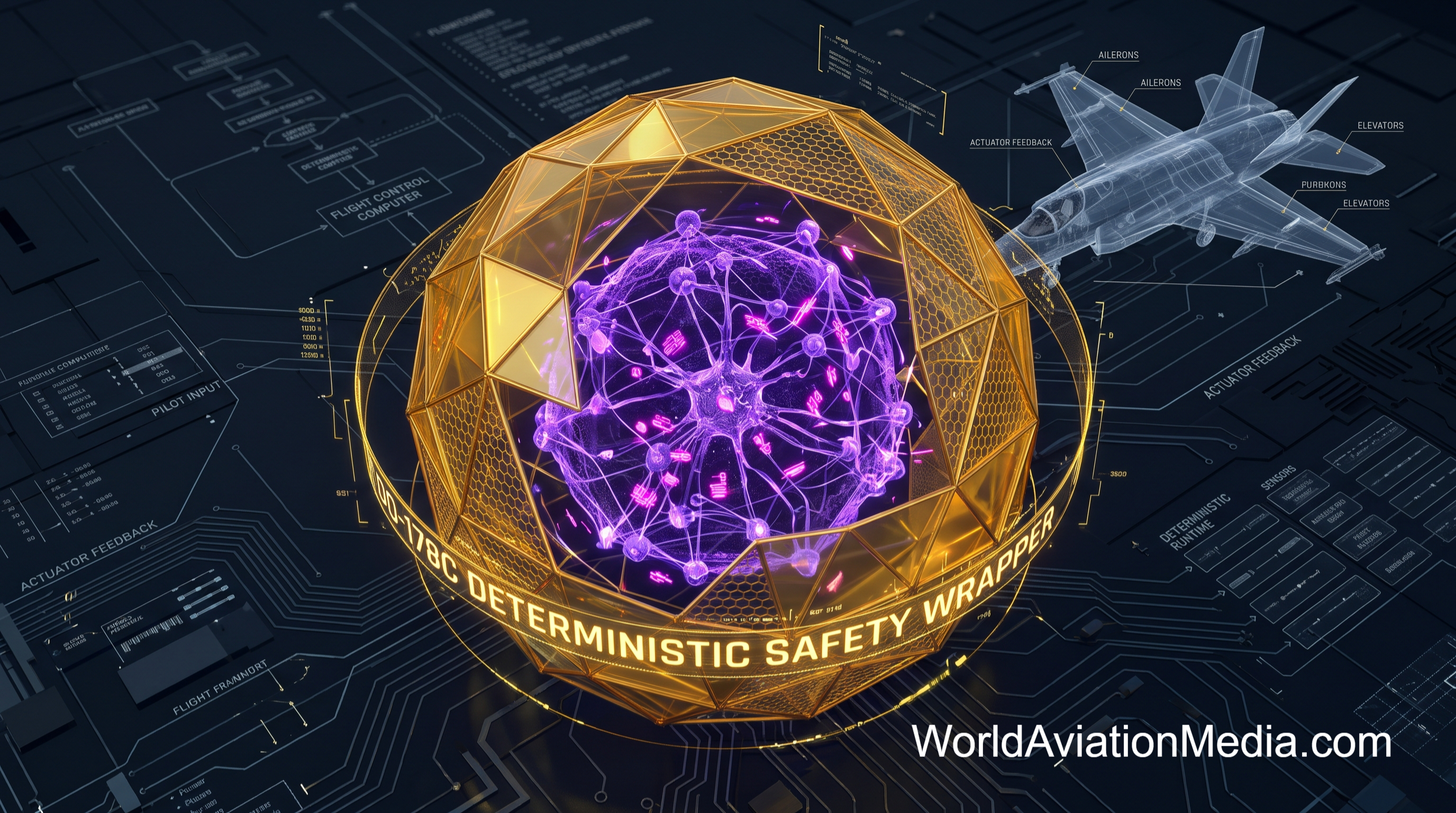
Run-Time Assurance (RTA) / Simplex Architecture | A complex AI controller operates inside a strict mathematical "Safety Wrapper" governed by a simple, DO-178C DAL-A deterministic monitor | Autonomous flight path optimization, tactical combat maneuvering, adaptive wind-shear recovery |
Formal Methods & Explainable AI (XAI) Bounding | Mathematical proofs verify that across the entire operational design domain (ODD), the neural network's output cannot exceed safe G-load or pitch limits | Next-gen fly-by-wire augmentation and automated Air Traffic Management (ATM) conflict resolution |
The breakthrough concept is Run-Time Assurance (RTA), standardized under ASTM F3269. Think of RTA as a "digital driving instructor with a dual brake pedal." An advanced, non-deterministic AI algorithm is permitted to optimize fuel burn, route around convective weather, or line up an optical landing approach—but its outputs pass through a deterministic, DO-178C-certified Safety Monitor. The millisecond the AI suggests a control surface deflection that approaches the aircraft's structural, stall, or airspace boundary envelope, the deterministic monitor overrides the AI and hands control to a proven, classical backup flight control law.
The Airspace Prerequisite: UK CAA’s Mandatory Electronic Conspicuity Roadmap
Even the most sophisticated onboard AI Detect-and-Avoid (DAA) system cannot safely navigate lower-altitude airspace if surrounding general aviation aircraft, helicopters, gliders, and drones are electronically invisible. While optical cameras and airborne radars provide backup, cooperative digital telemetry is the foundation of automated airspace.
This reality explains why the UK Civil Aviation Authority (CAA) has moved decisively toward mandating ADS-B Out Electronic Conspicuity (EC) for all aircraft operating in the UK's lower airspace, with an updated Concept of Operations (ConOps) slated to formalize requirements mandating that faster aircraft utilize ADS-B transponders with Mode S functionality.
However, the UK CAA’s industry consultation revealed a critical human-factors and AI-filtering lesson that both European and U.S. regulators are now addressing:
"Integrating lower-power EC devices with TCAS could lead to excessive alerts and traffic display distractions for manned aircraft operators to manage." — Industry Consultation Feedback to the UK CAA
When hundreds of low-power general aviation EC devices and commercial drones begin broadcasting position packets into busy terminal airspace, legacy Traffic Alert and Collision Avoidance Systems (TCAS II) on business jets and airliners risk flooding pilots with nuisance audio warnings.
This is precisely where certifiable machine learning and next-generation ACAS X (specifically ACAS Xu for uncrewed systems and ACAS Xr for rotorcraft/eVTOLs) intersect with Electronic Conspicuity:
Probabilistic Trajectory Filtering: Instead of using rigid geometric range-rate rules like legacy TCAS (which trigger false alarms when a VFR aircraft or eVTOL makes a normal steep turn near an airport), ACAS X uses dynamic programming lookup tables generated via offline machine learning to model realistic aircraft intent, slashing nuisance alerts while improving true collision protection.
Digital-First Air Traffic Management (ATM): By pairing universal ADS-B Out Electronic Conspicuity with FAA-certified AI conflict-probing tools at Air Route Traffic Control Centers, air traffic controllers can safely manage mixed fleets of manned airliners, eVTOLs, and remotely supervised cargo planes (such as Reliable Robotics' Caravans) without radio frequency saturation.
As Rep. Obernolte and Secretary Duffy made clear in Las Vegas, the future of aerospace AI will not be written by generalist bureaucrats—it will be forged inside the FAA and CAA through deterministic safety wrappers, universal electronic conspicuity, and modernized certification standards.
5-Item Q&A Section
Q1: What did Rep. Jay Obernolte say at NBAA-BACE 2026 about regulating aviation AI? At NBAA-BACE 2026, Pilot-Congressman Rep. Jay Obernolte (R-CA) argued that the Federal Aviation Administration (FAA)—and not a newly created standalone federal AI agency—should write and enforce AI rules for aviation, because only the FAA possesses the domain-specific safety certification expertise required for flight systems.
Q2: Why is it difficult to certify Artificial Intelligence under current FAA software rules? Current airborne software standards (RTCA DO-178C) require software to be deterministic—meaning the exact same input always produces the exact same output with 100% code traceability. Advanced machine learning and neural networks are non-deterministic (probabilistic), requiring new frameworks like Run-Time Assurance (RTA) safety wrappers and frozen-weight verification to guarantee flight safety.
Q3: What is the UK CAA’s mandatory Electronic Conspicuity (EC) roadmap? The UK Civil Aviation Authority (CAA) is advancing regulations to make ADS-B Out Electronic Conspicuity (EC) mandatory for aircraft operating in the UK's lower airspace—including requiring faster aircraft to equip ADS-B transponders with Mode S functionality—to create a cooperative digital airspace picture for manned and unmanned traffic.
Q4: Why are pilots concerned about mixing low-power Electronic Conspicuity devices with TCAS? In feedback to the UK CAA, manned aircraft operators warned that feeding high volumes of low-power EC signals directly into legacy Traffic Collision Avoidance Systems (TCAS) could trigger excessive nuisance alerts and cockpit display clutter. Next-generation systems like ACAS X use optimized probabilistic tables to filter out false alarms in dense airspace.
Q5: How is AI already being used in FAA regulatory compliance today? While flight-critical AI undergoes rigorous RTA validation, AI is already deployed in ground-based regulatory workflows. For example, at NBAA-BACE 2026, aviation software provider Web Manuals launched an AI Compliance Assistant that integrates directly with the FAA’s Data Collection Tools (DCT) to automate safety manual auditing.
Keywords and Hashtags
Keywords: Rep Jay Obernolte FAA AI regulation NBAA 2026, certifying non-deterministic AI aviation, DO-178C machine learning Run-Time Assurance, UK CAA mandatory Electronic Conspicuity ADS-B, Sean Duffy FAA certification modernization, ACAS X vs TCAS clutter, Web Manuals FAA Data Collection Tools AI.
Hashtags: #AviationAI #FAARegulations #NBAA2026 #AirTrafficManagement #ElectronicConspicuity #UKCAA #Avionics #AerospacePolicy
