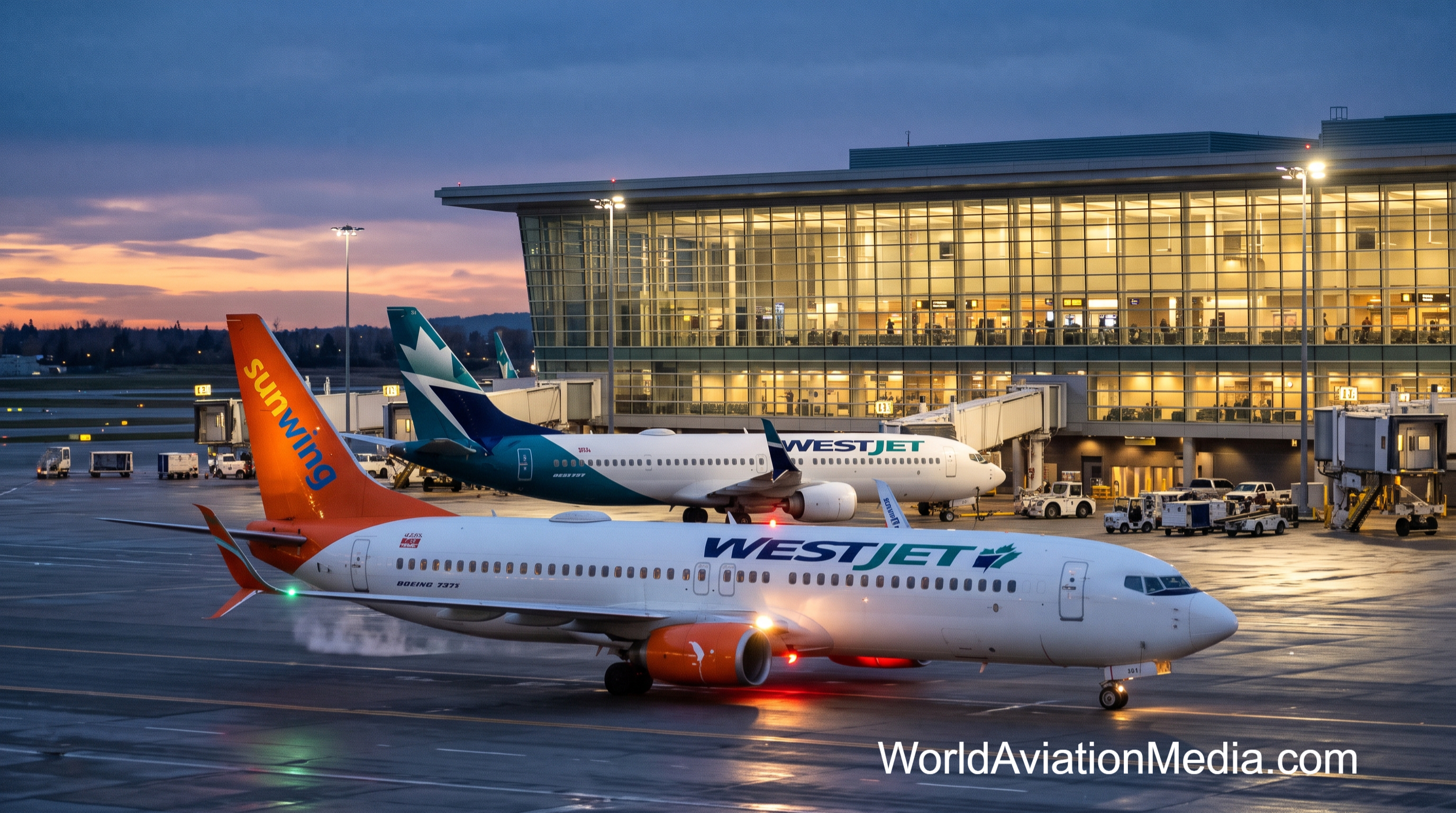
WestJet FY2026 Q3 Financial Performance & Credit Analysis: Fitch 'B-' Rating, CAD $1.6B Liquidity, and Sunwing Synergies Battle Fuel & Leverage
Key Takeaways
Private Ownership & Credit Market Transparency: As a privately held carrier backed by Onex Corporation (with minority stakes held by Delta Air Lines and Korean Air), WestJet does not file public equity earnings; instead, its 2026 financial health is tracked through institutional credit ratings and debt covenant disclosures.
Fitch 'B-' Rating & High Leverage Profile: Fitch Ratings downgraded WestJet’s Long-Term Issuer Default Rating (IDR) to 'B-' from 'B' (Outlook Stable) in 2026, citing thin margins ahead of the 2026 jet fuel shock, high year-end 2025 adjusted leverage of 6.8x, and EBITDAR fixed-charge coverage near 0.9x–1.0x.
Strong Liquidity Buffer: WestJet’s Stable credit outlook is anchored by a substantial liquidity cushion of CAD $1.6 billion in cash plus USD $510 million in revolver availability (backed by its USD $693 million senior secured revolving credit facility maturing June 2031).
Sunwing AOC Integration & Transborder Shifts: WestJet has moved past the 2.5-percentage-point margin drag caused by 2025 Sunwing single-AOC pilot training and aircraft conversions, helping offset 2026 headwinds from softer U.S. transborder demand (19% of network) and suspended Cuba flying.
How Are WestJet's Q3 2026 Financials Tracked as an Onex Private Portfolio Company?
Unlike publicly traded North American peers such as Air Canada (TSX: AC) or Delta Air Lines (NYSE: DAL), WestJet Airlines Ltd. has operated as a private corporation since its leveraged buyout by Canadian private equity firm Onex Corporation (and subsequent strategic equity investment by Delta Air Lines and Korean Air). Because WestJet does not file public quarterly Form 10-Q reports with securities regulators, institutional investors and aviation analysts evaluate its Q3 2026 and full-year FY2026 financial performance through its rated syndicated debt facilities, loyalty term loans, and credit agency surveillance reports from Fitch Ratings.
During 2026, Fitch Ratings published comprehensive credit updates on WestJet Airlines Ltd. (in April and June 2026), setting Long-Term Issuer Default Ratings (IDR) at 'B-' with a Stable Outlook, rating its proposed senior secured notes and existing loyalty term loan at 'B' / 'RR3', and affirming its USD $693 million senior secured revolving credit facility (maturing June 30, 2031) at 'B+' / 'RR2' (89% recovery rating).
Credit & Financial Metric | FY2026 / Q3 2026 Institutional Benchmark | Credit & Operational Context |
Long-Term Issuer Default Rating | 'B-' (Outlook: Stable) | Downgraded from 'B' on 2026 jet fuel pressure |
Senior Secured Revolver Rating | 'B+' / 'RR2' (USD $693M due June 2031) | Affirmed June 24, 2026 |
Secured Notes & Loyalty TL Rating | 'B' / 'RR3' | Reflects collateralized loyalty cash flows |
Cash & Revolver Liquidity | CAD $1.6B Cash + USD $510M Revolver | Strong buffer supporting Stable Outlook |
Adjusted Debt Leverage | 6.8x (Entering 2026); Delayed to 2027 | Mid-5x target delayed by 2026 fuel spike |
EBITDAR Fixed-Charge Coverage | ~1.0x Expected in FY2026 (0.9x YE25) | Constrained by thin operating margins |
2025 Transitory Margin Drag Abated | +2.5 percentage points YoY relief in 2026 | Sunwing single-AOC integration completed |
How Is the 2026 Jet Fuel Spike Impacting WestJet's Q3 Peak Season and Leverage?
For Canadian carriers, the third quarter (July–September) is the pivotal cash-generation window of the fiscal year. Entering 2026, WestJet carried an elevated adjusted leverage ratio of 6.8x and weak EBITDAR fixed-charge coverage of 0.9x, largely because one-time operational disruptions and merger integration expenses held its 2025 operating margins near breakeven (compared to ~9% for industry leaders like Delta).
Delay of Deleveraging Target from YE2026 to 2027
Prior to the 2026 surge in global crude oil and jet fuel prices, credit analysts anticipated that WestJet’s Q3 2026 summer cash flow would reduce adjusted leverage to the mid-5x range and lift fixed-charge coverage to the mid-1x range by year-end 2026. However, with jet fuel spiking above $3.90 USD per gallon in Q3 2026, Fitch noted that WestJet’s profitability remains strained in 2026, keeping 2026 EBITDAR fixed-charge coverage near 1.0x and pushing meaningful balance-sheet deleveraging out until at least 2027.
Pricing Pass-Throughs in a Consolidated Western Canadian Market
Despite elevated fuel bills, WestJet has successfully offset a substantial portion of its Q3 2026 energy costs through higher base fares and ancillary fees amid solid domestic Canadian travel demand. Following its strategic pivot to dominate Western Canada (calibrating capacity out of Calgary, Edmonton, and Vancouver) and the absorption of both Swoop and Sunwing Airlines into its mainline operation, WestJet faces significantly less ultra-low-cost carrier price dilution during peak Q3 domestic summer travel.
Operational Bright Spots: Sunwing Synergies and Loyalty Revamp
Two internal operational catalysts provided crucial margin relief during Q3 2026, helping prevent fuel costs from eroding WestJet’s credit cushion:
1. Recapturing the 2.5-Percentage-Point Sunwing Integration Drag
In 2025, WestJet suffered a combined 2.5-percentage-point operating margin hit from transitory integration costs—specifically pilot retraining and Boeing 737 cabin reconfigurations required to merge Sunwing Airlines onto WestJet’s single Air Operator Certificate (AOC), alongside an early-year operational disruption. By Q3 2026, those transitory integration expenses had fully abated. Operating under a unified single AOC with harmonized Boeing 737-800 and 737 MAX 8 fleet scheduling allowed WestJet to maximize aircraft utilization during the peak July–September 2026 summer schedule.
2. Revamped WestJet Rewards Loyalty Structure
WestJet’s overhauled loyalty program and co-branded credit card ecosystem (and its collateralized loyalty term loan structure) delivered higher unit revenue attachment in Q3 2026, aligning with the broader North American trend of monetizing premium seating (Extended Comfort) and unbundled UltraBasic fares.
Network Headwinds: U.S. Transborder Softness and Cuba Suspensions
In assessing WestJet’s Q3 and second-half 2026 revenue trajectory, credit analysts highlighted two specific geographic headwinds:
U.S. Transborder Demand: U.S. transborder routes account for roughly 19% of WestJet’s total network capacity. Slower-than-expected recovery in Canadian-to-U.S. leisure demand (pressured by the weaker Canadian dollar and high U.S. hotel rates) has required WestJet to selectively reallocate aircraft toward domestic Canadian trunk routes and transoceanic leisure markets.
Cuba Route Suspensions: Cancelled flights to Cuba—which historically represented a low-single-digit percentage of WestJet/Sunwing total flying—created a minor capacity redeployment hurdle heading into the autumn/winter sun season, though strong demand for Mexico and the Dominican Republic is absorbing much of the displaced sun-seeker volume.
Backed by CAD $1.6 billion in unrestricted cash, USD $510 million in undrawn revolver capacity, and active use of sale-leaseback financing to fund incoming Boeing 737 MAX deliveries, WestJet maintains ample liquidity to weather the late-2026 fuel environment.
5-Item Q&A Section (FAQ)
Q1: Does WestJet publish public Q3 2026 stock earnings reports?
No. Because WestJet is privately owned by Onex Corporation (alongside minority airline investors), it does not publish public quarterly shareholder earnings releases. Its financial performance is disclosed through institutional credit agency reports (such as Fitch Ratings) and syndicated debt filings.
Q2: What is WestJet's credit rating and liquidity position in 2026?
Fitch Ratings rates WestJet's Long-Term Issuer Default Rating at 'B-' with a Stable Outlook (affirmed June 24, 2026) and its USD $693 million senior secured revolver at 'B+' / 'RR2'. WestJet holds a strong liquidity cushion of CAD $1.6 billion in cash and USD $510 million in revolver availability.
Q3: How are rising jet fuel prices affecting WestJet's leverage in 2026?
WestJet entered 2026 with adjusted debt leverage of 6.8x. While fare increases are helping offset high jet fuel prices, fuel pressure is expected to keep 2026 EBITDAR fixed-charge coverage near 1.0x and delay WestJet's deleveraging to the mid-5x range until at least 2027.
Q4: How did completing the Sunwing integration improve WestJet's 2026 margins?
In 2025, pilot training and aircraft cabin conversions tied to moving Sunwing onto WestJet's single Air Operator Certificate (AOC) caused a ~2.5 percentage point margin drag. Completing that transition provided a 2.5pp structural tailwind in 2026 alongside new Sunwing vacation package and loyalty synergies.
Q5: What route network headwinds is WestJet managing in 2026?
WestJet is navigating slower demand recovery on U.S. transborder routes (which represent ~19% of its network) and suspended flights to Cuba (a low-single-digit share of flying), shifting capacity toward strong domestic Canadian and alternative sun destinations.
Metadata
Target SEO Keywords: WestJet Q3 2026 financial results, WestJet Airlines Fitch rating 2026, WestJet Onex financial performance, Sunwing single AOC integration synergies, WestJet CAD 1.6 billion liquidity, Canadian airline leverage 2026, WestJet transborder demand.
Hashtags: #WestJet #CanadianAviation #AviationFinance #FitchRatings #Onex #AirlineCredit #CalgaryAviation
