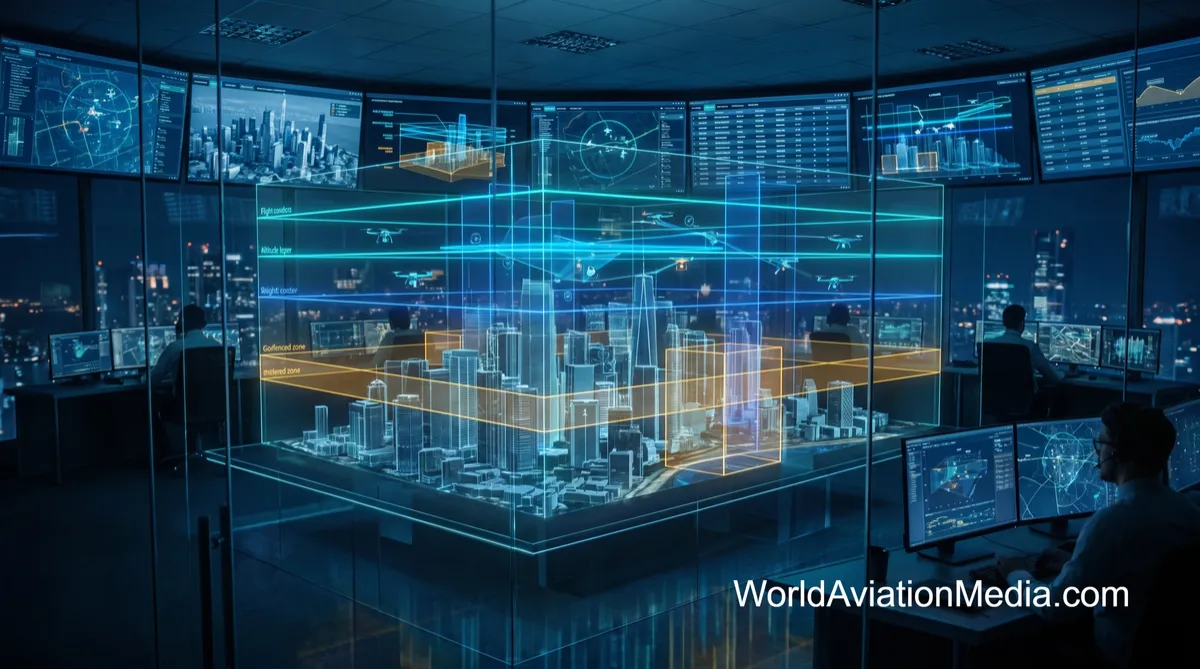
Urban Air Traffic Management (UTM): Bridging FAA/EASA Control with Automated Drone Corridors
Key Takeaways
The Airspace Congestion Crisis: The rapid proliferation of eVTOLs, delivery drones, and urban air mobility (AAM) fleets requires an entirely new paradigm in low-altitude traffic management.
Regulatory Convergence: Traditional Air Traffic Control (ATC) systems designed for high-altitude commercial jets lack the scalability to handle thousands of low-altitude autonomous sorties.
The UTM Ecosystem: Unmanned Traffic Management (UTM) platforms act as decentralized, digital operating systems that manage dynamic geofencing, flight planning, and collision avoidance.
Public-Private Interoperability: Seamless integration requires secure data-sharing protocols between federal aviation authorities (FAA, EASA) and commercial UTM service suppliers (USS).
Introduction
As skies above global metropolitan areas prepare for an unprecedented influx of commercial drones, air taxis, and automated cargo carriers, traditional Air Traffic Control (ATC) infrastructure faces an existential scaling wall. Built decades ago for high-altitude commercial jetliners managed by human air traffic controllers via voice radio, the legacy FAA and EASA air management systems cannot possibly process thousands of simultaneous, low-altitude, autonomous flight paths. The bridge between today's controlled skies and tomorrow's bustling low-altitude economy is Urban Air Traffic Management (UTM).
The Limitations of Legacy Air Traffic Control
Traditional ATC operates on a centralized, voice-dependent command structure. When applied to high-density, low-altitude urban environments—where hundreds of eVTOLs and delivery drones operate simultaneously along narrow corridors—human controllers would be instantly overwhelmed.
Furthermore, low-altitude airspace is complex. It is cluttered with physical obstacles (skyscrapers, construction cranes, power lines) and dynamic hazards (weather shifts, emergency medical helicopters, recreational drones). Managing this environment requires a paradigm shift from centralized human control to decentralized, automated digital coordination.
The Architecture of UTM and USS Ecosystems
Unmanned Traffic Management (UTM) is not a single software program; it is a collaborative, federated ecosystem of digital services. Rather than controllers issuing vector commands, automated UTM networks rely on UAS Service Suppliers (USS) to manage flight planning and deconfliction.
Strategic Deconfliction: Operators submit flight intent and 4D trajectory profiles (latitude, longitude, altitude, and time) into the UTM network before takeoff. The system automatically checks for spatial and temporal conflicts against other scheduled flights.
Dynamic Geofencing: UTM platforms establish real-time virtual boundaries around temporary hazards, VIP movements, severe weather cells, or emergency response zones, automatically rerouting automated fleets.
Collaborative Data Sharing: Real-time telemetry, ADS-B data, and wind conditions are shared continuously across a secure cloud-based network, giving every autonomous aircraft situational awareness of its surrounding airspace.
Bridging Federal Authority with Commercial Innovation
A major challenge in UTM deployment is regulatory interoperability. The FAA and EASA retain ultimate sovereign authority over national airspace safety, yet commercial software developers drive UTM innovation.
Regulatory agencies are establishing standardized APIs and data exchange protocols that allow commercial UTM providers to plug directly into federal air traffic management systems. This ensures that while automated drones and air taxis manage their immediate micro-corridors autonomously, federal authorities retain ultimate oversight, emergency override capabilities, and sovereign airspace security.
Security, Cybersecurity, and Resilience
Because UTM networks rely entirely on digital data pipelines, cloud computing, and wireless telemetry, robust cybersecurity is paramount. A malicious cyberattack on a municipal UTM node could paralyze an entire city's low-altitude logistics network. Consequently, resilient UTM architectures incorporate encrypted military-grade communications, decentralized edge-computing backup nodes, and redundant fail-safes to ensure that even if data links are severed, onboard aircraft collision-avoidance systems (such as Sense-and-Avoid radar) can safely land or hover-hold.
5-Item Q&A Section
Q1: Why can traditional Air Traffic Control (ATC) systems not manage urban drone fleets?
A: Legacy ATC relies on centralized human controllers and voice radio, which are incapable of processing the high volume and dynamic nature of thousands of low-altitude automated flights.
Q2: What is an Unmanned Traffic Management (UTM) system?
A: A federated digital network of software services that manages flight planning, strategic deconfliction, and situational awareness for autonomous aircraft.
Q3: How do USS (UAS Service Suppliers) function within the UTM ecosystem?
A: USS providers act as intermediaries, allowing commercial operators to submit flight intents and receive real-time airspace clearance and conflict warnings.
Q4: How do aviation authorities like the FAA and EASA maintain control over UTM?
A: By establishing standardized regulatory protocols, secure data-exchange APIs, and emergency override capabilities that integrate commercial UTM networks with sovereign airspace oversight.
Q5: What safeguards protect UTM networks against cyberattacks?
A: Encrypted communications, decentralized edge-computing backup nodes, and independent onboard Sense-and-Avoid collision-avoidance systems.
SEO & AEO Optimization
Core User Intent: Explain the technological convergence required between traditional FAA/EASA air traffic control and automated drone UTM corridors.
Direct Answer Definition: Urban Air Traffic Management (UTM) refers to a decentralized, digital airspace management ecosystem that enables automated deconfliction, flight planning, and safety oversight for low-altitude drones and eVTOLs.
Keywords & Hashtags
Keywords: Urban Air Traffic Management, UTM drone corridors, FAA EASA drone integration, UAS service supplier, low-altitude airspace management, automated flight deconfliction.
Hashtags: #UTM #AirTrafficControl #DroneManagement #UrbanAirMobility #AviationTechnology #AviationSafety
