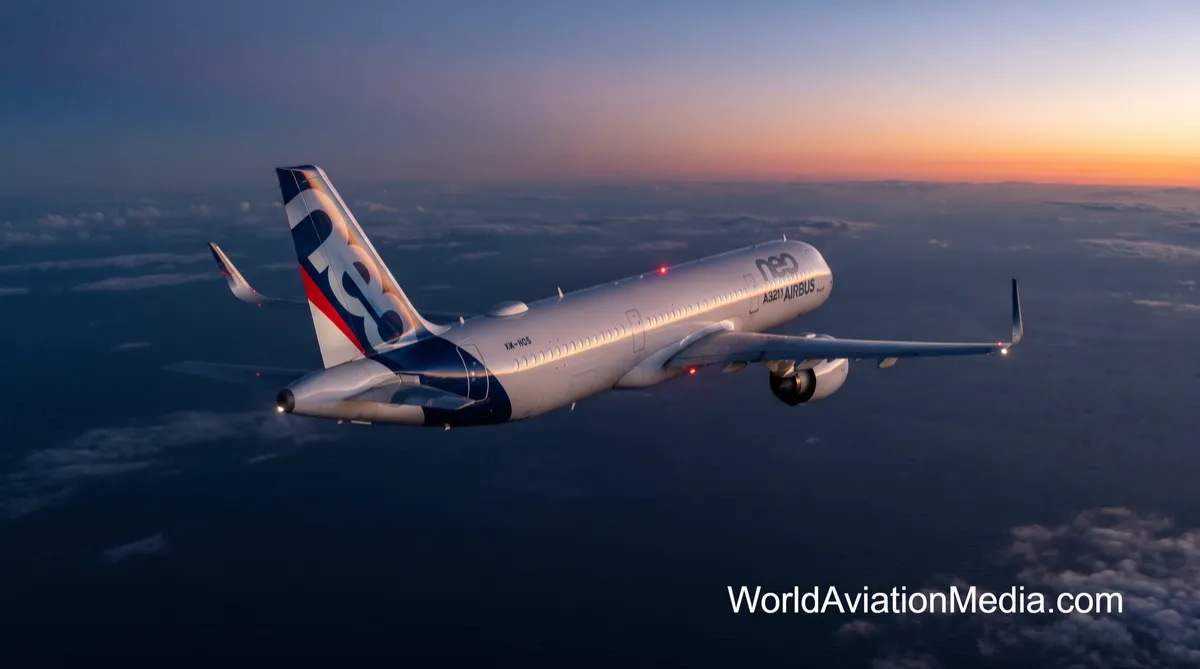
Ultra-Long-Range Regionalism: Examining the Operational Economics of Deploying Single-Aisle Aircraft on 3,000-Mile Routes
Key Takeaways
The "Middle-of-the-Market" Revolution: The full commercial rollout of the Airbus A321XLR alongside long-sector deployments of the Airbus A220-300 has fundamentally decoupled aircraft range from aircraft gauge, enabling profitable non-stop service on thin 3,000-to-4,700-nautical-mile routes.
50% Lower Trip Cost vs. Widebodies: While twin-aisle aircraft like the Boeing 787-8 or Airbus A330-900neo achieve slightly lower cost per available seat mile (CASM) when 100% full, the A321XLR and A220 reduce total trip cost by 35% to 55%, dramatically lowering the break-even load factor on secondary city pairs.
Hub-Bypass Network Fragmentation: Airlines such as Iberia, Aer Lingus, American Airlines, United, Qantas, and Breeze Airways are using long-range single-aisles to bypass congested mega-hubs, linking secondary cities (e.g., Indianapolis to Dublin, or Montreal to secondary European markets) directly.
Crew Rest, Cargo, and ETOPS Realities: Operating 6-to-9-hour sectors on narrowbodies introduces new operational constraints, requiring airlines to sacrifice revenue seats for augmented pilot rest bunks, manage zero containerized belly cargo capacity on the A220, and optimize winter headwind fuel reserves.
How Are Single-Aisle Aircraft Redefining Long-Haul Airline Economics?
For the first fifty years of the jet age, airline network planning was governed by a rigid physics equation: flying farther required flying larger aircraft. If a carrier wanted to operate a 3,000-to-4,500-mile route—whether across the North Atlantic, from North America to Northern South America, or across the Australian continent into Southeast Asia—it had no choice but to deploy a widebody twin-aisle jet carrying 250 to 350 passengers, or rely on aging Boeing 757-200s whose production ended in 2004.
In 2026, that paradigm has been permanently dismantled by two complementary single-aisle platforms at opposite ends of the narrowbody capacity spectrum: the Airbus A220-300 (120 to 145 seats) and the Airbus A321XLR (180 to 220 seats). Together, these aircraft have ushered in the era of Ultra-Long-Range Regionalism—an economic model where airlines prioritize low total trip cost and high yield preservation over raw seat volume, connecting secondary city pairs that could never fill a Boeing 787 Dreamliner or Airbus A330 year-round.
Trip Cost vs. Unit Cost (CASM): The Core Financial Equation
To understand why chief financial officers at both legacy network carriers and low-cost hybrids are shifting long-haul capital expenditure toward narrowbodies, one must examine the interplay between Trip Cost (the total cost in fuel, crew, maintenance, and navigation fees to fly an aircraft from Point A to Point B) and CASM (Cost per Available Seat Mile).
Consider a 3,400-nautical-mile transatlantic sector—such as Boston to Madrid or Philadelphia to Edinburgh—during the low-demand winter shoulder season (November through March):
Aircraft Type | Typical Two/Three-Class Seating | Maximum Range (Nautical Miles) | Est. Block Fuel Burn per Hour (kg) | Relative Total Trip Cost Index | Cargo Capability |
Airbus A220-300 | 125 – 145 Seats | 3,400 – 3,550 nm | ~2,050 kg / hr | 0.42x (Lowest Trip Risk) | Bulk Hold Only |
Airbus A321XLR | 180 – 206 Seats | 4,700 nm | ~2,650 kg / hr | 0.55x (Optimal Transatlantic) | LD3-45W Containers (Optional) or Bulk |
Boeing 737 MAX 8 | 162 – 178 Seats | 3,500 nm | ~2,350 kg / hr | 0.50x | Bulk Hold Only |
Boeing 787-8 Dreamliner | 235 – 255 Seats | 7,300 nm | ~4,800 kg / hr | 1.00x (Baseline Widebody) | Full LD3 Containers + Pallets |
Airbus A330-900neo | 280 – 300 Seats | 7,200 nm | ~5,300 kg / hr | 1.08x | Full LD3 Containers + Pallets |
On a winter Tuesday in February, a secondary transatlantic route may only generate 145 organic passengers willing to pay a profitable fare. If an airline flies a 280-seat Airbus A330-900neo on that route, it must either fly with 135 empty seats (destroying its load factor and operating margin) or slash ticket prices below cost to stimulate artificial discount demand (destroying its passenger yield, or RASM).
By deploying an Airbus A321XLR configured with 182 seats (including 16 to 20 lie-flat Business Class suites), the airline cuts its fuel burn and landing weight fees nearly in half compared to the widebody. It fills 80% of the cabin at full market fares, achieving profitability on day one without diluting yields.
The Airbus A220-300 on 3,000-Mile Sectors: The "Pocket Widebody" Effect
While the A321XLR captures headlines for 8-to-9-hour intercontinental missions, the Airbus A220-300 (powered by Pratt & Whitney PW1500G geared turbofan engines) has quietly revolutionized the 2,500-to-3,400-mile sector.
Designed originally by Bombardier as the CSeries with a clean-sheet composite wing and an asymmetric 2-3 economy seating cross-section, the A220-300 offers wider economy seats (18.5 inches) than a Boeing 777, alongside panoramic windows and oversized overhead bins. In North America, Europe, and Australia, airlines are pushing the A220 to the edges of its range envelope:
Transcontinental Point-to-Point: Carriers like Breeze Airways, JetBlue, and Air Canada routinely deploy the A220-300 on 5.5-to-6.5-hour sectors connecting secondary U.S. East Coast cities (such as Hartford, Providence, Raleigh-Durham, and Tampa) non-stop to the West Coast (Los Angeles, San Francisco, Seattle, and Phoenix).
Long-Thin Intra-Regional Corridors: Air Baltic operates the A220-300 from Riga and Tampere all the way to Dubai and the Canary Islands (sectors exceeding 6.5 hours), while Qantas Link uses the A220 to open ultra-long domestic and regional overwater routes across Australia and into the South Pacific that were previously unviable with Boeing 717s or 737-800s.
Furthermore, Airbus's increase of the A220-300's Maximum Takeoff Weight (MTOW) to 70.9 metric tons has unlocked an extra 200 nautical miles of range, allowing operators to carry a full passenger payload against stiff winter jet-stream headwinds without taking weight penalties.
Inside the Airbus A321XLR: How Engineering Enabled 4,700 Nautical Miles
To stretch the standard A321neo into an intercontinental disruptor capable of flying 4,700 nautical miles (8,700 km) for up to 10.5 hours, Airbus integrated three core structural modifications on the A321XLR:
The Rear Centre Tank (RCT): Integrated permanently into the lower fuselage structure behind the main landing gear bay, the RCT holds 12,900 liters of fuel—replacing four modular Additional Centre Tanks (ACTs) used on the earlier A321LR while freeing up forward underfloor cargo space for passenger luggage and containerized freight. Following EASA and FAA certification mandates, the RCT incorporates an inner protective liner and reinforced belly skin to guarantee crashworthiness and fire resistance.
101-Metric-Ton MTOW & Strengthened Landing Gear: To lift the massive extra fuel load, the airframe's MTOW was raised to 101 metric tons, supported by beefed-up braking systems, higher-ply tires, and structural wing-box reinforcements.
Modified Inboard Flap Aerodynamics: Re-optimized trailing-edge single-slotted inboard flaps preserve low-speed climb performance at heavy takeoff weights without requiring higher engine thrust ratings on the CFM LEAP-1A or PW1100G engines.
Hidden Operational Challenges of Ultra-Long-Range Narrowbodies
Despite their compelling spreadsheet economics, deploying single-aisle jets on 3,000-to-4,500-mile routes introduces operational friction points that fleet planners must carefully manage:
Augmented Flight Crew Rest Penalties: Under FAA Part 117 and EASA Flight Time Limitations (FTL), flights exceeding 8 hours require a third relief pilot. On a widebody, crew rest bunks are tucked invisibly into the overhead crown above the ceiling panels. On an A321XLR, airlines must sacrifice either a prime forward Business Class suite or block off seats in the cabin to accommodate pilot rest requirements, directly reducing high-yield revenue inventory.
Galley, Lavatory, and Catering Ratios: Serving two full meal services to 190 passengers over a 9-hour ocean crossing stretches single-aisle galley cart storage and potable water tanks to their absolute limits. Furthermore, with only one central aisle, meal service carts block lavatory access for up to 90 minutes at a time, requiring careful cabin layout engineering (such as Airbus's Airspace XL aft galley flex zones).
Loss of High-Margin Belly Cargo Revenue: On widebody routes between major industrial hubs, belly cargo accounts for 12% to 20% of total flight revenue. On an A321XLR maxed out with fuel and 190 passenger bags, residual payload for commercial freight is virtually zero. Consequently, ultra-long-range narrowbodies are pure passenger-yield plays.
5-Item Q&A Section (FAQ)
Q1: What is the maximum range of the Airbus A321XLR compared to the Airbus A220-300?
The Airbus A321XLR has a maximum range of 4,700 nautical miles (8,700 km), enabling flights up to 10.5 hours, while the Airbus A220-300 has a maximum range of approximately 3,400 to 3,550 nautical miles (6,300 to 6,570 km), suitable for flights up to 7 hours.
Q2: Why do airlines use narrowbody planes like the A321XLR on transatlantic routes instead of widebodies?
Airlines deploy the A321XLR on long-haul routes because its total trip cost (fuel burn, landing fees, and crew expenses) is roughly 45% lower than a widebody like the Boeing 787 or Airbus A330. This allows airlines to profitably serve smaller secondary cities that cannot fill 280+ seats daily, especially during winter low seasons.
Q3: What is the Rear Centre Tank (RCT) on the Airbus A321XLR?
The Rear Centre Tank (RCT) is a permanent, structurally integrated fuel tank located in the lower fuselage behind the wing box of the A321XLR. It holds 12,900 liters of fuel—equivalent to four removable auxiliary tanks—giving the aircraft its 4,700-nautical-mile range while preserving forward cargo space.
Q4: Can the Airbus A220 fly across the Atlantic Ocean?
Yes, with ETOPS 180 certification and a 3,550-nautical-mile range, the Airbus A220-300 is technically capable of crossing the North Atlantic between the U.S. Northeast/Eastern Canada and Western Europe (such as Ireland, the UK, and Portugal), though most airlines deploy it on long transcontinental and regional routes.
Q5: Do long-range narrowbody aircraft have lie-flat Business Class seats?
Yes. Nearly all major network airlines operating the Airbus A321XLR (such as Iberia, Aer Lingus, American Airlines, United Airlines, and Qantas) outfit the forward cabin with 14 to 20 fully lie-flat herringbone or staggered Business Class suites with direct aisle access.
Keywords and Hashtags
Keywords: Airbus A321XLR operational economics, Airbus A220-300 long range routes, narrowbody transatlantic flights, trip cost vs CASM aviation, hub bypass airline strategy, A321XLR Rear Centre Tank, single-aisle long haul economics 2026.
Hashtags: #AirbusA321XLR #AirbusA220 #AirlineEconomics #NetworkPlanning #LongHaulNarrowbody #TransatlanticFlights #AvGeek #FleetStrategy
