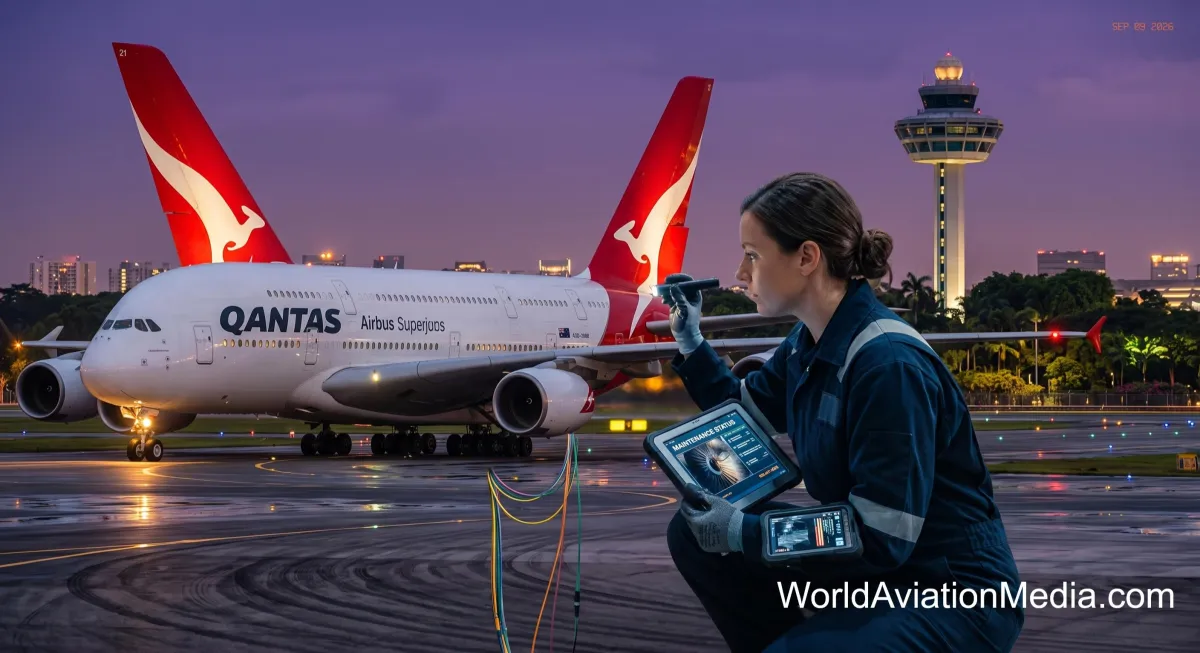
The Yield Swap: Inside Qantas' Bold Airbus A380 Singapore Shift
The global aviation sector in 2026 has transitioned from a period of erratic recovery to a state of calculated resilience, characterized by a strategic framework known as the Yield Swap. This involves a high-stakes trade: airlines are increasingly sacrificing immediate liquidity and traditional capacity-expansion models in exchange for long-term operational hardening. For Qantas Singapore operations, the centerpiece of this shift is the strategic redeployment of the Airbus A380. As passenger volumes across the Asia-Pacific corridor surge past pre-pandemic levels, the A380 serves as a critical buffer, providing high-utilization efficiency to high-density hubs while the broader industry grapples with a systemic maintenance crisis. In this environment, profitability is no longer just a function of load factors; it is the result of structural agility and the mitigation of "Yield Traps" created by supply chain fragility and environmental volatility.
Key Takeaways
Strategic Connectivity Pivot: Inflight connectivity is no longer an ancillary add-on but a primary loyalty driver, as demonstrated by American Airlines’ high-speed Wi-Fi rollout across two million annual flights for AAdvantage members. By utilizing an AT&T-sponsored model, carriers are shifting the cost of connectivity from OpEx to strategic partnership, mirroring the transition toward integrated digital ecosystems.
Fuel Security as Yield Management: The A30M (US22M) investment by Qantas and Airbus in Jet Zero Australia signifies a move toward direct equity in fuel production to hedge against future supply shocks. Direct funding of Queensland-based Sustainable Aviation Fuel (SAF) projects moves beyond simple procurement, creating a "Yield Swap" where capital today buys energy sovereignty tomorrow.
Operational Fragility in Asia: The September 2026 eruption of Anak Krakatau, which impacted 39 airports and affected over 270,000 passengers, highlights the narrow operational margins of the Asian corridor. While 39 airports across the region felt the disruption, the closure of eight specific Indonesian hubs—including Jakarta’s Soekarno-Hatta (CGK)—demonstrated how quickly natural phenomena can trigger regional ground stops.
Maintenance as a Growth Constraint: A critical shortage of high-pressure turbine (HPT) blades for CFM56 engines has transformed MRO (Maintenance, Repair, and Overhaul) into the primary choke point for global capacity. This supply crunch is forcing a "Yield Trap," where airlines risk long-term resilience by extending shop visits to meet immediate demand, leading to cascading reliability failures.
Sustainability Milestones: The 2026 decarbonization pathway is reliant on moving beyond experimental phases to commercial scalability, exemplified by American Airlines’ eSAF flights with Infinium. The integration of diverse feedstocks, such as forest slash and synthetic fuels, is now the baseline for carriers seeking to insulate themselves from future carbon-based regulatory and fuel-price volatility.
1. The Strategic Pivot: Aviation's New Yield Frontier
In the third quarter of 2026, the Asia-Pacific aviation market has entered a phase of "permanent volatility." While passenger numbers have hit record highs, the margin for error has evaporated. The industry has reached a threshold where high load factors, while profitable on paper, create a fragile system: there is simply no "slack" to absorb disruptions. This is where Qantas has executed its "Singapore Shift," deploying the Airbus A380 as a strategic asset to consolidate capacity into fewer, high-efficiency movements. By utilizing the A380’s 485-seat capacity on the Sydney-Singapore-London kangaroo route, Qantas mitigates the frequency limitations caused by the ongoing narrowbody engine crisis.
This transition from "recovery mode" to "resilience mode" requires more than just big planes; it requires a digital and operational infrastructure that mirrors the premium expectations of the 2026 traveler. The American Airlines model—offering free, high-speed Wi-Fi sponsored by AT&T for AAdvantage members—illustrates the new standard. For Qantas, the Yield Swap in Singapore is about ensuring that even when regional networks are strained, the high-capacity "long-haul spine" remains robust and technologically superior. The goal is to avoid the loss of premium traffic by offering a reliable, high-connectivity environment that justifies the "Yield Swap" of high capital expenditure for guaranteed operational stability.
2. The Sustainability "Yield": The Jet Zero Australia Venture
A cornerstone of Qantas’ resilience strategy is the vertical integration of its energy supply. In September 2026, Qantas and Airbus signaled a paradigm shift by backing a A30 million (US22 million) capital raise for Jet Zero Australia. This Queensland-based project, which focuses on converting agricultural byproducts and forest slash into Sustainable Aviation Fuel (SAF), represents a departure from traditional fuel-hedging models. Instead of merely buying fuel, Qantas is buying the infrastructure of fuel.
This investment is a textbook "Yield Swap." Qantas is deploying capital today to insulate itself from the "Signal" of future market shocks. As reliance on long-haul crude routes leaves aviation exposed to geopolitical volatility, domestic, regionally rooted SAF supply chains offer a more stable foundation. Furthermore, the partnership with Airbus ensures technical harmonization; as an aeronautical engineer, one recognizes that SAF is not merely an environmental palliative but a critical component of engine longevity and performance stability. By securing a domestic supply of lower-carbon alternatives, Qantas and Airbus are attempting to de-risk the future of flight, swapping the uncertainty of global oil markets for the reliability of a controlled, domestic energy ecosystem.
3. Crisis Management: Navigating the Anak Krakatau Eruption
The necessity of operational hardening was underscored by the cataclysmic eruption of Mount Anak Krakatau in early September 2026. Beginning at 23:07 on Friday, September 4, the volcano entered a continuous 25-hour lava phase, ejecting ash plumes that were tracked by the Darwin Volcanic Ash Advisory Centre (VAAC) to altitudes of 48,000 feet. Using Himawari-9 satellite imagery, the VAAC recorded cloud-top temperatures as low as minus 68 degrees Celsius, indicating a high-level eruption capable of infiltrating major air corridors.
The disruption was systemic: 39 airports across Asia were impacted, with over 1,500 flights cancelled on a single day. Crucially, the Indonesian Ministry of Transportation was forced to close eight airports, including Jakarta’s Soekarno-Hatta (CGK) and Halim Perdanakusuma (HLP), as ash was observed directly at the fields. Qantas’ response was a masterclass in yield preservation through avoidance. By dropping four flights to Jakarta and offering full refunds or credits, the airline avoided the "molten glass" phenomenon that famously downed British Airways Flight 9 in 1982. In a modern jet engine, volcanic ash—essentially pulverized rock—melts in the combustor and solidifies on turbine surfaces, choking airflow and causing catastrophic flameouts. While Bali’s Ngurah Rai airport remained largely unaffected due to eastward wind drift, Qantas’ decision to pause Jakarta operations preserved the long-term health of its engines, prioritizing the "Yield Swap" of safety over the high-risk revenue of a single weekend.
4. The Maintenance Bottleneck: HPT Blades and the "Yield Trap"
The most significant threat to the industry’s 2026 resilience is the "HPT blade supply crunch." According to AerFin, a critical shortage of high-pressure turbine blades is extending CFM56 overhaul times, turning MRO into the ultimate capacity choke point. This has led to the emergence of the "Yield Trap": airlines, desperate to maintain capacity, are extending engine shop visits and gambling on older assets. This is a high-risk strategy that contradicts the "resilience mode" required for modern operations.
The technical stakes are illustrated by recent emergencies. In early September 2026, an Alaska Airlines Boeing 737-700 (26 years old) was forced into a 30,000-foot emergency descent due to a technical failure, landing safely in Fresno after reaching its 40,000-foot cruise. Even more dire was the NetJets Citation Latitude incident in Laredo, Texas, where a fractured starter/generator shaft led to a double engine flameout on short final. These incidents, alongside FAA airworthiness directives requiring the replacement of HPC drum rotor disk assemblies on PW4000 engines due to incorrect shot peening, highlight a system under extreme mechanical stress.
For the Qantas A380 fleet, the Yield Swap involves utilizing these high-capacity aircraft to reduce the pressure on smaller, overworked narrowbodies. However, if the MRO supply chain cannot provide the necessary HPT blades and specialized engine "quick-turns," the A380 strategy itself risks becoming a liability. True resilience requires the efficiency of MRO spend—not just the volume of it—to ensure that "resilience" doesn't become a euphemism for "managing a crisis of reliability."
5. Competitive Models: The Rise of Strategic Partnerships
To navigate these headwinds, the industry is looking toward the "Ethiopian Model" of aviation management. This framework, currently being evaluated by markets like Namibia, focuses on "Expertise Access." It involves smaller carriers leveraging the established MRO, fleet planning, and procurement expertise of larger partners (like Ethiopian Airlines’ 49% stake in Malawian Airlines) to scale without the prohibitive cost of building internal capacity.
This model of integrated expertise is exactly what Qantas is pursuing through its Jet Zero venture and its deepened manufacturer partnerships. The financial data of 2026 makes the case for this efficiency: while the "China Big Three" have faced mounting losses due to soaring fuel costs and maintenance delays, Spring Airlines has remained profitable by maintaining strict cost controls and operational agility. Resilience is not merely about the size of the balance sheet; it is about the efficiency of the "Yield Swap."
Ultimately, the Qantas Singapore A380 shift is more than a route change; it is a declaration of a new era. In a world of volcanic ash, HPT blade shortages, and soaring demand, the airlines that succeed will be those that have "swapped" the old metrics of growth for the new metrics of integrated sustainability and technical reliability.
Frequently Asked Questions (Q&A)
What caused the massive flight disruptions in Indonesia in September 2026? The disruptions were triggered by a continuous 25-hour lava eruption of Mount Anak Krakatau, starting September 4, 2026. This resulted in the closure of eight airports, including Jakarta (CGK), and impacted 39 airports across the region due to ash plumes reaching up to 48,000 feet.
Why is volcanic ash considered a zero-tolerance threat for jet engines? Volcanic ash is pulverized rock that melts at temperatures lower than those found in a jet combustor. It enters the engine as dust, melts into "molten glass," and solidifies on cooler turbine surfaces, which chokes airflow and leads to engine flameouts, as seen in the 1982 British Airways Flight 9 case.
What is the significance of the Jet Zero Australia funding round? The A30M (US22M) capital raise, backed by Qantas and Airbus, represents a shift toward direct equity investment in SAF production. This allows airlines to secure domestic fuel supply and hedge against geopolitical shocks and future carbon costs.
How are maintenance issues currently affecting narrowbody engine overhauls? A shortage of high-pressure turbine (HPT) blades is significantly extending shop visit times for CFM56 engines. This supply chain bottleneck has increased demand for "quick-turn" services and forced some airlines to extend service intervals, creating a high-risk "Yield Trap."
How did the Anak Krakatau eruption affect Bali (Ngurah Rai) operations? Bali remained largely unaffected because the ash plume drifted westward over Sumatra and eastward over Java, staying well clear of the primary flight paths between Australia and Bali.
SEO Data
Keywords: Yield Swap, Qantas Singapore, Sustainable Aviation Fuel Australia, Anak Krakatau 2026, Qantas Fleet Strategy, Aviation Maintenance Supply Chain, HPT Blade Shortage, Jet Zero Australia, Airbus A380 Singapore, Inflight Connectivity AT&T.
Hashtags: #AviationStrategy #Qantas #A380 #SAF #AnakKrakatau #AirlineYield #MRO #Sustainability
