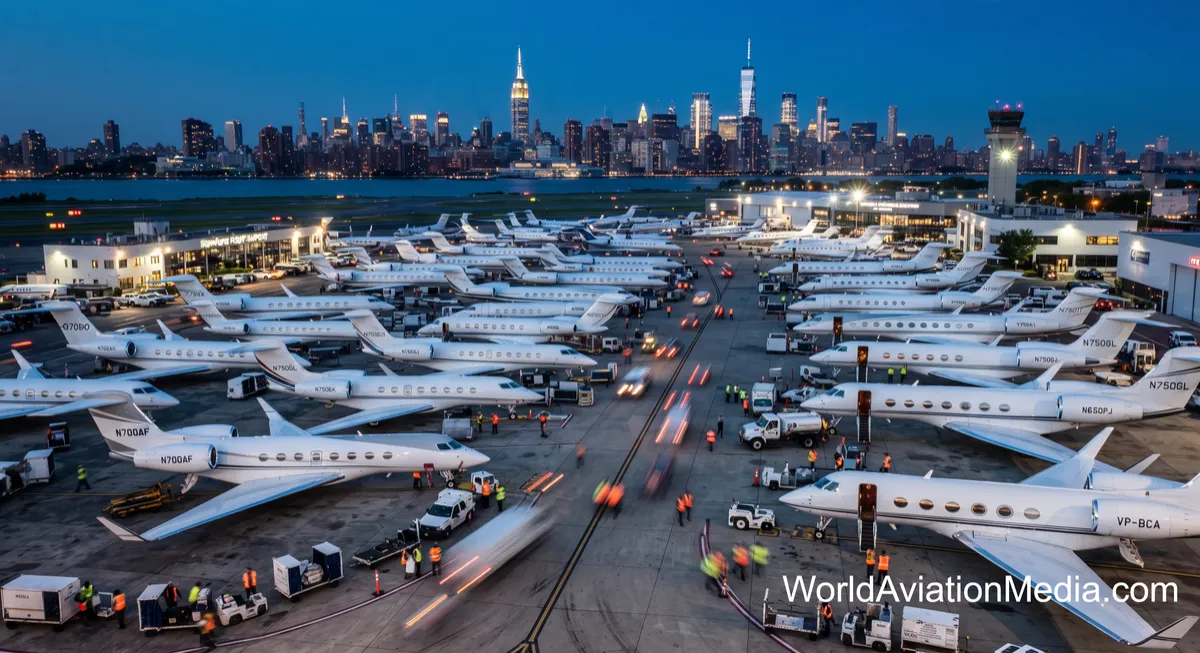
The Teterboro Paradox: Why Global Aviation is "Flat" but Your Airport is Overcrowded
KEY TAKEAWAYS
The Decoupling of Localized Demand: While North American aviation growth sits at a stagnant +0.3%, Teterboro (KTEB) faced a 29% traffic surge (1,605 movements) during a 72-hour event cluster, exposing a critical gap in infrastructure readiness.
Airspace as Symbolic and Economic Tool: Airspace closures, such as the Algeria/UAE rupture, serve as "diplomatic punctuation" with minimal commercial impact, while the 4,000km Sahel no-fly corridor acts as an economic strangulant for African carriers.
The Profitability Paradox: Despite a massive 21.5% projected surge in passenger traffic for 2026, African airlines face a baseline profit margin of only 0.2%, hindered by $774 million in blocked funds and a tax burden double the global average.
Fragility in the Widebody Supply Chain: The Airbus A350F program (107 orders) is threatened by a "single-plant bottleneck" in Kinston, NC (formerly Spirit AeroSystems), with customers like Cathay Pacific already forecasting six-month delivery delays.
The Digital Imperative for Mega-Hubs: Global infrastructure projects like the 110-million-capacity Bishoftu International require a workforce of 376,000 in North America and 75,000 in Africa, managed via unified digital offerings like Skywise.
INTRODUCTION: THE CALM BEFORE THE SURGE
In the high-stakes theater of global aviation strategy, macro-economic averages often serve as a veil rather than a lens. On paper, the North American market in 2026 suggests a state of industrial inertia, with year-over-year activity figures reflecting a nearly flat growth rate of just +0.3%. To the macro-economist, the sector appears to be in a stable holding pattern; to the operator on the tarmac, however, the reality is one of localized chaos.
Granular operational data reveals a profound decoupling of localized demand from broader economic indicators. Between September 10 and 12, 2026, Teterboro Airport (KTEB) was inundated by 1,605 movements—a 29% surge over the prior period. This "Teterboro Paradox" highlights the new operational playbook: while the "big picture" remains stagnant, event-driven demand clusters are pushing aviation infrastructure to its absolute breaking point, proving that global stability is often an illusion maintained by regional volatility.
TAKEAWAY 1: THE POWER OF THE EVENT OVERLAP (THE KTEB CASE)
The recent operational strain at Teterboro was not the byproduct of a single major event, but rather a "perfect storm" of cultural and sporting calendars. The simultaneous conclusion of New York Fashion Week and the US Open finals generated a demand cluster that moved movement figures from a baseline of ,1244 to 1,605 in just 72 hours. This included a net gain of 227 departures and 134 arrivals.
From a strategic consultancy perspective, these "event clusters" are significantly more hazardous than single-pulse events like the Super Bowl. They stress FBOs and air traffic control beyond predicted capacity, revealing that "Infrastructure Readiness" is not a static metric but a dynamic requirement. When two distinct high-net-worth demographics descend on a single metropolitan area, the lack of surge-capacity management transforms a busy weekend into a systemic bottleneck.
TAKEAWAY 2: THE "DIPLOMATIC PUNCTUATION" OF AIRSPACE
Aviation has evolved from a medium of transport into a tool of symbolic statecraft. At midnight on September 11, 2026, Algeria officially closed its airspace to all civilian and military aircraft registered in the United Arab Emirates. While the move appears seismic, a deeper analysis reveals it as a carefully choreographed diplomatic gesture with almost no commercial downside for the initiator.
The primary UAE carrier, Emirates, had already terminated its Dubai-to-Algiers service in March 2026, following Algeria’s move to cancel the 2013 air services agreement in February. Consequently:
"This is aviation being used as diplomatic punctuation."
By closing a corridor already devoid of the target’s traffic—save for a few commercial exceptions governed by unnamed contracts expiring in late 2026—nations can signal extreme hostility without incurring the self-inflicted economic wounds of a true blockade. Airspace is now a ledger for international grievances, where the "gesture" of a closure outweighs its actual operational impact.
TAKEAWAY 3: RECORD DEMAND VS. RAZOR-THIN MARGINS
The African market presents the industry’s most jarring "Profitability Paradox." While passenger traffic is projected to reach 137.3 million in 2026—a 21.5% year-over-year increase—the baseline regional profit margin remains a dismal 0.2%. Even the more optimistic 1.3% projection for late 2026 represents an industry fighting for its life.
The concept of "Airspace as a Tool" takes a darker turn here. Unlike the symbolic closure in Algeria, the 4,000km no-fly corridor spanning Niger, Mali, Sudan, and Libya (the Sahel) acts as a tool of economic strangulation. These conflict-driven re-routings force massive fuel burn increases on carriers already burdened by $774 million in blocked funds and a tax environment where fees account for 35–40% of ticket prices—double the 20% global average. As AFRAA Secretary General Mr. Berthé warns, "readiness is not the same as capacity." Africa’s growth is real, but its sustainability is being choked by geographical and fiscal bottlenecks.
TAKEAWAY 4: THE SUPPLY CHAIN BOTTLENECK (A350F DELAYS)
The aerospace manufacturing sector is learning that a robust order book of 107 aircraft is no protection against single-point-of-failure supply chains. The Airbus A350F program, originally intended for a 2025 entry, is now targeting H2 2027, though analysts view 2028 as the more realistic milestone.
The epicenter of this delay is the 500,000-square-foot Airbus Aerosystems facility in Kinston, North Carolina. Acquired from Spirit AeroSystems in late 2025, the plant is responsible for the critical fuselage panels and wing spar structures that set the pace for final assembly in Toulouse. Stakeholders are already adjusting: Atlas Air, the program’s largest customer with 20 aircraft, and Cathay Pacific, with eight on order, are bracing for impact. Specifically, Cathay Pacific has forecasted a six-month delay for its first delivery. This systemic slippage—paralleled by Boeing’s 777-8F delays toward 2029—proves that the next generation of cargo capacity is currently hostage to M&A integrations and single-plant production rates.
TAKEAWAY 5: THE RISE OF THE MEGA-HUB AND DIGITAL TRANSFORMATION
To survive a future of frequent event-driven surges, the industry is pivoting toward unprecedented scale and unified digital management. In Ethiopia, the Zaha Hadid-designed Bishoftu International is scaling toward a staggering 110-million-passenger capacity, while Angola’s Agostinho Neto International positions itself as a 15-million-passenger regional hub.
Managing this scale requires a shift to "connected, data-driven operations." Airbus is leading this transformation by merging Navblue and Skywise digital solutions into a single, unified digital offering under the "Skywise" entity. However, the software requires a massive influx of human capital. To support the projected US$54.4 billion North American services market and the doubling of Africa’s fleet by 2045, the industry faces a staggering recruitment target. Over the next two decades, the market will require a breakdown of 22,000 pilots, 25,000 technicians, and 28,000 cabin crew—a talent gap that could prove more restrictive than any supply chain delay.
CONCLUSION: THE FUTURE OF FLIGHT IS LOCALIZED
The "Teterboro Paradox" serves as a final warning: global averages are an analytical trap. The future of flight will not be defined by steady-state growth, but by how our infrastructure survives the volatile intersection of culture, diplomacy, and supply chain fragility. As we build 110-million-passenger hubs and navigate 4,000km no-fly zones, we must ask: can an industry built on macro-projections survive a reality defined by increasingly frequent, hyper-localized surges?
5-ITEM Q&A SECTION
Q1: What drove the specific 29% surge at Teterboro? The surge was the result of a "perfect storm" event overlap: the simultaneous timing of New York Fashion Week and the US Open finals between September 10–12, 2026.
Q2: Why are African airline margins so low despite record traffic? Margins are suppressed by a baseline profit of just 0.2%, driven by a tax burden of 35-40% on ticket prices, $774 million in blocked funds, and massive fuel costs from the 4,000km Sahel no-fly corridor spanning Niger, Mali, Sudan, and Libya.
Q3: What is the status of the Airbus A350F freighter program? Airbus holds 107 orders, but the first delivery (targeted for H2 2027) is likely to slip to 2028. Customers like Cathay Pacific already anticipate a six-month delivery delay due to production bottlenecks at the Kinston facility.
Q4: How much do taxes and fees contribute to ticket prices in Africa compared to the global average? Taxes and fees account for 35–40% of ticket prices in Africa, which is nearly double the global average of approximately 20%.
Q5: Why did Algeria close its airspace to UAE-registered aircraft if there were no active commercial flights? The closure was an act of "diplomatic punctuation" following the severing of ties. Because Algeria had already moved to terminate the 2013 air services agreement in February 2026, the closure carried immense symbolic weight with virtually zero self-inflicted commercial damage.
Keywords & Hashtags
Keywords: Business Aviation Trends 2026, Teterboro Airport Traffic, Event-Driven Aviation, Private Jet Market Analysis, African Aviation Growth, A350F Delivery Delays, Diplomatic Airspace Closures, Global Services Forecast, Skywise, KTEB Surge, Aviation Infrastructure Readiness, Sahel No-Fly Corridor, Spirit AeroSystems, Airbus Aerosystems Kinston, Aviation Workforce Gap.
Hashtags: #BizAv #KTEB #AviationInsights #Airbus #SupplyChain #AviationStrategy #AviationTransformation #GlobalAviation
