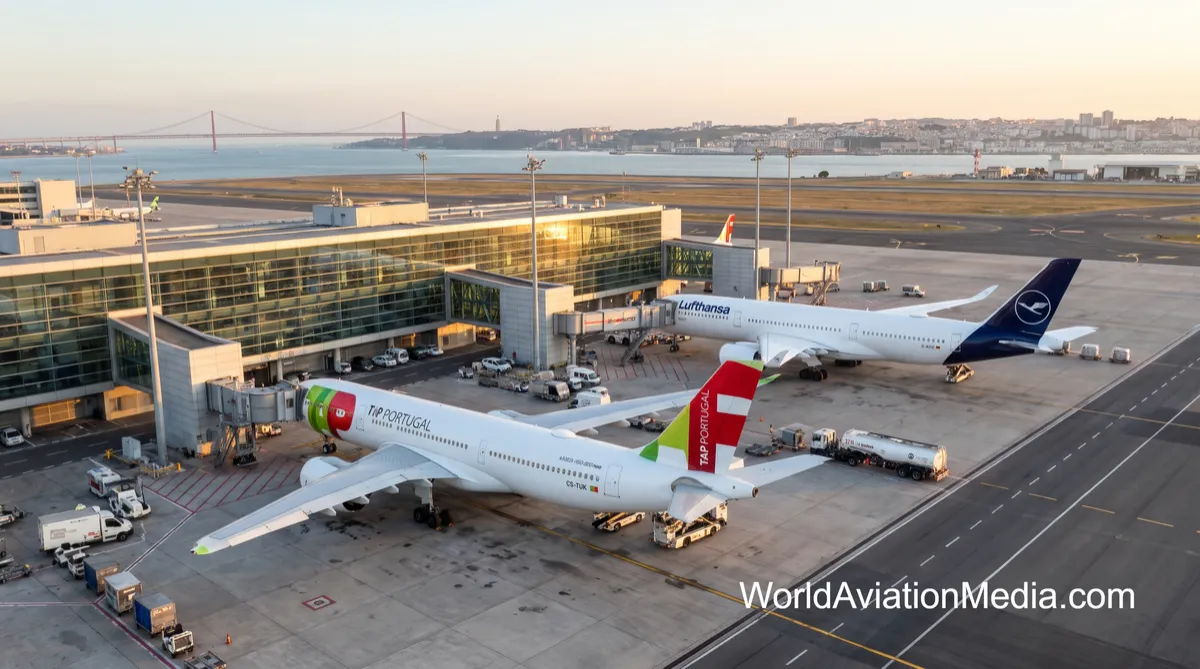
The TAP Air Portugal Domino Effect: How Lufthansa Group's $1.3 Billion Acquisition Reshapes the South Atlantic Aviation Market
Key Takeaways
Lufthansa Wins the Lisbon Prize: On October 14, 2026, the Portuguese government selected Lufthansa Group over rival bidder Air France-KLM to acquire a 44.9% minority stake in TAP Air Portugal for approximately €1.2 billion ($1.3 billion).
Instant South Atlantic Parity: Acquiring TAP's network of 101 aircraft and 16 South and Central American destinations immediately elevates Lufthansa Group from a distant third-place challenger to a co-equal titan alongside IAG and Air France-KLM on Europe–Brazil corridors.
Antitrust Strategy by Design: By purchasing a 44.9% stake while Lisbon retains 50.1% majority state ownership, Lufthansa avoids triggering the most punitive European Commission Directorate-General for Competition (DG COMP) divestiture thresholds while securing operational integration.
Multi-Hub Integration Complexity: Lufthansa must now absorb TAP's Lisbon hub while simultaneously executing the complex operational turnaround of Italy's ITA Airways and managing domestic labor unrest across its German mainline operations.
The Battle for Europe's Last Independent Atlantic Gateway
For nearly a decade, European airline consolidation has revolved around a single strategic question: who would ultimately claim Lisbon? On October 14, 2026, Portuguese Prime Minister Luís Montenegro provided the definitive answer, announcing that Lufthansa Group had prevailed over rival Air France-KLM to acquire a 44.9% equity stake in state-owned flag carrier TAP Air Portugal. Valued at approximately €1.2 billion ($1.3 billion / CAD 1.91 billion), the transaction represents the most consequential shift in European network geometry since IAG pursued Air Europa and Lufthansa finalized its entry into Italy's ITA Airways.
To understand why Frankfurt was willing to deploy $1.3 billion in capital while simultaneously battling pilot and cabin crew strikes at home and winding down Lufthansa CityLine, one must look at the map of the South Atlantic. While North Atlantic capacity is neatly partitioned among three immunized trans-Atlantic joint ventures—A++, Atlantic Joint Venture, and Blue Skies—the South Atlantic has historically suffered from an asymmetric balance of power. International Airlines Group (IAG), anchored by Iberia's fortress hub in Madrid, and Air France-KLM, leveraging Paris-Charles de Gaulle and Amsterdam-Schiphol, have long dominated passenger and belly-cargo flows between Europe and Latin America. Lufthansa Group, handicapped by the geographic positioning of Frankfurt, Munich, Zurich, and Vienna, lacked a natural Iberian funnel to capture high-yielding traffic to Lusophone and Hispanophone South America.
"This marks a new phase for TAP, guaranteeing the strategic preservation of the Lisbon hub while integrating our national carrier into a global aviation powerhouse capable of sustaining long-term fleet and network investment." — Portuguese Prime Minister Luís Montenegro, October 2026
By securing TAP Air Portugal, Lufthansa Group effectively leaps over the Pyrenees. TAP brings a fleet of 101 aircraft serving 93 global destinations, including 52 across Europe, 16 in South and Central America, 14 in Africa, and 11 in North America. More importantly, TAP arrives in robust operational health: in the first half of 2026, the Portuguese carrier transported a record 8.2 million passengers—a 4.2% year-over-year increase—while growing operating revenue by 4.3%.
Redrawing the South Atlantic Competitive Balance
South Atlantic network consolidation refers to the strategic concentration of Europe–Latin America scheduled seat capacity among Europe's three primary legacy airline groups: Lufthansa Group, IAG, and Air France-KLM. Prior to October 2026, Lufthansa relied heavily on Star Alliance code-sharing with TAP and long-stage-length widebody flights from Frankfurt to São Paulo, Rio de Janeiro, and Buenos Aires. However, flying a passenger from Milan, Geneva, or Brussels backtracking through Frankfurt to reach northeastern Brazil adds hours of flight time and thousands of dollars in fuel burn compared to routing via Lisbon.
TAP Air Portugal's Humberto Delgado Airport (LIS) hub is geographically situated as the closest European capital to Brazil. Crucially, TAP's utilization of next-generation narrowbody long-range aircraft—specifically the Airbus A321LR—allows it to profitably serve secondary Brazilian cities such as Recife, Fortaleza, Salvador, Belém, Natal, and Maceió alongside trunk widebody routes to São Paulo (GRU) and Rio de Janeiro (GIG).
Airline Group | Primary Iberian / Southern Hubs | Key South Atlantic Fleet Assets | Strategic Position Post-October 2026 |
Lufthansa Group (+ TAP & ITA) | Lisbon (LIS), Rome (FCO), Frankfurt (FRA), Zurich (ZRH) | A330-900neo, A321LR, A350-900, B747-8i | Dominant in Brazil & Lusophone Africa; dual Southern European hubs in LIS and FCO. |
IAG (Iberia, BA, Level) | Madrid (MAD), Barcelona (BCN), London (LHR) | A350-900, A330-200/300, A321XLR | Dominant in Spanish-speaking Latin America (Bogotá, Lima, Buenos Aires, Mexico City). |
Air France-KLM | Paris (CDG), Amsterdam (AMS) | B777-300ER, A350-900, B787-9 | Locked out of Iberian hub ownership; forced to rely on Gol partnership and organic CDG/AMS feed. |
For Air France-KLM, losing the TAP tender is a bitter strategic setback. Having already seen IAG entrench itself in Madrid and Lufthansa claim Rome-Fiumicino via ITA Airways, Paris-based executives viewed Lisbon as their last opportunity to acquire a Southern European hub. Without TAP, Air France-KLM must rely entirely on its commercial partnership with Brazilian carrier Gol Linhas Aéreas and direct flights from congested Paris and capacity-capped Amsterdam to defend its South Atlantic market share.
For IAG, Lufthansa's arrival in Lisbon creates an immediate next-door neighbor rival on the Iberian Peninsula. Following IAG's abandoned pursuit of Air Europa due to draconian Brussels antitrust demands, Iberia had enjoyed undisputed supremacy as the premier Iberian connector to Latin America. Now, Lufthansa Group can coordinate pricing, scheduling, and corporate contracting across both Lisbon (TAP) and Rome (ITA Airways), creating a pincer movement that squeezes Madrid's catchment area for connecting European traffic bound for South America.
The 44.9% Structure: Engineering Around Brussels Antitrust Scrutiny
Why did Lufthansa Group acquire exactly 44.9% of TAP rather than a 51% controlling majority? The answer lies in the treacherous regulatory waters of the European Commission's Directorate-General for Competition (DG COMP) and domestic Portuguese politics.
Under EU Merger Regulation, acquiring a de jure controlling stake triggers an exhaustive Phase I and frequently Phase II competition investigation. During Lufthansa's protracted acquisition of a 41% stake in ITA Airways—and IAG's doomed bids for Air Europa—DG COMP demanded massive slot divestitures at slot-constrained hubs and forced remedies on overlapping short-haul and long-haul routes. By structuring the TAP deal at 44.9%, with the Portuguese state retaining 50.1% and employees holding the remaining 5%, the transaction is engineered to preserve state majority ownership during the initial transition while granting Lufthansa deep commercial and operational governance rights.
Furthermore, Lufthansa and TAP already belong to the Star Alliance. Unlike an Air France-KLM acquisition—which would have required ripping TAP out of Star Alliance, migrating it to SkyTeam, and severing longstanding trans-Atlantic feed relationships with United Airlines and Air Canada—Lufthansa's investment maintains alliance continuity. There is virtually zero long-haul route overlap between Lufthansa's Frankfurt/Munich hubs and TAP's Lisbon hub on nonstop city pairs to Brazil, making it significantly harder for EU regulators to argue that the deal creates a route-level monopoly in the South Atlantic.
The Hidden Risks: Lisbon Slot Constraints and Lufthansa's Bandwidth Crisis
Despite the clear strategic logic, integrating TAP Air Portugal presents severe operational hazards for Lufthansa Group CEO Carsten Spohr:
Humberto Delgado Airport (LIS) Saturation: TAP's primary hub is operating at the absolute limit of its single-runway physical capacity, while Lisbon's greenfield replacement airport at Alcochete will not open until the mid-2030s. Growth at LIS cannot come from adding peak-hour movements; it must come from up-gauging aircraft and optimizing connecting banks.
Management Bandwidth and Financial Strain: Lufthansa is simultaneously digesting ITA Airways in Rome while confronting acute structural headwinds in Germany. In 2026, Lufthansa Group was forced to slash 20,000 summer flights due to surging fuel costs, accelerate the closure of Lufthansa CityLine, and endure cascading 48-hour walkouts by mainline pilots and cabin crew at Frankfurt and Munich.
Fleet Harmonization vs. NDC Integration: Integrating TAP's all-Airbus fleet (A320neo family and A330-900neo) into Lufthansa Group's procurement, maintenance (Lufthansa Technik), and distribution ecosystem—including the group's aggressive New Distribution Capability (NDC) and GDS surcharge architecture—will require delicate diplomacy with Portuguese unions and state board directors.
Ultimately, Lufthansa Group's $1.3 billion bet on TAP Air Portugal completes the Southern European consolidation puzzle. By pairing Rome-Fiumicino and Lisbon with its traditional DACH-region fortresses, Lufthansa has insulated itself against Northern European environmental taxes and hub congestion while locking down the fastest-growing corridors across the South Atlantic and Lusophone Africa.
5-Item Q&A Section (FAQ)
Q1: How much did Lufthansa Group pay for its stake in TAP Air Portugal in October 2026?
Lufthansa Group agreed to pay approximately €1.2 billion ($1.3 billion USD / $1.91 billion CAD) for a 44.9% equity stake in TAP Air Portugal, defeating rival bidder Air France-KLM in the privatization tender announced on October 14, 2026.
Q2: Why did Lufthansa acquire 44.9% of TAP instead of a 100% controlling stake?
The 44.9% minority stake satisfies the Portuguese government's political commitment to retain a majority state shareholding for now, while also structuring the investment below traditional EU majority-control thresholds to streamline European Commission antitrust approval.
Q3: Will TAP Air Portugal remain in the Star Alliance after the Lufthansa investment?
Yes. Because both Lufthansa Group and TAP Air Portugal are founding or longstanding members of the Star Alliance, TAP will remain in Star Alliance, preserving its vital trans-Atlantic feed partnerships with United Airlines, Air Canada, and Avianca.
Q4: How does the TAP acquisition impact IAG and Air France-KLM on South Atlantic routes?
The deal gives Lufthansa Group control over Europe's premier gateway to Brazil (16 South and Central American destinations), neutralizing Air France-KLM's bid for an Iberian hub and directly challenging IAG's Madrid-based dominance across Latin America.
Q5: What does TAP Air Portugal's fleet and network look like in 2026?
As of mid-2026, TAP operates 101 aircraft serving 93 global destinations (52 in Europe, 16 in South/Central America, 14 in Africa, and 11 in North America) and carried a record 8.2 million passengers in the first half of 2026.
Metadata
Keywords: Lufthansa TAP Air Portugal acquisition, TAP Air Portugal 44.9% stake, South Atlantic airline consolidation, Lufthansa vs Air France-KLM TAP bid, Lisbon hub aviation strategy, European airline M&A 2026, Humberto Delgado Airport slots.
Hashtags: #LufthansaGroup #TAPAirPortugal #AviationMA #SouthAtlantic #AirlineStrategy #StarAlliance #EuropeanAviation
