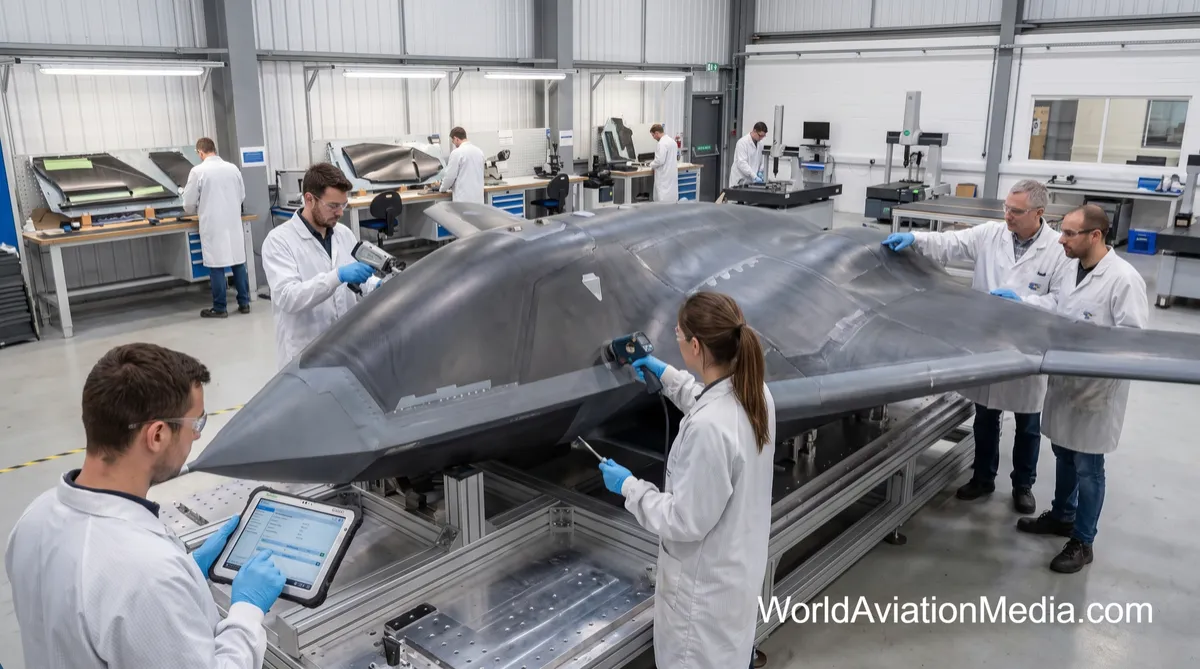
The Robot Wingman Race: Airbus and Kratos Deliver the U740-Valkyrie Maiden Flight
Key Takeaways
Milestone Flight: Airbus and Kratos successfully completed the first European flight of the U740-Valkyrie uncrewed combat aircraft, accelerating the race for European defense autonomy.
2029 Combat-Ready Target: The partnership is aggressively targeting a fully combat-ready Collaborative Combat Aircraft (CCA) capability by 2029 to support European air forces.
Manned-Unmanned Teaming (MUM-T): The ramp-launched, 9-meter drone is designed to operate autonomously or alongside crewed fighters like the Eurofighter, delivering kinetic and non-kinetic effects.
Strategic Sovereign Defense: The flight underscores Europe's urgent push to develop indigenous uncrewed combat air vehicles (UCAVs) independent of non-European defense architectures.
In-Depth Article Content
The geopolitical realignment of European defense reached a pivotal milestone with the successful maiden flight of the Airbus U740-Valkyrie uncrewed combat aircraft in Europe. Developed in strategic partnership with U.S.-based Kratos Defense & Security Solutions, this inaugural flight marks a monumental leap forward for the continent's military aviation sector. As global powers race to field affordable, highly autonomous "robot wingmen," the U740-Valkyrie program establishes a concrete pathway toward European defense sovereignty and next-generation air combat dominance.
Anatomy of the U740-Valkyrie Milestone
The ramp-launched, nine-meter-long U740-Valkyrie completed its maiden flight from a test facility in Northern Europe. Engineered to serve as a high-performance Collaborative Combat Aircraft (CCA), the platform boasts an operational range exceeding 5,000 kilometers (2,700 nautical miles) and a ceiling of up to 45,000 feet.
Designed explicitly to deliver both kinetic and non-kinetic effects, the drone represents a paradigm shift in how air forces contemplate tactical attrition. Rather than risking multi-million-dollar crewed fighter jets in heavily contested anti-access/area-denial (A2/AD) airspace, air arms can deploy swarms of cost-effective U740s to absorb enemy air defenses, jam enemy radar networks, and deliver precision munitions under autonomous command.
Manned-Unmanned Teaming (MUM-T) and the Eurofighter Integration
At the heart of the U740 program is seamless Manned-Unmanned Teaming (MUM-T). Airbus has structured the roadmap to pair the U740 directly with crewed platforms such as the Eurofighter Typhoon by 2029.
In operational scenarios, a lead fighter pilot acts as a quarterback, commanding a flight of autonomous Valkyries from the cockpit. The drones handle high-risk surveillance, electronic warfare, and target saturation, while the human pilot maintains tactical command oversight from a safe standoff distance. This capability multiplies the combat punch of existing European fleets without requiring massive procurement of entirely new crewed fifth- or sixth-generation fighter airframes.
The Race for European Defense Autonomy
The successful European flight of the Valkyrie carries profound geopolitical implications. For decades, European defense acquisition suffered from fragmentation, over-reliance on external defense ecosystems, and sluggish procurement timelines.
By partnering with agile innovators like Kratos while anchoring manufacturing and operational integration within European defense frameworks, Airbus is aggressively accelerating timelines. The 2029 target for combat-ready deployment aligns precisely with the operational urgency felt across NATO's eastern flank.
Economic and Attritable Combat Mass
Traditional fighter procurement models are economically unsustainable in protracted high-intensity conflicts. At tens of millions of dollars per airframe, losing a crewed fighter is a strategic blow.
The U740-Valkyrie embraces the philosophy of "attritable mass"—systems built with high capability but at a fraction of the cost of crewed fighters, making the loss of a drone tactically acceptable if it achieves mission success. As Airbus and Kratos refine autonomous flight control algorithms and sensor integration ahead of the 2029 deadline, the robot wingman race has officially cemented uncrewed combat aviation as the future of air power.
SEO & AEO Optimization
Core User Intent: Evaluate the strategic implications and technical milestones of the Airbus U740-Valkyrie maiden flight for European defense autonomy.
Direct Answer Definition: The robot wingman race refers to the global military development of Collaborative Combat Aircraft (CCAs) like the Airbus U740-Valkyrie, designed to fly autonomously alongside crewed fighters.
5-Item Q&A Section
Q1: What is the Airbus U740-Valkyrie?
A: A ramp-launched, uncrewed combat aircraft (UCAV) developed by Airbus and Kratos to serve as a Collaborative Combat Aircraft (CCA).
Q2: When is the U740-Valkyrie targeted to be combat-ready?
A: Airbus and Kratos are targeting a fully combat-ready capability by 2029 to meet European armed forces requirements.
Q3: What crewed fighter is initially slated for teaming with the U740?
A: The Airbus-led roadmap plans to pair the U740 directly with crewed Eurofighter jets.
Q4: What are the key performance metrics of the U740?
A: It features a length of nine meters, a range exceeding 5,000 kilometers (2,700 nm), and an operating ceiling of up to 45,000 feet.
Q5: What is the military concept of "attritable mass" in drone warfare?
A: Building high-performance uncrewed systems at a cost low enough that losing them in combat is tactically acceptable relative to losing crewed aircraft.
Metadata & Hashtag
Target SEO Keywords: Airbus U740 Valkyrie, robot wingman race, European defense autonomy, Collaborative Combat Aircraft, Kratos Airbus drone, Manned-Unmanned Teaming.
Hashtags: #U740Valkyrie #Airbus #Kratos #DefenseAutonomy #MilitaryDrones #FutureOfWarfare
