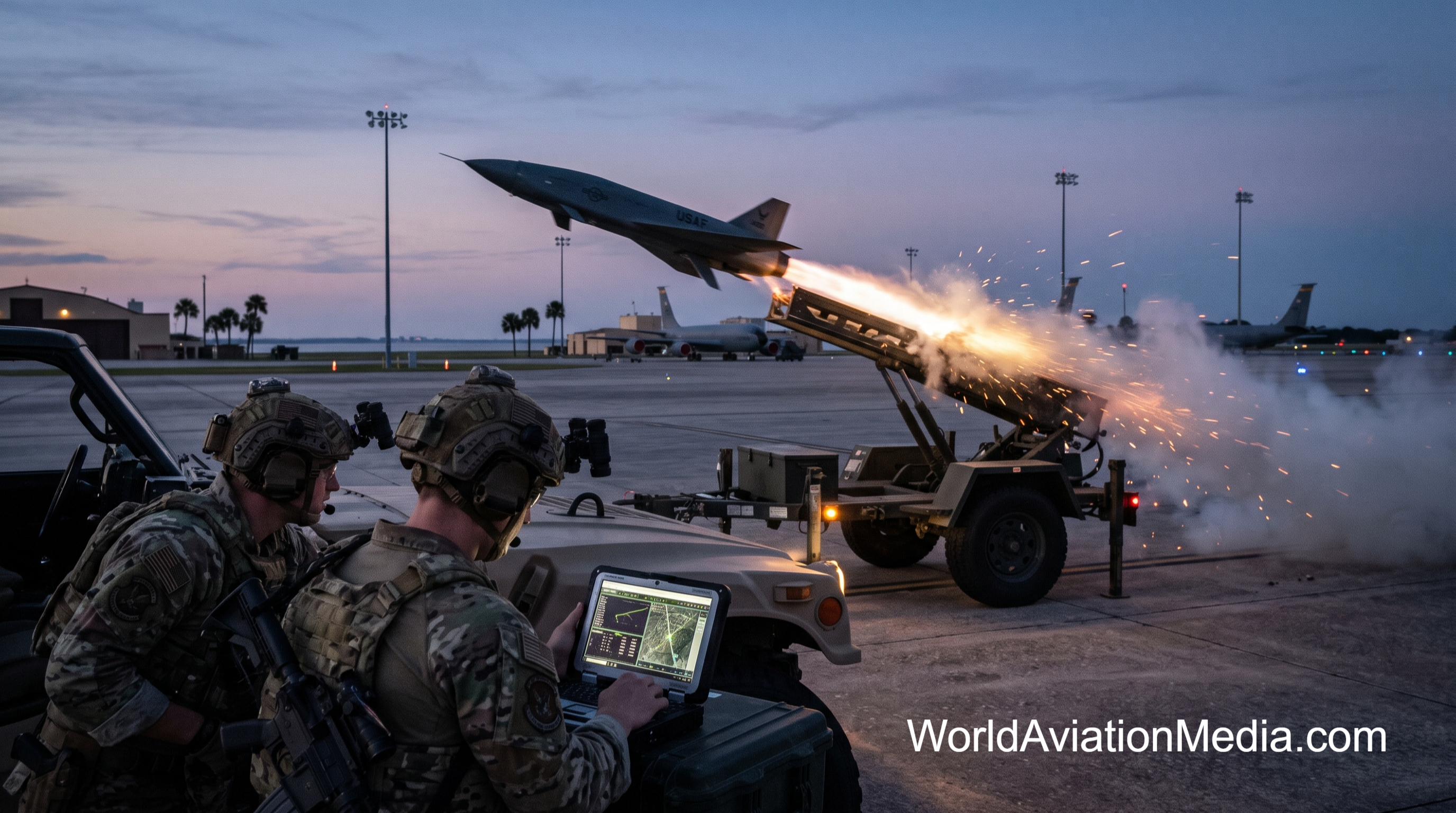
The Rise of the Interceptor Drone: Inside the Kinetic Counter-UAS Boom from MacDill AFB to Prague
Key Takeaways
Why Jamming Is No Longer Enough: As adversarial drones adopt fiber-optic tethers, AI-driven visual terrain navigation, and inertial guidance immune to radio-frequency (RF) jamming, military and homeland security planners are pivoting aggressively to hard-kill kinetic drone interceptors.
U.S. Air Force Trains with Bumblebee V2: On October 25, 2026, the U.S. Air Force demonstrated enhanced domestic air base defense at MacDill Air Force Base, Florida, training with the high-speed Bumblebee V2 kinetic drone interceptor.
European Hard-Kill Innovation in Prague: At the October 2026 Future Forces Forum in Prague, Czech defense OEMs unveiled purpose-built kinetic systems, led by LPP’s JWI-4000 Interceptor (engineered specifically to hunt Shahed-136 one-way attack drones) and KBP International’s Gryf airborne drone carrier.
FEMA’s $250M Domestic C-UAS Catalyst: Backed by FEMA’s rapid $250 million Counter-UAS Grant Program for state and local authorities, layered drone detection and low-collateral interception are moving from overseas battlefields to domestic stadiums, power grids, and military bases.
The End of the "Soft-Kill" Illusion: Why Electronic Warfare Hit a Wall
For the better part of a decade, the global Counter-Unmanned Aircraft Systems (C-UAS) market relied heavily on "soft-kill" electronic warfare (EW): radio-frequency (RF) jammers, GPS/GNSS spoofers, and protocol-manipulation rifles designed to sever the command link between an operator and a quadcopter.
By late 2026, combat lessons from Eastern Europe and the Middle East—combined with brazen "drone swarm" incursions over Western military installations—have exposed the fatal flaw of soft-kill reliance. Modern one-way attack (OWA) drones and reconnaissance UAS no longer require continuous RF links or satellite navigation during their terminal phase. Equipped with unjammable fiber-optic spools, onboard computer-vision optical flow cameras, and autonomous AI target recognition, an incoming drone that gets jammed simply switches to internal inertial/visual guidance and completes its strike.
What is a kinetic interceptor drone? A kinetic interceptor drone is a high-speed, expendable or reusable unmanned aerial vehicle engineered to physically collide with, detonate alongside, or entangle a hostile drone in mid-air. Operating as an ultra-low-cost surface-to-air or air-to-air guided effector, it defeats autonomous and RF-immune drones at a fraction of the cost of traditional air-defense missiles.
Inside MacDill AFB: The U.S. Air Force Deploys the Bumblebee V2
The urgency of protecting domestic U.S. military installations from low-altitude UAS reconnaissance and sabotage reached a milestone on October 25, 2026, when the U.S. Air Force showcased active base defense training at MacDill Air Force Base in Tampa, Florida—home to U.S. Central Command (CENTCOM) and U.S. Special Operations Command (SOCOM)—utilizing the new Bumblebee V2 interceptor drone.
Protecting a sprawling stateside air base like MacDill presents an agonizing rules-of-engagement (ROE) dilemma:
The Cost-Exchange Asymmetry: Firing a $500,000 AIM-9X Sidewinder or a $150,000 Stinger missile at a $2,000 commercial-off-the-shelf (COTS) quadcopter or a $30,000 delta-wing loitering munition is financially unsustainable.
The Collateral Damage Constraint: MacDill AFB sits on a peninsula surrounded by dense civilian neighborhoods, commercial shipping lanes, and Tampa International Airport’s busy Class B airspace. Unleashing 20mm C-RAM autocannon rounds or heavy explosive surface-to-air missiles over suburban Florida is legally and physically unacceptable.
The Bumblebee V2 solves both problems. Engineered for rapid launch, high thrust-to-weight acceleration, and terminal optical/radar lock, the Bumblebee V2 functions as a "smart kinetic bullet." Guided by base C-UAS radar and electro-optical sensor fusion into the target's flight path, the Bumblebee V2 uses sheer kinetic impact—or a localized, low-fragmentation airburst/capture payload—to shatter the intruding drone's airframe and propellers over designated safe drop zones without showering surrounding civilian areas with heavy shrapnel.
The Prague Breakthrough: LPP’s JWI-4000 and KBP’s Gryf Carrier
While the U.S. Air Force refines base perimeter defense in Florida, Central European defense manufacturers are scaling industrial kinetic C-UAS architectures to counter massed long-range strike drones. At the Future Forces Forum in Prague (October 21–26, 2026), Czech defense innovators unveiled a suite of hard-kill platforms designed specifically around the threat profile of Iranian-designed Shahed-136 (Geran-2) attack drones.
Platform Name | Developer / Country | Primary Role | Target Threat Set | Key Technical Innovation |
Bumblebee V2 | U.S. Defense Partner (Deployed at MacDill AFB) | Agile Kinetic Air Base Interceptor | Group 1–3 Recon & Tactical Attack Drones | High-G terminal maneuverability; low-collateral base defense integration |
JWI-4000 Interceptor | LPP (Czech Republic) | High-Speed Anti-OWA Interceptor | Shahed-136 / Geran-2 Class Loitering Munitions | High-speed dash propulsion capable of overtaking 185+ km/h piston/jet delta-wing drones |
Gryf Tactical Carrier | KBP International (Czech Republic) | Airborne "Mothership" Drone Carrier | Extended Perimeter & Swarm Defense | Combines airborne kinetic interceptors and micro-missiles on a loitering patrol carrier |
Chaser LM | CSG (Czech Republic) | Smart Loitering Munition | Mobile Ground Launchers & Armor (40 km reach) | Destroys adversarial C-UAS/UAS launch trucks before drones are airborne |
LPP’s JWI-4000: The Dedicated Shahed Hunter
Unveiled on October 21, 2026, by Czech firm LPP, the JWI-4000 Interceptor addresses the velocity and altitude gap of first-generation FPV interceptors. Standard battery-powered quadcopters struggle to catch a Shahed-136 diving at 185–250 km/h or flying at altitudes above 3,000 meters. The JWI-4000 utilizes an aerodynamically streamlined airframe and high-output propulsion to rapidly climb, intercept, and destroy heavy Group 3 one-way attack drones mid-cruise—preserving scarce Patriot, NASAMS, and IRIS-T missiles for cruise and ballistic missile threats.
KBP International’s Gryf: Taking the Interceptor Carrier Airborne
On October 26, 2026, Czech manufacturer KBP International introduced an even more ambitious concept at the Prague forum: the Gryf tactical counter-UAS drone carrier. Rather than launching interceptors from the ground—which wastes precious battery or rocket endurance climbing through thick lower air—the Gryf acts as an airborne "mothership," loitering at altitude on extended air-defense patrols while carrying multiple airborne interceptors and compact missiles ready for top-down engagement.
FEMA’s $250 Million C-UAS Grant Program and Domestic Homeland Security
The shift toward structured, multi-layered C-UAS architectures is not confined to the Pentagon or NATO’s eastern flank; it is reshaping domestic state and local law enforcement across the United States.
Executed as the fastest non-disaster grant award in agency history, the Federal Emergency Management Agency’s (FEMA) $250 million Fiscal Year 2026 Counter-Unmanned Aircraft Systems (C-UAS) Grant Program injected a quarter-billion dollars into state and local security agencies—initially anchored around the 11 U.S. host regions for the 2026 FIFA World Cup and expanding into permanent state fusion center infrastructure.
How does FEMA’s $250M grant program change the domestic market?
Standardized Sensor-Fusion Backbones: State police and emergency management agencies are procuring networked passive RF detectors, compact 3D micro-Doppler radars, and AI optical tracking turrets that feed into unified State Fusion Centers.
Bridging the Federal-Local Legal Authority Gap: While Title 18 kinetic takedown authorities remain tightly controlled by federal partners (DoD, DHS, DOJ, DOE) and expanding congressional legislative frameworks, state-level sensor networks funded by FEMA provide the real-time "detect, track, and identify" (DTI) cueing required for federal kinetic teams—and low-collateral net/kinetic interceptors—to neutralize threats over stadiums, power substations, and ports.
From the flight line at MacDill AFB to the exhibition halls of Prague, the message of October 2026 is unmistakable: in the era of autonomous drones, the only reliable defense against an unmanned aircraft is a faster, smarter unmanned interceptor.
5-Item Q&A Section
Q1: What is the Bumblebee V2 drone interceptor? The Bumblebee V2 is a kinetic counter-UAS (C-UAS) interceptor drone utilized by the U.S. Air Force—highlighted during October 2026 base defense training at MacDill Air Force Base, Florida—to physically intercept and neutralize hostile drones threatening military airfields.
Q2: What is the Czech LPP JWI-4000 Interceptor designed to do? Unveiled at the Future Forces Forum in Prague on October 21, 2026, by Czech defense company LPP, the JWI-4000 is a high-speed kinetic interceptor drone engineered specifically to hunt and destroy Shahed-136 (Geran-2) class one-way attack drones at a fraction of the cost of conventional air-defense missiles.
Q3: Why are military forces shifting from electronic jamming to kinetic drone interceptors? Adversarial drones increasingly use fiber-optic wire guidance, onboard AI computer vision, and inertial navigation systems that do not rely on radio-frequency (RF) control links or GPS signals. Because these drones cannot be jammed electronically, defenders must use kinetic interceptors to physically destroy them in flight.
Q4: What is the KBP International Gryf drone carrier? Introduced at the October 2026 Future Forces Forum in Prague by Czech manufacturer KBP International, the Gryf is an airborne tactical counter-UAS carrier ("mothership") that combines parasitic airborne interceptor drones and compact missiles to conduct extended air-defense patrols from altitude.
Q5: How is FEMA’s $250 million Counter-UAS Grant Program used by U.S. states? FEMA’s $250 million FY2026 C-UAS Grant Program—originally accelerated to protect the 11 U.S. host regions for the 2026 FIFA World Cup—funds state emergency management agencies and fusion centers to deploy layered drone detection, tracking, identification (DTI), and mitigation infrastructure around critical venues and airspace.
Keywords and Hashtags
Keywords: Kinetic interceptor drone 2026, Bumblebee V2 MacDill AFB, LPP JWI-4000 Shahed interceptor, KBP Gryf drone carrier Prague, FEMA $250M Counter-UAS grant program, hard-kill C-UAS technology, Future Forces Forum Prague 2026.
Hashtags: #CounterUAS #DroneDefense #USAirForce #MacDillAFB #DefenseTech #MilitaryDrones #AirspaceSecurity #FutureForces2026
