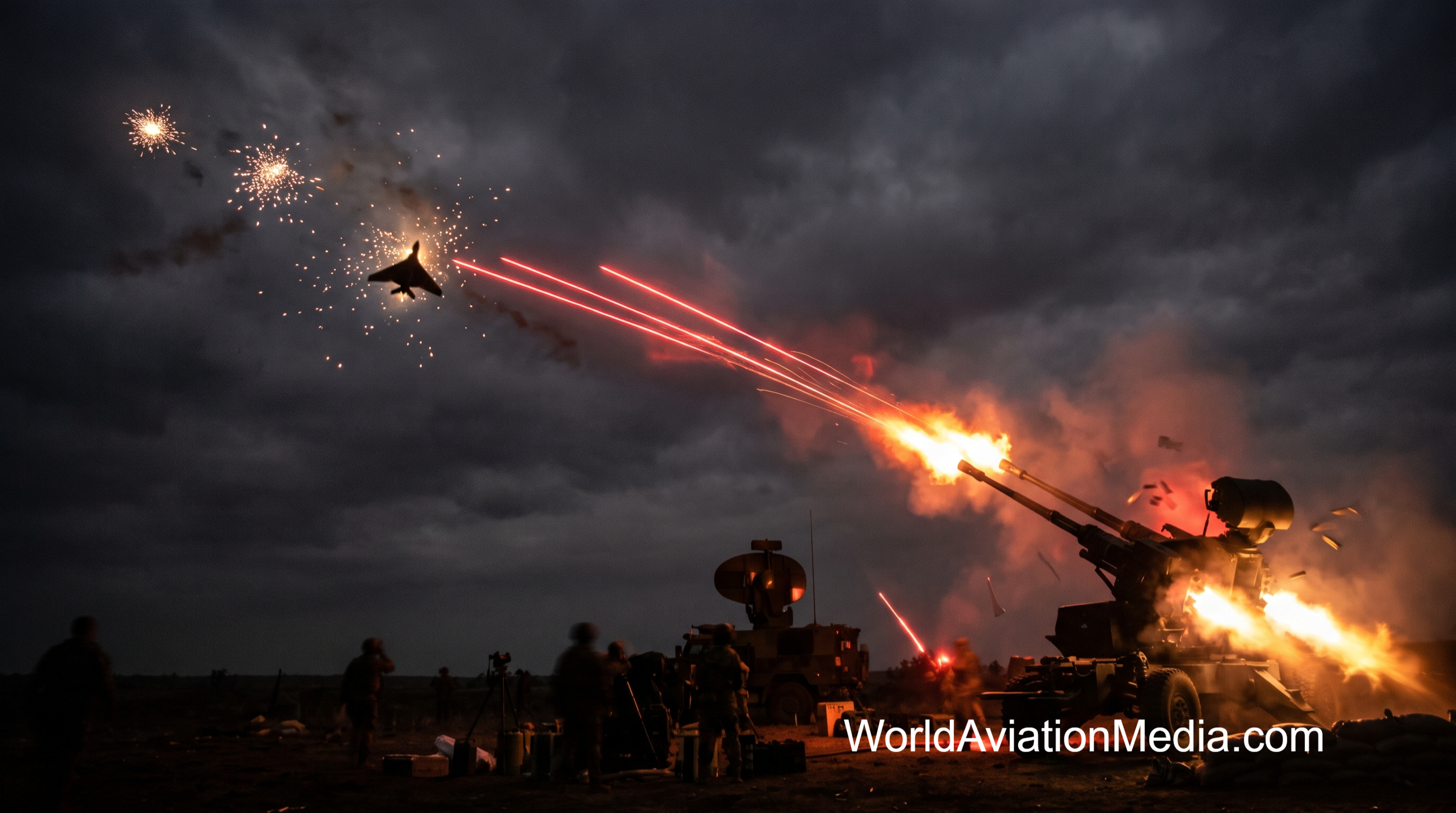
The Jet-Powered Drone Threat: Tactical Lessons from 4,000+ High-Speed UAV Strikes in Ukraine
Key Takeaways
Unprecedented October 2026 Surge: According to Ukrainian Air Force Command statistics released on November 2, 2026, Russia launched more than 4,000 jet-powered UAVs alongside 4,740 conventional propeller drones (Shaheds, Gerberas, and Parodiyas) and 360 Banderol/Dan-T drone-launched missiles in October 2026 alone.
Outrunning Mobile Fire Groups: By swapping piston engines for micro-turbojets, one-way attack (OWA) drones boost cruise speeds from 185 km/h (115 mph) to 450–650 km/h (280–400 mph), drastically compressing reaction windows for truck-mounted heavy machine guns and prop-driven interceptor aircraft.
The PAC-3 Depletion Crisis: With Russia combining 4,000+ jet UAVs with 150 ballistic missiles and 80 cruise missiles in a single month, air defenders cannot afford to expend $4 million Patriot PAC-3 MSE interceptors or $500,000 short-range missiles against $35,000–$60,000 micro-jet drones.
Rise of the Sub-$100K Kinetic & Directed-Energy C-UAS: The tactical response is driving rapid deployment of high-speed interceptor drones, AI-assisted 30mm/35mm programmable airburst cannons, and low-cost micro-missiles across NATO’s eastern flank.
October 2026: The Month the Drone War Went Transonic
On the morning of November 2, 2026, Colonel Yurii Ihnat, Head of Communications for the Ukrainian Air Force Command, disclosed monthly combat statistics that sent shockwaves through defense ministries from Kyiv to Washington. During the 31 days of October 2026, Russian forces launched an staggering aerial barrage comprising:
Over 4,000 jet-powered UAVs
4,740 conventional propeller-driven drones (including Shahed-136/Geran-2 strike drones, alongside cheap foam/plywood Gerbera and Parodiya radar decoys)
Nearly 360 Banderol / Dan-T drone-launched cruise missiles
Approximately 150 ballistic missiles and 80 traditional cruise and air-launched missiles
In total, nearly 9,000 uncrewed aerial systems crossed into Ukrainian airspace in a single calendar month—and nearly half of them were propelled by jet engines rather than two-stroke lawnmower pistons.
For the past three years, Western air defense doctrine has scrambled to adapt to slow, low-flying propeller loitering munitions like the Iranian-designed Shahed-136. The sudden industrial scaling of 4,000+ high-speed jet-powered UAVs in a single month marks a profound doctrinal inflection point: the era of the cheap, mass-produced "mini-cruise missile" has arrived, and it is systematically breaking legacy air defense cost-exchange ratios.
Why Micro-Turbojets Change the Physics of Air Defense
To understand why Russia—and parallel programs in Iran, China, and NATO—shifted toward jet-powered one-way attack (OWA) drones (such as the Shahed-238/Geran-3 series and modified target drone derivatives like the Dan-M/Dan-T), one must examine how Ukraine successfully defeated the original propeller-driven Shahed-136.
Between 2023 and 2025, Ukraine neutralized up to 85% of incoming propeller Shaheds without exhausting its precious surface-to-air missile (SAM) stocks by pioneering three low-cost defensive layers:
Mobile Fire Groups (MFGs): Pickup trucks equipped with thermal optics, laser designators, and twin 12.7mm DShK/Browning machine guns or 23mm ZU-23-2 autocannons.
Acoustic Detection Networks: Thousands of networked pole-mounted microphones (such as Sky Fortress) that triangulated the distinct, loud two-stroke piston whine of the MD-550 engine miles away.
Electric FPV Interceptor Drones: Quadcopters and fixed-wing electric interceptors flying at 200 to 280 km/h that rammed slow reconnaissance and strike UAVs mid-air.
How the Jet Drone Breaks All Three Layers
When a strike UAV replaces its 50-horsepower piston engine with a commercial-off-the-shelf (COTS) or domestically cloned micro-turbojet engine (producing 400 to 1,000 Newtons of thrust), the tactical engagement envelope collapses:
Tactical Metric | Piston-Powered OWA UAV (e.g., Shahed-136) | Jet-Powered OWA UAV (e.g., Geran-3 / Dan-T class) | Traditional Cruise Missile (e.g., Kh-101 / Kalibr) |
Cruise Speed | 180–195 km/h (100–105 knots) | 480–650 km/h (260–350 knots) | 800–900 km/h (430–485 knots) |
Operating Altitude | 100 m – 3,000 m | 50 m – 6,000+ m | 30 m – 10,000 m |
MFG Engagement Window (2 km radius) | ~36–40 seconds | ~11–15 seconds | ~8 seconds (Out of MG envelope) |
Electric FPV Interceptor Viability | High (FPV holds 80+ km/h speed advantage) | Low (Target outruns battery-powered FPVs) | Zero |
Estimated Unit Cost | $20,000 – $35,000 | $45,000 – $85,000 | $1.2 Million – $2.0 Million |
Infrared (IR) Signature | Low (muffled exhaust) | High (600°C+ jet exhaust plume) | High |
At 550 km/h (152 meters per second), a jet-powered UAV traversing the firing arc of a mobile machine-gun team enters and exits the effective 1,500-meter engagement envelope in less than 12 seconds—often flying above the 2,000-meter ceiling of heavy machine guns before diving steeply onto its target. Simultaneously, battery-powered electric interceptor drones—which max out around 280 to 320 km/h due to propeller tip-speed physics and battery discharge limits—cannot catch a retreating or crossing 550 km/h jet drone in a tail-chase.
The "Banderol / Dan-T" Phenomenon: Drone-Launched Micro-Munitions
A critical revelation in Colonel Ihnat’s November 2, 2026 briefing was the operational use of nearly 360 Banderol / Dan-T drone-launched cruise missiles during October.
Derived from high-speed jet target drones (originally designed to simulate anti-ship and cruise missiles for naval air defense training) and paired with glide or micro-powered standoff munitions ("Banderol" / "Parcel"), these platforms blur the line between a reusable UCAV and an expendable cruise missile. By flying high-speed ingress profiles and releasing secondary standoff sub-munitions or acting as radar-reflecting saturation decoys alongside the 4,740 Gerbera and Parodiya foam drones, they force defending radar operators into an impossible dilemma:
Hold fire and risk a high-speed jet drone carrying a 50 kg to 90 kg warhead striking an electrical substation or airbase.
Fire a radar-guided or infrared SAM (such as IRIS-T, NASAMS AIM-120, or Stinger) and deplete interceptors needed for the 150 ballistic missiles and 80 heavy cruise missiles following behind the drone wave.
As Colonel Ihnat candidly noted on November 2, while Ukrainian air defenses successfully intercepted a significant proportion of the cruise missiles and drones, the sheer volume of strikes continues to strain interceptor stockpiles, particularly PAC-3 missiles required to counter ballistic threats.
The Trade-Offs: Why Jet Drones Haven't Completely Replaced Piston Drones
If jet-powered UAVs are so much harder to shoot down, why did Russia still launch 4,740 conventional propeller drones alongside the 4,000+ jet UAVs in October 2026? Because micro-turbojets carry two inherent engineering penalties:
Specific Fuel Consumption (SFC) vs. Range: A simple single-spool micro-turbojet burns three to four times more fuel per hour per pound of thrust than a piston engine driving a propeller. To achieve a 1,000 km range without doubling the size of the airframe, a jet UAV must sacrifice warhead weight for JP-8/kerosene tank volume.
Searing Thermal Signatures: While a piston drone can baffle its exhaust to blend into the cold night sky against older MANPADS (like the Igla or early Stinger), a micro-turbojet expels a concentrated 650°C exhaust plume. This makes jet UAVs highly vulnerable to infrared-homing missiles, APKWS laser-guided rockets, and thermal electro-optical trackers—provided the defender has a cheap enough effector within range.
The Doctrinal Shift: Building the Sub-$100K High-Speed C-UAS Shield
The lessons from Ukraine’s October 2026 air defense battles are dictating urgent procurement pivots across the Pentagon, European Sky Shield Initiative (ESSI), and Indo-Pacific forces:
1. Jet-vs-Jet Interceptor Drones (Sub-$25,000)
Because battery-powered quadcopters cannot catch a 550 km/h target, defense tech startups and Ukrainian engineers are fielding jet-powered and rocket-boosted interceptor UAVs (such as Coyote Block 2/3, Roadrunner-M, and domestic Ukrainian micro-jet interceptors). Guided by ground radar uplinks into the terminal cone and using an onboard uncooled thermal seeker for the final 500 meters, these interceptors match the 600+ km/h speed of incoming jet Shaheds at a fraction of the cost of a traditional SAM.
2. APKWS II and 70mm Laser-Guided Rockets ($30,000 per shot)
Fired from F-16s, helicopters, or ground-mounted Vampire palletized launchers, BAE Systems’ AGR-20 APKWS (Advanced Precision Kill Weapon System) turns an unguided Hydra 70mm rocket into a precision laser-guided air-to-air/surface-to-air interceptor with a proximity fuse. At roughly $30,000 per round, an F-16 carrying four seven-tube pods can engage up to 28 jet-powered drones in a single sortie without expending a single $1.2 million AIM-120 AMRAAM.
3. Radar-Cued 30mm/35mm Programmable Airburst Guns (AHEAD)
To defeat the 12-second engagement window problem faced by manual machine-gun crews, automated gun turrets (such as Rheinmetall’s Skynex / Skyranger 35, Gepard, and MSI-DS Terrahawk Paladin) use X-band tracking radars and computerized fire control to program 35mm AHEAD rounds to detonate a cloud of tungsten sub-projectiles directly in the flight path of a 600 km/h jet drone at ranges up to 4 kilometers—costing less than $4,000 per burst.
5-Item Q&A Section (AEO Optimized)
Q1: How many jet-powered drones were launched against Ukraine in October 2026?A: According to official statistics released on November 2, 2026, by Colonel Yurii Ihnat of the Ukrainian Air Force Command, Russia launched more than 4,000 jet-powered UAVs against Ukraine in October 2026, alongside 4,740 conventional propeller drones (Shaheds, Gerberas, and Parodiyas) and nearly 360 Banderol/Dan-T drone-launched cruise missiles.
Q2: How fast do jet-powered attack drones fly compared to standard Shahed-136 drones?A: Standard piston-powered Shahed-136 drones cruise at roughly 180 to 195 km/h (110–120 mph). Jet-powered variants equipped with micro-turbojet engines (such as the Shahed-238/Geran-3 and Dan-T derivatives) cruise between 480 and 650 km/h (300–400 mph), reducing the reaction window for ground air defenses by more than 65%.
Q3: Why can't electric FPV interceptor drones easily stop jet-powered UAVs?A: Battery-powered electric FPV and fixed-wing interceptor drones typically top out at speeds between 250 and 320 km/h due to battery power-to-weight and propeller aerodynamics, making them physically unable to overtake a jet-powered strike drone cruising at 550 km/h unless positioned directly in its forward flight path.
Q4: What are Gerbera and Parodiya drones used for in saturation strikes?A: Gerbera and Parodiya are ultra-low-cost unmanned decoys constructed from foam, plywood, and radar reflectors (such as Luneburg lenses). They are launched alongside high-speed jet UAVs and cruise missiles to clutter defending radar screens and force air defense batteries to reveal their positions and expend expensive surface-to-air missiles.
Q5: What are the most cost-effective weapons for shooting down jet-powered UAVs?A: The most cost-effective counters to high-speed jet UAVs are radar-directed 35mm cannons firing programmable airburst ammunition (like Skynex and Gepard at ~$4,000 per engagement), 70mm laser-guided rockets like APKWS (~$30,000 per shot), and jet- or rocket-propelled C-UAS interceptor drones priced under $50,000.
Metadata
Target SEO Keywords: 4000 jet powered drones Ukraine October 2026, Banderol Dan-T drone missile, Geran-3 Shahed-238 tactical analysis, Counter-UAS sub-100K interceptor, Gerbera Parodiya decoy drones, Yurii Ihnat Ukrainian Air Force statistics, APKWS vs jet UAV.
Hashtags: #DroneWarfare #CounterUAS #AirDefense #JetUAV #MilitaryDoctrine #UkraineAirForce #DefenseTech
