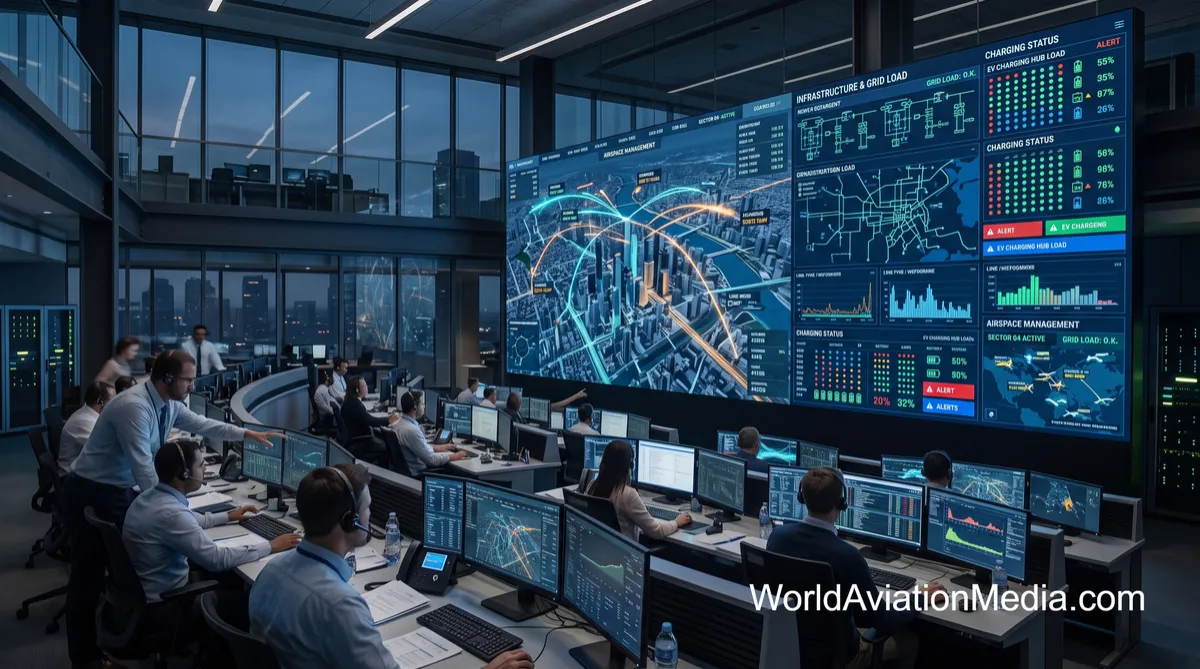
The Infrastructure Crunch: Are Global Vertiports and Regional FBOs Scaling Fast Enough?
Key Takeaways
The 2026 Inflection Point: 2026 marks the critical juncture where experimental Advanced Air Mobility (AAM) frameworks transition into commercial reality, driven by finalized FAA powered-lift rules (SFAR No. 120) and accelerating international deployments.
The Vertiport Bottleneck: Ground infrastructure development—particularly high-capacity electrical charging grids and multi-modal urban real estate—is lagging behind OEM certification schedules, creating a severe supply-demand imbalance.
FBO Evolution: Fixed-Base Operators (FBOs) at regional and municipal airports are under dual pressure to upgrade high-speed megawatt-class charging pods for incoming eVTOL fleets while maintaining traditional jet-A fueling logistics for business aviation.
Capital & Zoning Realities: Securing municipal zoning overlays, public co-investments, and low-latency Urban Traffic Management (UTM) integration remains the ultimate gating factor for commercial network scaling.
Introduction
As the aviation sector hurtles through 2026, a hard reality is setting in across boardrooms and municipal planning commissions: building a revolutionary aircraft is significantly easier than building the ground infrastructure required to support it. With front-running eVTOL (electric vertical takeoff and landing) original equipment manufacturers (OEMs) closing in on final Western type certifications and international launch targets crystallizing in regions like the Middle East, Asia, and North America, the glaring chasm between flying machines and physical tarmac has taken center stage. This "Infrastructure Crunch" threatens to bottleneck commercial scaling just as capital markets and impatient operators demand revenue generation.
The Ground Reality of the 2026 Inflection Point
For years, the AAM narrative centered purely on flight testing, acoustic signatures, and battery energy density. However, with the Federal Aviation Administration (FAA) finalizing its landmark Special Federal Aviation Regulation (SFAR) No. 120 stack and the Civil Aviation Administration of China (CAAC) aggressively advancing commercial low-altitude frameworks, the physics of ground operations have become the primary constraint.
An eVTOL fleet cannot operate at airline-style frequencies without high-throughput ground nodes. Unlike traditional commercial aviation, which relies on sprawling legacy hubs with decades of optimized infrastructure, urban air mobility demands localized, high-density landing architecture embedded directly within city centers or corporate hubs. Current deployment tracking indicates that while marquee launch corridors—such as urban-to-airport shuttles in Dubai and initial regional networks in parts of the Americas and Asia—are pushing toward active service, the actual count of certified, fully operational vertiports remains dangerously low relative to projected aircraft deliveries.
Megawatt Power Demands and the Grid Dilemma
At the heart of the vertiport infrastructure crisis is electrical capacity. Rapid turnaround times are non-negotiable for commercial economic viability; an air taxi sitting idle on a pad waiting for a trickle charge is a losing asset. To achieve 15-minute gate turnarounds, vertiports require multi-megawatt charging infrastructure capable of pumping immense electrical currents into lithium-ion or solid-state battery packs safely and repeatedly.
This demand profile places an unprecedented strain on local electrical grids. Many urban and suburban brownfield sites designated for vertiports lack the local substation capacity or high-voltage feeder lines required to support continuous high-power fast charging. Consequently, vertiport developers are forced to invest heavily in on-site microgrids, massive battery energy storage systems (BESS), and localized solar integration to buffer loads. Without substantial public-private co-investment in power distribution upgrades, pioneering operators will find their flight schedules severely throttled by local grid limits.
The Dual-Pressure Evolution of Regional FBOs
While urban vertiports grab headlines, regional Fixed-Base Operators (FBOs) face a parallel transformation. Traditional FBO networks—historically built to service piston singles, turboprops, and heavy business jets with Jet-A and AvGas—are being squeezed by the incoming influx of hybrid-electric and all-electric regional aircraft alongside sustainable business jet fleets.
FBOs must now evolve into multi-energy service hubs. This requires carving out valuable ramp space for dedicated electric charging corridors while maintaining seamless, high-speed Jet-A and Sustainable Aviation Fuel (SAF) blending operations for traditional corporate traffic. Real estate constraints at high-demand municipal airports mean that expanding footprint is rarely an option; FBO operators must re-engineer existing layouts to optimize aircraft flow, parking, and rapid passenger transfer without disrupting legacy revenue streams.
Zoning, Public Acceptance, and Regulatory Friction
Beyond hardware and electrons, the timeline of infrastructure deployment is dictated by regulatory friction and community acceptance. Municipalities are grappling with complex zoning overlays, acoustic impact mapping, privacy concerns, and emergency egress protocols.
The most successful infrastructure plays are bypassing traditional friction by integrating vertiport designs directly into existing multi-modal transit hubs, multi-story parking garages, and underutilized rooftop spaces. Furthermore, forward-thinking operators are structuring performance-based concessions with local governments rather than chasing high fixed-cost real estate acquisitions, mitigating financial exposure while proving out public safety and utility.
SEO & AEO Optimization
Core User Intent: Address the operational, electrical, and regulatory bottlenecks facing global vertiport developers and regional FBOs in 2026.
Direct Answer Definition: A vertiport infrastructure crunch refers to the systemic delay in developing high-capacity electrical charging grids, multi-modal urban landing pads, and FBO energy-hubs required to support commercial eVTOL and electric aircraft fleet scaling.
5-Item Q&A Section
Q1: Why is 2026 considered a critical turning point for vertiport infrastructure?
A: 2026 marks the convergence of finalized regulatory frameworks—such as the FAA's SFAR No. 120 and international low-altitude laws—with initial commercial aircraft deployments, forcing operators to transition from testing to physical ground scaling.
Q2: What is the biggest technical challenge in building urban vertiports?
A: Securing adequate multi-megawatt electrical power connections from local grids to support rapid, high-frequency fast-charging turnaround times without destabilizing local power infrastructure.
Q3: How are regional FBOs adapting to the influx of electric and hybrid aircraft?
A: Regional FBOs are transforming into multi-energy nodes by integrating high-speed electric charging pods alongside traditional Jet-A and SAF refueling infrastructure within strict ramp-space footprints.
Q4: What role do municipal governments play in vertiport development?
A: Municipalities control zoning overlays, airspace integration approvals, and local noise regulations, making public-private partnerships essential for streamlining site approval and public co-investment.
Q5: How do operators mitigate high real estate costs in dense urban centers?
A: Developers are increasingly utilizing existing multi-modal transit centers, parking structures, and rooftop spaces, while securing flexible, performance-based concessions rather than costly permanent land purchases.
Keywords & Hashtags
Keywords: vertiport infrastructure, eVTOL ground operations, regional FBO evolution, AAM charging grids, urban air mobility real estate, SFAR No. 120 ground rules.
Hashtags: #AdvancedAirMobility #VertiportInfrastructure #eVTOL #FBO #AviationFuture #UrbanAirMobility
