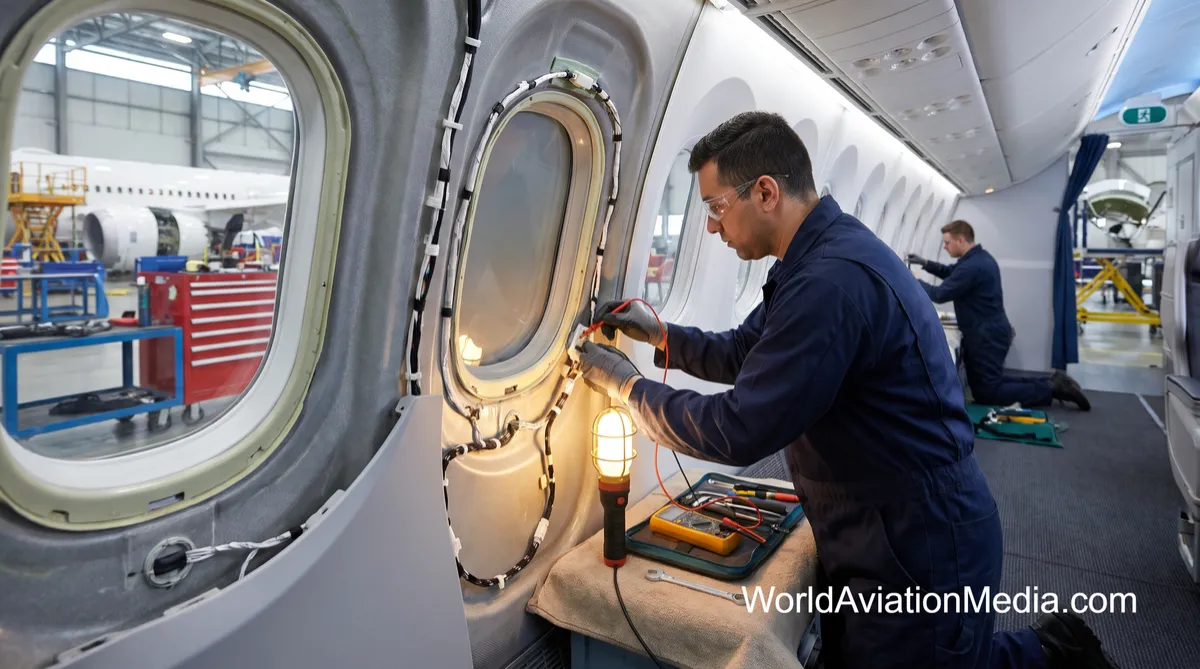
The Hidden Costs of Next-Gen Airframes: From American Airlines' $5,000-Per-Window Boeing 787 Replacements to Global Engine Shop Bottlenecks
Key Takeaways
The $5,000 Window Shock: In October 2026, disclosures revealed that American Airlines is confronting a costly cabin maintenance campaign across its 70-aircraft Boeing 787 Dreamliner fleet, where replacing degraded electrochromic auto-dimming windows costs up to $5,000 per window.
When Passenger Amenities Become MRO Liabilities: On older 787 airframes, degraded electrochromic gel layers fail to darken properly—leading to viral passenger complaints and flight attendants taping paper over windows—transforming a signature marketing feature into a multi-million-dollar heavy check penalty.
The Next-Gen Maturity Curve: As first-wave composite widebodies (Boeing 787-8/9 and early Airbus A350-900s) hit their 10-to-14-year D-check and heavy structural intervals in 2026, airlines are discovering that bespoke proprietary components carry drastically higher replacement costs and fewer PMA/DER repair alternatives than legacy aluminum jets.
Compounded by Engine Shop Gridlock: Cabin and airframe inflation is colliding with acute durability bottlenecks on next-generation turbofans (Pratt & Whitney PW1100G GTF, CFM LEAP, Rolls-Royce Trent 1000/XWB, and GEnx), driving global airline MRO unit costs to historic highs.
Why Are Flight Attendants Taping Paper Over Million-Dollar Dreamliner Windows?
When the Boeing 787 Dreamliner entered commercial service over a decade ago, two passenger-facing innovations were celebrated above all others: a carbon-fiber composite fuselage pressurized to a comfortable 6,000-foot cabin altitude, and oversized electrochromic dimmable windows that eliminated plastic pull-down shades forever. At the touch of a button—or via a master cabin crew console—passengers could transition the window from crystal clear to deep twilight tint.
Fast-forward to October 18, 2026, and that space-age cabin amenity has presented American Airlines with a sobering maintenance bill. According to aviation intelligence disclosed by insider JonNYC and reported across the industry in mid-October 2026, American Airlines is moving to replace aging electrochromic window units across its fleet of 70 Boeing 787 Dreamliners (comprising 787-8 and 787-9 aircraft)—at a reported replacement cost of up to $5,000 per individual window.
"The reported cost of replacing a damaged or degraded window-dimming unit on the Boeing 787 can reach $5,000 per window—highlighting how high-tech next-generation features designed to elevate passenger comfort can morph into punishing lifecycle maintenance liabilities as fleets mature." — MRO Industry Analysis of American Airlines' 787 Window Campaign, October 18, 2026
Prior to initiating the replacement program, recurring failures of the electrochromic dimming units on American's older 787s had reached the point where cabin crew were occasionally forced to tape sheets of galley paper or plastic over malfunctioning windows to block blinding stratospheric sunlight during long-haul sleep phases. When a single Boeing 787 fuselage houses roughly 80 to 100 passenger windows, a fleet-wide replacement campaign across dozens of aging tails rapidly escalates into a multi-million-dollar unscheduled capital expenditure.
The Physics and Economics of the $5,000 Electrochromic Window
Next-generation airframe maturity inflation refers to the steep, often unanticipated spike in Maintenance, Repair, and Overhaul (MRO) costs that occurs when technologically complex aircraft transition out of initial OEM warranty windows into their 8-to-15-year heavy maintenance cycles.
Why does a single Boeing 787 window dimmer cost up to $5,000 to replace, whereas a traditional polycarbonate dust pane and mechanical plastic shade on a Boeing 767 or 777 costs a few hundred dollars?
Solid-State / Gel Electrochromic Complexity: Manufactured primarily by Gentex Corporation in partnership with PPG Aerospace, the 787's interactive window system sits behind the structural outer pressure panes. It consists of two thin glass panels sandwiching a proprietary electrochromic gel layer, wired into a local control module and networked into the aircraft's central Cabin Services System (CSS) so flight attendants can lock or override window tint levels globally.
UV and Thermal Degradation Over 30,000+ Flight Hours: On early-build 787-8s delivered to American Airlines starting in 2015, these electrochromic cells have now endured more than a decade of intense upper-atmosphere ultraviolet (UV) radiation, extreme thermal cycling, and thousands of electrical charge/discharge cycles. Over time, the chemical gel degrades—developing "dead spots," failing to reach full opacity, or getting stuck permanently clear or dark.
Zero Repairability (Throw-Away LRU Economics): Unlike a jammed mechanical window shade whose spring track can be lubricated or repaired by an airline's in-house trim shop for $40 in parts, a delaminated or chemically degraded electrochromic window is a sealed Line Replaceable Unit (LRU). When the gel fails, the entire electronic window assembly must be scrapped and replaced with a costly OEM unit.
Aircraft System / Component | Legacy Metal Fleet (B767 / B777 / A330ceo) | Next-Gen Fleet Reality (B787 / A350 / A320neo / MAX) | 2026 Mature-Fleet MRO Financial Impact |
Cabin Window Shading | Mechanical plastic pull-down shade (150–300 repair/replacement). | Electrochromic smart glass LRUs costing up to $5,000 per window on B787. | Multi-million-dollar cabin refurbishment bills at 10-year heavy checks. |
Electrical Architecture | Traditional pneumatic bleed-air systems with mature MRO overhaul shops. | B787 "More-Electric" 235V AC / 270V DC starter-generators & power distribution panels. | High proprietary OEM component repair charges and limited third-party DER repairs. |
Composite Surface & Paint | Standard aluminum polishing or chemical strip/repaint cycles. | UV-sensitive CFRP composite wing/fuselage surfaces (e.g., A350/B787 paint-peeling remediation). | Specialized sanding, copper-mesh lightning-strike protection repairs, and extended hangar downtime. |
Propulsion / Turbofans | Mature CFM56 / GE90 / Trent 700 with 15,000–25,000 hours on-wing. | PW1100G GTF, CFM LEAP, Trent 1000, GEnx with hot-section coating and powder-metal distress. | Severe shop visit queues, 120–200+ day engine turnaround times (TAT), and soaring lease rates. |
Beyond the Windows: The Four Horsemen of Next-Gen MRO Inflation
American Airlines' $5,000-per-window 787 headache is not an isolated quirk; it is a symptom of a broader structural reckoning hitting airline maintenance budgets in 2026 as next-generation fleets reach middle age:
1. The "More-Electric" Architecture Tax on the Boeing 787
To achieve its 20% fuel-burn improvement over the Boeing 767, the 787 eliminated traditional engine bleed-air ducts for cabin pressurization, wing anti-ice, and hydraulic pumps, replacing them with a high-voltage electrical architecture driven by variable-frequency starter-generators and massive Remote Power Distribution Units (RPDUs). While this reduces fuel burn on day one, the high-power solid-state electronics and liquid-cooled power conversion modules require specialized OEM shop visits that independent airline MROs cannot easily perform in-house without paying steep licensing royalties.
2. Composite Structural & Surface Repair Complexity
Both the Boeing 787 and Airbus A350 have proven remarkably resilient against traditional aluminum corrosion and metal fatigue—delivering genuine savings on structural corrosion tasks during 12-year heavy checks. However, carbon-fiber reinforced polymer (CFRP) structures introduce different headaches: UV paint-layer degradation (famously seen on the A350 wing and fuselage skin layers, requiring delicate copper-foil lightning protection restoration) and strict non-destructive testing (NDT) ultrasonic inspections whenever a composite fuselage suffers a catering truck impact or hail strike on the ramp.
3. The Global Next-Gen Engine Durability Crisis
Nowhere is the gap between OEM marketing promises and 2026 reality wider than under the wing. Whether on narrowbodies (Pratt & Whitney PW1100G GTF and CFM International LEAP-1A/1B) or widebodies (Rolls-Royce Trent 1000 and GE Aerospace GEnx), pushing bypass ratios and turbine inlet temperatures to historic extremes to save 15% on fuel has resulted in premature distress of high-pressure turbine (HPT) blades, combustor linings, and rotor discs. Across harsh hot-and-high or sandy operating environments, next-gen engines are coming off-wing after just 4,000 to 8,000 flight hours—less than half the time-on-wing of a mature CFM56—creating 150-to-200-day induction bottlenecks at global engine overhaul shops.
4. OEM Aftermarket Lock-In (Blocking PMA and DER Alternatives)
On legacy fleets, once an aircraft type turned 10 years old, independent engineering firms flooded the market with FAA-approved Parts Manufacturer Approval (PMA) replacement parts and Designated Engineering Representative (DER) component repairs, forcing OEMs to keep spare parts prices in check. On the 787, A350, 737 MAX, and A320neo, airframe and engine OEMs have bundled long-term flight-hour maintenance contracts (TotalCare, TrueChoice, Rate-Per-Flight-Hour) with strict intellectual property software locks, starving the independent aftermarket of repair manuals and keeping component prices—like a $5,000 window dimmer—at monopoly levels.
The Strategic Takeaway for Fleet Planners
Does this mean the Boeing 787 or Airbus A350 was a mistake? Hardly—especially in a 2026 operating environment where geopolitical shocks pushed jet fuel spikes toward $1,838 per tonne earlier in the year, the 20% fuel burn savings of composite widebodies remains indispensable. However, airline CFOs and fleet planners negotiating lease extensions or mid-life acquisitions can no longer model next-gen airframe MRO costs using legacy escalation curves. From $5,000 smart windows to software-locked avionics and fragile hot-section coatings, the price of next-generation efficiency comes due in the hangar at year ten.
5-Item Q&A Section (FAQ)
Q1: How much does it cost American Airlines to replace a Boeing 787 window in 2026?
According to October 2026 maintenance disclosures, replacing a damaged or degraded electrochromic auto-dimming window unit across American Airlines' fleet of 70 Boeing 787 Dreamliners can cost up to $5,000 per individual window.
Q2: Why are Boeing 787 Dreamliner windows failing on older aircraft?
The Boeing 787 uses an electronic electrochromic gel sandwiched between thin glass panes instead of a plastic pull-down shade. Over 10+ years of intense high-altitude UV exposure, thermal cycling, and electrical use, the chemical gel degrades and loses its ability to darken uniformly—sometimes forcing flight attendants to tape paper over the window.
Q3: How many Boeing 787 aircraft does American Airlines operate in 2026?
American Airlines operates a fleet of 70 Boeing 787 Dreamliners (spanning 787-8 and 787-9 variants) that are subject to the ongoing cabin maintenance evaluations.
Q4: Why are next-generation aircraft more expensive to maintain at 10+ years than legacy jets?
Next-generation aircraft (such as the B787, A350, A320neo, and B737 MAX) rely on proprietary solid-state electronics, complex composite surface treatments, and high-temperature turbofan engines bound by strict OEM intellectual property contracts, which limit cheaper third-party PMA parts and DER repairs.
Q5: Do composite airframes like the Boeing 787 still save airlines money despite high component costs?
Yes. While specialized components like $5,000 electrochromic windows and next-gen engine overhauls carry higher unit MRO costs, the 20% lower fuel burn and reduced metallic corrosion tasks during heavy D-checks still deliver superior overall trip economics on long-haul routes.
Metadata
Target SEO Keywords: American Airlines Boeing 787 window replacement cost, $5000 Dreamliner window dimmer, Boeing 787 electrochromic window failure, next-gen aircraft MRO costs 2026, mature composite fleet maintenance, aviation engine shop bottlenecks 2026, airline lifecycle MRO inflation.
Hashtags: #Boeing787 #AmericanAirlines #AviationMRO #Dreamliner #AircraftMaintenance #FleetManagement #AerospaceEngineering
