The Great Drone Supply Chain Split: China's Export Controls vs. Pentagon Marketplace
Key Takeaways
Beijing's Dual-Use Tightening: China has rolled out revised, stringent dual-use export controls on unmanned aerial vehicles (UAVs), restricting the global flow of high-end drone motors, thermal cameras, and flight controllers.
The Pentagon's Allied Solution: To counter reliance on Chinese hardware, the U.S. Department of Defense and federal agencies (including ongoing FCC scrutiny over DJI and Autel) are scaling the 33-Nation Allied Drone Marketplace.
Decoupling Manufacturing: Western defense supply chains are aggressively decoupling from Shenzhen-based components, creating localized trusted manufacturing hubs across the U.S., Europe, and allied Indo-Pacific nations.
Strategic Vulnerability: While trusted marketplaces secure military-grade supply chains, commercial enterprise drone operators face severe cost inflation and hardware shortages during the transition.
The Great Geopolitical Fracture of the Drone Industry
For over a decade, the global commercial and tactical drone industry operated within a unified, China-centric manufacturing ecosystem anchored in Shenzhen. From high-resolution gimbals and brushless motors to lithium-polymer battery packs and flight control software, the vast majority of the world’s unmanned aerial vehicles—both consumer and industrial—relied on Chinese supply chains. That era of globalization has officially ended.
The global drone market is undergoing a structural fracture driven by two simultaneous regulatory sledgehammers: Beijing’s rollout of revised dual-use UAV export controls and the Pentagon’s aggressive scaling of a 33-nation allied drone marketplace. Caught between export restrictions and federal bans, global defense and enterprise operators are scrambling to decouple their supply chains before hardware supplies dry up entirely.
Beijing's Export Controls and the Weaponization of Supply
In response to tightening Western sanctions and military technology restrictions, Chinese regulatory authorities enacted comprehensive updates to dual-use UAV export controls. These rules place strict licensing requirements on the export of critical drone subsystems, including:
High-performance optical and thermal imaging payloads.
Specialized radio frequency (RF) communication modules and encrypted data links.
High-energy density battery chemistry and precision guidance microprocessors.
By restricting these components, Beijing effectively weaponized its manufacturing dominance, forcing foreign drone manufacturers to either secure cumbersome state export approvals or redesign their supply chains entirely.
The Pentagon's 33-Nation Allied Marketplace
Simultaneously, Washington has accelerated efforts to purge Chinese-manufactured components from Western security and critical infrastructure networks. Citing ongoing Federal Communications Commission (FCC) and Department of Homeland Security scrutiny over commercial giants like DJI and Autel, the U.S. Department of Defense has championed the 33-Nation Allied Drone Marketplace.
"The Great Drone Supply Chain Split marks the permanent end of reliance on single-source manufacturing, replacing globalized tech integration with a fractured, ally-secured industrial base." — Global Aerospace Trade Analysis, 2026
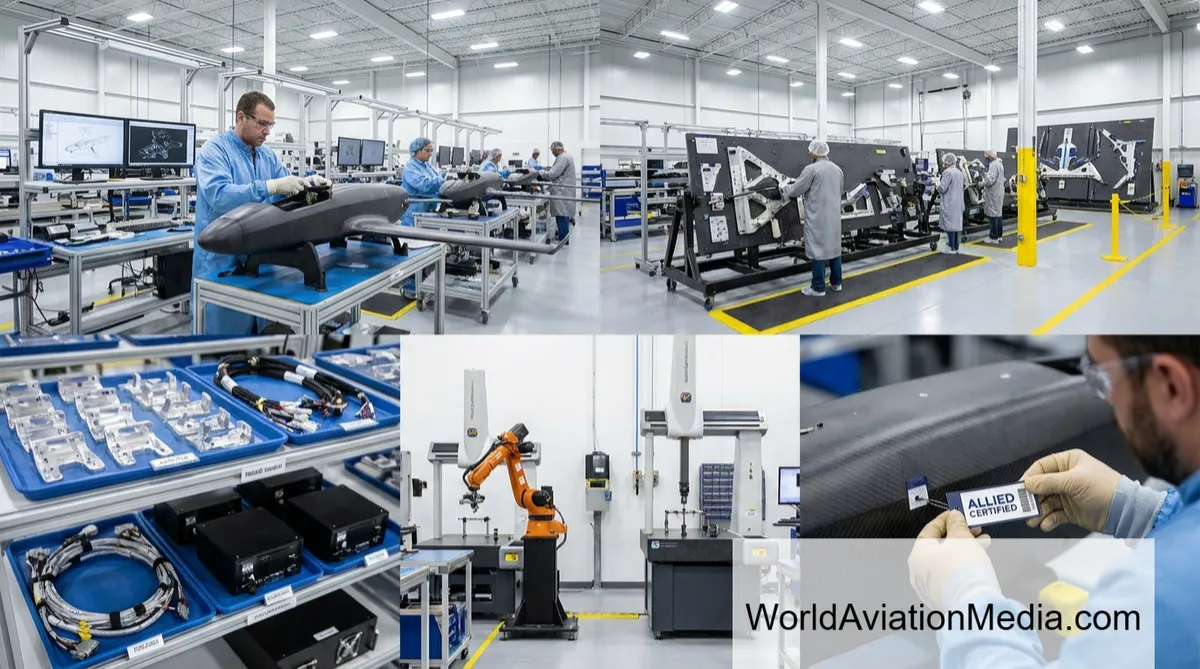
This initiative establishes a secure, vetted procurement framework connecting defense ministries across the U.S., NATO allies, and Indo-Pacific partners. Rather than relying on low-cost commercial off-the-shelf components built in Shenzhen, the allied marketplace incentivizes trusted domestic manufacturing of modular, secure, cyber-hardened small-to-medium unmanned systems.
Impact on Commercial and Defense Operators
The consequences of this global supply chain split are reverberating across every sector of aviation:
Commercial Cost Inflation: Enterprise operators (such as police departments, agricultural surveyors, and inspection firms) face soaring hardware costs as they transition from inexpensive commercial drones to certified, secure Western alternatives.
Rapid Innovation in Allied Hubs: Trusted manufacturers in the U.S., Taiwan, Europe, and South Korea are seeing unprecedented venture capital and defense contract inflows, accelerating domestic silicon and motor manufacturing.
Permanent Decoupling: Dual-sourcing is dead. Companies must now choose whether they operate within a China-aligned supply chain or a Western allied ecosystem, with zero interoperability between the two.
5-Item Q&A Section (FAQ)
Q1: What are China's revised export controls targeting in the drone industry?
Beijing's revised dual-use export controls restrict the global shipment of critical drone components, including thermal cameras, RF communication modules, and specialized motors.
Q2: What is the Pentagon's 33-Nation Allied Marketplace?
It is a secure, vetted procurement framework designed to build trusted, non-Chinese drone supply chains across the U.S., NATO, and Indo-Pacific allies.
Q3: Why are Western agencies cracking down on Chinese commercial drones?
Concerns over data security, espionage, and critical infrastructure vulnerability have driven strict FCC and DHS scrutiny over brands like DJI and Autel.
Q4: How does this supply chain split affect commercial enterprise operators?
Commercial operators face higher hardware costs and inventory shortages as they are forced to transition to more expensive Western and allied-manufactured drones.
Q5: Will global drone supply chains ever return to how they were?
No. The industry has permanently bifurcated into distinct, non-interoperable China-aligned and Western-allied manufacturing ecosystems.
Metadata
Target SEO Keywords: China revised drone export controls 2026, Pentagon 33 nation allied drone marketplace, FCC DJI Autel ban supply chain, trusted drone manufacturing Western allies, global UAV supply chain split.
Hashtags: #DroneSupplyChain #Geopolitics #DefenseTech #UAV #GlobalTrade #NationalSecurity
