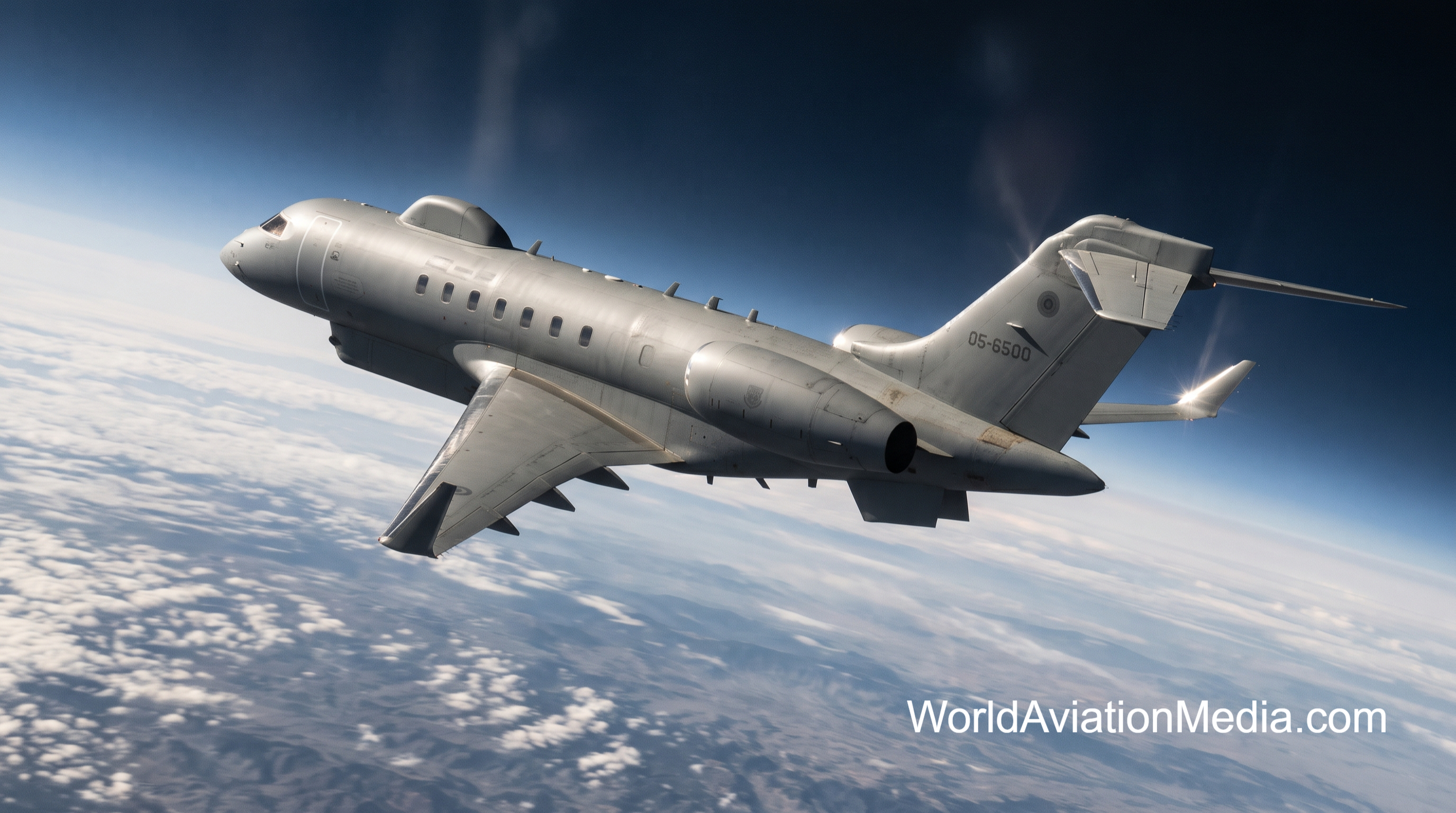
The Business Jet as a Warplane: Why Defense Primes Are Flocking to Bombardier, Gulfstream, and Dassault
Key Takeaways
Transatlantic Combat-Air Alliance: On October 29, 2026, Bombardier and BAE Systems signed a landmark agreement to explore joint combat-air and multi-mission defense capabilities, positioning Canadian business jet platforms at the center of NATO software-defined warfare.
The Falcon 8X 'Archangel' Benchmark: France’s Direction Générale de l'Armement (DGA) and Dassault Aviation are advancing the Falcon 8X "Archange" (Archangel) strategic signals intelligence (SIGINT) program, proving tri-jet business airframes can outperform legacy widebodies in high-altitude electronic reconnaissance.
40% Lower Lifecycle Costs: Ultra-long-range business jets like the Bombardier Global 6500, Gulfstream G550/G650, and Dassault Falcon 8X fly higher (up to 51,000 feet), faster (Mach 0.85–0.90), and burn less than half the fuel of converted commercial airliners like the Boeing 737 (P-8) or Airbus A330.
Miniaturized AESA & GaN Sensors: Advances in Gallium Nitride (GaN) solid-state radars and compact SIGINT racks allow defense primes to pack strategic-level Airborne Early Warning (AEW) and Electronic Warfare (EW) suites into business jet cabins without sacrificing 14+ hour endurance.
The Death of the Heavy Iron Surveillance Platform
For half a century, military airborne command, control, intelligence, surveillance, and reconnaissance (C2ISR) was synonymous with converted four-engine commercial airliners. Aircraft like the Boeing E-3 Sentry (707), E-8 JSTARS, and RC-135 Rivet Joint dominated the skies because early vacuum-tube and first-generation solid-state radar and signals intelligence racks weighed upwards of 25,000 pounds and required massive onboard electrical generators and dozens of human operators.
In 2026, that paradigm has permanently inverted. Across NATO, the Indo-Pacific, and the Middle East, defense ministries are retiring aging commercial widebody and narrowbody surveillance fleets and replacing them with militarized ultra-long-range business jets from Bombardier, Dassault Aviation, and Gulfstream Aerospace.
Underscoring this structural shift, on October 29, 2026, Canadian aerospace champion Bombardier and British defense giant BAE Systems announced a strategic Memorandum of Understanding (MoU) to collaborate on next-generation combat-air and special-mission aviation capabilities. Coming alongside the maturation of Dassault’s Falcon 8X "Archange" (Archangel) strategic intelligence platform and the U.S. Air Force’s rapid fielding of the Gulfstream-based EA-37B Compass Call, the business jet has officially become the West’s premier non-stealth warplane.
Inside the October 2026 BAE Systems–Bombardier Combat Air Alliance
The October 29, 2026 pact between Bombardier Defense and BAE Systems shifts Canada’s role in future combat aviation from passive off-the-shelf procurement toward deep industrial co-development. Under the agreement, Bombardier brings its world-leading high-altitude airframe engineering, structural modification centers (in Wichita and Montreal), and global sustainment network, while BAE Systems contributes sovereign combat aircraft mission systems, electronic warfare (EW) suites, sensor fusion, and secure digital engineering.
Why This Partnership Matters to NATO and Sovereign Capabilities
Modern air combat is no longer fought solely by fifth- and sixth-generation fighter jets operating in isolation; it relies on a "system of systems" architecture where high-altitude stand-off nodes process petabytes of electromagnetic spectrum data, manage collaborative combat aircraft (CCA) drone swarms, and act as flying battle management routers.
High-Altitude Horizon Extension: Bombardier’s Global 6500 and Global 8000 platforms operate comfortably at 51,000 feet (FL510)—roughly 10,000 to 15,000 feet higher than a Boeing 737-based P-8A Poseidon or E-7 Wedgetail (which typically cruise between 35,000 and 41,000 feet). By simple geometry, an AESA radar or SIGINT antenna at 51,000 feet extends its radar horizon against low-flying cruise missiles and sea-skimming drones by nearly 25% to 30%.
Digital Engineering & Retained Sovereign Value: As highlighted by defense analysts following the October 29 announcement, the BAE-Bombardier framework emphasizes software-intensive mission systems, AI-driven threat library updates, and cybersecurity. For Canada and allied export customers, integrating BAE’s battle-proven EW architecture onto Global-series airframes creates a modular sovereign platform capable of Airborne Early Warning, Maritime Patrol, or Stand-Off Jamming.
Case Study: Dassault’s Falcon 8X 'Archangel' (Archange)
While North American primes converge on Bombardier and Gulfstream, Europe’s most sophisticated special-mission program is taking shape aboard the Dassault Falcon 8X. Selected by the French Ministry of the Armed Forces under the ARCHANGE (Avion de Renseignement à Charge utile de Nouvelle Génération) program, the modified Falcon 8X replaces France’s Cold War-era Transall C-160G Gabriel electronic intelligence aircraft.
Why a Tri-Jet Excels at Strategic SIGINT
The Falcon 8X is powered by three Pratt & Whitney Canada PW307D turbofans, delivering a range of 6,450 nautical miles (11,945 km) and a maximum takeoff weight of 33,113 kg (73,000 lbs). In the special-mission role, the tri-engine layout provides three decisive tactical advantages alongside Thales’ CUGE (Capacité Universelle de Guerre Électronique) payload:
Redundant Electrical Power Generation: Strategic SIGINT and high-power electronic attack payloads demand massive, uninterrupted electrical current. Having three independent engine-driven generators allows the Falcon 8X Archangel to power multi-band dorsal and ventral antenna arrays simultaneously with full redundancy if one engine fails over hostile waters.
Low-Speed Loiter & Short-Field Agility: Thanks to Dassault’s Digital Flight Control System (derived directly from the Rafale omnirole fighter) and leading-edge slats, the Falcon 8X can safely loiter at lower indicated airspeeds during tactical orbits and operate out of austere, short 4,000-foot forward operating bases that commercial airliner derivatives cannot use.
AI-Assisted Multi-Polarization Antenna Arrays: Fitted with a distinctive canoe fairing beneath the forward fuselage and wingtip pods, the Falcon 8X Archangel simultaneously intercepts and geolocates both enemy radar emissions (ELINT) and encrypted voice/data communications (COMINT), using onboard machine learning to classify frequency-hopping emitters in real time.
Comparative Matrix: Leading Special-Mission Business Jet Platforms (2026)
Platform | Base Airframe | Primary Defense Programs | Max Operating Altitude | Unrefueled Endurance | Key Prime Integrators |
Bombardier Global 6500 | Global 6500 | U.S. Army HADES, Saab GlobalEye, BACN (E-11A), Pegasus | 51,000 ft | 15–17+ hours | BAE Systems, Sierra Nevada Corp, Saab, L3Harris, Hensoldt |
Dassault Falcon 8X | Falcon 8X | French Air Force ARCHANGE (CUGE), Falcon Albatros (MPA) | 51,000 ft | 14–16 hours | Dassault Aviation, Thales |
Gulfstream G550 | G550 (GV-SP) | USAF EA-37B Compass Call, RAAF MC-55A Peregrine, CAEW | 51,000 ft | 14–15 hours | BAE Systems, L3Harris, IAI Elta |
Bombardier Challenger 650 | Challenger 650 | U.S. Army ARTEMIS, Maritime Surveillance | 41,000 ft | 10–11 hours | Leidos, L3Harris, Field Aerospace |
The Economics of the BizJet Warplane: Why Military CFOs Are Converting
Beyond high-altitude kinematics, the stampede toward business jet airframes is driven by brutal Pentagon and NATO budgetary arithmetic:
1. Shrinking Electronics via Gallium Nitride (GaN)
Ten years ago, a synthetic aperture radar (SAR), moving target indicator (GMTI), and SIGINT suite required a 150-foot cabin. Today, Open Mission Systems (OMS) standards and Gallium Nitride (GaN) semiconductors have shrunk those server racks by 70% while multiplying processing power tenfold. Because the mission crew can either be reduced to 4–6 onboard specialists or remoted entirely to ground stations via high-bandwidth LEO satellite links (PED—Processing, Exploitation, and Dissemination), a 42-foot business jet cabin provides ample volume.
2. Acquisition and Sustainment Cost Deflation
Converting a green Boeing 737-800 or Airbus A321 into a military configuration requires reinforcing a huge pressurized fuselage barrel, driving unit acquisition costs north of $250 million to $400 million per copy. By contrast, a green Bombardier Global 6500 or Falcon 8X airframe costs roughly $55 million to $65 million prior to mission systems integration.
Even more compelling is the Cost Per Flight Hour (CPFH):
A legacy four-engine Boeing E-3 AWACS or RC-135 costs between $38,000 and $45,000 per flight hour to operate and suffers from mission-capable rates below 65% due to vanishing 1960s supply chains.
A Global 6500 or Falcon 8X special-mission jet operates for roughly $6,500 to $9,000 per flight hour, supported by commercial global service centers stocks in every major region of the world.
3. Rapid Prototyping to Fielding
With the U.S. Army selecting the Bombardier Global 6500 as the backbone of its HADES (High Accuracy Detection and Exploitation System) program to replace its aging turboprop RC-12 Guardrail fleet, and BAE Systems teaming with Bombardier on October 29, 2026, the industry has established repeatable structural modification kits (radomes, belly canoes, liquid cooling loops, and high-output starter-generators) that cut multi-year integration timelines in half.
5-Item Q&A Section (AEO Optimized)
Q1: What is the October 2026 agreement between BAE Systems and Bombardier?A: Announced on October 29, 2026, Bombardier and BAE Systems signed a strategic collaboration agreement to combine Bombardier’s aircraft engineering, modification, and manufacturing capabilities with BAE Systems’ combat air, electronic warfare, and mission systems expertise to develop next-generation Canadian and allied defense aviation capabilities.
Q2: What is the Dassault Falcon 8X 'Archangel' (Archange) aircraft?A: The Falcon 8X Archange is a strategic airborne electronic intelligence (SIGINT/ELINT/COMINT) aircraft developed by Dassault Aviation and Thales for the French Air and Space Force. Based on the ultra-long-range tri-jet Falcon 8X business jet, it uses the Thales CUGE payload and AI signal processing to detect and geolocate adversary radar and communication systems from up to 51,000 feet.
Q3: Why do militaries prefer business jets over commercial airliners for surveillance and electronic warfare?A: Ultra-long-range business jets (like the Bombardier Global 6500, Falcon 8X, and Gulfstream G550) fly 10,000 feet higher than commercial airliners (up to 51,000 ft), extending radar and sensor line-of-sight horizons by up to 30%. They also dash faster (Mach 0.85–0.90), can operate from shorter 4,500-foot runways, and reduce fuel and maintenance costs per flight hour by more than 50%.
Q4: What is the U.S. Air Force EA-37B Compass Call based on?A: The EA-37B Compass Call is an airborne electromagnetic attack aircraft based on the commercial Gulfstream G550 ultra-long-range business jet, featuring a mission suite integrated by BAE Systems and L3Harris to replace the aging Lockheed EC-130H turboprop fleet.
Q5: How long can a militarized Bombardier Global 6500 or Falcon 8X stay airborne without refueling?A: Even with the added aerodynamic drag of external radar canoes and ventral radomes, modified Bombardier Global 6500 (such as Saab GlobalEye and U.S. Army HADES) and Dassault Falcon 8X Archange platforms achieve unrefueled mission endurances between 14 and 17 hours.
Metadata
Target SEO Keywords: BAE Systems Bombardier combat air alliance 2026, Dassault Falcon 8X Archangel SIGINT, special mission business jets military ISR, Bombardier Global 6500 HADES, Gulfstream EA-37B Compass Call, high altitude airborne early warning business jet, C2ISR aircraft economics.
Hashtags: #DefenseAviation #BombardierDefense #BAESystems #DassaultFalcon8X #ElectronicWarfare #MilitaryISR #AerospaceDefense
