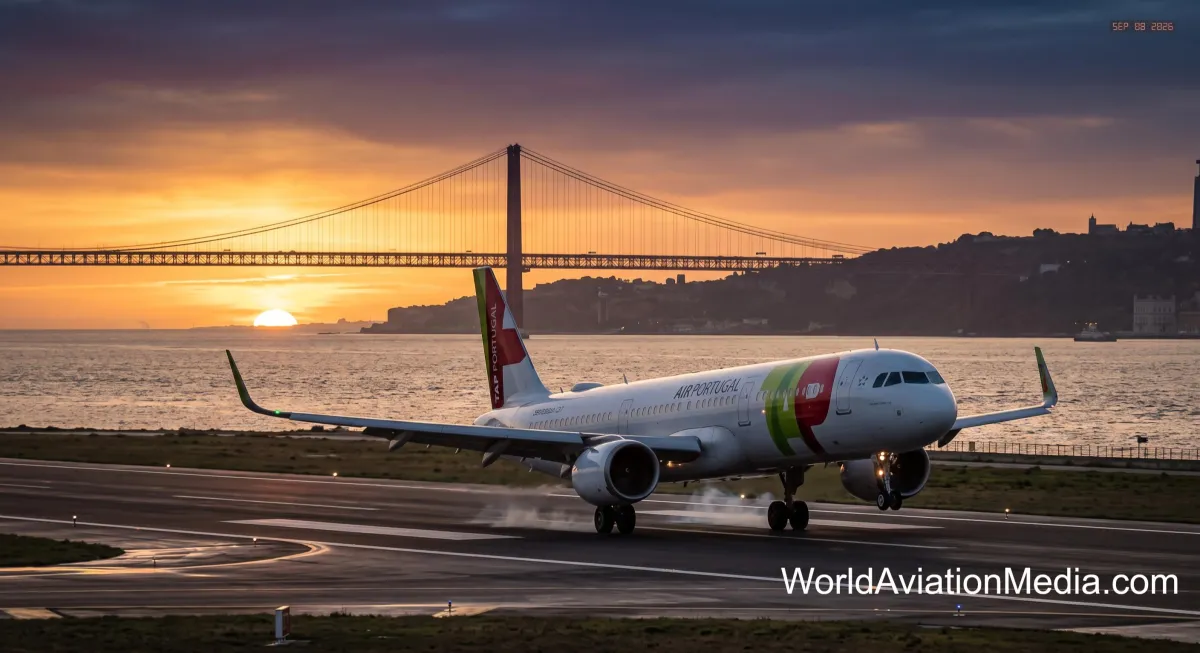
The Battle for TAP Air Portugal: Why Lisbon is Europe's Most Strategic Geopolitical Gateway (2026 Analysis)
Key Takeaways
Strategic Primacy of the Lisbon Hub: As the host of the AeroEngines Europe event in September 2026, Lisbon has solidified its position as the intellectual and technical epicenter of the global narrowbody market, making the acquisition of TAP Air Portugal a masterstroke for any global airline group.
Operational Elasticity as a Competitive Moat: The systemic paralysis observed in Asia during the Anak Krakatau eruption (Sept 4–6, 2026) serves as a cautionary archetype, proving that hubs without robust resilience margins and alternate routing protocols face total network collapse during environmental shocks.
Fuel Sovereignty and Resource Security: Strategic investments, such as the $22 million capital raise for Jet Zero Australia (backed by Qantas and Airbus) and American Airlines’ eSAF commercial flights with Infinium, redefine hub dominance as the ability to control domestic, lower-carbon fuel corridors.
The "Ethiopian Model" vs. National Interests: The Ethiopian Airlines-Namibia talks provide a blueprint for "Sovereignty-Plus" ownership, where national carriers trade equity for technical empowerment—specifically in fleet planning, maintenance, and training—to survive the scale wars.
MRO Capacity as a Strategic Bottleneck: Technical integrity is currently throttled by the CFM56 HPT blade supply crunch. The success of a gateway like Lisbon is now inextricably linked to the throughput of high-tech facilities like SR Technics in Bad Zurzach, which must bypass global supply chain failures to maintain high-utilization fleets.
1. Introduction: The Geopolitical Gravity of Lisbon
The ongoing "Battle for TAP Air Portugal" is the defining geopolitical contest of the 2026 aviation landscape. For years, the industry viewed Lisbon as a peripheral European gateway; today, it is recognized as the most efficient geographical pivot between the Americas, Africa, and the European continent. Controlling TAP is no longer a simple exercise in balance-sheet expansion; it is an acquisition of a strategic infrastructure asset that dictates the "Great Game" of global connectivity. In an era where narrowbody long-haul technology—specifically the A321LR and XLR—has decentralized traditional hub-and-spoke models, Lisbon’s unique position allows for a high-utilization elasticity that larger, more congested Northern European hubs cannot replicate.
The technical and intellectual weight of this hub was put on global display in September 2026 as the city hosted the AeroEngines Europe event. This gathering was not merely a conference but a signal of Lisbon's status as the capital of propulsion strategy. By centralizing the discourse on narrowbody engine maintenance and carbon analysis, Portugal has positioned itself as the technical guardian of the Atlantic corridor. For C-suite executives and policy-makers, the "So What?" is clear: To evaluate Lisbon's position is to recognize it as a central node in a multi-polar world where yield protection and asset management are dictated by geographic efficiency.
The strategic importance of geography, however, is a hollow advantage if the hub’s operational infrastructure cannot withstand the systemic shocks that have recently paralyzed competitors in the East.
2. Hub Resilience: Lessons from the 2026 Asian Disruption Wave
In early September 2026, the global aviation community received a stark reminder of the fragility of "thin operational buffers" when a massive wave of disruption swept across Asia. The catalyst was the continuous eruption of Mount Anak Krakatau in the Sunda Strait, Indonesia, which began on September 4 and lasted for roughly 25 hours. This geological event triggered a cascade of failures that impacted 39 airports and affected approximately 4,000 flights in a single day. At the peak of the crisis, more than 3,600 flights were delayed and over 470 were canceled. For the Lisbon-Atlantic nexus, the "So What?" layer involves deconstructing the systemic paralysis observed at Soekarno-Hatta (CGK) to ensure that Portugal’s gateway maintains a "resilience margin" capable of absorbing similar shocks.
The impact of the eruption was not just a matter of flight counts; it was an infrastructure stress test. Eight Indonesian airports were forced into temporary closures, and by September 7, the cumulative number of affected passengers exceeded 270,000. The technical risks were absolute: volcanic ash, consisting of pulverized rock, melts at temperatures far below the operating levels of modern turbines, turning into molten glass that chokes the airflow and causes catastrophic engine failure. This necessitated total airspace avoidance, forcing carriers to seek indirect routings that consumed additional fuel and narrowed schedule buffers. We must extrapolate these risks to Lisbon: a premier gateway must possess the airspace capacity and alternate routing protocols to handle sudden, non-negotiable environmental threats without total network collapse.
While operational resilience ensures that the gateway remains open, the future relevance of a hub is increasingly determined by the energy sovereignty that powers its fleets.
3. The Fuel Sovereignty Front: SAF and eSAF as Geopolitical Assets
The battle for hub dominance in 2026 has transitioned into a battle for "green corridors." National hubs are no longer evaluated solely on terminal capacity or landing fees; they are now judged on their fuel sovereignty—the ability to provide secure, lower-carbon fuel supplies that reduce exposure to "geopolitical shocks" and volatile long-haul crude routes. As noted by James Tam of EcoCeres, a reliance on traditional fuel supply chains leaves aviation dangerously exposed to regional conflicts. Therefore, the strategic value of TAP Air Portugal is tied to the development of a Portuguese SAF/eSAF corridor that can attract the type of investment currently being seen in North America and Australia.
Two major developments in September 2026 highlight this shift toward resource sovereignty:
Jet Zero Australia: An Australian SAF startup completed a 22 million (A30 million) capital raise, notably backed by the titans of the industry, Qantas and Airbus. This funding is a defensive move to secure a domestic SAF production project in Queensland, ensuring that regional operations are not held hostage by foreign energy dependencies.
American Airlines and Infinium: American Airlines achieved a landmark commercial passenger flight powered by eSAF (synthetic sustainable aviation fuel). This partnership demonstrates that the market is already moving beyond conventional SAF toward technology-driven, synthetic alternatives.
To synthesize these events, the "Battle for TAP" must be viewed through the lens of fuel security. Lisbon is perfectly positioned to serve as a SAF distribution node for the Atlantic, providing a "green moat" that protects the hub from carbon-related regulatory pressures and global oil supply shocks.
The pivot from operational elasticity to resource sovereignty is a defensive strategy, yet the ultimate control of these corridors rests on the ownership models that govern them.
4. The Ownership Debate: Sovereignty vs. Strategic Integration
The contest for control of TAP Air Portugal reflects a broader global tension between national sovereignty and the scaling benefits of strategic integration. Governments are increasingly hesitant to relinquish control over their "flag carriers," yet the technical complexities of 2026—encompassing fleet planning, advanced maintenance, and massive procurement—require the scale that only global airline groups can offer. To evaluate the future of TAP, we must look to the Ethiopian Airlines-Namibia air talks, which serve as a primary case study for this dynamic.
The "Ethiopian model" is highly attractive to nations like Namibia because it offers a "Sovereignty-Plus" solution: access to established expertise in maintenance, training, and fleet planning without having to build these capabilities from scratch. However, the Namibia government’s rejection of certain leaked memos highlights the fear of losing strategic control. This tension is mirrored in the Chinese market, where the "Big Three" state carriers remain in the red, losing money to high fuel costs, while Spring Airlines remains profitable through rigorous efficiency and cost control. Furthermore, the exit of Carl Icahn as a major shareholder in JetBlue suggests a shift in investor sentiment, as activists weigh the elusive profitability of mid-sized carriers against the risks of high exposure. The takeaway for TAP is clear: for any partnership to succeed, it must provide technical empowerment and maintenance scaling rather than just a capital infusion.
Technical empowerment, however, is only effective if the hub can maintain the mechanical integrity of its assets in a high-utilization environment.
5. Technical Integrity: Maintaining Safety in a High-Utilization Gateway
Technical excellence and Maintenance, Repair, and Overhaul (MRO) capacity are the silent pillars that support a strategic gateway. A hub like Lisbon, characterized by high-utilization narrowbody traffic, is only as strong as its MRO supply chain. Currently, the industry is struggling with a significant "HPT blade supply crunch" affecting CFM56 engine overhauls. As reported by Aviation Daily and AerFin, a shortage of high-pressure turbine blades is extending shop visits and driving up the demand for scarce spare engines. Without a reliable MRO infrastructure, a hub becomes a graveyard for grounded assets.
The consequences of technical failures are starkly evident in recent incidents:
Alaska Airlines Flight AS671: On September 6, 2026, a 26-year-old Boeing 737-700 was forced into an emergency diversion to Fresno after a rapid descent from 40,000 feet to 10,000 feet in a matter of minutes. This maneuver, standard for pressurization or technical failures, underscores the immense stress placed on older airframes in busy gateways.
NetJets/Cessna 680A (June 2026): A double engine flameout on short final in Laredo resulted in a fatal crash. Investigators found missing screws on the right engine’s starter/generator and fractured fan blades, illustrating how minor mechanical anomalies can cascade into systemic disaster.
The "So What?" layer here connects these failures directly to the Lisbon MRO gateway. The hub’s status depends on facilities that can navigate the "blade crunch." The SR Technics ramp-up in Bad Zurzach, which is progressing faster than anticipated due to strong demand, is a critical signal. Lisbon must ensure its technical infrastructure can provide "quick-turn" opportunities to bypass the supply chain bottlenecks that currently threaten Atlantic air travel.
6. Conclusion: The Lisbon-Atlantic Nexus
As we look toward the remainder of 2026, Lisbon has emerged as the ultimate prize in European aviation. The convergence of the AeroEngines Europe event, the aggressive push for SAF/eSAF infrastructure, and the hard-won lessons from Asian hub disruptions all point to a singular conclusion: Lisbon is the most strategic geopolitical gateway in the Western Hemisphere.
The "Battle for TAP" is the defining conflict for European aviation’s relevance in a multi-polar, resource-constrained world. The winner of this contest will not just own an airline; they will control the most efficient node for the Atlantic corridor. By integrating technical integrity (MRO resilience), fuel sovereignty (SAF production), and operational elasticity, Lisbon will remain the cornerstone of global connectivity for the next decade. In a world of increasing volatility, the Lisbon-Atlantic Nexus is the only stable bridge between the Old World and the rising markets of the New.
II. 5-Item Q&A
What role did volcanic activity play in 2026 aviation disruptions? The eruption of Mount Anak Krakatau (Sept 4–6, 2026) caused a massive systemic shock, closing eight Indonesian airports including Jakarta’s Soekarno-Hatta (CGK). Volcanic ash—which melts at temperatures below a turbine’s operating level—caused over 1,500 flight delays/cancellations and affected more than 270,000 cumulative passengers by September 7.
How are airlines securing future fuel supplies? Airlines are moving toward resource sovereignty by investing directly in production. This is exemplified by the 22M (A30M) capital raise for Jet Zero Australia (backed by Qantas and Airbus) and American Airlines’ landmark commercial flight using synthetic eSAF developed with Infinium.
Why is engine maintenance currently a bottleneck for the industry? The industry is facing a severe HPT (high-pressure turbine) blade supply crunch for CFM56 overhauls. This shortage is extending shop visits and causing a spike in demand for spare engines, making efficient MRO facilities like the SR Technics plant in Bad Zurzach vital for hub continuity.
What is the "Ethiopian Model" in airline partnerships? The "Ethiopian Model" involves a large carrier providing technical and management services—specifically in fleet planning, maintenance, and training—to a national carrier (such as Namibia) in exchange for equity. It allows smaller nations to scale rapidly while raising debates over national sovereignty.
Why was the Alaska Airlines Fresno diversion significant? Flight AS671, a 26-year-old Boeing 737, highlighted the technical stress of high-utilization environments by declaring an emergency and performing a rapid descent from 40,000 to 10,000 feet. It emphasizes the critical need for rigorous MRO standards to prevent mechanical failures in aging airframes.
III. SEO Metadata
Keywords: TAP Air Portugal, Lisbon Aviation Hub, SAF Investment, 2026 Aviation Disruptions, AeroEngines Europe, Hub Resilience, eSAF, MRO Supply Chain, Geopolitical Aviation, Engine Maintenance.
Hashtags: #AviationGeopolitics #LisbonGateway #SAFFuels #MRO2026 #TAPAirPortugal
