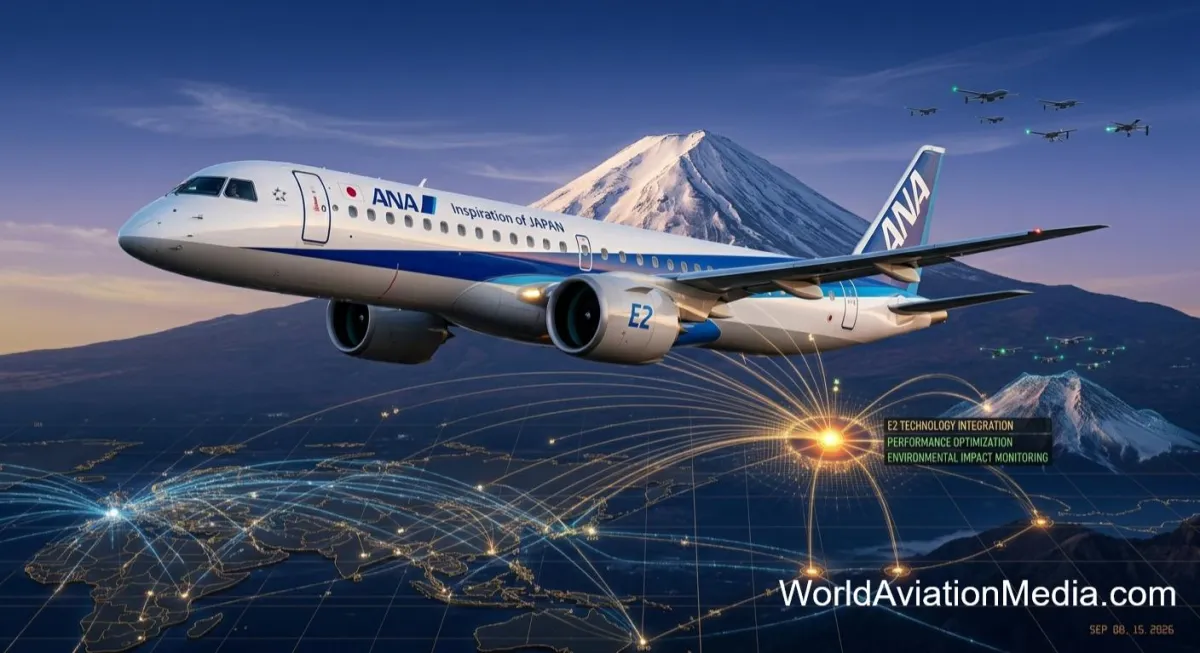
The ANA Holdings Regional Pivot: Analyzing the ¥105B Embraer E190-E2 Strategy and the Future of Japanese Aviation
KEY TAKEAWAYS
Capital Allocation: ANA Holdings has firmed an order for eight additional Embraer E190-E2 aircraft, an investment of approximately ¥105 billion (US$642 million).
Total Commitment: This brings the group’s firm commitment to 23 E190-E2 units, with five additional options remaining, marking a significant consolidation around Brazilian hardware.
ACMI Strategic Partnership: The fleet is designated for an expanded wet-lease (ACMI) agreement with IBEX Airlines, scheduled to commence in fiscal year 2029.
Post-Mitsubishi Reality: This procurement serves as the definitive "Plan B" to secure the regional network following the 2023 collapse of the Mitsubishi SpaceJet program.
Operational Efficiency: The E190-E2 utilizes Pratt & Whitney PW1900G geared turbofans to achieve a 25% reduction in fuel burn/CO2 emissions and is certified for 50% Sustainable Aviation Fuel (SAF) blends.
Regulatory Alignment: The move directly addresses May 2026 findings from the Japanese Ministry’s Expert Panel regarding the critical supply-demand imbalance in domestic aviation.
1. Introduction: The ¥105 Billion Strategic Gamble
In the highly regulated and demographically challenged Japanese domestic market, ANA Holdings’ September 4, 2026, announcement to firm eight additional Embraer E190-E2 jets is a clear admission of the new "regional reality." This ¥105 billion investment is more than a fleet expansion; it is a defensive pivot. After the 2023 termination of the Mitsubishi SpaceJet—a program where ANA was the launch customer and waited over a decade for a domestic solution that never materialized—the group has finally abandoned national manufacturing sentiment in favor of proven Brazilian reliability.
As a senior analyst, I view this not just as a procurement event, but as a survival strategy for regional connectivity. Japan’s domestic network is under immense pressure from a persistent pilot shortage and a shifting supply-demand balance. By committing to 23 firm E190-E2 units, ANA is betting that this specific "middle child" of aviation—the 100-seat jet—is the only way to maintain thin routes profitably through the 2030s.
2. The ACMI Advantage: Understanding the Wet-Lease Logic with IBEX
ANA’s decision to utilize an Aircraft, Crew, Maintenance, and Insurance (ACMI) model with IBEX Airlines is a sophisticated play in risk management. Rather than absorbing these assets into its own high-cost infrastructure, ANA is leveraging IBEX’s specialized regional operational profile. Crucially, this addresses the 2026 findings of the Japanese Ministry of Land, Infrastructure, Transport and Tourism (MLIT), which identified ACMI arrangements as a vital mechanism for balancing the domestic network's supply-demand crisis.
From a strategic MRO (Maintenance, Repair, and Overhaul) perspective, the "maintenance loop" is the deal's most brilliant stroke. While IBEX handles the low-margin, high-risk operational headaches of flight crews and insurance, they outsource the technical maintenance back to ANA. This allows ANA Holdings to capture high-margin MRO revenue from the very aircraft it is leasing out, effectively de-risking its capital investment.
Responsibility Category | Marketing Carrier (ANA) | Operating Carrier (IBEX) |
Route Planning | Primary Strategic Control | Consultative Role |
Sales & Marketing | Full Brand Responsibility | None |
Flight Operations & Crew | None (Offloaded Risk) | Full Operational Responsibility |
Aircraft Maintenance | Strategic Provider (High Margin) | Outsourced to ANA |
Fleet Replacement | Portfolio Manager | Replacement of CRJ700 Fleet |
3. The Embraer E190-E2: A "Middle Child" Solving a 100-Seat Problem
The E190-E2 is a "gauge tool" designed to bridge the gap between 74-seat turboprops and 150-seat narrowbodies like the Boeing 737. For thin domestic routes where a 737 would fly half-empty and a Dash 8-400 lacks jet-speed appeal, the E2 is the optimized solution. With a per-unit investment of approximately $80 million—a significant figure in a market where Embraer no longer publishes list prices—ANA is paying for premium efficiency.
Technical advantages are substantial: the Pratt & Whitney PW1900G engines provide a 25% reduction in fuel burn and CO2, and the airframe is already certified for 50% SAF blends, aligning with Japan's rigorous 2030 sustainability targets. However, the true competitive edge is the passenger experience. The "no middle seat" 2-2 configuration is a powerful marketing differentiator in Japan; internal data suggests passengers are already "asking for this aircraft by name" in regional markets, a rarity for short-haul equipment.
4. The Ghost of SpaceJet: Filling the Mitsubishi Vacuum
One cannot analyze this ¥105B bet without acknowledging the vacuum left by the Mitsubishi Regional Jet (MRJ)/SpaceJet. ANA originally signed for the MRJ in 2010, expecting a 2014 delivery. The 14-year delay between those initial expectations and the first projected E2 delivery in 2028 represents a lost decade of fleet modernization.
By firmed this second tranche of E2s, ANA is effectively erasing the last traces of its Mitsubishi commitment. While the SpaceJet was a "Plan A" built on national ambition, the E2 is a "Plan B" built on economic necessity. However, as an analyst, I maintain a degree of healthy skepticism: given the catastrophic delays of the past 15 years in the 100-seat segment, the 2028–2032 delivery window must be hit with absolute precision for ANA to maintain its network integrity. The replacement of IBEX's aging CRJ700 fleet depends entirely on Embraer meeting this schedule.
5. Regional Context: The E-Jet Footprint in Japan and Asia-Pacific
While ANA is the first to adopt the second-generation "E2" in Japan, it enters a mature ecosystem. JAL Group currently operates 32 first-generation E-Jets, and Fuji Dream Airlines remains an all-Embraer operator. ANA’s move ensures it is not left behind in the technical race for efficiency.
In the broader Asia-Pacific region, the E2 is becoming the equipment of choice for premium regional players who have already moved into the type:
Scoot (Singapore): Fully integrated its nine-aircraft E2 fleet by December 2025.
Virgin Australia: Commenced E2 operations in September 2025.
ANA Holdings: Positioned to become the third major E2 hub in the region starting in 2028.
6. Conclusion: A Sustainable Blueprint for Regional Aviation
ANA Holdings' ¥105 billion commitment is a definitive statement that the future of Japanese regional aviation is Brazilian-built and ACMI-operated. By offloading crew risks to IBEX while retaining high-margin maintenance work, ANA has created a sustainable financial blueprint. This strategy will likely serve as a template for other global carriers struggling with pilot shortages and thin-route economics. The 2028–2032 delivery window is the final frontier for ANA's regional modernization; if executed, it will finally exorcise the ghost of the SpaceJet and secure a reliable, efficient network for the next generation of Japanese travelers.
Q&A SECTION
1. How many E190-E2s has ANA ordered in total? ANA Holdings has a total commitment of 23 firm orders (15 from the 2025 Paris Air Show and 8 from the September 2026 agreement) plus five remaining options.
2. Who will fly these new E190-E2 aircraft? The aircraft will be operated by IBEX Airlines under an ACMI (wet-lease) agreement. IBEX provides the crew and operations, while ANA acts as the marketing carrier and maintenance provider.
3. When will the first aircraft be delivered? The first E190-E2 is scheduled for delivery in 2028. The additional eight units firmed in 2026 are slated for delivery between fiscal years 2029 and 2032.
4. What is the total cost of the latest order? ANA disclosed an investment of approximately ¥105 billion (US$642 million) for the eight-aircraft tranche, averaging roughly $80 million per unit.
5. Is the E190-E2 replacing ANA’s existing turboprop fleet? No. ANA Wings is actually reinforcing its Dash 8-400 fleet. The E190-E2 is primarily intended to replace IBEX’s CRJ700 fleet and provide jet-speed capacity on routes that require 100 seats.
METADATA & ASSETS
Keywords: ANA Holdings, Embraer E190-E2, IBEX Airlines, ACMI, wet-lease, Japanese aviation, Mitsubishi SpaceJet, regional jet, ¥105 billion, PW1900G, MRO revenue, pilot shortage, sustainable aviation.
Hashtags: #AviationAnalysis #ANA #Embraer #E2 #RegionalAviation #JapanAviation #FleetStrategy #ACMI
