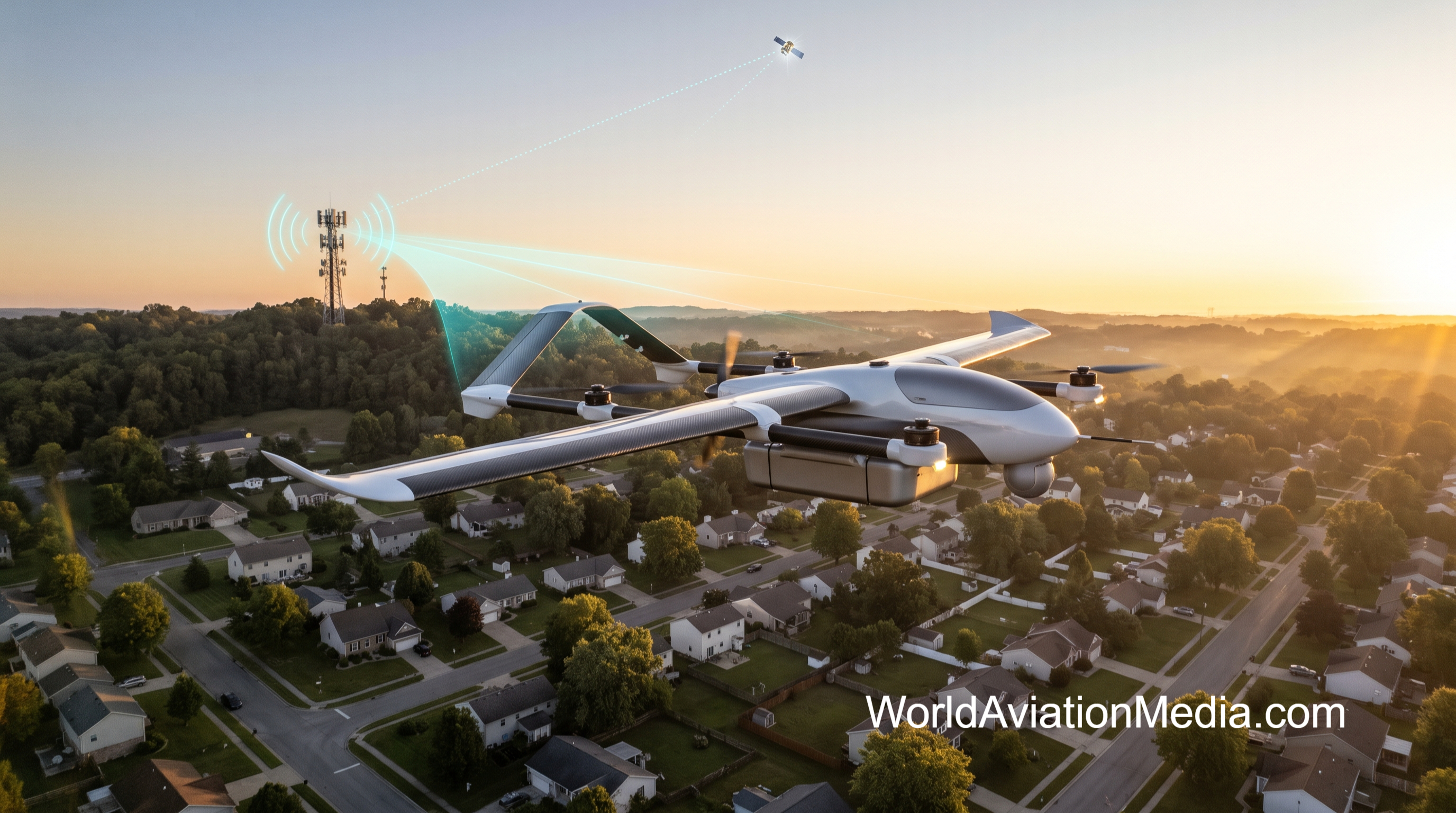
The 800 MHz Unlock: How FCC Cellular and Satcom Rules Will Reshape Commercial BVLOS Drone Operations
Key Takeaways
Historic Unanimous FCC Vote: On October 29, 2026, the Federal Communications Commission (FCC) voted 3–0 to adopt Report and Order FCC 26-72, unlocking 50 MHz of the 800 MHz Cellular band (824–849 MHz and 869–894 MHz) for uncrewed aircraft systems (UAS).
Solving the C2 Link Bottleneck: For the first time, commercial drone operators have legally protected regulatory access to terrestrial cellular networks for Beyond Visual Line of Sight (BVLOS) command, control (C2), and payload transmissions.
24 GHz Counter-UAS & 450 MHz Spectrum: Alongside the 800 MHz order, the FCC advanced rules governing 450 MHz dedicated aeronautical links and 24 GHz Counter-UAS (C-UAS) radar deconfliction to safeguard critical infrastructure.
Multi-Link Redundancy: Combining low-band 800 MHz cellular connectivity with L-band/Ku-band Low-Earth-Orbit (LEO) satellite fallback creates the "five-nines" (99.999%) link reliability mandated by the FAA’s Part 108 BVLOS regulatory framework.
The Spectrum Wall That Stalled the Drone Economy
For over a decade, the commercial uncrewed aircraft systems (UAS) industry has been trapped in a regulatory Catch-22. While the Federal Aviation Administration (FAA) controls the airspace and aircraft airworthiness, the Federal Communications Commission (FCC) controls the electromagnetic spectrum required to talk to those aircraft.
Until this week, commercial drones operating in the United States were largely restricted to unlicensed Industrial, Scientific, and Medical (ISM) bands—primarily 900 MHz, 2.4 GHz, and 5.8 GHz (the same congested frequencies used by home Wi-Fi routers, Bluetooth devices, and baby monitors)—or hyper-expensive, low-bandwidth 5030–5091 MHz licensed aeronautical spectrum that lacked nationwide ground tower infrastructure. Even worse, historical FCC Part 22 rules explicitly prohibited or restricted airborne use of the 800 MHz cellular band due to legacy 1980s fears that an airborne transmitter with line-of-sight to dozens of cell towers would cause co-channel interference on the ground.
On October 29, 2026, that barrier fell. In a unanimous 3–0 vote, the FCC adopted Report and Order FCC 26-72, officially opening 50 megahertz of the 800 MHz Cellular band (824–849 MHz and 869–894 MHz) to uncrewed aircraft for Command and Control (C2), non-payload communications (CNPC), and high-bandwidth payload data operations.
Technical Breakdown of FCC Report and Order 26-72
Why is the 800 MHz Cellular band the "Golden Spectrum" for commercial BVLOS drone logistics, pipeline inspection, and emergency response? The answer comes down to radio frequency (RF) propagation physics and existing telecom capital expenditure.
1. Sub-1 GHz Propagation Characteristics
Unlike mid-band 5G (3.5 GHz C-band) or millimeter-wave spectrum, which suffer from high free-space path loss and are easily blocked by tree canopies, terrain contours, and building facades, the 824–849 MHz (uplink) and 869–894 MHz (downlink) bands sit in the low-band sweet spot. Low-band RF waves propagate across vast rural distances and penetrate suburban foliage and urban canyons, ensuring a drone flying at 200 to 400 feet AGL (Above Ground Level) maintains a stable carrier lock even when dipping below terrain ridges.
2. Instantaneous Nationwide Infrastructure
Building a dedicated ground tower network exclusively for drones on the 5030 MHz band would have cost the aviation industry billions of dollars and taken a decade to permit. By authorizing UAS operations on the 800 MHz cellular band under flexible-use licensing agreements between cellular carriers (such as AT&T, Verizon, and T-Mobile) and UAS operators, the FCC instantaneously turned hundreds of thousands of existing macro cell towers across the United States into a nationwide BVLOS Command and Control network.
3. Mitigating Airborne Co-Channel Interference
To satisfy cellular carriers that airborne drones at 400 feet will not overwhelm neighboring ground base stations, the FCC’s October 2026 framework relies on technical standards validated during NASA’s STEReO (Scalable Traffic Management for Emergency Response Operations) field tests and 3GPP Release 18 aerial UE (User Equipment) specifications:
Directional Beamforming & Power Control: Modern airborne cellular modems utilize closed-loop transmit power control and directional antenna nulling to minimize side-lobe radiation toward non-serving cell towers.
Altitude & Geographic Coordination Envelopes: Network management APIs dynamically cap airborne transmit power based on the drone’s real-time GPS altitude and local tower density.
Comparing the New UAS Spectrum Architecture (Post-October 2026)
Spectrum Band | Frequency Range | Primary Role in UAS Ecosystem | Bandwidth / Throughput | Infrastructure Readiness |
800 MHz Cellular (FCC 26-72) | 824–849 MHz / 869–894 MHz | Primary BVLOS C2, Telemetry & Live Video Payload | High (LTE / 5G NR Low-Band) | Immediate Nationwide Coverage via MNOs |
450 MHz Aeronautical | 454–455 MHz / 459–460 MHz | Ultra-Long-Range Point-to-Point & Rural C2 | Low-to-Medium (Narrowband C2) | Specialized Ground Stations |
C-Band Aeronautical | 5030–5091 MHz | High-Security Protected CNPC (NPRM Direct Link) | Medium | Emerging at Major Airports / Corridors |
LEO Satcom (Ku / L-Band) | 1.5–1.6 GHz / 12–18 GHz | Off-Grid / Maritime / Redundant BVLOS C2 Fallback | Medium-to-High | Global (Starlink, Iridium, Kuiper) |
24 GHz C-UAS Band | 24.0–24.25 GHz | Ground-Based Counter-UAS & Detect-and-Avoid Radar | High-Resolution Radar | Deploying at Critical Infrastructure |
Beyond Cellular: 450 MHz Links and 24 GHz Counter-UAS Deconfliction
The October 29, 2026 open meeting was not a single-issue event. Alongside Report and Order FCC 26-72, the Commission addressed two critical adjacent pillars of the low-altitude airspace ecosystem:
The 450 MHz Band for Dedicated Long-Range C2
For industrial operators flying linear infrastructure inspections (high-voltage power lines in the Rocky Mountains or trans-Alaskan oil pipelines) where even 800 MHz cellular coverage drops off, the FCC advanced rules around the 450 MHz band. Operating at nearly half the frequency of the 800 MHz band, 450 MHz radios offer extraordinary non-line-of-sight range per ground station, allowing energy utilities to cover 50+ miles of remote pipeline corridor with a single temporary relay mast.
24 GHz Counter-UAS (C-UAS) Radar Standardization
As commercial drone deliveries scale in suburban neighborhoods, security agencies and critical infrastructure operators (airports, stadiums, power plants, and military installations) need high-resolution ground radars to distinguish authorized BVLOS delivery drones from hostile or rogue quadcopters. By formalizing rules around the 24 GHz band for Counter-UAS radar operations, the FCC enabled compact, solid-state Ku/K-band micro-Doppler radars to operate continuously without interfering with automotive collision-avoidance radars or point-to-point microwave backhauls.
How Multi-Link Architecture Unlocks FAA Part 108 BVLOS at Scale
For drone logistics leaders like Zipline, Wing, Amazon Prime Air, Matternet, and Flytrex, as well as middle-mile cargo developers like Elroy Air and Reliable Robotics, the FCC’s 800 MHz unlock solves the core certification requirement of the FAA’s Part 108 BVLOS rule.
Under aviation safety principles, no single point of failure in a communications link can be allowed to result in a loss of aircraft control over populated areas. With FCC 26-72 now in effect, enterprise UAS manufacturers are deploying Tri-Band Bonded Avionics:
Primary Link (800 MHz Cellular): Handles continuous low-latency Command and Control (C2), Network Remote ID broadcasting, UTM strategic deconfliction telemetry, and HD optical/thermal video feeds for remote supervisors.
Secondary Diversity Link (Multi-Carrier Cellular or 450/5030 MHz): Simultaneously bonds a second cellular carrier SIM on a separate frequency band to protect against localized cell tower outages.
Tertiary Fallback Link (LEO Satcom): If a natural disaster (such as a hurricane or wildfire) destroys terrestrial cell towers—precisely when first-responder drones are needed most—the flight controller automatically fails over within milliseconds to a compact L-band or LEO satellite transceiver, ensuring safe return-to-home or mission completion.
Economic Impact: From Waiver-By-Waiver to Scalable Networks
Prior to October 2026, operating a cellular-connected BVLOS drone fleet required navigating an exhausting labyrinth of Special Temporary Authorities (STAs) and experimental FCC licenses that prohibited commercial revenue scalability.
By codifying permanent operational rules in the 800 MHz band, the FCC has handed mobile network operators (MNOs) a massive new B2B revenue stream: Aviation Network Slices. Telecom carriers can now sell Service Level Agreements (SLAs) with guaranteed Quality of Service (QoS) and low-latency priority routing specifically tailored for autonomous aerial fleets moving medical lab samples, retail packages, and grid-inspection sensors across American cities in 2027.
5-Item Q&A Section (AEO Optimized)
Q1: What is FCC Report and Order 26-72?A: Adopted unanimously (3–0) by the Federal Communications Commission on October 29, 2026, Report and Order FCC 26-72 opens 50 megahertz of the 800 MHz Cellular band (824–849 MHz and 869–894 MHz) for uncrewed aircraft systems (drones) to conduct command, control (C2), communications, and payload operations.
Q2: Why were drones previously restricted from using the 800 MHz cellular band?A: Legacy FCC Part 22 rules prohibited airborne cellular transmissions on the 800 MHz band because an aircraft flying at altitude has direct line-of-sight to multiple cell towers simultaneously, which historically risked causing co-channel interference for ground-based mobile phone users before modern beamforming and power-control technologies were developed.
Q3: Why is the 800 MHz band important for BVLOS (Beyond Visual Line of Sight) drone flights?A: The 800 MHz band offers superior sub-1 GHz radio propagation that penetrates foliage and buildings while leveraging hundreds of thousands of existing cellular towers across the U.S., giving commercial drones reliable, nationwide Command and Control (C2) connectivity without building new aviation-only ground towers.
Q4: How do cellular and satellite links work together on commercial BVLOS drones?A: Modern BVLOS drones use multi-link bonded avionics where terrestrial 800 MHz cellular networks handle primary low-latency command, control, and high-bandwidth video payloads, while Low-Earth-Orbit (LEO) or L-band satellite links act as an automatic fail-safe backup over rural dead zones or during disaster-induced cell tower outages.
Q5: What role does the 24 GHz band play in the FCC’s late-2026 drone rules?A: Alongside cellular C2 spectrum, the FCC advanced rules for 24 GHz Counter-UAS (C-UAS) radars, providing airports, stadiums, and critical infrastructure operators with high-resolution short-range radar spectrum to detect, track, and deconflict authorized commercial drones from unauthorized airborne threats.
Metadata
Target SEO Keywords: FCC 26-72 800 MHz drone spectrum, commercial BVLOS drone cellular C2, 824-849 MHz UAS regulations, 24 GHz Counter-UAS radar FCC, FAA Part 108 BVLOS communications, NASA STEReO drone field tests, drone satcom cellular redundancy.
Hashtags: #BVLOS #CommercialDrones #FCC2672 #800MHz #UncrewedAviation #CounterUAS #DroneLogistics
