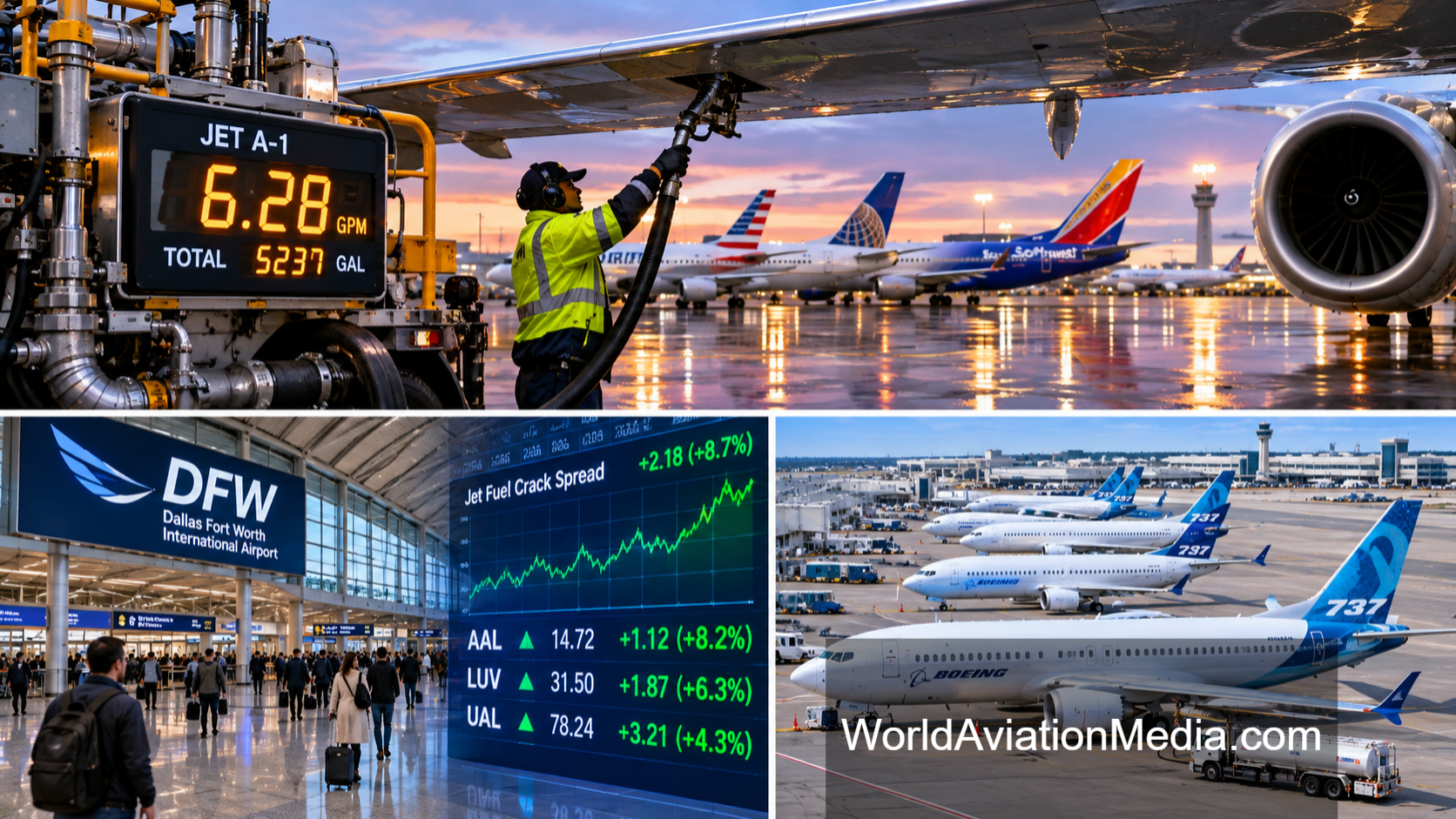
The $4.55/Gallon Crucible: Why Soaring Q4 Jet Fuel Costs Are Splitting U.S. Legacy Carriers into Winners and Losers
Key Takeaways
The Q4 Fuel Spike: U.S. airlines face a severe fourth-quarter energy shock, with projected Q4 2026 jet fuel prices surging to a range of $4.25 to $4.85 per gallon—centered around Southwest’s $4.55/gallon benchmark—up sharply from sub-$4.00 levels in Q3.
American Airlines' Profit Reversal: Despite posting record Q3 2026 revenue of $16.3 billion, American Airlines saw its quarterly fuel bill surge 67.5% year-over-year to $4.6 billion, forcing management to forecast a full-year 2026 adjusted loss of $1.00 to $1.60 per share.
Southwest & United’s Commercial Buffer: While United Airlines and Southwest Airlines also pared back Q4 profit guidance below early Wall Street consensus, record unit revenues (RASM), bag-fee monetization, and premium cabin yield allowed both carriers to remain solidly profitable.
2027 Capacity Discipline: To restore margin stability amid an annual fuel bill running over $7 billion higher than the prior year, American Airlines has signaled a deliberate slowdown in 2027 network capacity growth, accelerating industry-wide seat supply discipline.
Anatomy of an Energy Shock: When Jet-A Outruns Airfare Gains
Throughout the first half of 2026, U.S. commercial aviation appeared poised for a banner year of post-pandemic margin expansion. Consumer travel demand remained resilient, domestic airfares climbed more than 20% year-over-year, and international premium cabins operated at historic load factors. Yet during the October 2026 third-quarter earnings cycle, a single macroeconomic variable shattered industry-wide guidance: the price of refined jet fuel.
Why are U.S. airline profits diverging in Q4 2026? U.S. airline profitability is diverging because fourth-quarter 2026 jet fuel prices have surged to between $4.25 and $4.85 per gallon—an increase of more than $0.60 to $0.90 per gallon over Q3 assumptions—faster than airlines can pass the expense along to consumers through base fare hikes. Carriers with stronger ancillary monetization, lower debt service, or superior fuel efficiency are maintaining positive margins, while highly leveraged carriers with unhedged exposure face full-year net losses.
During Q3 2026, average fuel prices had already crept above internal airline forecasts—Southwest Airlines, for example, paid an average of $3.92 per gallon against an initial assumption of $3.70 to $3.7Entering Q4, widening refinery crack spreads and global crude supply tightness pushed projected Q4 fuel costs to $4.55 per gallon at Southwest and up to $4.85 per gallon across coastal hubs. Because airline tickets are often booked 30 to 90 days in advance, a sudden spike in spot Jet-A prices creates an immediate margin squeeze: airlines must fly passengers at ticket prices locked in when fuel was $3.70, while paying $4.55 at the wingtip.
American Airlines’ Q4 Loss Warning and the $7 Billion Fuel Bill
Nowhere was the impact of the fuel spike more pronounced than in Fort Worth, Texas. On October 22, 2026, American Airlines Group (NASDAQ: AAL) reported a third-quarter adjusted loss of $0.28 per share and issued a sobering revision to its full-year outlook. Reversing its July guidance that had projected full-year profitability, American forecast an adjusted full-year 2026 loss of $1.00 to $1.60 per share.
"We produced a loss in the quarter that, but for this fuel spike, would've been solidly profitable." — Robert Isom, CEO, American Airlines
The raw numbers inside American’s Q3 financial disclosures illustrate the scale of the headwind:
Record Top-Line Demand: American generated record third-quarter operating revenue of $16.3 billion, proving that passenger demand was not the culprit.
The 67.5% Fuel Surge: Third-quarter fuel expenses jumped 67.5% year-over-year to reach $4.6 billion in a single quarter.
Full-Year Delta: For the entirety of 2026, American’s total fuel expenditure is tracking more than $7 billion higher than the previous year.
Why did the fuel spike push American into the red while peers stayed profitable? First, American carries a heavier balance sheet debt load from its pre-2020 fleet renewal program, leaving thinner net margins after interest expense. Second, American is still recovering high-margin corporate agency revenue following its earlier commercial distribution restructuring. Third, because U.S. legacy carriers largely abandoned systematic fuel hedging over the past decade due to high option premiums, American is fully exposed to spot market refinery volatility.
How Southwest and United Absorbed the Blow
While Delta Air Lines, United Airlines, and Southwest Airlines all trimmed their fourth-quarter earnings projections relative to Wall Street expectations, their operational architectures provided critical shock absorbers.
Financial & Operational Metric | Southwest Airlines (LUV) | American Airlines (AAL) | United Airlines (UAL) |
Q3 2026 Revenue | $8.0 Billion (Record Q3) | $16.3 Billion (Record Q3) | Record Q3 Passenger Revenue |
Q3 Fuel Price Paid | $3.92 / gallon | ~67.5% YoY Expense Surge ($4.6B) | Sub-$4.00 / gallon |
Q4 2026 Projected Fuel Cost | ~$4.55 / gallon | $4.25 – $4.85 / gallon range | $4.25 – $4.85 / gallon range |
Q4 / FY26 Earnings Guidance | Q4 Adj. EPS: $0.55 – $0.80 | FY26 Adj. EPS Loss: $(1.00) – $(1.60) | Profitable Q4 (Below prior Street est.) |
2026–2027 Fleet & Cap Strategy | 2026 Cap growth trimmed to 1.2% | 2027 network growth to slow from 2026 | Next-gen MAX 10 & Starlink rollout |
Southwest Airlines’ Commercial Transformation Payoff
Southwest’s Q3 2026 results demonstrated why Wall Street rewarded its stock with an after-hours rally to $40.30 despite the $4.55/gallon Q4 fuel forecast. Even as Q3 operating expenses rose 16.3% to $8.0 billion (with CASM-ex rising 3.4%), Southwest expanded its adjusted operating margin by 4.8 percentage points to 5.4%.
"Demand remained strong as we lapped last year's bag fee and other commercial initiatives, reinforcing our belief that the earnings power we've built is durable, even with significantly higher fuel costs." — Bob Jordan, CEO, Southwest Airlines
By abandoning its decades-old "bags fly free" and open-seating orthodoxy over the 2025–2026 transition, Southwest unlocked massive ancillary revenue streams. For Q4 2026, Southwest guided to an astounding 19% to 21% surge in unit revenue (RASM) on modest capacity growth of 3% to 4%, yielding projected Q4 adjusted earnings of $0.55 to $0.80 per share. Furthermore, Southwest is actively modernizing its fleet efficiency, taking delivery of 67 Boeing 737-8 and 737-7 aircraft in 2026 while retiring 60 older, fuel-thirsty 737-700s, and trimming full-year capacity growth from 1.5% down to 1.2%.
United Airlines’ Premium & Technological Moat
United Airlines similarly weathered the Q3 storm by leaning into international widebody yields, domestic first-class segmentation, and structural up-gauging. Although United’s Q4 profit projection came in below consensus due to the $4.25–$4.85/gallon fuel band, its revenue diversity kept it firmly in positive territory. United noted that its rapid fleet-wide rollout of high-speed Starlink Wi-Fi, expansion of a new concourse at Houston Bush Intercontinental (IAH), and the arrival of Pratt & Whitney GTF Advantage engines and newly certified 737 MAX 10s are driving measurable corporate share gains that offset fuel inflation.
The 2027 Outlook: Capacity Slowdowns and Cost Reengineering
When fuel prices stabilize at an elevated plateau rather than retreating, airlines have only two levers to restore pre-tax margins: cut non-fuel costs and restrict seat supply to force airfares higher.
American Airlines is pulling both levers simultaneously:
$1 Billion Run-Rate Reengineering: Through automated maintenance workflows, back-office consolidation, and procurement renegotiations, American is on track to capture nearly $1 billion in annual run-rate cost savings by the end of 2026.
2027 Capacity Brakes: CEO Robert Isom confirmed that given elevated fuel prices, American will deliberately slow its 2027 network capacity growth compared to 2026 levels. Instead of chasing market share with marginal off-peak flights, American will concentrate capital into high-return commercial upgrades: expanded Flagship lounges, new gate expansions at Dallas Fort Worth (DFW) Terminal A, seatback infotainment retrofits, and Starlink Wi-Fi integration.
Looking ahead to Q1 2027—and specifically to Southwest’s upcoming Capital Markets Day in New York on March 2, 2027—the $4.55/gallon Q4 crucible is accelerating a permanent structural shift in U.S. aviation. Carriers that treat seats as a commodity are being priced out by refinery economics, while those investing in cabin segmentation, ancillary bundling, and next-generation fleet gauge are proving that airline earnings power can survive $4.50+ Jet-A.
5-Item Q&A Section
Q1: Why did American Airlines forecast a full-year loss for 2026? On October 22, 2026, American Airlines projected an adjusted full-year 2026 loss of $1.00 to $1.60 per share because a sharp spike in jet fuel prices outpaced airfare gains. American’s Q3 fuel expenses surged 67.5% year-over-year to $4.6 billion, and its full-year 2026 fuel bill is expected to exceed 2025 levels by more than $7 billion.
Q2: What are U.S. airlines paying for jet fuel in Q4 2026? Major U.S. airlines project fourth-quarter 2026 jet fuel prices to range between $4.25 and $4.85 per gallon, up from under $4.00 per gallon in Q3 202Southwest Airlines specifically guided to an average Q4 fuel price of approximately $4.55 per gallon, compared to $3.92 per gallon in Q3.
Q3: How is Southwest Airlines remaining profitable despite $4.55/gallon jet fuel? Southwest Airlines offset higher fuel costs through commercial initiatives introduced over the past year—including checked bag fees and assigned/premium seating—which are driving a projected 19% to 21% surge in fourth-quarter unit revenue (RASM). In addition, Southwest trimmed its 2026 capacity growth to 1.2% and is retiring 60 older planes in favor of 67 fuel-efficient Boeing 737 MAX aircraft.
Q4: How will high jet fuel costs affect airline ticket prices and capacity in 2027? Because jet fuel costs have risen faster than ticket prices (even with airfares already up more than 20% year-over-year), carriers like American Airlines and Southwest are slowing capacity growth into 202Fewer available seats combined with $4.50+ per gallon fuel will maintain upward pressure on domestic and international airfares throughout 2027.
Q5: How is American Airlines planning to return to profitability in 2027? American Airlines plans to restore profitability in 2027 by executing a reengineering program targeting $1 billion in annual run-rate cost savings by year-end 2026, slowing 2027 network capacity expansion, and investing in high-yield passenger amenities including Starlink Wi-Fi, premium cabin expansions, seatback screens, and new gates at its DFW hub.
Keywords and Hashtags
Keywords: Q4 2026 jet fuel prices $4.55 gallon, American Airlines 2026 loss forecast, Southwest Airlines Q3 2026 earnings RASM, United Airlines Q4 2026 profit guidance, airline fuel cost surge 67.5%, 2027 airline capacity slowdown, US legacy carriers financial comparison.
Hashtags: #AirlineEarnings #JetFuelPrices #AmericanAirlines #SouthwestAirlines #UnitedAirlines #AviationFinance #AirlineStocks #TravelEconomics
