The $150,000 Type-Rating Trap: Unpacking the 8% Surge in Business Aviation Compensation
Key Takeaways
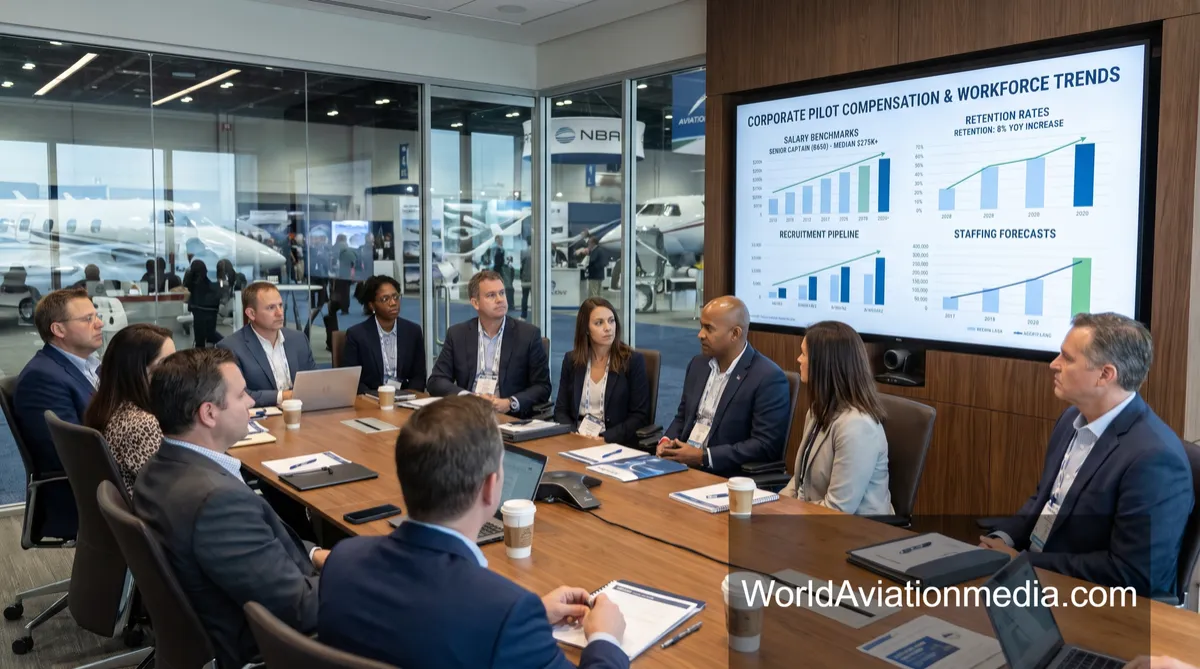
Surging Pay Rates: Analysis presented at NBAA-BACE 2026 by AirComp Calculator reveals that U.S. business aviation compensation jumped 8% over the past year—more than double the national inflation rate of 3.4%.
The High Cost of Type Ratings: With specialized initial training and type ratings for modern jets costing up to $150,000, flight departments face crippling replacement costs if incumbent pilots leave.
Culture Over Cash: Industry leaders note that pilots increasingly reject purely transactional pay bumps (20,000–30,000) in favor of predictable scheduling, rotating crews, and healthy workplace cultures.
Strategic Retention: Corporate flight departments are restructuring compensation, budgeting for contract relief pilots, and transforming internal culture to protect their massive human capital investments.
The Compensation Boom at NBAA-BACE 2026
Inside the packed convention halls of the Las Vegas Convention Center during NBAA-BACE 2026, one economic reality dominated executive discussions: corporate aviation salaries are surging at an unprecedented pace. According to comprehensive compensation data released by Dallas-based AirComp Calculator—drawing on multiple industry surveys across 21 positions, nine aircraft classes, and over 80 U.S. metropolitan markets—U.S. business aviation pay climbed 8% in 2026. This rate doubles the broader U.S. national wage inflation average of 3.4%, underscoring a severe talent shortage across corporate flight departments and MRO facilities.
The underlying catalyst for this wage explosion is not just general labor scarcity; it is rooted in the immense replacement cost of specialized technical talent. As Chris Broyhill, founder of AirComp Calculator, highlighted during his NBAA-BACE briefing, training a captain on a modern ultra-long-range business jet requires an investment that routinely reaches $150,000 in simulator training, lodging, and lost operational time.
"You lose that person, then you've got to pay another 150 grand to replace them... So people are saying, 'You know what? We're going to suck it up, and we are going to pay out the wazoo to keep these people here.'" — Chris Broyhill, AirComp Calculator, NBAA-BACE 2026
The Economics of the $150,000 Type-Rating Trap
In business aviation, aircraft capability has advanced faster than the pilot pipeline. Modern large-cabin business jets—such as Gulfstream G700s, Bombardier Global 7500s, and Dassault Falcon 10X models—require rigorous, highly specialized type ratings.
When a corporate flight department invests $150,000 to type-rate a pilot on a flagship airframe, that pilot instantly becomes a target for poaching by competing flight departments, charter operators, and fractional giants like NetJets. If the pilot departs, the hiring flight department faces a double penalty: the loss of operational capacity and the immediate expenditure of another $150,000 to train a replacement. This dynamic has turned retention into an existential financial calculation for corporate aviation managers.
Beyond the Paycheck: Why Culture Trumps Cash
Interestingly, data presented alongside Aviation Personnel International CEO Sheryl Barden at NBAA-BACE revealed that throwing money at retention has diminishing returns. Many corporate pilots and aviation technicians have turned down incremental salary raises of $20,000 to $30,000 when offered by toxic or unpredictable flight departments.
Instead, lifestyle and workplace culture have become decisive differentiators:
Predictable Scheduling: Implementing robust rotating crew schedules that guarantee time off rather than unexpected on-call duty extensions.
Contract Pilot Budgeting: Allocating corporate funds to hire dependable contract relief pilots, ensuring full-time crews get uninterrupted days off.
Psychological Safety and Respect: Fostering a corporate culture where safety reporting is encouraged and flight deck crews are treated as strategic assets rather than disposable expenses.
Structuring the Future Flight Department
To navigate the 2026 compensation landscape, corporate flight departments must look past basic pay scales. By investing in predictable quality-of-life frameworks and robust retention programs, organizations can break out of the high-turnover replacement cycle and protect their multi-million-dollar capital investments in human talent.
5-Item Q&A Section (FAQ)
Q1: How much did business aviation compensation rise in 2026 according to AirComp Calculator?
U.S. business aviation pay climbed 8% in 2026, more than double the national inflation rate of 3.4%.
Q2: What is the estimated cost of obtaining a type rating for a modern business jet?
Initial simulator training and type ratings for modern corporate jets cost approximately $150,000.
Q3: Why are flight departments willing to pay higher salaries despite these costs?
Because losing a trained pilot forces the company to spend another $150,000 to train a replacement, making high compensation a rational retention defense.
Q4: Do pilots always accept higher-paying job offers?
No. Many pilots have turned down $20,000 to $30,000 raises to stay at companies that offer better schedules, predictable time off, and healthy workplace cultures.
Q5: Where was this compensation data presented in 2026?
The data was unveiled at the NBAA-BACE 2026 convention in Las Vegas during specialized workforce and training educational sessions.
Metadata
Target SEO Keywords: AirComp Calculator business aviation pay 2026, NBAA BACE 2026 salary trends, pilot type rating cost $150000, corporate flight department retention, bizav compensation surge.
Hashtags: #NBAABACE #Bizav #PilotShortage #AviationJobs #CorporateAviation #Compensation
