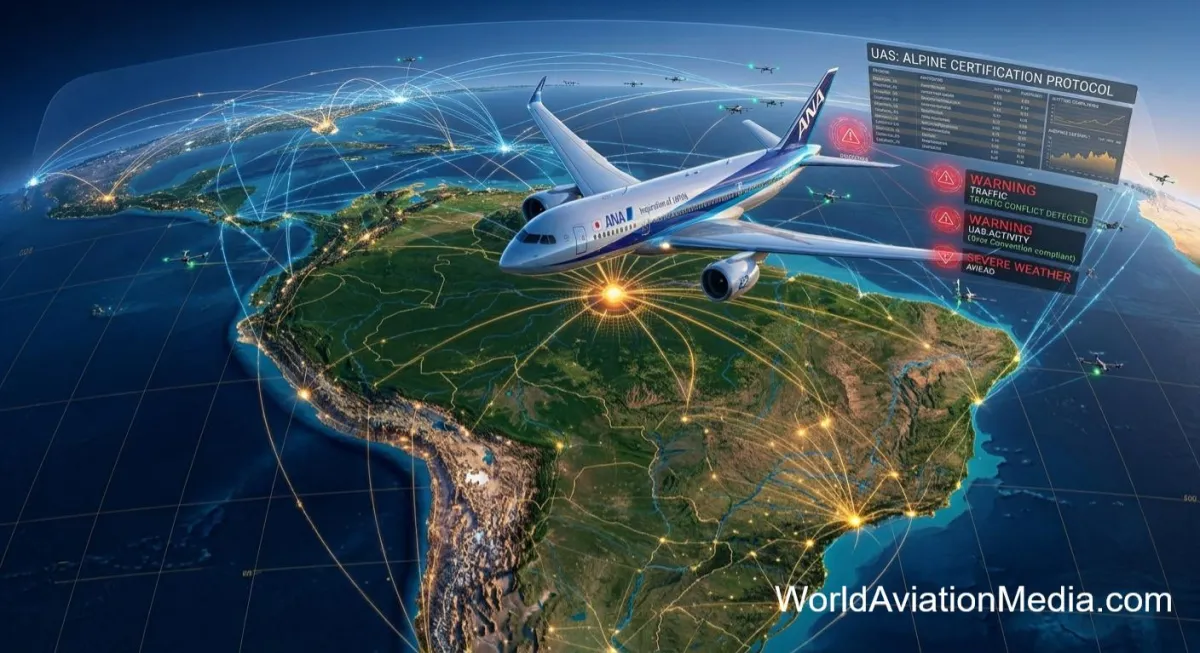
South America's Single Sky: Will the "Wing Agreement" Unlock the Next Aviation Powerhouse?
KEY TAKEAWAYS
Actionable Sovereignty via the Hybrid Equity Model: Policymakers must bypass the standard 20-year infrastructure development cycle by adopting a "49% Equity-Technical Hybrid." This leverages established global expertise to provide immediate access to fleet planning and MRO without sacrificing long-term strategic control.
SAF as a Geopolitical Energy Moat: South America must capitalize on its unique forestry sectors (Brazil’s pulp industry and Chile’s timber) to "mine forest slash" as a primary feedstock. Securing domestic fuel supply via direct capital injections—modeled on the Jet Zero Australia raise—is the only way to stabilize the regional competitive landscape.
Unified Air Traffic Resilience Protocols: Survival in a high-utilization block requires the institutionalization of standardized Service Recovery Options (SROs). These must include 730-day credit accounts to manage airline liquidity during systemic shocks like the September 2026 volcanic disruptions.
Emergency ATC Priority Standards: The "Single Sky" must enforce flexible vectoring protocols. The 2026 Cessna 680A disaster proves that rigid Air Traffic Control (ATC) adherence to standard approach lengths during mechanical emergencies is a lethal systemic failure that the Wing Agreement must regulate.
Connectivity as a Hub Differentiation Lever: High-speed, satellite-based connectivity is no longer a premium add-on but a foundational requirement for passenger loyalty. Hubs like São Paulo/Guarulhos and Bogotá/El Dorado must adopt "sponsored digital access" to remain competitive against Northern Hemisphere networks.
1. Geopolitical Necessity and the Strategic Integration of the "Single Sky"
In the complex geopolitical theater of late 2026, the formation of regional aviation blocks is no longer a luxury of the European Union; it has become a survival mechanism for emerging markets. For South America, the "Wing Agreement" is the essential catalyst required to transition from a collection of fragmented national interests into a unified global "powerhouse." By consolidating airspace and regulatory oversight, the region can create a seamless operational theater that matches the scaling efficiencies of the Asia-Pacific markets. This integration is the foundational infrastructure required to support the massive passenger growth projected through 2027.
However, the path to a "Single Sky" is fraught with the tension between national pride and operational reality. To solve this, South American leaders are increasingly looking toward the "Ethiopian Model" highlighted during the September 2026 air talks between Ethiopia and Namibia. This strategic framework, where an established powerhouse takes a 49% minority stake and provides technical management, offers a pragmatic bypass of the 20-year lead time usually required to build world-class aviation capabilities from scratch. By accessing existing expertise in procurement, training, and maintenance, smaller nations within the South American block can achieve instant network relevance while maintaining a strategic veto.
The logic of this benchmarking is undeniable. Rather than struggling to develop independent airline systems, the Wing Agreement proposes that regional partners leverage the "plug-and-play" expertise of the continent's dominant players like LATAM or Avianca. This prevents the inefficiency of redundant systems and allows the block to act as a single, high-utilization asset in global negotiations. The move toward this unified political framework is the prerequisite for the technological and energy transformations currently disrupting the sector.
2. The Energy Frontier: Scaling SAF and eSAF Infrastructure
In 2026, the definition of fuel security has shifted. It is no longer about the price of crude; it is about the reliability and sustainability of local supply chains. For a South American aviation block to maintain a competitive moat, it must aggressively pursue a domestic production strategy for both Sustainable Aviation Fuel (SAF) and synthetic sustainable aviation fuel (eSAF). Decarbonization is the new entry requirement for global network participation, and those who do not control their supply will be subject to the volatility of international carbon taxes and supply-side crunches.
The Wing Agreement must prioritize synthetic pathways to ensure long-term scalability. The September 2026 commercial passenger flight powered by Infinium’s eSAF in partnership with American Airlines proves that synthetic fuels are no longer a laboratory curiosity. For South American hubs like Bogotá or Lima, testing these alternative fuel pathways is critical for emissions reduction without the land-use conflicts often associated with traditional biofuels. By investing in eSAF, the region can decouple its growth from the physical constraints of biomass availability.
Simultaneously, the region should exploit its massive geographic advantages in the forestry sector. Analysts are currently pointing to "mining forest slash"—the debris left by the logging industries of the Amazon and the Southern Cone—as a high-potential feedstock. Unlike the United States or Europe, which face complex logistics for biomass collection, Brazil and Chile already possess the industrial infrastructure to convert forestry waste into a self-sustaining energy ecosystem. This model turns an environmental fire hazard into a strategic aviation asset, providing a low-carbon fuel source that is geographically insulated from global supply disruptions.
To fund this transition, the block must encourage direct airline and manufacturer involvement in fuel production. The A30 million (22 million) capital raise for Jet Zero Australia, backed by Qantas and Airbus in September 2026, provides a clear "So What?" for the industry: airlines are now funding their own suppliers to secure future volumes. South American policymakers must create similar investment vehicles to ensure that the region’s carriers are not left at the back of the queue for sustainable fuel.
3. Digital Transformation and the Reimagined Passenger Journey
The passenger of 2026 views the aircraft cabin as a high-speed digital node, not a sanctuary of isolation. Within the Wing Agreement’s unified block, inflight connectivity (IFC) must be standardized as a core product feature rather than a tiered premium. Digital parity across the block is essential for maintaining the "Single Sky" illusion and ensuring passenger loyalty as they move between regional carriers.
The gold standard for this was set by American Airlines in early September 2026 with the rollout of free, high-speed Wi-Fi sponsored by AT&T. This model of "sponsored digital access" is a strategic masterstroke for network carriers. It removes friction from the passenger experience while providing airlines with a diversified revenue stream that offsets the cost of satellite bandwidth. For a South American block, implementing this at major hubs like São Paulo/Guarulhos would provide a critical differentiator against carriers that still treat connectivity as a luxury upcharge.
Furthermore, digital transformation extends to how the block expands its network visibility. Air Canada’s "travel puzzle" campaign for its Summer 2027 network expansion serves as a case study in engagement. By gamifying route announcements, airlines can build hub relevance and premium traffic flows before a single flight is even operated. A unified South American strategy should employ similar creative tactics to announce intra-continental routes, shifting the narrative from simple "transit" to a cohesive regional experience. However, these digital and network ambitions are fundamentally dependent on the block’s ability to survive systemic volatility.
4. Systemic Resilience: Navigating the 2026 Disruption Spikes
The high-utilization aviation blocks of 2026 operate on such thin margins that a single environmental or technical shock can cause a continental collapse. A "Single Sky" is only as strong as its weakest point of failure. The massive disruption spike of September 2026, triggered by the eruption of Mount Anak Krakatau in the Sunda Strait, serves as a chilling warning. The eruption, which lasted 25 continuous hours, resulted in the closure of eight airports and the displacement of over 270,000 passengers by September 7th.
The "So What?" for the Wing Agreement is the absolute necessity for unified weather monitoring (modeled on the BMKG and VAAC Darwin collaboration) and standardized Service Recovery Options (SROs). During the Anak Krakatau crisis, the 1,558 flights delayed or cancelled in a single day demonstrated that without clear protocols, passenger management becomes an impossible bottleneck. The block must institutionalize the four SROs pioneered by AirAsia:
Full Refunds to the original payment method.
Credit Accounts valid for 730 days (a critical tool for airline liquidity management).
One-time Free Flight Changes within 30 days.
Rerouting to alternative hubs within the network.
Beyond environmental shocks, the Wing Agreement must address the safety failures inherent in current air traffic management. The June 16, 2026, accident involving a NetJets Cessna 680A in Laredo, Texas, highlights a fatal flaw in ATC rigidity. After a fractured starter/generator shaft led to a series of fuel system warnings and a double engine flameout, the crew requested a five-mile final for an emergency visual approach. Instead, Houston Center controllers, following standard altitude-based protocols, vectored the dying aircraft for a 270-degree turn and a 14-mile final. The aircraft flamed out on short final, striking a vehicle and killing a passenger.
This tragedy underscores that in a "Single Sky," the regulatory block must enforce "Emergency ATC Priority Standards." Controllers must be trained and empowered to abandon standard spacing in favor of tactical emergencies. Similarly, the TBM 850 crash in Manitoba, caused by a double engine flameout after "uncoordinated flight" led to fuel starvation, points to a training gap. A unified block must enforce "Coordinated Flight" standards and aerodynamic trim training to ensure that pilots do not inadvertently starve their engines of fuel during high-stress descents.
5. Supply Chain Fragility and the MRO Bottleneck
A global aviation powerhouse cannot survive if its fleet is grounded by a broken supply chain. In 2026, the industry is mired in a "component crunch" that is specifically targeting the narrowbody fleets—the A320ceo and B737NG—that form the backbone of South American aviation.
The most critical bottleneck is the shortage of high-pressure turbine (HPT) blades, which has paralyzed CFM56 engine overhauls. Without these blades, shop visits are being extended indefinitely, driving a desperate demand for spare engines. This has opened a "quick-turn" maintenance market, currently being exploited by players like China Aircraft Leasing (CALC) and HAECO in Hong Kong. For the Wing Agreement to succeed, the block must invest in its own regional MRO infrastructure. South American carriers cannot afford to send their engines to Asia or Europe for "quick-turn" solutions; they must build local capacity for HPT blade procurement and specialized engine overhauls to avoid being the victims of a global supply bottleneck.
Furthermore, the block must learn from the "ramp-up challenges" of new hubs like Delhi’s Noida International Airport, which launched in June 2026 but struggled to secure consistent airline connectivity. New South American projects, such as Chinchero in Peru or the expansion of Bogotá’s El Dorado, must be supported by immediate, incentivized route development. Finally, the block must have the regulatory power to address safety redesigns, such as the calls for new airstairs equipment on Ryanair's Boeing 737s following a series of fall-related mishaps. A unified regional block must enforce these safety standards collectively to avoid cascading operational delays across the entire network.
6. Conclusion: The Roadmap to an Aviation Powerhouse
The success of a South American "Single Sky" via the Wing Agreement will be determined by the region's ability to synthesize political sovereignty with technical excellence and mechanical resilience. We are at a crossroads where national interests must be subsumed by the strategic necessity of a continental block.
Strategic Action Plan for Policymakers:
Mandate the Partnership Hybrid: Use the 49% equity/technical service model to secure immediate global expertise in fleet planning and MRO, bypassing two decades of trial-and-error.
Incentivize the Biomass Ecosystem: Transition from high-carbon imports to domestic SAF by "mining forest slash" in Brazil and Chile, backed by direct airline capital.
Institutionalize Resilience: Standardize weather monitoring and SROs across all member states to ensure that environmental volatility does not lead to financial insolvency.
Final Verdict: If the "Wing Agreement" can successfully codify these technical, operational, and digital standards by 2027, South America will emerge not just as a regional player, but as the next global aviation powerhouse.
7. Q&A: STRATEGIC INSIGHTS
Q1: Why is volcanic ash considered a non-negotiable threat to jet engines? Volcanic ash is pulverized rock that acts as a "sandblasting" agent on windscreens and airframes. More critically, its melting point is lower than the internal operating temperature of a modern jet engine. As seen in the British Airways Flight 9 incident, the ash enters as dust, melts into "molten glass" in the combustor, and then solidifies on the cooler turbine blades. This chokes the airflow and causes a total engine flameout with almost no warning.
Q2: What is the "Ethiopian Model" of aviation partnership? It is a strategic framework where an established carrier (e.g., Ethiopian Airlines) takes a 49% stake in a national carrier and provides comprehensive technical, management, and procurement services. This allows a nation to instantly access world-class airline systems and MRO expertise without the multi-decade lead time required to build those capabilities from scratch.
Q3: How is the eSAF landscape evolving according to 2026 data? The landscape has moved into commercial reality. In September 2026, American Airlines and Infinium launched commercial passenger flights powered by synthetic sustainable aviation fuel (eSAF). This highlights a major shift toward testing synthetic pathways that can scale independently of biomass land-use constraints.
Q4: What specific supply chain shortage is currently impacting MRO schedules? There is a critical shortage of high-pressure turbine (HPT) blades, which is specifically slowing down the overhaul of CFM56 engines. This shortage has increased the demand for spare engines and created a lucrative "quick-turn" maintenance market for lessors and MRO shops.
Q5: Why are specific Service Recovery Options (SROs) like 730-day credits necessary for regional liquidity? During systemic shocks like the 2026 Anak Krakatau eruption, which displaced 270,000 passengers, providing full cash refunds can trigger an airline liquidity crisis. By offering credit accounts valid for 730 days, airlines can manage their cash flow while still providing long-term value and rerouting options to the displaced passengers.
KEYWORDS & HASHTAGS
Keywords: Sustainable Aviation Fuel (SAF), eSAF, Single Sky Agreement, Aviation MRO supply chain, Ethiopian Airlines partnership model, Anak Krakatau aviation impact, Inflight connectivity trends 2026, Regional aviation integration.
Hashtags: #AviationStrategy #SingleSky #SustainableAviation #AviationNews2026 #MRO #SouthAmericaAviation #AirTrafficResilience
