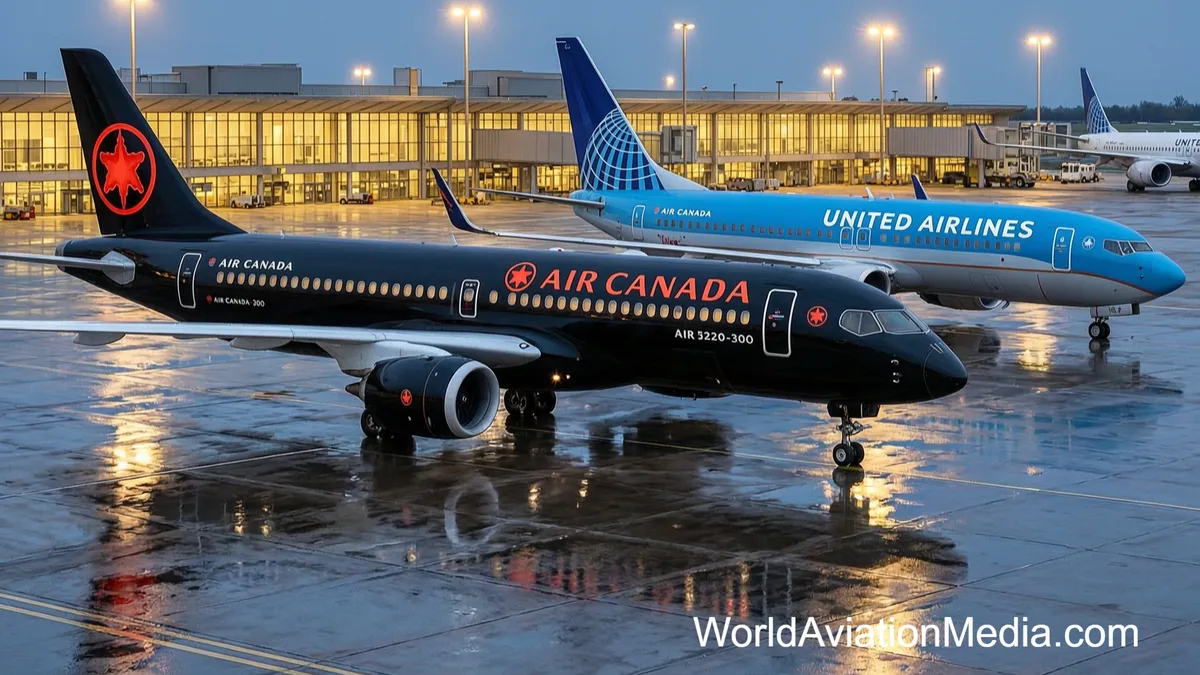
Small-Hub Transborder Strategy: Why United Airlines and Air Canada Are Pivoting Toward Secondary Markets Like St. John's, Louisville, and Indianapolis
Small-Hub Transborder Strategy: Why United Airlines and Air Canada Are Pivoting Toward Secondary Markets Like St. John's, Louisville, and Indianapolis
Key Takeaways
The October 19, 2026 Network Expansion: Air Canada and United Airlines unveiled a sweeping Summer 2027 transborder schedule expansion targeting underserved secondary bypass markets—highlighted by Toronto–Louisville, Montréal–Indianapolis, Edmonton–Newark, Newark–St. John's, Denver–Ottawa, and Denver–Québec City.
Regulatory Timing for the JBA: The route announcements coincide strategically with Canadian regulatory scrutiny of the carriers' expanded Joint Business Agreement (JBA), where public consultations run through November 15, 2026.
Bypassing Trunk Congestion: With primary transborder corridors (like Toronto–Newark or Montréal–Chicago) saturated and slot- or gate-constrained, secondary spoke-to-hub routes capture high-yielding corporate, energy, midwestern manufacturing, and leisure traffic without fare dilution.
Fleet Economics as the Enabler: The deployment of next-generation small narrowbodies and large regional jets—such as Air Canada's Airbus A220-300 (up-gauging Edmonton–San Francisco) and 76-seat E175/CRJ-900 platforms—allows profitable daily operations on thin 80-to-130-passenger city pairs.
Moving Beyond the Saturated Trunk Routes of North America
For decades, the commercial aviation map across the 49th parallel followed a rigid, predictable hierarchy. If a traveler in Louisville, Kentucky, wanted to reach Toronto, or a passenger in St. John's, Newfoundland, needed to get to the New York metropolitan area, they were forced to endure a dogleg domestic connection through Chicago O'Hare, Newark, Toronto Pearson, or Montréal-Trudeau. Meanwhile, the primary transborder trunk routes—Toronto (YYZ) to New York, Chicago, and Los Angeles—became fiercely contested battlegrounds saturated with hourly frequencies.
On Monday, October 19, 2026, Air Canada and United Airlines signaled that the next phase of U.S.–Canada growth will not be won by piling another widebody onto saturated trunk corridors. Instead, the Star Alliance partners unveiled an aggressive Summer 2027 transborder network expansion focused squarely on secondary bypass markets: launching nonstop links into Louisville (SDF), Indianapolis (IND), St. John's (YYT), Edmonton (YEG), Ottawa (YOW), Québec City (YQB), and Winnipeg (YWG).
"From Louisville and Indianapolis to Newark, we are giving customers more ways to travel directly to U.S. destinations, together with convenient connections across United's and Air Canada's extensive networks." — Air Canada & United Airlines Transborder Expansion Announcement, October 19, 2026
Small-hub transborder bypass strategy is an airline network planning methodology that connects a primary fortress hub in one country directly to a secondary or tertiary catchment city in a neighboring country, eliminating double-connect itineraries while feeding global long-haul banks at the anchor hub. Why are Montreal and Chicago headquarters executing this pivot right now, and how does it tie into the November 15, 2026 regulatory deadline governing their cross-border partnership?
Inside the Summer 2027 Air Canada & United Route Blueprint
To understand the strategic architecture of the October 19, 2026 announcement, look at how the two carriers divided the operational assignments across their respective hubs:
Operating Carrier | New / Expanded Transborder Route | Operational Window & Frequency | Strategic Catchment & Network Role |
Air Canada | Toronto (YYZ) – Louisville (SDF) | April 28 – October 31, 2027 (Up to daily) | Connects Kentucky's automotive, logistics, and bourbon/tourism corridor into YYZ's global European/Asian banks. |
Air Canada | Montréal (YUL) – Indianapolis (IND) | June 1 – September 30, 2027 (Daily) | Links Indiana's pharmaceutical, life sciences, and motorsport hub with YUL's Francophone European/African network. |
Air Canada | Edmonton (YEG) – Newark (EWR) | June 1 – October 17, 2027 (4x weekly) | Restores nonstop New York City access for Alberta's capital and energy/government sector without connecting in YYZ or YYC. |
Air Canada | Edmonton (YEG) – San Francisco (SFO) | Summer 2027 (Capacity up-gauge) | Up-gauges existing service to the larger, longer-range Airbus A220, linking Alberta tech/energy to Silicon Valley. |
United Airlines | Newark (EWR) – St. John's (YYT) | Summer 2027 (Seasonal nonstop) | Captures booming Newfoundland tourism, offshore energy, and VFR traffic directly into United's NYC transatlantic gateway. |
United Airlines | Denver (DEN) – Ottawa (YOW) | Summer 2027 (New nonstop) | Connects Canada's federal capital directly into United's massive mid-continent Mountain West mega-hub. |
United Airlines | Denver (DEN) – Québec City (YQB) | Summer 2027 (New nonstop + IAD boost) | Taps high-spending U.S. western leisure/cruise tourists bound for Québec City; paired with increased Washington Dulles (IAD) – YQB frequencies. |
United Airlines | Denver (DEN) – Winnipeg (YWG) | Summer 2027 (+65% daily seat capacity) | Major capacity injection (+65% seats) connecting Manitoba's commercial hub to the Western U.S.. |
Notice the mirror-image symmetry across the border. Air Canada uses its two eastern mega-hubs—Toronto Pearson (YYZ) and Montréal-Trudeau (YUL)—to reach deep into underserved Midwestern U.S. industrial centers (Louisville and Indianapolis) that lack direct international flights across the Atlantic or Pacific. Conversely, United Airlines uses its powerhouse U.S. hubs at Newark (EWR), Denver (DEN), and Washington Dulles (IAD) to reach directly into secondary Canadian provincial capitals (St. John's, Ottawa, Québec City, and Winnipeg).
Four Drivers Behind the Secondary Transborder Pivot
1. Sixth-Freedom Long-Haul Feed vs. Domestic Hub Bypass
When Air Canada launches daily summer service between Montréal (YUL) and Indianapolis (IND) or Toronto (YYZ) and Louisville (SDF), it is not merely selling tickets to Americans visiting Niagara Falls or Old Montréal. Thanks to sterile international-to-international transit facilities at YYZ and YUL (where U.S.-originating passengers do not need to clear formal Canadian customs entry before boarding a flight to Europe), Air Canada transforms Louisville and Indianapolis into feeder spokes for its flights to Paris, Rome, Athens, Geneva, Casablanca, and Tokyo. For a corporate traveler at Eli Lilly in Indianapolis or Humana in Louisville, connecting through Montréal or Toronto with a single stop to Europe is often faster and less delay-prone than battling thunderstorm ground stops at JFK, Newark, or Chicago O'Hare.
Similarly, United's new Denver–Ottawa, Denver–Québec City, and expanded Denver–Winnipeg (+65% seat capacity) flights allow Canadian travelers in the prairies and eastern provinces to bypass congested Toronto Pearson altogether, clearing U.S. Customs and Border Protection (CBP) preclearance (where available) and dropping straight into Denver's massive bank of 170+ U.S. West Coast, Southwest, and Latin American connections.
2. The Regulatory Chess Match: Securing the Expanded JBA (November 15 Deadline)
The timing of the October 19, 2026 announcement is anything but coincidental. Air Canada and United Airlines are actively seeking formal regulatory authorization from Ottawa to expand the Joint Business Agreement (JBA) that governs their Canada–U.S. transborder partnership. Under the JBA framework, the two carriers coordinate flight schedules, harmonize through-fares, share revenues on select corridors, and offer seamless integrated rebooking during irregular operations.
With the Canadian public consultation period running until November 15, 2026—after which the Minister of Transport can authorize the arrangement unconditionally, authorize it with conditions, or refuse it—demonstrating tangible consumer benefits is paramount. Antitrust regulators at Canada's Competition Bureau historically view joint ventures with skepticism if they merely consolidate market share on trunk routes. By proving that the JBA enables direct transborder connectivity for eight secondary Canadian gateways (Calgary, Edmonton, Halifax, Ottawa, Québec City, Regina, St. John's, and Winnipeg) alongside new U.S. mid-sized cities (Louisville and Indianapolis), Air Canada and United hand the Transport Minister an ironclad public-interest justification to approve the JBA expansion.
3. Airbus A220 and Next-Gen Regional Fleet Economics
Ten years ago, operating Edmonton–Newark four times a week or Newark–St. John's required either a fuel-thirsty 50-seat CRJ-200 (which lacked the range or passenger comfort for 4+ hour stages) or a 160-seat Boeing 737/Airbus A320 that forced airlines to slash fares to fill the back of the cabin. Today, Air Canada's deployment of the 137-seat Airbus A220-300—explicitly highlighted in its decision to up-gauge Edmonton–San Francisco for Summer 2027—alongside United's Next-annotated E175s and 737 MAX 8s, completely changes the breakeven load factor math on thin 1,500-to-2,200-mile sectors.
4. WestJet's Pivot and Competitive Vacuum
With rival WestJet concentrating its narrowbody core in Calgary and focusing heavily on leisure sun destinations (even as WestJet topped North American on-time rankings for five straight months in 2026), and Porter Airlines building out its Embraer E195-E2 network from Toronto Pearson and Ottawa, the United–Air Canada alliance is aggressively walling off corporate and secondary transborder catchments before competitors can establish a foothold.
5-Item Q&A Section (FAQ)
Q1: What new transborder routes did Air Canada announce on October 19, 2026, for Summer 2027?
Air Canada announced three new U.S. routes for Summer 2027: Toronto–Louisville (up to daily, April 28 to October 31), Montréal–Indianapolis (daily, June 1 to September 30), and Edmonton–Newark (4x weekly, June 1 to October 17), while up-gauging Edmonton–San Francisco to the Airbus A220.
Q2: What new Canadian routes did United Airlines announce for Summer 2027?
United Airlines announced three new seasonal routes for Summer 2027: Newark–St. John's, Denver–Ottawa, and Denver–Québec City, alongside increased frequencies on Washington Dulles–Québec City and a 65% boost in daily seat capacity on Denver–Winnipeg.
Q3: How does the United Airlines–Air Canada Joint Business Agreement (JBA) work?
The transborder JBA allows Air Canada and United to coordinate flight schedules, offer integrated through-fares, share revenue on covered routes, and provide seamless cross-carrier rebooking during flight disruptions across primary and secondary cities.
Q4: What is the regulatory deadline for the expanded Air Canada–United partnership in 2026?
Public consultation in Canada on the expanded Air Canada–United transborder arrangement runs until November 15, 2026, after which the Minister of Transport will decide whether to authorize the partnership, attach conditions, or refuse it.
Q5: Why are airlines adding routes to secondary cities like Louisville, Indianapolis, and St. John's?
Secondary bypass routes allow Air Canada and United to avoid gate and slot congestion at saturated trunk hubs, capture high-yield local corporate and leisure travelers, and feed sixth-freedom international connecting banks in Toronto, Montréal, Newark, and Denver.
Metadata
Target SEO Keywords: Air Canada United Airlines Summer 2027 routes, Toronto Louisville flights Air Canada, Montreal Indianapolis flights, Newark St Johns United Airlines, Denver Ottawa Quebec City flights, US Canada transborder Joint Business Agreement 2026, small hub bypass aviation strategy.
Hashtags: #AirCanada #UnitedAirlines #TransborderFlights #AviationNetworks #StarAlliance #RoutePlanning #CanadianAviation
