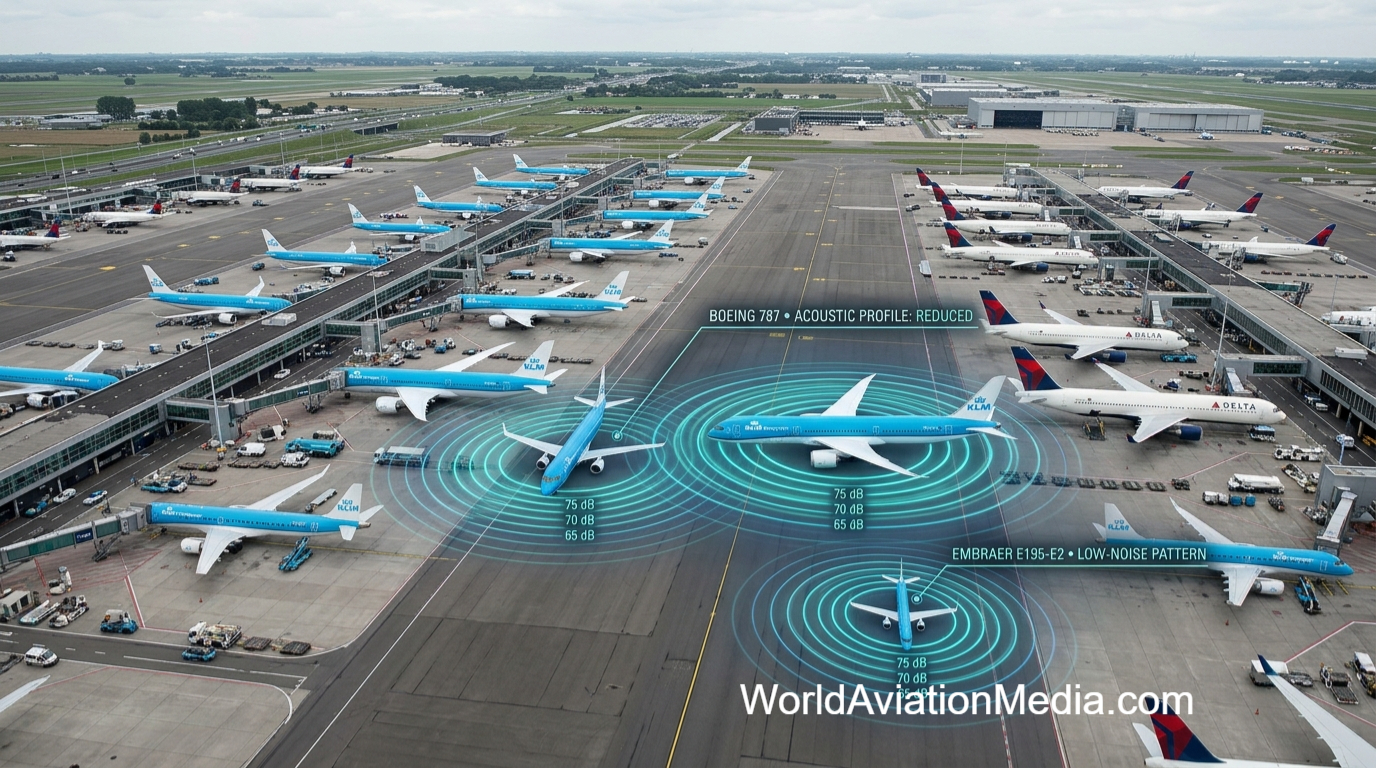
Schiphol's 478,000-Movement Ceiling: The Blueprint for European Environmental Capacity Capping?
Key Takeaways
The Legislated Contraction: Following years of legal battles and European Commission "Balanced Approach" reviews, the Dutch government has cemented a permanent operational ceiling at Amsterdam Airport Schiphol (AMS) of 478,000 annual aircraft movements—forcing a structural reduction from its pre-pandemic 500,000-flight threshold to hit a 15%–20% noise reduction target.
KLM's Hub-and-Spoke Existential Squeeze: As Schiphol's home carrier operating roughly 55% to 60% of all slots, Air France-KLM subsidiary KLM Royal Dutch Airlines faces a mathematical vise: losing feeder slots threatens the six-wave transfer connectivity that makes intercontinental routes viable from a catchment of just 18 million Dutch citizens.
Multi-Billion-Euro Fleet Quietness Pivot: Rather than surrendering passenger volume, KLM is executing a €7 billion fleet overhaul—replacing Boeing 737-700/800s and older widebodies with Airbus A321neos, Embraer E195-E2s, and Airbus A350-900/1000s that lower noise footprints by up to 40% while carrying more passengers per slot.
The European Domino Effect: From Brussels (BRU) and Paris Orly (ORY) to Dublin (DUB) and Lisbon (LIS), European environmental ministries and noise-lobby coalitions are adopting Schiphol's ICAO "Balanced Approach" dossier as the legal template to cap airport growth across the continent.
What Is Amsterdam Schiphol's 478,000-Movement Flight Cap?
Amsterdam Airport Schiphol's 478,000-movement ceiling is the Dutch government's legally binding environmental capacity limit restricting the total number of commercial aircraft takeoffs and landings permitted per year at the Netherlands' primary hub. Enacted following European Commission scrutiny under the ICAO "Balanced Approach" Regulation (EU 598/2014), the cap cuts Schiphol's historical 500,000-flight limit by 4.4%—accompanied by stricter night-flight caps (reduced to 27,000 movements) and punitive noise-differentiated landing tariffs—to achieve a mandatory 15% to 20% reduction in surrounding residential noise exposure.
For a century, the golden rule of national aviation policy in Europe was simple: when a hub airport runs out of capacity, you poured concrete. You built a fifth or sixth runway, expanded the terminal piers, and celebrated the GDP multiplier of global connectivity.
At Amsterdam Airport Schiphol (AMS)—Europe's premier single-terminal transfer super-hub—that era is dead.
After a tumultuous three-year regulatory saga that pitted the Dutch Ministry of Infrastructure and Water Management against KLM, IATA, Airlines for America, the U.S. Department of Transportation (which threatened retaliatory slot seizures against Dutch carriers at U.S. airports), and the European Commission, The Hague has locked in its legally fortified compromise: a permanent ceiling of 478,000 annual aircraft movements (representing a slightly softer cut than the earlier, court-halted 452,500 and 460,000 proposals, yet still a painful contraction from the 500,000 cap and the originally promised 540,000 expansion).
Why did a slightly higher 478,000 figure pass muster where earlier cuts failed—and why are airline strategists across Europe terrified that Amsterdam has just written the legal blueprint for capping aviation growth across the European Union?
How the Dutch Government Navigated the ICAO "Balanced Approach"
To understand why Schiphol's 478,000 cap is a watershed moment in aviation law, one must look at why the Dutch Supreme Court (Hoge Raad) and the European Commission blocked the government's first attempt to slash flights back in 2023–2024.
Under EU Regulation 598/2014—which codifies the International Civil Aviation Organization's (ICAO) "Balanced Approach" to Aircraft Noise Management into binding European law—a member state is strictly forbidden from arbitrarily slapping a movement cap on an international airport. Instead, an Operating Restriction (cutting flights) may only be used as a measure of last resort after the state has transparently modeled and exhausted three prior pillars:
Reduction of Noise at the Source: Counting the organic noise benefits of airlines taking delivery of quieter next-generation aircraft (A320neos, A350s, 787s, E2s).
Land-Use Planning and Management: Soundproofing homes and restricting residential zoning under approach paths.
Noise Abatement Operational Procedures: Optimizing continuous descent approaches (CDAs), preferential runway usage, and steeper glide slopes.
In its revised submission to Brussels, the Dutch government didn't skip the Balanced Approach; it weaponized it.
By first defining an explicit, quantifiable health objective—reducing the number of residents experiencing severe noise annoyance (48dBLden) and sleep disturbance (40dBLnight) by 15% to 20% initially—and then mathematically incorporating KLM's fleet renewal schedule, banning the loudest legacy aircraft (such as Boeing 747-400Fs and older 737s) at night, cutting the night ceiling from 32,000 to 27,000 movements, and still demonstrating a residual noise gap, the Ministry proved to EU regulators that a 478,000 movement cap was legally proportionate.
+-------------------------------------------------------------------------+
| AMSTERDAM SCHIPHOL CAPACITY & NOISE REGIME (2019 vs 2026) |
+-------------------------------------------------------------------------+
| Regulatory Metric | Pre-Cap Baseline | New Legislated Cap|
|-------------------------------|---------------------|-------------------|
| Total Annual Flight Ceiling | 500,000 Movements | 478,000 Movements |
| Night Flight Cap (23:00-07:00)| 32,000 Movements | 27,000 Movements |
| Prohibited Night Aircraft | Chapter 3 Marginals | QC2+ / Loud 737s |
| Noise Reduction Mandate | Voluntary Targets | -15% to -20% Legal|
| Tariff Spread (Loud vs Quiet) | ~2.5x Landing Fee | Up to 5.0x Fee |
+-------------------------------------------------------------------------+
The KLM Hub Dilemma: Why a 4.4% Cut Hits Network Math Exponentially
On paper, reducing an airport's ceiling from 500,000 to 478,000 flights is a 4.4% reduction. Why, then, has KLM Royal Dutch Airlines warned that the cap combined with soaring Schiphol airport charges threatens the foundational logic of its business model?
Because a hub-and-spoke network does not scale linearly; it scales exponentially (N2).
Unlike British Airways in London (which sits inside a wealthy local metropolitan catchment of 14+ million people and a UK population of 68 million) or Air France in Paris, KLM operates out of the Netherlands—a country of just 18 million people. Local Dutch origin-and-destination (O&D) demand cannot fill a daily Boeing 787-10 to Kilimanjaro, Austin, Bogota, or Osaka on its own.
Instead, roughly 60% to 70% of the passengers on a KLM long-haul widebody are transfer passengers collected from 90 short-haul European "spoke" cities (such as Billund, Newcastle, Nuremberg, Gothenburg, and Krakow) via KLM Cityhopper and KLM mainline narrowbodies.
How the Slot Squeeze Breaks the Wave System
Under EU Slot Regulation (EEC 95/93), when an airport's total capacity is forcibly reduced, the pain is distributed proportionally across incumbent slot holders before any new entrants are admitted. For KLM (together with subsidiary Transavia and SkyTeam partner Delta Air Lines), losing even 10,000 to 12,000 annual slots forces an agonizing triage:
You Cannot Cut the Long-Haul Trunk First: Cutting a daily widebody to Tokyo or New York surrenders high-margin corporate revenue and strands feed across 90 European spokes.
Cutting Short-Haul Spokes Starves the Widebodies: Conversely, if KLM trims frequencies on thin 88-seat Embraer E175 feeder routes from secondary UK, Scandinavian, or German cities to free up slots, its long-haul 777s and 787s suddenly lose 15 to 25 high-yield connecting business passengers per flight—pushing marginal intercontinental destinations below the break-even load factor threshold.
The Night Curfew Crush on Cargo and Transavia: Cutting Schiphol's night cap from 32,000 to 27,000 movements hits two segments hardest: full-freighter operators (KLM Cargo/Martinair and Asian cargo carriers) that rely on late-night flower and pharmaceutical arrivals, and leisure carrier Transavia, whose business model relies on departing Schiphol at 05:30–06:30 AM to complete three Mediterranean rotations per day.
KLM's €7 Billion Counter-Strategy: Up-Gauging and Acoustic Engineering
Faced with a hard ceiling on how many times its wheels can touch Schiphol's asphalt, KLM has pivoted its entire capital expenditure plan toward maximizing Passengers per Movement and Decibels per Seat.
Over the 2024–2029 window, KLM is executing a €7 billion fleet transformation specifically calibrated to defeat Schiphol's noise contours and punitive acoustic landing tariffs (where Schiphol now charges the loudest aircraft up to five times more per landing than the quietest Chapter 14 jets):
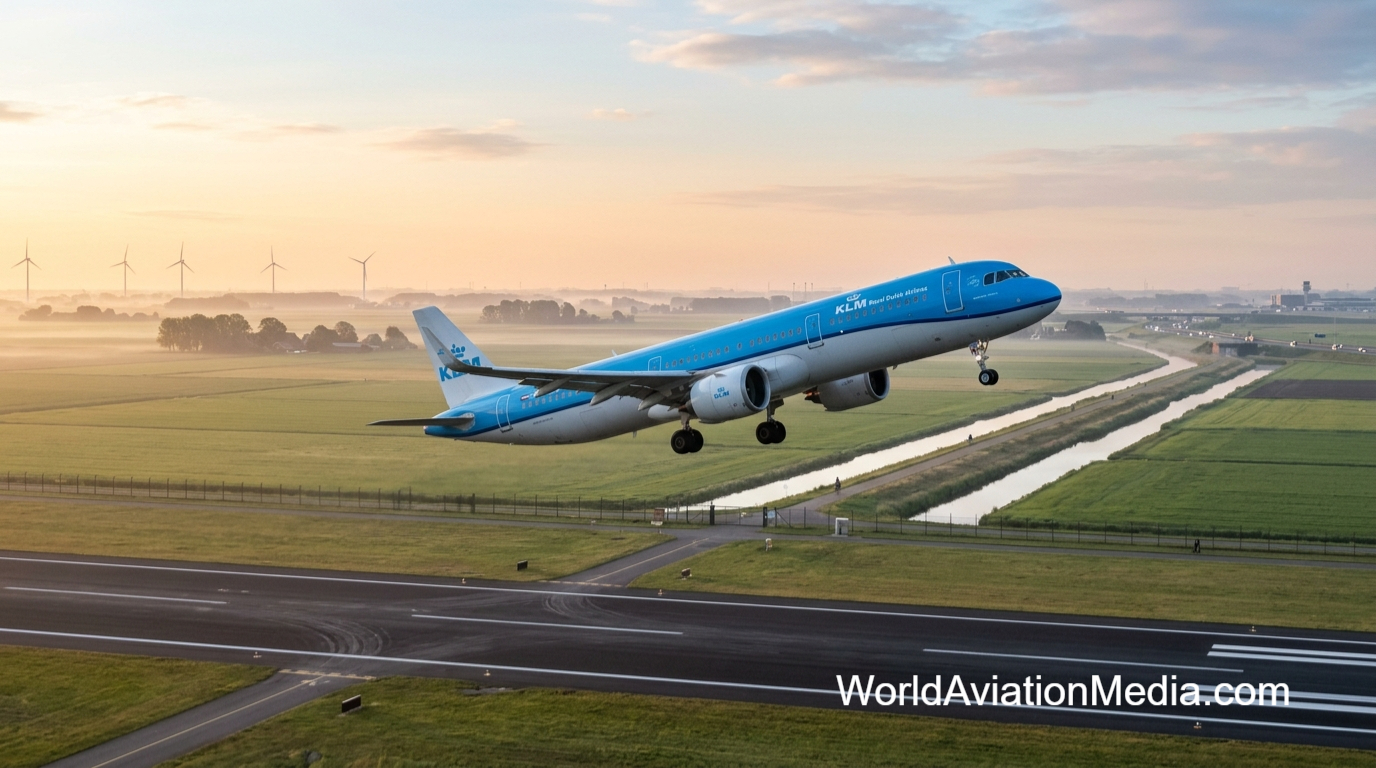
Replacing 737s with High-Capacity Airbus A321neos: By retiring its aging Boeing 737-700 (142 seats) and 737-800 (186 seats) fleet and replacing them with 227-seat Airbus A321neos powered by CFM LEAP-1A engines, KLM increases seat capacity per slot by 22% to 60% while simultaneously shrinking the ground noise contour by nearly 50%.
Up-Gauging KLM Cityhopper to Embraer E195-E2s: In the regional feeder fleet, KLM is systematically shifting capacity from smaller 88-to-100-seat E175/E190 jets to the 132-seat Embraer E195-E2—the quietest single-aisle jet in production. Additionally, KLM reconfigured its E195-E2 cabins to pack an extra four seats per aircraft, squeezing more transfer passengers into every single regional slot.
Retiring A330s and 747-400Fs for Airbus A350s and A350Fs: On long-haul and cargo routes, KLM is replacing its Airbus A330-200/300 passenger jets and aging Boeing 747-400ERF nose-loader freighters with Airbus A350-900s, A350-1000s, and next-generation A350F freighters—ensuring its cargo hub survives the stricter night noise regime.
The European Domino Effect: Who Caps Next?
For the wider European aviation industry, the danger of Schiphol's 478,000 ceiling is not confined to the polders of North Holland. By proving that an EU member state can successfully navigate the European Commission's Balanced Approach audit and legally force a major hub to shrink, the Netherlands has handed a turnkey legal template to transport and environment ministries across Europe:
Brussels Airport (BRU): In Belgium, the renewal of Brussels Airport's regional environmental permit has already been tied to tightening annual movement caps (~240,000 movements by 2032), stricter night-noise quotas, and progressive phase-outs of louder night cargo flights.
Dublin Airport (DUB): Ireland's gateway has spent years entangled in planning battles over its 32-million-passenger-per-year terminal planning cap, forcing airlines like Ryanair and Aer Lingus as well as U.S. carriers into courtroom battles over seasonal slot allocations.
France (Paris Orly & Regional Hubs) and Spain: French environmental authorities continue to pair short-haul domestic flight bans with tightening night curfews and movement limits at slot-coordinated airports like Paris Orly (capped at 250,000 slots), while Spanish ministries scrutinize short-haul substitution and hub expansion limits in Madrid and Barcelona.
In the late 2020s, the primary constraint on European airline growth is no longer how many planes Airbus and Boeing can build, or how many passengers want to fly. It is the decibel meter bolted to a suburban lamppost five kilometers from the runway threshold.
SEO & AEO Optimization Summary
Primary Search Intent: Regulatory/Strategic Network Analysis (European airline planners, environmental aviation lawyers, and aerospace analysts studying the Schiphol 478,000 flight cap, ICAO Balanced Approach law, and KLM's fleet modernization).
Featured Snippet Target: Concise definition of the 478,000 Schiphol cap, its legal basis under EU Regulation 598/2014 (ICAO Balanced Approach), and a comparison table of pre-cap vs. post-cap rules.
5-Item Q&A Section (FAQ)
Q1: What is the new annual flight limit at Amsterdam Airport Schiphol? A: The Dutch government has legislated a ceiling of 478,000 commercial aircraft movements per year at Amsterdam Schiphol—down from its previous 500,000 limit—alongside cutting night flights (11:00 PM to 7:00 AM) from 32,000 to 27,000 per year to achieve a 15%–20% noise reduction.
Q2: What is the ICAO "Balanced Approach" and how did it affect Schiphol's cap? A: Codified into European law under EU Regulation 598/2014, the ICAO Balanced Approach requires governments to first calculate noise reductions from quieter new aircraft, land-use planning, and quieter flight procedures before cutting flight numbers. The Dutch government's revised 478,000 cap succeeded because it formally modeled KLM's fleet renewal and operational measures before applying the slot cut as a final measure.
Q3: Why does a 4.4% flight cut hurt KLM's hub-and-spoke model so severely? A: Because the Netherlands has a small domestic population of 18 million, KLM relies on transfer passengers for 60%–70% of its long-haul traffic. Losing short-haul feeder slots from secondary European cities reduces connecting passenger feed across its entire intercontinental widebody network, threatening the profitability of long-haul routes.
Q4: How is KLM adapting its fleet to survive Schiphol's flight cap and noise tariffs? A: KLM is investing €7 billion to up-gauge its fleet with larger, up to 40%–50% quieter aircraft—replacing Boeing 737s with 227-seat Airbus A321neos, expanding 132-seat Embraer E195-E2 regional operations, and ordering Airbus A350-900/1000 passenger jets and A350F freighters to carry more passengers per slot while avoiding punitive noise landing fees.
Q5: Could other European airports follow Schiphol's environmental capacity cap? A: Yes. Aviation analysts view Schiphol's EU-reviewed Balanced Approach dossier as a legal blueprint for other noise-constrained European hubs, with airports such as Brussels (BRU), Dublin (DUB), and Paris Orly (ORY) already facing or enforcing strict environmental movement and passenger caps.
Metadata
Target SEO Keywords: Amsterdam Schiphol 478000 flight cap, ICAO Balanced Approach EU Regulation 598/2014, KLM hub and spoke strategy Schiphol, KLM A321neo A350 fleet renewal, European airport environmental capacity caps, Schiphol night flight reduction 27000, Dutch government aviation noise law.
Relevant Hashtags: #Schiphol #KLM #AviationRegulation #SustainableAviation #AirportCapacity #A321neo #EuropeanAviation #AirlineNetwork
