SAF Blending Infrastructure: Regulatory Mandates vs. Refinery Output Realities Key Takeaways
Key Takeaways
The Mandate Gap: Aggressive European and North American regulatory mandates are legally forcing airlines to scale Sustainable Aviation Fuel (SAF) adoption, yet global production accounts for less than 1% of total jet fuel consumption.
Production Economics: While global SAF market valuations are climbing toward multi-billion-dollar milestones, physical output is severely constrained by scarce waste oil and agricultural lipid feedstocks.
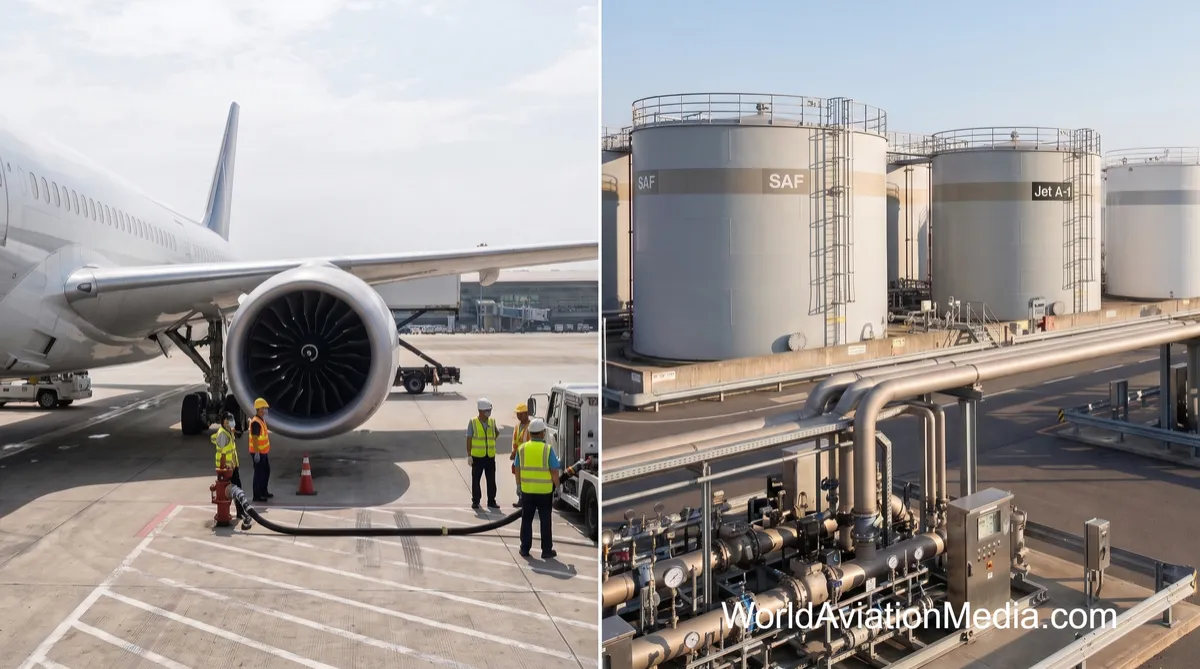
Blending & Logistics Bottlenecks: Traditional airport fuel hydrant systems and off-site storage terminals require dedicated segregated infrastructure to prevent cross-contamination and manage precise physical blending ratios.
Alternative Pathways: Scaling past current HEFA (Hydroprocessed Esters and Fatty Acids) limitations requires urgent commercialization of Alcohol-to-Jet (AtJ) and Power-to-Liquid (PtL) synthetic fuel technologies.
In-Depth Article Content
Sustainable Aviation Fuel (SAF) has justifiably earned its reputation as the most potent weapon in aviation's decarbonization arsenal. As a certified "drop-in" fuel capable of reducing lifecycle greenhouse gas emissions by up to 80% without requiring any modifications to existing aircraft engines or airport fuel infrastructure, SAF is the industry's immediate bridge to net-zero. However, as European regulatory mandates and North American policy incentives tighten their grip, a glaring structural crisis has emerged: the chasm between aggressive legal mandates and actual refinery output is widening into an operational chasm.
The Mandate vs. Output Mismatch
Governments on both sides of the Atlantic have enacted stringent blending mandates that penalize airlines for failing to incorporate specified percentages of SAF into their annual uplift. In Europe, blending obligations climb steeper year-on-year, while North American tax credits stimulate aggressive corporate procurement.
Yet, hard operational data reveals a stark reality: global SAF production hovers around 2.4 million tonnes annually, accounting for a fraction of total global jet fuel consumption. Airlines are legally mandated to buy a product that simply does not exist in sufficient physical quantities. This supply deficit triggers severe market distortions, inflating SAF spot prices significantly above conventional Jet-A and sparking fierce corporate competition for available batches.
Feedstock Scarcity and the HEFA Bottleneck
The root cause of the production deficit lies in feedstock availability. The overwhelming majority of current commercial SAF is produced via the HEFA-SPK (Hydroprocessed Esters and Fatty Acids) pathway, utilizing waste cooking oils, animal fats, and industrial lipid residues.
These feedstocks are finite. As multiple industrial sectors—including maritime shipping and road transport—compete for the same waste oils, supply chains face severe ceilings. Relying indefinitely on waste fats is mathematically unsustainable if global aviation intends to scale SAF past single-digit percentages. Transitioning to second- and third-generation feedstocks—such as cellulosic agricultural residues, municipal solid waste, and captured industrial carbon (Power-to-Liquid / PtL)—is an absolute necessity, but these capital-intensive facilities take years to permit, finance, and construct.
Airport Infrastructure and Supply Chain Logistics
Beyond the refinery gate, physical blending infrastructure presents its own set of hurdles. SAF is rarely pumped into aircraft in pure 100% form (unless specifically certified for ultra-low emission test flights); it must be blended precisely with conventional fossil Jet-A to meet strict chemical property standards regarding aromatic content and density.
This necessitates dedicated storage tanks, segregated pipeline injection manifolds, and rigorous testing protocols at major airport fuel farms. In many regional airports and secondary hubs, the lack of separate bulk storage infrastructure makes physical SAF delivery logistically impossible, forcing airlines to rely on complex book-and-claim accounting systems rather than actual physical molecules in their wings.
Bridging the Gap: Policy, Investment, and Technological Horizons
Closing the infrastructure and output gap requires synchronized intervention across three pillars:
Long-Term Offtake Agreements: Airlines must continue signing multi-year, multi-billion-dollar offtake agreements to provide the revenue certainty required for project finance banks to fund new refinery builds.
Regulatory Streamlining: Governments must fast-track environmental permitting for advanced Alcohol-to-Jet (AtJ) and e-fuels facilities, cutting through bureaucratic red tape that delays plant commissioning.
Dedicated Feedstock Cultivation: Expanding certified, non-food-competing cover crops and municipal waste sorting infrastructure to unlock massive new pools of sustainable carbon feedstocks.
SEO & AEO Optimization
Core User Intent: Evaluate the mismatch between government SAF blending mandates and actual global refinery production output.
Direct Answer Definition: SAF blending infrastructure refers to the physical storage tanks, pipeline manifolds, and terminal logistics required to mix sustainable aviation fuel with conventional Jet-A, currently constrained by severe feedstock shortages and low refinery output.
5-Item Q&A Section
Q1: What percentage of global jet fuel consumption does SAF currently represent?
A: Global SAF production accounts for approximately 0.8% (around 2.4 million tonnes) of total annual jet fuel consumption.
Q2: What is the primary bottleneck limiting SAF refinery output?
A: A severe scarcity of certified waste oils, animal fats, and lipid feedstocks, combined with intense competition from other biofuel sectors.
Q3: What does "drop-in fuel" mean in the context of SAF?
A: It means SAF is chemically compatible with conventional Jet-A and can be safely used in existing aircraft engines and airport fuel systems without modification.
Q4: Why is physical blending at airports logistically challenging?
A: Many airports lack dedicated secondary storage tanks and segregated hydrant infrastructure, requiring complex physical blending management or book-and-claim accounting.
Q5: What next-generation technologies are expected to replace HEFA production?
A: Alcohol-to-Jet (AtJ), biomass gasification, and Power-to-Liquid (PtL) synthetic e-fuels derived from captured carbon and green hydrogen.
Metadata & Hashtag
Target SEO Keywords: SAF blending infrastructure, sustainable aviation fuel mandates, refinery output reality, HEFA-SPK aviation fuel, jet fuel supply chain, aviation decarbonization.
Hashtags: #SustainableAviationFuel #SAF #AviationDecarbonization #GreenEnergy #SupplyChain #NetZero
