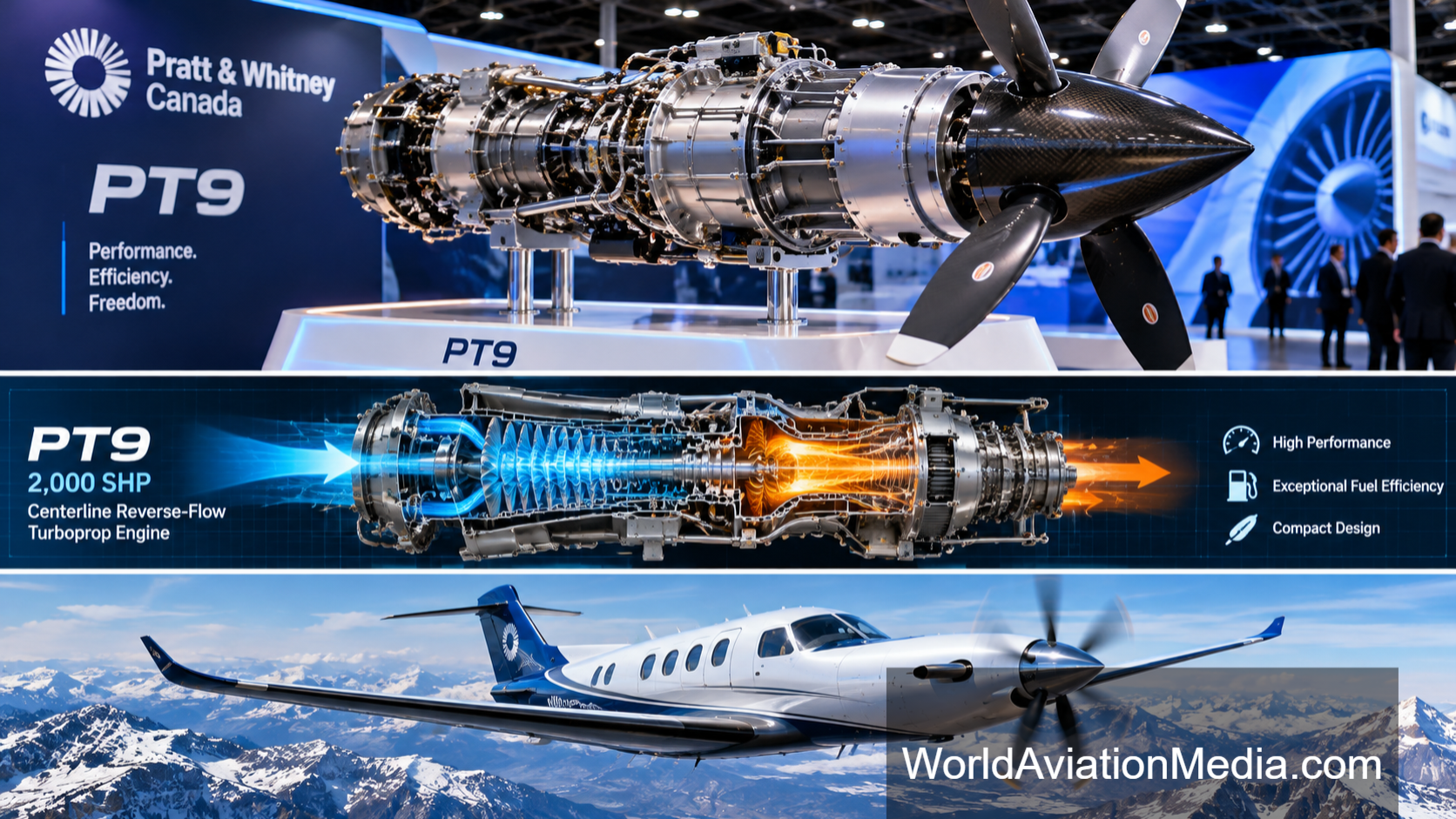
Pratt & Whitney Canada’s Stealth Move: What the Clean-Sheet 2,000-SHP PT9 Means for the Turboprop Market
Key Takeaways
Certified in Secret: On October 21, 2026, at NBAA-BACE in Las Vegas, Pratt & Whitney Canada (P&WC) shocked the aerospace sector by unveiling the PT9—an all-new, clean-sheet 2,000-SHP class turboprop engine that had already quietly received Transport Canada type certification on October 1, 2026.
Step-Change Performance: Spanning a scalable power band from 1,700 to 2,300 shaft horsepower (SHP), the PT9 delivers 33% more power at cruise altitude and 20% lower specific fuel consumption than legacy engines in its class.
Aerodynamic Architecture: Featuring a centerline gearbox layout, reverse-flow combustor, and an ultra-slim 19-inch "barrel" diameter, the PT9 minimizes nacelle drag and is pre-architected for future hybrid-electric integration.
Bridging the PT6–PW100 Gap: Assembled in Lethbridge, Alberta, the PT9 does not replace the iconic PT6 family; instead, it bridges the horsepower gap between top-end PT6 variants and lower-end PW100 regional engines while countering GE Aerospace’s Catalyst.
The Ultimate NBAA-BACE Surprise: An Engine Certified Before Its Reveal
In modern aerospace development, clean-sheet turbine engine programs typically follow a predictable, decade-long public arc: conceptual announcements at airshows, years of publicized ground runs, protracted certification delays, and eventual service entry. On October 21, 2026, at the National Business Aviation Association Business Aviation Convention & Exhibition (NBAA-BACE) in Las Vegas, Pratt & Whitney Canada (P&WC) tore up that playbook.
Without a single prior leak to the trade press, P&WC President Satheeshkumar Kumarasingam pulled back the curtain on the Pratt & Whitney Canada PT9—the manufacturer's first clean-sheet turboprop engine family in decades. Even more astonishing than the hardware itself was the paperwork accompanying it: Transport Canada had already awarded the PT9 its official Type Certificate three weeks earlier, on October 1, 2026.
"The PT9 represents the next evolution of turboprop propulsion—drawing on the legendary reliability of our turboprop heritage while introducing an all-new, scalable architecture built for the next generation of aircraft." — Satheeshkumar Kumarasingam, President, Pratt & Whitney Canada
What is the Pratt & Whitney Canada PT9? The Pratt & Whitney Canada PT9 is a clean-sheet, 2,000-shaft-horsepower (SHP) class turboprop engine certified by Transport Canada in October 202Scalable from 1,700 to 2,300 SHP, it features a centerline architecture with a slim 19-inch diameter barrel and reverse-flow combustor, delivering 33% more power at altitude and 20% lower fuel burn than legacy engines in its class.
Why Develop and Certify in Stealth?
Developing an all-new turbine core, running hundreds of hours of endurance block testing, icing tunnel trials, and blade-off containment tests, and completing Transport Canada certification in total secrecy is an extraordinary feat of industrial security. Why did P&WC choose stealth over early marketing?
Eliminating the "Osborne Effect" on PT6 Sales: P&WC’s iconic PT6 engine family powers the vast majority of the global single- and twin-engine business turboprop fleet, including the Pilatus PC-12 PRO/NGX, Beechcraft King Air 260/360, and Daher TBM 960. Announcing a next-generation turboprop five years prior to certification risks freezing customer aircraft orders as buyers wait for the "new engine".
De-Risking Airframe OEM Commitments: Over the past decade, airframe manufacturers have seen flagship aircraft programs delayed by multi-year engine certification bottlenecks (most notably GE Aerospace’s Catalyst turboprop on the Textron Beechcraft Denali). By walking into OEM boardrooms with a Type Certificate already in hand, P&WC eliminates propulsion certification risk from an airframer’s clean-sheet development timeline.
Competitive Counter-Intelligence: Keeping the PT9's pressure ratios, turbine metallurgy, and 19-inch barrel envelope classified prevented competitors from adjusting their own product roadmaps until the PT9 was ready for production at P&WC's global turboprop center of excellence in Lethbridge, Alberta.
Inside the PT9 Architecture: 19-Inch Barrel, 33% More Altitude Power, 20% Less Fuel
The PT9 is not a scaled-up PT6; it is a clean-sheet thermodynamic and mechanical design engineered to solve the high-altitude performance limitations of traditional turboprops.
The 19-Inch Slim-Line Centerline Layout: Unlike the classic PT6, which uses an offset reduction gearbox with twin exhaust ports near the front of the cowling, the PT9 utilizes a centerline engine layout paired with a reverse-flow combustor encased in a remarkably slim 19-inch "barrel" section. For aerodynamicists, frontal area equals parasite drag. A 19-inch cylindrical cross-section allows airframers to sculpt ultra-tight, low-drag nacelles, boosting cruise speeds into light-jet territory.
33% More Power at Cruise Altitude: Turboprops lose thermodynamic power as air density drops with altitude (lapse rate). By utilizing advanced multi-stage axial-centrifugal compression, higher overall pressure ratios, and single-crystal hot-section metallurgy, the PT9 retains 33% more shaft horsepower at high cruise altitudes (FL280–FL350) than comparable current-generation engines. That translates directly into faster climb rates over weather and 330+ knot true airspeeds.
20% Lower Fuel Consumption: Through integrated electronic engine and propeller control (FADEC/EPECS) and superior thermal efficiency, the PT9 cuts specific fuel consumption (SFC) by 20%. On a 1,500-nautical-mile mission, a 20% fuel savings not only slashes direct operating cost per hour—it reduces the weight of fuel the aircraft must carry, expanding useful payload.
Hybrid-Electric Readiness: P&WC explicitly designed the PT9’s modular accessory gearbox and centerline shaft architecture to accommodate high-kilowatt electric motor-generators, allowing the PT9 to serve as the thermal core of future parallel hybrid-electric propulsion systems.
Market Positioning: PT6 vs. PT9 vs. PW100 vs. GE Catalyst
During the NBAA-BACE briefing, P&WC President Satheeshkumar Kumarasingam addressed the question on every aircraft owner's mind: Does the PT9 make the PT6 obsolete? His answer was unequivocal: "We still feel that the PT6 has many years ahead of it."
Rather than cannibalizing the PT6 E-Series (which dominates the 500 to 1,650 SHP segment), the PT9 fills the strategic chasm between the largest PT6A-67 variants and the bottom end of the heavy regional PW100/PW150 series (which starts around 2,400–2,750 SHP for 40-to-70-seat regional airliners).
Engine Family | Manufacturer | Power Band (SHP) | Core Architecture | Primary Target Platforms |
PT6A / PT6 E-Series | Pratt & Whitney Canada | 500 – 1,650+ SHP | Reverse-flow, offset gearbox, dual-channel FADEC (E-Series) | Pilatus PC-12, Daher TBM 960, Beechcraft King Air, Cessna Caravan |
Catalyst | GE Aerospace | 850 – 1,600+ SHP | Clean-sheet 16:1 pressure ratio, VSVs, full FADEC | Beechcraft Denali, MALE Unmanned Aerial Vehicles |
PT9 (New) | Pratt & Whitney Canada | 1,700 – 2,300 SHP | Clean-sheet centerline, 19-in barrel, reverse-flow, hybrid-ready | Next-gen super-single/twin biz-turboprops, tactical BWB freighters, Group 5 UAS |
PW100 / PW127XT | Pratt & Whitney Canada | 2,400 – 5,000+ SHP | Three-shaft free turbine regional turboprop | ATR 42/72, De Havilland Dash 8-400 |
Which Future Airframes Will the PT9 Power?
Because the PT9 requires airframers to design or adapt nacelles and structures around its 2,000-SHP output and 19-inch centerline footprint, the first PT9-powered aircraft is several years from commercial delivery. However, three distinct aerospace segments are prime candidates for immediate airframe-engine integration:
Super-Single and High-Speed Twin Business Turboprops: For years, business aviation operators have asked whether a pressurized single-engine turboprop can break the 350-knot speed barrier or carry 10–12 passengers in a stand-up cabin. A single 2,000-to-2,300 SHP PT9 engine gives airframers like Pilatus, Daher, or Textron the thrust at FL320 to build a "Super-Single" that rivals light jets in speed while burning 40% less fuel, or a clean-sheet twin turboprop to succeed the King Air 360.
Next-Generation Tactical and Blended-Wing-Body (BWB) Freighters: Emerging tactical cargo platforms—such as Natilus’s 19,000-lb MTOW Kona BWB freighter (currently launching with legacy PT6s) or next-generation STOL commuter cargo aircraft—desperately need high-power-to-weight turboprops in the 2,000-SHP class to lift 8,000-to-12,000-lb payloads out of austere runways.
High-Altitude Defense ISR and Group 5 Autonomous UAS: Military medium-altitude and high-altitude long-endurance (MALE/HALE) drones and airborne early warning platforms suffer severely from engine power lapse above 30,000 feet. The PT9’s 33% boost in altitude power and 20% fuel burn reduction immediately extends on-station loiter endurance and provides abundant electrical extraction capacity for high-powered AESA radars and directed-energy payloads.
With Transport Canada certification complete and FAA validation next in the queue, the Lethbridge assembly line is poised to usher in a golden era for the 2,000-SHP turboprop class.
5-Item Q&A Section
Q1: What is the Pratt & Whitney Canada PT9 engine? Unveiled on October 21, 2026, at NBAA-BACE, the Pratt & Whitney Canada PT9 is a clean-sheet turboprop engine in the 2,000-shaft-horsepower (SHP) class (scalable from 1,700 to 2,300 SHP). It features a slim 19-inch centerline architecture and received Transport Canada type certification on October 1, 2026.
Q2: How much more efficient is the P&WC PT9 compared to existing turboprops? According to Pratt & Whitney Canada, the PT9 delivers 33% more power at cruise altitude and 20% lower fuel consumption compared to current in-service engines in the same horsepower class, alongside a modular design ready for future hybrid-electric integration.
Q3: Does the PT9 replace the Pratt & Whitney PT6 engine? No. P&WC explicitly confirmed that the PT9 does not replace the PT6 family. Instead, the PT9 (1,700–2,300 SHP) fills the power gap between the largest PT6 business turboprop engines and the lower end of the PW100 regional airline turboprop family, while competing directly against upper-end versions of GE Aerospace's Catalyst engine.
Q4: Where will the Pratt & Whitney Canada PT9 be manufactured? Production and final assembly of the PT9 will take place at Pratt & Whitney Canada’s facility in Lethbridge, Alberta, which also serves as the company’s global center of excellence for the PT6 engine family.
Q5: Does the PT9 affect the resale value of current PT6-powered aircraft like the PC-12 or King Air? No. Because no airframe manufacturer has yet announced or certified an aircraft around the clean-sheet PT9, the first PT9-powered aircraft is still several years away from entering service. Existing PT6-powered aircraft retain full factory investment, established overhaul networks, and strong resale liquidity.
Keywords and Hashtags
Keywords: Pratt & Whitney Canada PT9 turboprop, P&WC PT9 2000 SHP engine, NBAA-BACE 2026 PT9 reveal, PT9 vs PT6 turboprop, PT9 vs GE Catalyst, Transport Canada PT9 certification, Lethbridge Alberta turboprop manufacturing.
Hashtags: #PrattWhitneyCanada #PT9Engine #Turboprop #NBAABACE #BusinessAviation #AerospacePropulsion #AviationInnovation #PT6
