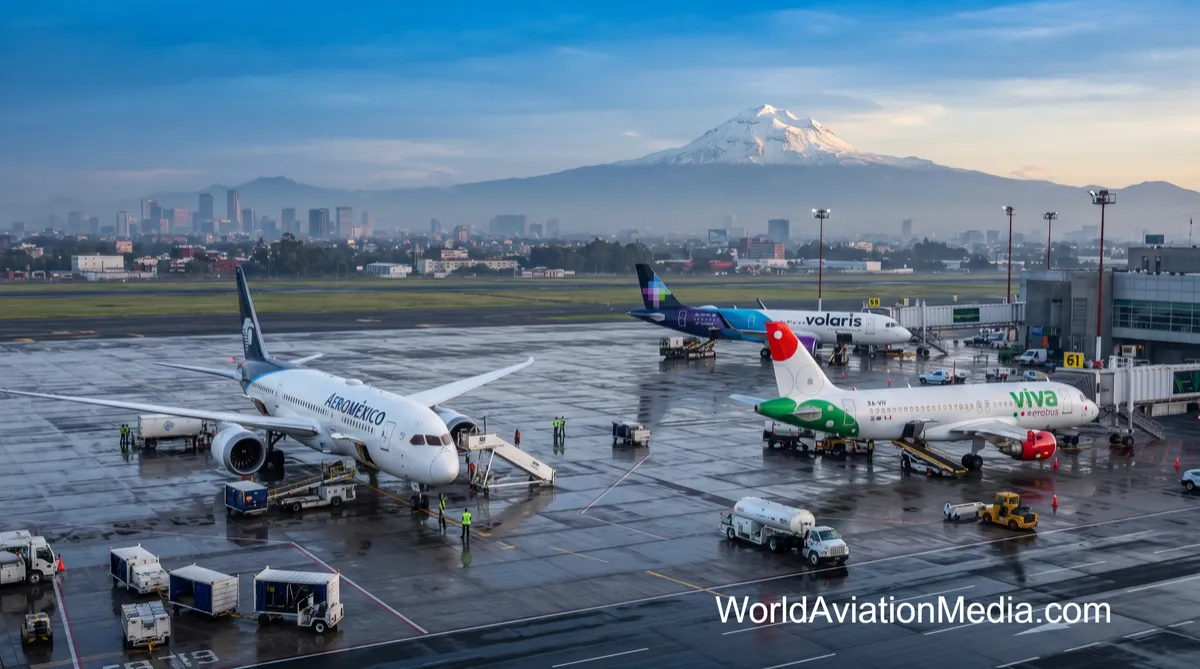
Post-Freeze U.S.–Mexico Network Wars: Where Aeroméxico, Viva, and Volaris Will Deploy Capacity After DOT Revokes Order 213-2
Key Takeaways
The Freeze Is Over: On October 16, 2026, the U.S. Department of Transportation (DOT) officially revoked Order 213-2 with immediate effect, ending a nearly yearlong regulatory blockade imposed on October 28, 2025, that barred Mexican carriers from launching or expanding U.S. routes.
Dual-Airport Unshackling: The repeal restores full schedule flexibility for Aeroméxico, Volaris, Viva Aerobus, and Mexicana de Aviación out of both Benito Juárez International Airport (AICM) and Felipe Ángeles International Airport (AIFA).
Rebuilding After a Costly Standoff: The 2022–2026 bilateral conflict—sparked by AICM slot cuts and forced cargo relocations to AIFA—cost the market 13 routes and stripped the Delta–Aeroméxico Joint Cooperation Agreement (JCA) of antitrust immunity.
Divergent Carrier Strategies: While Aeroméxico focuses on high-yield business frequencies from slot-constrained AICM into U.S. hubs, ULCCs Volaris and Viva Aerobus are poised to unleash low-cost VFR capacity from AIFA and secondary Mexican gateways.
The End of a Yearlong Cross-Border Aviation Blockade
On Friday, October 16, 2026, the U.S. Department of Transportation (DOT) signed a regulatory order that instantly redrew the competitive battleground across the largest international aviation market in North America. With immediate effect, Washington revoked DOT Order 213-2, dismantling the punitive capacity freeze enacted on October 28, 2025, that had prohibited Mexican passenger and charter airlines from introducing new routes or adding frequencies to the United States.
For nearly twelve months, Mexico's flagship carriers—Aeroméxico, Volaris, and Viva Aerobus—alongside state-backed startup Mexicana de Aviación, had been locked in a regulatory straitjacket. While cross-border travel demand for nearshoring business traffic, leisure sun-seekers, and Visiting Friends and Relatives (VFR) hit record levels, Mexican airlines were legally barred from deploying a single incremental seat into the U.S. from the Mexico City metropolitan basin.
"The revocation of Order 213-2 marks an immediate breakthrough for cross-border aviation connectivity out of both AICM and AIFA, restoring schedule flexibility and unlocking long-stalled U.S. expansion plans across Mexico's commercial fleet." — CANAERO & Industry Reaction to the October 16, 2026 DOT Ruling
DOT Order 213-2 was the culmination of a bitter four-year bilateral dispute tracing back to 2022 and 2023, when the Mexican government unilaterally reduced hourly slot operations at Mexico City's primary gateway, Benito Juárez International Airport (AICM), from 61 to 52 and subsequently to 43 operations per hour, while issuing a presidential decree forcing all dedicated cargo airlines to relocate operations 30 miles north to the newly constructed Felipe Ángeles International Airport (AIFA). Finding that Mexico had violated the 2015 U.S.–Mexico Air Transport Agreement, the DOT stripped the Delta Air Lines–Aeroméxico joint venture of its antitrust immunity (ATI), froze route applications, and blocked 13 planned cross-border routes. Following nearly a year of intense diplomatic negotiation between Mexico's Infrastructure, Communications and Transport Ministry (SICT), civil aviation authority AFAC (which also underwent an FAA IASA audit in August 2026), and U.S. regulators, the October 16 repeal opens the floodgates for a fierce capacity war.
AICM vs. AIFA: The Two-Front War in the Valley of Mexico
To predict where Aeroméxico, Volaris, and Viva Aerobus will deploy capacity for Winter 2026/2027 and Summer 2027, network analysts must distinguish between the starkly different economics of Mexico City's two commercial airports:
Benito Juárez International Airport (AICM / MEX): Located minutes from central Mexico City's financial districts, AICM commands an massive yield premium for corporate and connecting traffic. However, because hourly slot caps remain tightly managed to prevent terminal collapse ahead of ongoing renovations, Mexican carriers cannot simply flood AICM with new flights. Growth at AICM requires slot reallocation (shifting domestic frequencies to higher-margin U.S. transborder flights) and up-gauging from Boeing 737-800s or Airbus A320ceos to 737 MAX 9s and A321neos.
Felipe Ángeles International Airport (AIFA / NLU): Located in Zumpango, State of Mexico, AIFA possesses abundant runway and terminal capacity alongside drastically lower airport passenger fees (TUA). Under Order 213-2, AIFA was crippled in its ability to establish transborder credibility because Mexican carriers were blocked from opening U.S. routes from the facility. With the freeze lifted, AIFA transforms into an ultra-low-cost launchpad for price-sensitive VFR traffic across the northern Valley of Mexico.
Carrier | Primary Fleet | Post-Freeze AICM (MEX) Strategy | Post-Freeze AIFA (NLU) & Regional Strategy |
Aeroméxico | B737 MAX 8/9, B787-8/9 | Restore the 13 blocked U.S. routes; maximize frequencies to Delta hubs (ATL, JFK, DTW, SLC, LAX) and business centers. | Selective tactical presence; preserve yield integrity at primary AICM fortress hub. |
Viva Aerobus | A320neo, A321neo (240 seats) | Optimize existing slots via up-gauging to dense A321neos on core Texas/California trunks. | Aggressive U.S. expansion from AIFA and Monterrey (MTY) to Houston, Dallas, Chicago, Las Vegas, and Orlando. |
Volaris | A320neo, A321neo | Defend core VFR slots to California (LAX, OAK, SJC, ONT) and Chicago (MDW/ORD). | Scale AIFA and Guadalajara (GDL) transborder point-to-point network to secondary U.S. Hispanic markets. |
Mexicana de Aviación | B737-800, Embraer E2 (incoming) | No slot access at AICM. | Launch long-stalled U.S. charter and scheduled operations from its AIFA home base. |
Carrier-by-Carrier Playbook: Where the Planes Go Next
1. Aeroméxico: Reclaiming the Corporate Crown and Rebuilding Delta Synergy
No airline suffered more acutely under the 2025–2026 regulatory freeze than Aeroméxico. Stripped of antitrust immunity with equity partner Delta Air Lines and blocked from launching 13 planned routes, Mexico's full-service carrier watched U.S. competitors capture premium transborder share. With Order 213-2 revoked, Aeroméxico's immediate priority is re-activating stalled route authorities linking AICM and secondary Mexican business hubs (Monterrey, Guadalajara, Querétaro, Bajío) to key U.S. metropolitan gateways. Expect immediate frequency additions into New York (JFK/EWR), Chicago O'Hare (ORD), Los Angeles (LAX), Houston (IAH), Austin (AUS), and Raleigh-Durham (RDU), Utilizing its growing fleet of Boeing 737 MAX 8 and MAX 9 aircraft, Aeroméxico will cannibalize lower-yielding domestic frequencies at AICM to feed high-margin U.S. dollar-denominated routes.
2. Viva Aerobus: Turning AIFA and Monterrey into ULCC Powerhouses
Viva Aerobus publicly celebrated the October 16 DOT ruling, and for good reason: as the largest and fastest-growing operator at AIFA, Viva was sitting on an underutilized transborder goldmine. Backed by high-density 240-seat Airbus A321neos, Viva will move rapidly to connect AIFA (NLU) with heavily populated U.S. diaspora and leisure hubs including Dallas/Fort Worth (DFW), Houston (IAH), Chicago (ORD), Las Vegas (LAS), Los Angeles (LAX), and San Antonio (SAT). Even without active antitrust immunity for its proposed joint venture with Allegiant Air, Viva's rock-bottom unit costs (CASM) allow it to stimulate price-elastic VFR traffic that legacy carriers cannot profitably serve.
3. Volaris: The VFR Heavyweight Pivots back to Dollar Revenue
Having weathered two years of Pratt & Whitney PW1100G geared turbofan (GTF) engine inspections that grounded dozens of its A320neo-family aircraft, Volaris enters late 2026 with returning fleet availability just as the U.S. border reopens for growth. Volaris will deploy incremental capacity from AIFA, Guadalajara, Morelia, and Tijuana/Cross Border Xpress into California's secondary basins (Ontario, Sacramento, Fresno, Oakland) and Pacific Northwest gateways (Seattle, Portland), insulating its balance sheet with hard U.S. dollar revenues.
The Fine Print: Continuing DOT Oversight
While Order 213-2 is gone, Mexican carriers do not have a blank check. The DOT explicitly noted on October 16, 2026, that heightened regulatory oversight remains in force: Mexican airlines must continue to file all U.S.-bound schedules with Washington and obtain prior DOT approval for large-aircraft and charter operations. Should Mexico City backtrack on its commitments regarding transparent AICM slot allocation or non-discriminatory treatment of U.S. carriers, the DOT retains the statutory hammer to reinstate capacity restrictions within days.
5-Item Q&A Section (FAQ)
Q1: What was U.S. DOT Order 213-2 and when was it revoked?
Enacted on October 28, 2025, DOT Order 213-2 froze Mexican airlines from launching new U.S. routes or expanding frequencies from Mexico City's AICM and AIFA airports due to a bilateral dispute over slot cuts and cargo relocations. The DOT revoked the order with immediate effect on October 16, 2026.
Q2: Which Mexican airlines benefit from the repeal of Order 213-2?
Aeroméxico, Volaris, Viva Aerobus, and state-owned Mexicana de Aviación all regain the legal authority to apply for and launch new and expanded passenger and charter routes to the United States from both AICM and AIFA.
Q3: Why did the U.S. and Mexico have an aviation dispute between 2022 and 2026?
The dispute began in 2022–2023 when the Mexican government cut hourly flight slots at Benito Juárez International Airport (AICM) and forced all dedicated cargo airlines to move to Felipe Ángeles International Airport (AIFA), which the U.S. DOT ruled violated the 2015 bilateral air transport agreement.
Q4: Does the revocation of Order 213-2 automatically restore Delta-Aeroméxico antitrust immunity?
No. While revoking Order 213-2 allows Aeroméxico to add U.S. routes and frequencies from AICM and AIFA, the loss of antitrust immunity (ATI) for the Delta-Aeroméxico joint venture remains a separate regulatory matter, and the DOT continues to require schedule filings.
Q5: How will Mexican airlines use AIFA (Felipe Ángeles Airport) for U.S. flights now?
With AICM remaining physically slot-constrained, low-cost carriers Viva Aerobus and Volaris—alongside Mexicana de Aviación—will use AIFA's ample capacity and lower passenger fees to launch low-fare VFR routes to Texas, California, Illinois, and Nevada.
Metadata
Target SEO Keywords: US DOT Order 213-2 revoked, US Mexico aviation dispute 2026, AICM AIFA US flights, Aeromexico US route expansion, Viva Aerobus AIFA flights, Volaris transborder capacity, Mexicana de Aviacion US charters.
Hashtags: #USMexicoAviation #Aeromexico #VivaAerobus #Volaris #AICM #AIFA #AirlineNetworks
