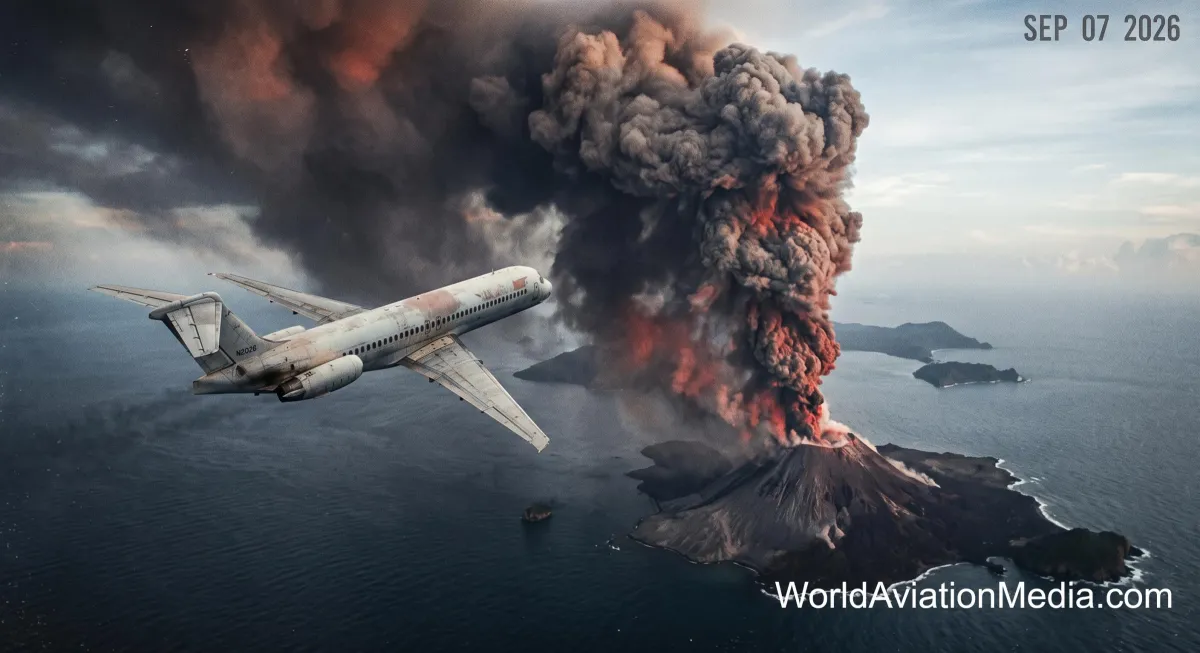
Plumes over Paradise: What the Anak Krakatau Shutdown Teaches Us About Aviation Infrastructure Fragility
KEY TAKEAWAYS
Systemic Fragility in High-Utilization Markets: The September 2026 eruption of Anak Krakatau exposed dangerously thin operational buffers in Southeast Asia, leading to the disruption of over 270,000 passengers and the cancellation of nearly 1,800 flights within a 72-hour window.
Technical Non-Negotiables of Turbine Physics: Volcanic ash remains an absolute barrier to flight; the technical reality of pulverized rock melting into "molten glass" within modern engines necessitates a policy of absolute avoidance rather than risk mitigation.
The Modernity Paradox: A profound strategic irony exists where the industry successfully advances toward decarbonization (eSAF) and digital omnipresence (satellite Wi-Fi) yet remains vulnerable to primal geological arbitration.
Meteorological Volatility: The crisis was amplified by a minor 9 km/h eastward wind shift, demonstrating how regional "cardiac arrest" can be triggered by subtle shifts in the atmosphere dragging ash over previously "safe" hubs.
Supply Chain and Cargo Disruption: Beyond passenger metrics, the grounding of 10 dedicated cargo services at Soekarno-Hatta (CGK) alone highlighted the immediate impact on time-sensitive regional supply chains.
Intermodal Redundancy as a Strategic Buffer: Infrastructure resilience in "Ring of Fire" nations is found not in the air, but in the ability to pivot rapidly to ground-based modalities such as state-provided bus and rail networks.
Historical Precedent as Safety Protocol: The industry’s zero-tolerance policy remains rooted in the foundational trauma of the 1982 British Airways Flight 9 incident, ensuring that avoidance is the only acceptable operational response.
I. INTRODUCTION: THE ILLUSION OF DOMINANCE
In the strategic landscape of 21st-century aviation, the industry has long sought to project an image of technological dominance. By the first week of September 2026, this vision seemed realized. American Airlines had recently inaugurated its high-speed, satellite-based Wi-Fi—sponsored by AT&T—across its global network, while simultaneously celebrating a milestone commercial flight powered by synthetic sustainable aviation fuel (eSAF) in partnership with Infinium. These dual pillars of digital connectivity and environmental sustainability suggest a system that has transcended the limitations of the physical world. However, this illusion of dominance is periodically shattered by the lithospheric realities of our planet.
The eruption of Mount Anak Krakatau serves as a "black swan" case study in infrastructure resilience. Beginning at 23:07 WIB on Friday, September 4, 2026, the volcano initiated a continuous 25-hour eruptive phase. The event was not a mere venting of pressure; it was a violent geological statement, with incandescent rock and ash plumes accompanied by booming echoes heard up to 700 kilometers away. While the industry is increasingly focused on the intangible—data speeds and carbon offsets—the Anak Krakatau event reminds us that aviation remains a fundamentally physical endeavor, tethered to the stability of the earth and the clarity of the atmosphere.
This event revealed that while we can engineer eSAF-powered turbines and provide gigabit-speed internet at 40,000 feet, the systemic paralysis caused by a single geological node can ground an entire region's fleet. While the eruption was geologically expected, the resulting systemic paralysis revealed deeper vulnerabilities in the regional aviation network—vulnerabilities that we must now analyze to secure the 2050 horizon.
II. THE ANATOMY OF A SHUTDOWN: EIGHT AIRPORTS, ONE VOLCANO
The strategic efficiency of Southeast Asian aviation is predicated on a high-utilization hub-and-spoke model. In this network, Jakarta’s Soekarno-Hatta International (CGK) functions as a primary cardiac valve for regional trade and transit. When Anak Krakatau erupted, the resulting "cardiac arrest" was not a localized failure but a systemic collapse that radiated across the Indonesian archipelago. The closure of CGK represents a single-point-of-failure that the regional infrastructure is currently ill-equipped to circumvent.
Mapping the Paralysis
By the morning of Sunday, September 6, the paralysis was total. Eight specific airports were forced to suspend operations, effectively circumscribing the logistical capacity of Western Java:
Soekarno-Hatta (CGK): The central node of the region's air traffic.
Halim Perdanakusuma (HLP): A vital secondary hub for the capital.
Radin Inten II (TKG): The primary link for Lampung across the Sunda Strait.
Husein Sastranegara (BDO): Serving the industrial and educational center of Bandung.
Budiarto (RTO): Curug.
Pondok Cabe (PCB): South Tangerang.
Taufik Kiemas (TFY): Pesisir Barat.
Atung Bungsu (PXA): Pagar Alam.
The criticality of these closures was underscored by the "VA" (Volcanic Ash) weather code issued directly by Soekarno-Hatta at 05:30 UTC on September 6. This was not a theoretical forecast; it was an observation of ash on the field, rendering the runways operationally toxic.
The Wind Shift Factor and Meteorological Complexity
The complexity of the shutdown was exacerbated by a subtle but devastating meteorological shift. At an altitude of approximately 5 kilometers, the wind swung eastward at a speed of roughly 9 km/h. This seemingly minor drift dragged the ash plume over airfields that had been considered safely upwind just an hour prior. This unpredictability complicates Air Traffic Control (ATC) scheduling and airline fleet management, as "safe" airports can become "unsafe" within a single operational window.
Monitoring this threat required high-fidelity data from the Darwin Volcanic Ash Advisory Centre (VAAC). Using Himawari-9 satellite imagery, analysts recorded cloud-top temperatures of minus 68 degrees Celsius, tracking a plume that reached 48,000 feet and moved west at a rapid 93 km/h. Despite this sophisticated tracking, the "Siaga" (Level III) alert status—which had been in force since July 3—meant that the 3-kilometer exclusion zone had to be maintained even as seismic energy appeared to fall. The inability to project the plume's movement with absolute certainty necessitates a conservative, and therefore disruptive, response.
This logistical standstill was not confined to the tarmac; its echoes were felt across the socio-economic fabric of the region. As Jakarta moved its schools online for the following Monday and authorities monitored 20 tsunami gauges for sea-level changes in the Sunda Strait, the human and economic cost of the standstill began to come into sharp focus.
III. THE 270,000 PASSENGER PROBLEM: QUANTIFYING SYSTEMIC FRAGILITY
The logistical burden of "passenger recovery" in a market that has returned to pre-pandemic utilization levels is nearly impossible to manage without extreme delays. With high load factors across the board, there is no inherent "network elasticity" to absorb a sudden influx of thousands of displaced travelers. The September 2026 event demonstrated how quickly an infrastructure failure cascades into a humanitarian and economic crisis.
Disruption Metrics: Sept 6 vs. Sept 7, 2026
The following table summarizes the rapid escalation of the disruption over the first 72 hours:
Metric | Sept 6, 2026 (17:06 WIB) | Sept 7, 2026 (Cumulative) |
Airports Closed | 8 | 6 (CGK and HLP remain shut) |
Flights Delayed/Cancelled | 1,558 | 1,798+ |
Passengers Affected | ~170,000 | 270,000+ |
Soekarno-Hatta Impact | 900+ flights affected | 240+ additional (Monday AM) |
Weather Code (CGK) | VA (Volcanic Ash) | VA (Observed at field) |
Carrier and Supply Chain Impact
The disruption orthagonally affected every carrier operating in the Sunda Strait corridor. The Lion Air Group and Garuda Indonesia faced the brunt of the domestic collapse, while international majors such as Singapore Airlines, Scoot, and Malaysia Airlines were forced to sever their Jakarta links. Qantas was compelled to drop four flights, offering refunds and credits for all Jakarta bookings between September 5 and 9.
Crucially, data from the airport operator InJourney reveals the impact on the regional supply chain: of the 209 flights cancelled at Soekarno-Hatta on Sunday morning alone, 10 were dedicated cargo services. In a global economy reliant on "just-in-time" logistics, the grounding of these services represents a significant break in the industrial flow.
In response, AirAsia demonstrated the necessity of robust Service Recovery Options (SROs), providing four distinct pathways for their "guests": full refunds, credit accounts valid for 730 days, a one-time free date change within 30 days, or rerouting to other Indonesian destinations. This scale of disruption reveals that our modern aviation system is built for efficiency, not for resilience. When the "buffer" is removed, the system fails exponentially, leading us to examine the underlying technical reason for such extreme caution: the physics of the aircraft engine.
IV. THE PHYSICS OF AVOIDANCE: WHY ASH IS NON-NEGOTIABLE
In the world of aviation risk, most environmental factors—from thunderstorms to crosswinds—are managed through "mitigation." Pilots are trained to navigate through or around these threats. However, volcanic ash represents a unique "non-negotiable" where mitigation is replaced by absolute avoidance. This is not a matter of choice; it is a matter of metallurgical and thermodynamic reality.
The "Molten Glass" Threat
The technical threat of volcanic ash is found in its composition. It is not soft dust; it is pulverized rock, high in silicates. A modern jet turbine operates at temperatures far exceeding the melting point of these rocks. When ash enters the engine, it melts in the high-heat combustor. As this liquid rock is sprayed onto the cooler surfaces of the turbine blades, it solidifies as molten glass.
This glassification chokes the airflow through the turbine, causing an immediate and total flameout. The pilot receives no warning of impending failure; the engine simply ceases to function. Beyond the internal combustion issues, the abrasive nature of the ash acts as a high-speed sandblaster, turning windscreens opaque and stripping paint from the airframe. Furthermore, the ash can block pitot-static ports, the external sensors that provide pilots with critical data on airspeed and altitude, leaving the flight crew blind to their own flight parameters.
The Ghost of BA Flight 9
The industry’s collective memory is haunted by the 1982 British Airways Flight 9 incident. On June 24, a Boeing 747 over Mount Galunggung flew into an invisible ash cloud. All four engines failed, turning the "Queen of the Skies" into a glider for sixteen terrifying minutes. While the crew managed a miraculous restart and diverted to Jakarta, the incident became the "foundational trauma" that dictates modern volcanic ash protocols.
Today, while we utilize Darwin VAAC data and Himawari-9 satellite imagery to track plumes with pinpoint accuracy, the operational response remains identical to the post-1982 era: if ash is present, the airspace is closed. The industry attempts to modernize and find resilience, yet it remains caught in a paradox of high-tech communication and primitive geological threat.
V. THE MODERNITY PARADOX: HIGH-SPEED WI-FI VS. VOLCANIC ASH
The events of September 2026 present a striking juxtaposition. On one hand, the industry is celebrating the launch of free, high-speed AT&T-sponsored satellite Wi-Fi and testing the commercial scalability of eSAF. On the other, the most advanced aircraft in the world—such as the Boeing 787 and A350—are rendered useless by a cloud of rock dust.
The Sustainability Duality
The American Airlines/Infinium flight represents a strategic victory for long-term decarbonization. However, this event proves that a "green" fleet is just as vulnerable to geological disruption as a traditional one. A synthetic-fuel-powered engine will "glassify" just as readily as one burning Jet-A. The industry's focus on 2050 sustainability goals must be balanced with the immediate necessity of regional infrastructure resilience. We must ensure that our pursuit of the "future of flight" does not come at the expense of ignoring the primitive threats of the present.
Operational Modernization
Digital connectivity is no longer an amenity; as Acumen’s Take suggests, it is now a "core product." During the Anak Krakatau crisis, digital platforms were the primary tool for crisis management. Airport operators like InJourney and carriers like AirAsia used their digital infrastructure to provide real-time updates and Service Recovery Options. This digital transformation is critical for "passenger recovery," but the paradox remains: high-speed connectivity is a crisis management tool, not a crisis solution. You can have the fastest Wi-Fi in the world, but it cannot restart an engine choked with volcanic glass.
VI. RESILIENCE IN PRACTICE: ALTERNATE MODALITIES AND SEEDING
When the aviation system reaches its physical limit, the solution must be "intermodal." The Indonesian government’s response to the Anak Krakatau crisis provides a strategic blueprint for how infrastructure resilience must include ground-based alternatives.
Emergency Measures and Alternate Hubs
Recognizing that the aviation network had reached a state of "cardiac arrest," the Ministry of Transportation designated five alternate airports to absorb diverted traffic:
Kertajati
Juanda (Surabaya)
Yogyakarta
Ahmad Yani (Semarang)
Solo
To facilitate the movement of 270,000 stranded individuals, the government provided free buses and trains, shifting the logistical burden from the air to the ground. This "ground-based buffer" is the only true way to maintain network elasticity when the airspace is compromised.
Environmental Intervention
In an attempt to shorten the duration of the crisis, the disaster agency employed cloud seeding. By inducing rain, they aimed to wash the suspended ash out of the atmosphere over Jakarta. This represents a rare and aggressive instance of active environmental intervention to restore infrastructure. However, as Minister of Transportation Dudy Purwagandhi noted on September 7, the situation remains fluid because "we cannot plan around a mountain." This honest admission reflects the limits of human intervention in the face of geological forces.
VII. CONCLUSION: LESSONS FOR THE 2050 HORIZON
The 2026 Anak Krakatau eruption was not merely a natural disaster; it was a high-stakes stress test for global aviation. It demonstrated that "fragility" is not a lack of technology, but a lack of buffer. Our modern systems are so optimized for throughput and profit that they have lost the ability to absorb shocks.
As we look toward the 2050 horizon, the lesson is clear: while we continue to develop eSAF and launch high-speed satellites, the geological reality of the planet remains the ultimate arbiter of air travel. True resilience is not found in a single technological advancement but in a multi-layered approach that encompasses technical avoidance, digital transparency, and robust intermodal alternatives. The plumes over paradise have cleared, but the warning remains: modern aviation is only as strong as its weakest geological link.
VIII. FREQUENTLY ASKED QUESTIONS (Q&A)
Q1: Why is volcanic ash more dangerous than a heavy thunderstorm? Analyst Response: While modern aircraft are engineered to withstand extreme turbulence and heavy precipitation, volcanic ash is composed of pulverized rock with a melting point significantly lower than the internal operating temperatures of a jet engine. Inside the turbine, this ash turns into molten glass, which chokes airflow and leads to immediate engine failure. Furthermore, ash sandblasts windscreens and can block pitot-static sensors, stripping pilots of critical data and visibility.
Q2: Which Indonesian airports were most affected by the September 2026 eruption? Analyst Response: Eight airports were initially closed on September 6, 2026. These included the primary international hubs of Soekarno-Hatta (CGK) and Halim Perdanakusuma (HLP), as well as regional airfields like Radin Inten II, Husein Sastranegara, Budiarto, Pondok Cabe, Taufik Kiemas, and Atung Bungsu. As of the afternoon of September 7, six of these—including CGK—remained closed.
Q3: How many passengers were impacted during the first three days of the crisis? Analyst Response: The disruption escalated with remarkable speed. By 17:06 WIB on September 6, approximately 170,000 passengers were affected. By Monday, September 7, the Ministry of Transportation reported a cumulative figure of over 270,000 people across the region, reflecting the massive scale of the systemic failure.
Q4: Did any other eruptions in the past lead to similar aviation protocols? Analyst Response: The definitive case remains the 1982 British Airways Flight 9 incident over Mount Galunggung. After losing all four engines to an ash cloud, the flight highlighted the "molten glass" threat, leading to the creation of the current Volcanic Ash Advisory Centre (VAAC) network and the "absolute avoidance" policy that was implemented during the 2026 Anak Krakatau event.
Q5: What measures did the Indonesian government take to assist stranded passengers? Analyst Response: The government designated five alternate airports (including Juanda and Kertajati) and provided free buses and trains to move passengers to their destinations. Additionally, the disaster agency utilized cloud seeding to wash ash from the atmosphere, and the Ministry of Transportation guaranteed full refunds for all ash-related cancellations.
SEO OPTIMIZATION & KEYWORDS
Primary Keywords: Aviation Infrastructure Resilience 2026, Anak Krakatau Eruption Impact, Volcanic Ash Jet Engine Safety, Soekarno-Hatta Airport Closure 2026, BA Flight 9 Volcanic Ash Precedent.
Hashtags: #AviationSafety #AnakKrakatau2026 #InfrastructureFragility #AviationRisk #VolcanicAsh #JakartaAviation #CrisisManagement #JetEnginePhysics #AviationLogistics #ResilientInfrastructure
