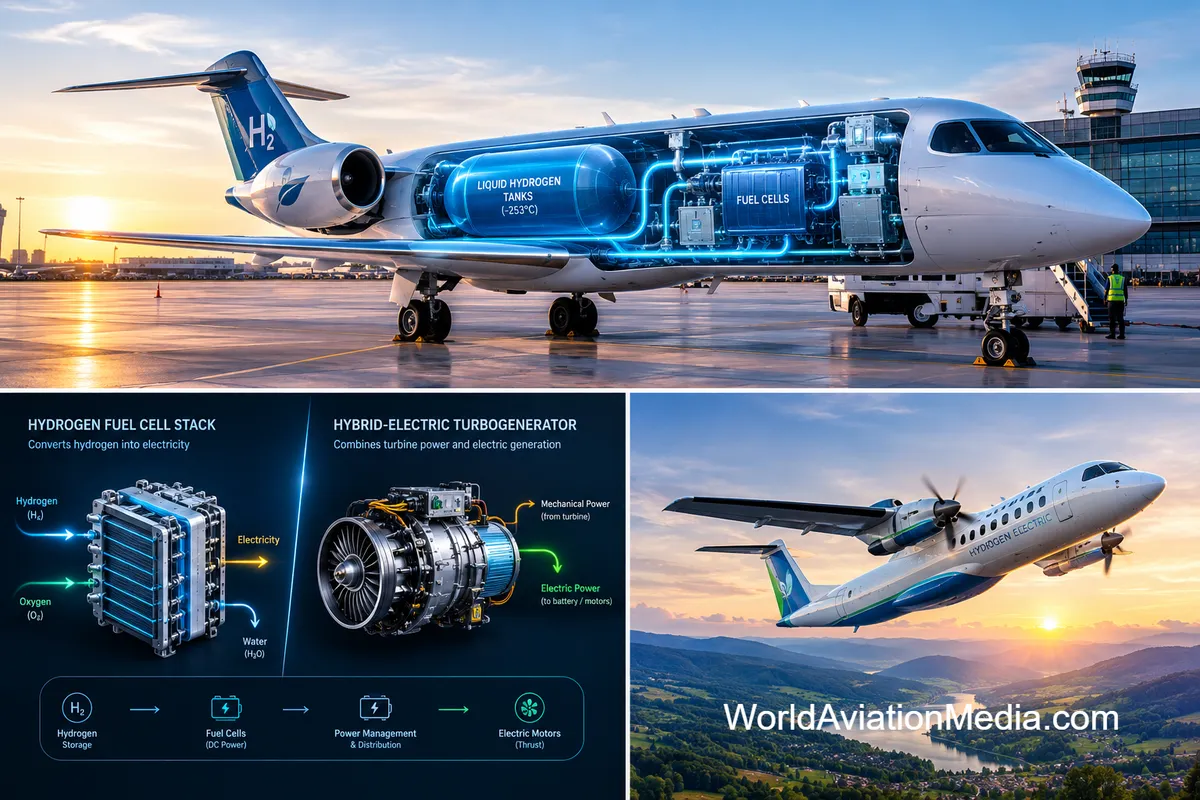
Part 25 Hydrogen vs. Hybrid-Electric: Which Clean Propulsion Architecture Will Win Regional and Business Aviation Markets?
Key Takeaways
Certification Pathways Shift: Beyond Aero has transitioned its strategic focus toward full Federal Aviation Administration (FAA) Part 25 transport-category certification for its BYA-1 hydrogen-electric business jet.
Hybrid-Electric Momentum: Concurrently, Heart Aerospace advances its FAA-backed ES-36 turbogenerator hybrid regional aircraft, while Zuri tests its Rotax-powered hybrid VTOL freighter.
The Energy Density Dilemma: Hydrogen offers superior gravimetric energy density for long-range business jets, while hybrid-electric architectures provide immediate regulatory compliance for short-haul regional routes.
Infrastructure Realities: Hydrogen fuel cell adoption remains bottlenecked by cryogenic fueling infrastructure at regional airports, giving a near-term operational edge to hybrid-electric drop-in fuel solutions.
The Fork in the Clean Aviation Road
As the aviation industry grapples with mandatory net-zero carbon reduction targets, clean propulsion developers have reached a critical strategic fork in the road. Will the future of regional and business aviation be propelled by cryogenic hydrogen fuel cells operating under rigorous Part 25 transport-category rules, or will it be dominated by distributed hybrid-electric turbogenerator systems operating on drop-in sustainable aviation fuels (SAF)?
Recent strategic maneuvers highlight this divergence. Beyond Aero has formally pivoted its development pipeline toward full FAA Part 25 certification for its BYA-1 hydrogen-electric business jet, signaling a bold bet on zero-emission hydrogen combustion and fuel-cell technology. Meanwhile, competitors like Heart Aerospace—backed by major airline investments—are advancing the ES-36 hybrid-electric regional aircraft, and innovators like Zuri are flight-testing Rotax-powered hybrid VTOL freighters. Analyzing these competing architectures reveals distinct engineering and operational trade-offs.
Beyond Aero and the Part 25 Hydrogen Bet
Developing a clean-sheet hydrogen-powered aircraft under FAA Part 25 (the regulatory standard for transport-category airplanes seating more than 19 passengers or weighing over a specific threshold) is one of the most punishing engineering challenges in modern aerospace. Hydrogen requires extreme cryogenic storage (-253°C) or high-pressure composite tanks that occupy up to four times the volume of conventional Jet-A fuel.
"Hydrogen offers unmatched energy density by weight for long-range zero-emission flight, but navigating Part 25 crashworthiness, fuel-tank venting, and cryogenic distribution standards is an unprecedented regulatory climb." — Zero-Emission Propulsion Analysis, 2026
Beyond Aero’s focus on the BYA-1 business jet targets the high-margin corporate travel market, where buyers can absorb higher initial capital costs in exchange for true zero-emission credentials. However, securing Part 25 type certification requires proving structural crashworthiness of hydrogen tanks, developing fail-safe fuel-cell thermal management systems, and establishing standardized fueling protocols across international airports.
Heart Aerospace and the Hybrid-Electric Practicality
In contrast, hybrid-electric architectures—exemplified by Heart Aerospace’s ES-36 and various regional concepts—take a more pragmatic approach to near-term certification. By combining battery-electric motors for silent, zero-emission taxi and takeoff with sustainable aviation fuel (SAF)-powered turbogenerators for cruise en-route power, hybrid aircraft sidestep the infrastructure bottleneck of cryogenic hydrogen.
Key advantages of the hybrid-electric approach include:
Drop-In Fuel Compatibility: Utilizing existing Jet-A or SAF infrastructure at regional airports eliminates the need to build multi-million-dollar liquid hydrogen storage facilities at every destination.
Easier Certification Pathways: Hybrid systems can rely on existing Part 23 or emerging regional airworthiness frameworks without inventing entirely new fuel-tank safety standards.
Operational Flexibility: If battery reserves run low or charging stations are unavailable, the onboard turbogenerator ensures uninterrupted dispatch reliability.
The Verdict for Regional & Bizav Markets
The market will likely bifurcate based on mission profile. For high-end business aviation seeking transcontinental zero-emission prestige, Part 25 hydrogen architectures will capture the luxury and corporate ESG market once airport infrastructure matures. For high-frequency regional commuter routes connecting small cities, hybrid-electric architectures will dominate the 2030s by delivering immediate carbon reductions using existing airfield networks.
5-Item Q&A Section (FAQ)
Q1: What certification standard is Beyond Aero targeting for its BYA-1 hydrogen jet?
Beyond Aero has focused its development pipeline toward full FAA Part 25 transport-category certification for the BYA-1 hydrogen-electric business jet.
Q2: What are the main engineering challenges of hydrogen-powered aircraft?
Hydrogen requires cryogenic storage or high-pressure tanks that take up significantly more volume than Jet-A, requiring rigorous Part 25 crashworthiness testing.
Q3: How do hybrid-electric aircraft operate?
Hybrid-electric aircraft use battery-electric motors for takeoff and landing, supplemented by SAF-powered turbogenerators for cruise flight.
Q4: Why do hybrid-electric systems have an infrastructure advantage?
They can utilize existing aviation fuel (SAF/Jet-A) infrastructure at regional airports, avoiding the need to build specialized cryogenic hydrogen fueling stations immediately.
Q5: Which architecture is expected to dominate regional commuter routes?
Hybrid-electric architectures are positioned to dominate near-term regional routes due to easier certification and flexible drop-in fuel compatibility.
Metadata
Target SEO Keywords: Beyond Aero hydrogen business jet Part 25, Heart Aerospace hybrid electric aircraft, hydrogen vs hybrid electric propulsion aviation, clean aviation certification 2026, BYA-1 hydrogen jet.
Hashtags: #CleanAviation #HydrogenFuel #HybridElectric #SustainableAviation #Aerospace #Innovation
