North Africa's Green Fuel Play: Why Shell Bet on Morocco's $239M Port Nador Plant Ahead of CORSIA Phase 2
Key Takeaways
The $239 Million Port Nador Med Anchor: Energy supermajor Shell's long-term offtake and strategic backing of Morocco's $239 million Port Nador West Med biofuel and Sustainable Aviation Fuel (SAF) complex marks North Africa's arrival as a tier-one green aviation export hub.
The January 1, 2027 Regulatory Double-Hammer: The facility's ramp-up is precisely timed for January 1, 2027—the date when ICAO's CORSIA Phase 2 transitions from voluntary to mandatory global emissions offsetting, coinciding with the scaling of the EU's ReFuelEU Aviation blending mandates (rising from 2% toward 6% in 2030).
Geographic Proximity to Southern Europe: Sitting on Morocco's Mediterranean coast at the Strait of Gibraltar shipping crossroads, Port Nador West Med can ship SAF via short-sea tankers to Madrid, Barcelona, Paris, Rome, and Lisbon in 24 to 72 hours—slashing transport carbon intensity scores.
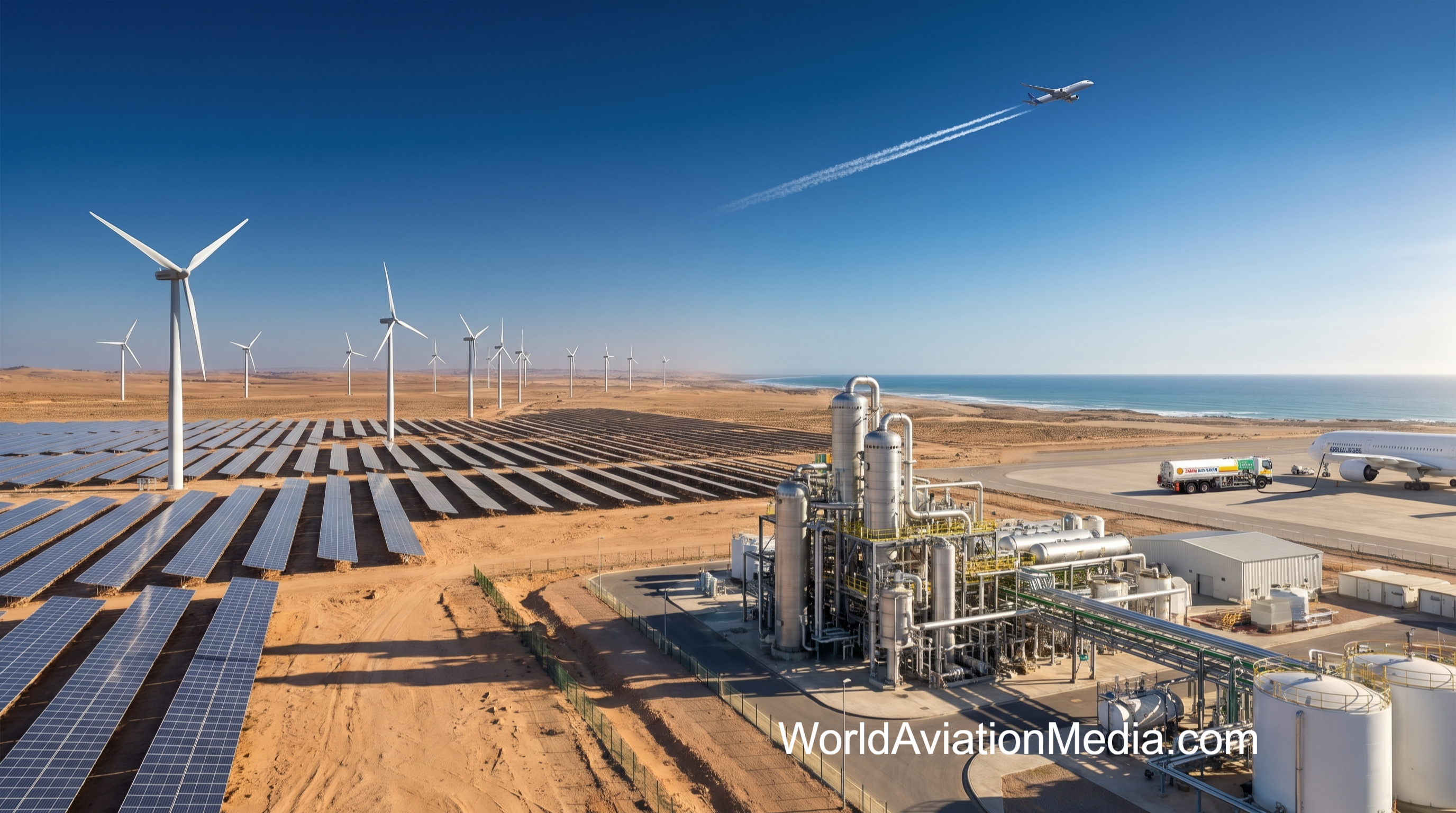
The Power-to-Liquid (e-SAF) Future: Beyond immediate HEFA/waste-feedstock bio-SAF, Morocco's unmatched solar irradiance and Atlantic/Mediterranean wind resources give it the lowest-cost green hydrogen economics on Europe's doorstep, positioning North Africa for the 2030+ synthetic e-SAF mandate wave.
Why Is Morocco Emerging as a Global Sustainable Aviation Fuel (SAF) Export Hub?
Morocco is emerging as a premier Sustainable Aviation Fuel (SAF) and low-carbon biofuel export powerhouse ahead of 2027 due to its combination of world-class solar and wind renewable energy resources, deepwater Mediterranean port infrastructure at Nador West Med, and immediate maritime proximity to mandated European Union aviation hubs. Anchored by projects like the $239 million Port Nador plant backed by a multi-year Shell offtake deal, North Africa offers European and global airlines lower production costs and superior lifecycle carbon reduction scores just as mandatory CORSIA Phase 2 and ReFuelEU compliance rules take effect.
In the boardrooms of European and international airlines in late 2026, a single calendar date looms like a ticking regulatory clock: January 1, 2027.
On that day, two massive global decarbonization frameworks converge simultaneously:
ICAO CORSIA Phase 2 (Mandatory Phase): The International Civil Aviation Organization's Carbon Offsetting and Reduction Scheme for International Aviation ends its initial voluntary pilot and first phase and becomes legally mandatory for virtually all major international aviation states worldwide (accounting for over 90% of global international RTK traffic). Airlines must either purchase eligible carbon credits or directly reduce emissions by burning CORSIA-eligible Sustainable Aviation Fuel (CEF).
ReFuelEU Aviation & UK SAF Mandate Escalation: Across the European Union, the ReFuelEU Aviation Regulation—which kicked off with a mandatory 2% SAF blend at all EU airports in 2025—begins its steep climb toward 6% in 2030 (including a mandatory 1.2% synthetic e-SAF sub-mandate), while the United Kingdom's standalone SAF mandate scales aggressively toward 10% by 2030.
Unlike previous environmental pledges, these are not aspirational corporate PR targets. Under ReFuelEU, fuel suppliers and airlines that fail to meet blending quotas face mandatory financial penalties equal to at least twice the price difference between conventional Jet A-1 and SAF—plus the legal obligation to still supply the missing SAF volume the following year.
Faced with this ironclad demand wall, global energy supermajors like Shell are looking beyond high-cost Northern European refineries to secure bankable, low-carbon supply. And their capital has landed squarely on the Mediterranean coast of North Africa: specifically, the $239 million Port Nador West Med advanced biofuel and SAF production complex in Morocco.
Inside the $239 Million Port Nador West Med Deal
Developed at the brand-new deepwater industrial complex of Nador West Med on Morocco's northeastern Mediterranean coastline—a strategic successor to Morocco's wildly successful Tanger Med megaport—the $239 million project (spearheaded by advanced renewable fuels producer GranBio/Green Energy Park partners and anchored by a long-term global offtake commitment from Shell) is designed to process agricultural residues, non-food biomass, and waste feedstocks into low-carbon biofuels and Sustainable Aviation Fuel precursors.
Why did Shell—one of the world's largest aviation fuel suppliers, serving over 1,000 airport locations globally—commit to locking up North African production capacity while simultaneously pausing or re-evaluating certain high-cost domestic European bio-refinery expansions (such as slowing intervals at Pernis/Rotterdam during cost inflation spikes)?
The answer comes down to four structural economic advantages that North Africa possesses and Northern Europe lacks.
+-------------------------------------------------------------------------+
| SAF PRODUCTION ECONOMICS: NORTH EUROPE vs. MOROCCO (PORT NADOR) |
+-------------------------------------------------------------------------+
| Competitive Factor | NW Europe Refinery | Morocco Port Nador|
|------------------------------|----------------------|-------------------|
| Industrial Electricity Cost | $0.11 - $0.18 / kWh | $0.03 - $0.05 /kWh|
| Dedicated Renewable Power | Grid-Constrained | Co-Located Solar/W|
| Green Hydrogen (H2) CapEx | High ($5.50+/kg H2) | Low ($2.80-$3.50) |
| Permitting & Construction | 5 - 8 Years | 2.5 - 3.5 Years |
| Proximity to EU Med Hubs | 1,500 - 2,500 km | 250 - 900 km |
| ReFuelEU / CORSIA Eligibility| Full (RED III) | Full Export Cert. |
+-------------------------------------------------------------------------+
The Renewable Energy Cost Arbitrage (Crucial for CI Scores)
Under both ICAO CORSIA and the European Union's Renewable Energy Directive (RED III), not all Sustainable Aviation Fuel is treated equally. The commercial value of a metric ton of SAF is determined by its Lifecycle Carbon Intensity (CI) score—measured in grams of CO2 equivalent per megajoule (gCO2e/MJ) compared to the fossil Jet A-1 baseline of 89gCO2e/MJ.
To earn the highest compliance credit (and command the highest price premium from airlines), a SAF refinery must not only use sustainable waste or residue feedstocks; it must power the refining and hydrotreating process itself using 100% renewable electricity and green hydrogen.
In Germany, the Netherlands, or the UK, industrial electricity prices remain structurally elevated following the European natural gas reorganization, and connecting a new 100-megawatt industrial facility to congested European power grids can take six years.
Morocco, by contrast, has spent the past 15 years executing one of the world's most ambitious renewable energy buildouts (targeting over 52% installed renewable capacity before 2030), blessed with over 3,000 hours of intense solar irradiation per year coupled with steady trade winds averaging 9+ meters per second. By running the Port Nador refining and hydrogen-upgrade loops on ultra-cheap Moroccan solar and wind power ($0.03 to $0.05 per kWh), the facility slashes both its cash operating cost (OpEx) and its lifecycle Carbon Intensity score—yielding higher compliance credits per ton shipped to Europe.
Strategic Maritime Geometry: Sitting in the Strait of Gibraltar
In the global SAF supply chain, shipping fuel 12,000 kilometers on a diesel-burning chemical tanker from Asia or the U.S. Gulf Coast to Europe adds transport emissions that degrade the fuel's final RED III carbon reduction certificate, while tying up working capital on the water for 35 days.
Port Nador West Med sits less than 150 nautical miles from the Spanish coast.
Equipped with deepwater petrochemical berths and vast tank storage farms right on the primary East-West Mediterranean shipping highway, a coastal product tanker departing Port Nador can deliver neat SAF or blending components into:
Malaga, Valencia, or Barcelona (feeding IAG / Iberia / Vueling) in 12 to 24 hours.
Marseille/Fos-sur-Mer (feeding the NATO/French pipeline system to Lyon and Paris CDG) in 36 hours.
Genoa or Civitavecchia (feeding Rome Fiumicino and Northern Italy) in 48 hours.
Rotterdam (ARA Hub) or London Thames in 4 to 5 days.
3. Overcoming the "HEFA Feedstock Wall" via 2G Biomass and Alcohol-to-Jet
Today, roughly 85% of the world's commercial SAF is produced via the HEFA (Hydroprocessed Esters and Fatty Acids) pathway—refining Used Cooking Oil (UCO) and waste animal fats. However, every energy economist in 2026 knows that global UCO supply is fundamentally finite; humans only eat so many French fries, and the EU's ReFuelEU legislation strictly caps or excludes food-and-feed crop feedstocks while scrutinizing fraudulent Asian UCO imports.
By investing in Port Nador's ability to convert second-generation (2G) cellulosic agricultural residues, industrial biomass wastes, and regional non-food feedstocks into cellulosic sugars, ethanol/isobutanol, and Alcohol-to-Jet (AtJ) / advanced hydrotreated aviation fuels, Shell and its Moroccan partners bypass the UCO feedstock bottleneck entirely. Morocco and the broader Mediterranean agricultural basin generate millions of tons of olive-mill pomace, forestry trimmings, and agricultural straw residues annually—creating a localized, circular feedstock loop that meets the strictest Annex IX Part A criteria of the EU's RED III directive.
The Long Game: Why 2030's e-SAF Mandate Belongs to North Africa
While the $239 million Port Nador plant addresses the immediate 2027 CORSIA Phase 2 and bio-SAF crunch, aviation fuel strategists view this project as the Beachhead for an even bigger prize: Power-to-Liquid (PtL) synthetic e-SAF.
Starting in 2030, the EU's ReFuelEU Aviation law introduces a legally binding sub-mandate specifically for synthetic aviation fuels (e-SAF)—starting at 1.2% in 2030, rising to 2% in 2032, 5% in 2035, and 35% by 2050.
Unlike bio-SAF (which comes from plants or waste oils), e-SAF is made from thin air and water: combining green hydrogen (produced by splitting water with renewable electricity via electrolyzers) with captured carbon dioxide (CO2) through Fischer-Tropsch synthesis.
Because producing one ton of e-SAF requires roughly 5 to 6 times more renewable electricity than producing bio-SAF, synthesizing e-SAF using expensive European grid electricity results in prohibitive production costs of $6,000 to $8,000 per metric ton (nearly 8 to 10 times the price of fossil Jet A-1).
In Morocco—where the government launched the "Offre Maroc" (Morocco Offer) allocating over one million hectares of state land specifically for integrated green hydrogen, ammonia, and e-fuel export consortiums—the math changes dramatically. By co-locating gigawatt-scale solar/wind arrays with coastal desalination and Fischer-Tropsch synthesis units tied into export ports like Nador West Med, Tangier, and Dakhla, North Africa can produce synthetic e-SAF at a 35% to 45% structural cost discount compared to Northern Europe.
Impact on Regional Airlines: Royal Air Maroc and Southern European Hubs
Beyond pure exports to Shell's European terminals, having domestic SAF production on Moroccan soil transforms the competitive positioning of North African aviation itself:
Royal Air Maroc's Casablanca Hub Expansion: As Oneworld member Royal Air Maroc (RAM) executes its ambitious fleet expansion toward 200 aircraft by the 2030s (ahead of Morocco co-hosting the 2030 FIFA World Cup with Spain and Portugal), having domestic CORSIA-eligible SAF at Mohammed V International Airport (CMN) insulates the carrier from carbon allowance spikes while preventing "tankering" penalties on European routes.
Eliminating "Carbon Leakage" Criticisms: European legacy carriers (Lufthansa, Air France-KLM) have frequently complained to Brussels that ReFuelEU mandates encourage passengers to fly one-stop via non-EU hubs (such as Istanbul, Cairo, or Casablanca) to avoid EU SAF surcharges on the long-haul leg. By building a domestic SAF export industry aligned with EU RED III standards, Morocco positions itself not as a carbon-leakage loophole, but as Europe's indispensable clean-fuel partner.
As the calendar flips toward 2027's CORSIA Phase 2 enforcement, Shell's $239 million Port Nador bet proves a fundamental truth of the energy transition: the geography of green jet fuel will not follow the old map of oil wells; it will follow the map of sun, wind, and deepwater ports.
SEO & AEO Optimization Summary
Primary Search Intent: Commercial/Sustainability & Energy Market Analysis (Aviation sustainability officers, SAF procurement directors, energy transition investors, and airline compliance managers tracking CORSIA Phase 2, ReFuelEU, and Shell's Morocco SAF investments).
Featured Snippet Target: Direct explanation of why Shell backed Morocco's $239M Port Nador plant ahead of January 1, 2027 (CORSIA Phase 2 + ReFuelEU mandates + low-cost renewable energy + proximity to EU), supported by a comparative cost/logistics table.
5-Item Q&A Section (FAQ)
Q1: Why is Shell investing in Morocco's $239 million Port Nador biofuel and SAF plant? A: Shell backed the $239 million Port Nador West Med facility via a long-term offtake deal to secure scalable, low-carbon Sustainable Aviation Fuel (SAF) and advanced biofuels right on Europe's doorstep—capitalizing on Morocco's ultra-low solar/wind electricity costs, circular agricultural waste feedstocks, and 24-to-72-hour tanker shipping access to mandated European aviation hubs.
Q2: What happens on January 1, 2027, under ICAO CORSIA Phase 2? A: On January 1, 2027, ICAO's Carbon Offsetting and Reduction Scheme for International Aviation (CORSIA) enters its mandatory Second Phase. Unlike the voluntary pilot and first phases, Phase 2 legally requires airlines flying between virtually all major aviation states globally to offset international emissions growth above baseline levels using eligible carbon credits or CORSIA-Eligible Fuels (SAF).
Q3: How does the EU's ReFuelEU Aviation mandate drive demand for Moroccan SAF? A: ReFuelEU Aviation requires fuel suppliers at EU airports to blend a minimum of 2% SAF starting in 2025, jumping to 6% in 2030 (including 1.2% synthetic e-SAF) and 70% by 2050, backed by steep financial fines for non-compliance. Because European domestic SAF production faces high energy costs and feedstock limits, EU suppliers rely on nearby, RED III-compliant export hubs like Port Nador.
Q4: Why is North Africa uniquely suited for future synthetic e-SAF (Power-to-Liquid) production? A: Producing synthetic e-SAF requires massive amounts of green hydrogen generated by renewable electricity. Morocco possesses some of the world's highest combined solar irradiation and coastal wind speeds—yielding green power at 0.03–0.05/kWh—allowing producers to synthesize e-SAF at a 35% to 45% lower cost than in Northern Europe.
Q5: How does Port Nador West Med's location improve SAF carbon intensity (CI) scores? A: Under both CORSIA and EU RED III rules, the emissions generated while refining and transporting fuel are deducted from its climate benefit. By powering the refinery with Moroccan renewables and shipping the fuel just a few hundred kilometers across the Mediterranean to Spain, France, and Italy, Port Nador delivers a significantly lower lifecycle Carbon Intensity score.
Metadata
Target SEO Keywords: Shell Morocco Port Nador $239M SAF plant, CORSIA Phase 2 mandatory 2027, ReFuelEU Aviation SAF mandate 2030, North Africa Sustainable Aviation Fuel export, Port Nador West Med biofuel complex, e-SAF Power to Liquid Morocco green hydrogen, aviation decarbonization supply chain.
Relevant Hashtags: #SustainableAviationFuel #SAF #CORSIA #ReFuelEU #ShellAviation #MoroccoEnergy #NetZeroAviation #GreenHydrogen
