Light Jets, Chain Guns, and Microwaves: Fixing the Cost-Exchange Ratio in Counter-Drone Air Defense
Key Takeaways
The Cost-Exchange Crisis: Firing multimillion-dollar surface-to-air missiles at cheap $20,000 loitering munitions is economically unsustainable for modern defense forces.
Estonia's Light Jet Strategy: Estonia’s exploration of utilizing affordable light jets to intercept and destroy incoming jet-powered drones introduces a novel kinetic intercept model.
Directed-Energy and Gun Systems: Technologies like Northrop Grumman's dual-feed chain guns, BAE Systems' high-power microwave (HPM) systems, and Anduril's mass-produced Steelfin interceptors offer multi-layered cost-effective mitigation.
Asymmetric Defense: Restoring balance to the cost-exchange ratio requires pairing low-cost kinetic effectors with electronic defeat mechanisms.
The Economics of Asymmetric Attrition
Modern air defense is facing a devastating economic mismatch. When an adversary deploys a swarm of low-cost, mass-produced loitering munitions or jet-powered suicide drones costing $20,000 to $50,000 each, defending critical infrastructure with $2 million Patriot or NASAMS interceptor missiles guarantees financial ruin. This unsustainable math has forced military technologists to rethink counter-unmanned aerial systems (C-UAS) architecture from the ground up, seeking to fix the cost-exchange ratio.
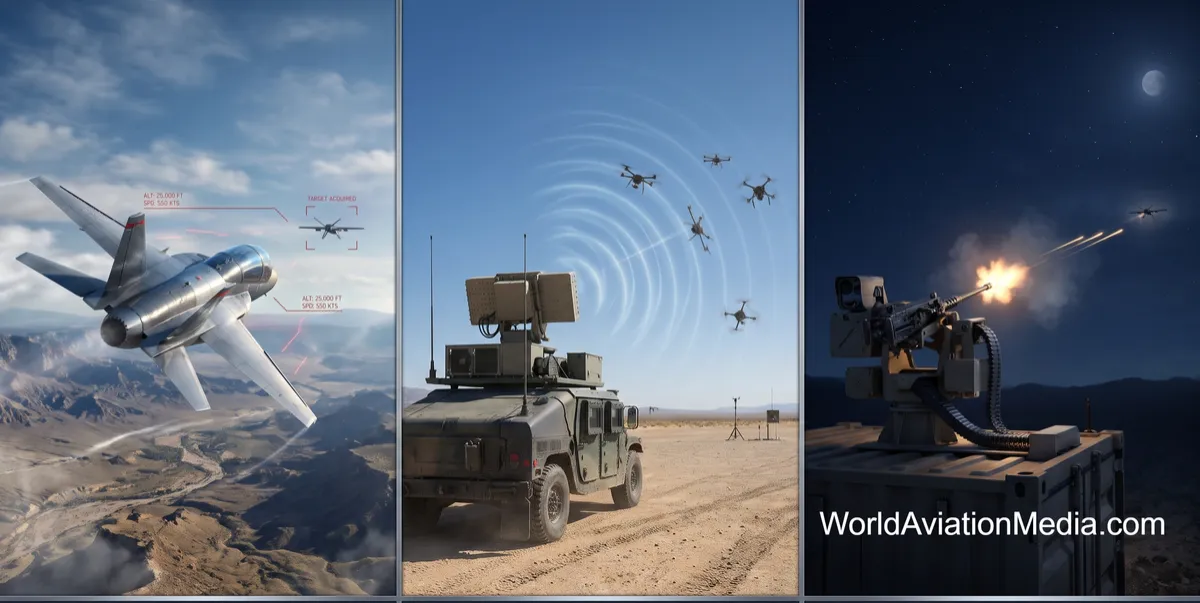
To achieve asymmetric parity, defense innovators are exploring three distinct technological vectors: affordable kinetic interception via light jets, high-rate precision cannon fire, and high-power directed-energy microwaves.
Estonia's Light Jet Initiative and Kinetic Interception
Among the most unconventional kinetic proposals is Estonia's defense planning initiative to procure and adapt agile, low-cost light jets to hunt and destroy incoming jet-powered drones. Traditional fighter aircraft like the F-35 or Eurofighter are prohibitively expensive to operate per flight hour when hunting slow or medium-speed unmanned aerial vehicles.
Light jets offer a middle ground: high speed to intercept distant threats quickly, equipped with affordable infrared or radar-guided missiles or ventral gun pods, at a fraction of the operating cost of a frontline multirole fighter. While operational challenges—such as radar cross-section detection and night-interception coordination—remain, the concept highlights Europe's desperate search for affordable kinetic airspace control.
Guns, Microwaves, and Mass-Produced Interceptors
Beyond crewed or light-jet platforms, ground-based C-UAS architecture is coalescing around three proven pillars:
Dual-Feed Chain Guns: Systems like Northrop Grumman’s M230 Bushmaster paired with programmable air-burst ammunition provide a dense wall of kinetic fragments capable of shredding drone rotors and control surfaces at a cost of hundreds of dollars per engagement rather than millions.
High-Power Microwaves (HPM): BAE Systems and other defense primes are deploying directed-energy microwave emitters that flood incoming drone swarms with invisible electromagnetic energy, instantly frying internal flight control microchips and causing multi-target dropouts simultaneously.
Mass-Produced Interceptor Missiles: Companies like Anduril Industries are scaling production of low-cost, AI-guided kinetic interceptors like the Steelfin and Roadrunner families, designed to launch vertically, destroy incoming threats, and return safely if an engagement is aborted.
"Fixing the cost-exchange ratio in counter-drone defense requires moving away from exquisite missile systems and embracing layered, high-volume kinetic and electronic effectors." — Defense Economics Analysis, 2026
The Future Layered Shield
No single weapon system can solve the counter-drone crisis. Effective air defense requires a networked architecture: high-power microwaves to neutralize incoming swarms at range, chain guns and light jets for intermediate kinetic engagement, and low-cost interceptors for high-value targets. By ruthlessly optimizing the cost-exchange ratio, military forces can ensure that air defense remains economically viable in the drone age.
5-Item Q&A Section (FAQ)
Q1: What is the main economic problem facing modern air defense systems?
The cost-exchange ratio is broken because militaries are firing multimillion-dollar missiles at cheap $20,000 drones.
Q2: What approach is Estonia exploring to counter jet-powered drones?
Estonia has evaluated procuring and adapting affordable light jets to intercept and shoot down incoming unmanned aerial vehicles cost-effectively.
Q3: How do high-power microwave (HPM) systems neutralize drones?
HPM systems emit directional electromagnetic energy that fries internal drone electronics, causing multiple targets to crash simultaneously.
Q4: What role do dual-feed chain guns play in C-UAS defense?
Chain guns firing programmable air-burst rounds provide a dense, low-cost kinetic barrier against drone swarms.
Q5: Why are companies like Anduril developing mass-produced interceptors?
To provide reusable, low-cost guided interceptors that bridge the gap between expensive missiles and ineffective small arms.
Metadata
Target SEO Keywords: counter drone cost exchange ratio, Estonia light jet drone defense, high power microwave C-UAS, Northrop Grumman chain gun drones, Anduril Steelfin interceptor.
Hashtags: #AirDefense #CUAS #MilitaryTech #DefenseEconomics #Drones #Innovation
