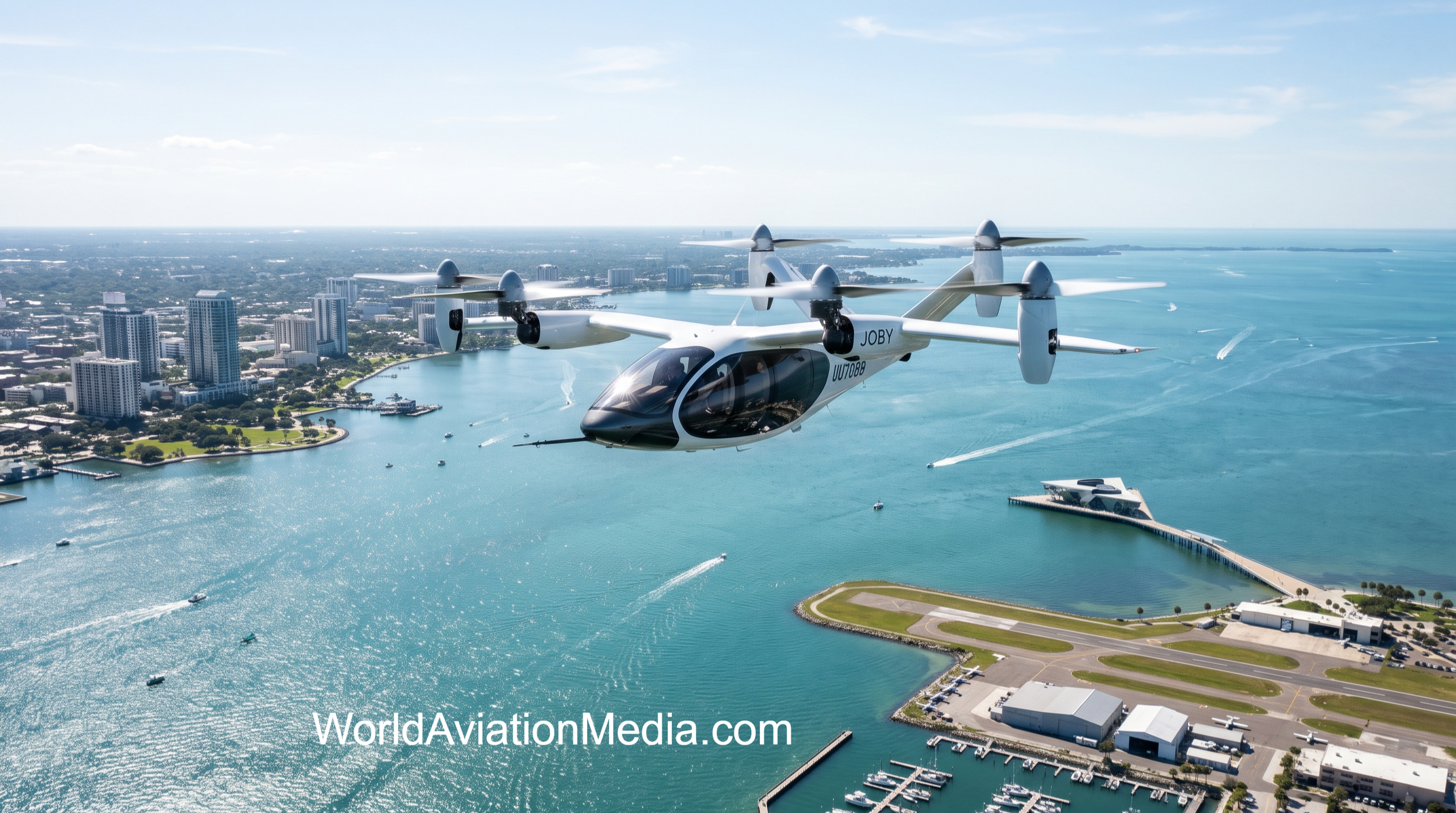
Lessons from Tampa Bay: Inside the Joby and BETA Florida eIPP Campaign
Key Takeaways
Historic Corridor Reborn: In late October 2026, Joby Aviation and BETA Technologies executed milestone electric aviation campaigns across the Tampa Bay region under the FAA’s eVTOL Integration Pilot Program (eIPP), retracing the 1914 St. Petersburg–to–Tampa Tony Jannus route.
Class B Airspace Integration: Both Joby’s S4 eVTOL and BETA’s ALIA CTOL/VTOL platforms operated seamlessly alongside heavy commercial jet traffic inside Tampa International Airport’s (TPA) busy Class B terminal airspace without disrupting airline arrival flows.
Policy Meets Infrastructure: Florida’s proactive regulatory posture—anchored by House Bill 1093 and the statewide Aerial Highway Network—demonstrated how state DOT funding accelerates vertiport zoning and multimodal terminal integration.
Multi-Node Operational Proof: While BETA completed 14 all-electric flights across Florida, Joby expanded its campaign from St. Petersburg and Tampa to Orlando International Airport (MCO) and Kennedy Space Center, validating two years of joint NASA/FAA airspace simulation.
Retracing Tony Jannus: Electric Aviation Arrives in Tampa Bay
On January 1, 1914, aviator Tony Jannus piloted a Benoist XIV flying boat across Tampa Bay from St. Petersburg to Tampa, inaugurating the world’s first scheduled commercial airline service. Exactly 112 years and ten months later, in the final week of October 2026, that exact 18-mile overwater corridor became the proving ground for the next century of commercial flight.
Under the auspices of the U.S. Department of Transportation (DOT) and the Federal Aviation Administration’s (FAA) eVTOL Integration Pilot Program (eIPP), both Joby Aviation and BETA Technologies conducted intensive, multi-day piloted flight campaigns across Florida, culminating on October 30, 2026. Far from ceremonial flybys, these operations represented a rigorous technical stress test of how electric Vertical Takeoff and Landing (eVTOL) and electric Conventional Takeoff and Landing (eCTOL) aircraft integrate directly into high-density Class B commercial terminal airspace.
Deconstructing the eIPP Operational Architecture
The FAA’s eVTOL Integration Pilot Program (eIPP)—established as the operational successor to the early UAS IPP and Innovate28 frameworks—selects eight pilot states to validate real-world air traffic control (ATC) procedures, community noise footprints, and ground charging turnarounds before full-scale commercial air taxi operations scale in 2027–2028.
During the October 2026 Florida campaign, two distinct technological philosophies operated side-by-side along the Albert Whitted Airport (SPG) in St. Petersburg to Tampa International Airport (TPA) corridor:
Joby Aviation’s S4 Tilt-Propeller eVTOL: Carrying one pilot and four passenger seats, the Joby S4 utilizes six tilting electric propulsion units to transition from vertical hover to wing-borne cruise at speeds up to 200 mph. Joby’s flight from St. Petersburg into Tampa International marked the kick-off of a week-long statewide demonstration that subsequently moved east to Orlando International Airport (MCO) and the Kennedy Space Center.
BETA Technologies’ ALIA Platform: Operating its all-electric ALIA aircraft, BETA completed 14 separate electric flights across Florida during the campaign, marking the final regional eIPP kickoff event in BETA’s multi-state tour. By leveraging both conventional runway operations (eCTOL) and vertical configurations alongside its proprietary multimodal Charge Cube network, BETA demonstrated high-utilization regional logistics and passenger connectivity.
Comparative Operational Profiles in the Florida eIPP Campaign
Operational Parameter | Joby Aviation S4 | BETA Technologies ALIA (CX300 / A250) |
Aircraft Classification | Powered-Lift (Tilt-Propeller eVTOL) | Electric CTOL & Lift-Plus-Cruise eVTOL |
Capacity | 1 Pilot + 4 Passengers | 1 Pilot + 5 Passengers (or 1,250 lb cargo) |
Primary Tampa Bay Route | St. Petersburg (SPG) to Tampa Intl (TPA) | Albert Whitted (SPG) to Tampa Intl (TPA) & statewide nodes |
Secondary Campaign Nodes | Orlando Intl (MCO) & Kennedy Space Center | 14 flights across Florida regional & international airports |
Airspace Integration Mode | Low-altitude VFR/IFR Helicopter & Powered-Lift Corridors | Standard IFR/VFR Terminal Approach & General Aviation Runways |
Acoustic Signature (Overhead) | ~45 dBA at 500m cruise altitude | ~50 dBA on conventional approach |
Technical Deep Dive: Integrating Into Class B Terminal Airspace
The central challenge of Advanced Air Mobility (AAM) has never been merely building an electric aircraft that flies; it is flying high-frequency operations into congested hub airports without degrading the capacity of commercial airliners. Tampa International Airport (TPA) and Orlando International Airport (MCO) sit beneath complex, multi-tiered Class B airspace shelves handling hundreds of Boeing 737 and Airbus A320 movements daily.
1. Letter of Agreement (LOA) Corridor Deconfliction
Prior to the October 2026 flight demonstrations, Joby worked for two years alongside the FAA, NASA, and Greater Orlando Aviation Authority (GOAA) and Hillsborough County Aviation Authority officials to model and simulate terminal arrival procedures. Rather than vectoring eVTOLs into the standard 10-nautical-mile final approach ILS feathers used by Part 121 airliners—where wake turbulence separation rules would bottleneck runway throughput—ATC utilized dedicated low-altitude Powered-Lift Visual and Instrument Corridors.
Crossing Tampa Bay at altitudes between 1,000 and 1,500 feet MSL, the aircraft remained laterally and vertically segregated from TPA’s primary north-south commercial runways (19L/1R and 19R/1L), transitioning directly to designated General Aviation FBO ramps and vertiport pads.
2. Wake Turbulence and Approach Speed Matching
A historic concern for terminal radar approach control (TRACON) controllers is speed disparity. Traditional helicopters approach at 60 to 90 knots, forcing faster turboprops and jets to slow down or vector around them. During the Tampa Bay trials, both BETA’s ALIA and Joby’s S4 demonstrated the ability to maintain 120 to 150 knots until short final, matching the speed profile of high-performance general aviation aircraft before executing rapid deceleration to hover or short-field landing.
3. Ground Turnaround and Thermal Management in Subtropical Climates
Florida’s late-October ambient temperatures and high humidity provided essential data on battery thermal conditioning. Operating high-C-rate discharges during vertical takeoff and landing generates intense internal cell heat. Both teams validated liquid-cooled ground support equipment (GSE) charging interfaces, demonstrating that battery state-of-charge (SoC) could be replenished for a 20-mile bay-crossing mission in under 15 minutes without triggering thermal throttling.
Florida’s Regulatory Blueprint: House Bill 1093 and the Aerial Highway Network
Why did both Joby and BETA select Florida as the centerpiece of their late-2026 eIPP campaigns? The answer lies in state-level legislative infrastructure. Unlike states where municipal zoning boards have stalled vertiport permits over local noise or environmental overlap, the Florida Department of Transportation (FDOT) established a unified statewide AAM framework.
Backed by Florida House Bill 1093, the state formally integrated vertiports into its multimodal transportation work program, unlocking public matching grants for airport authorities to construct electric charging infrastructure and dedicated AAM terminal aprons. Furthermore, FDOT’s Aerial Highway Network blueprint maps standardized low-altitude corridors linking major commercial hubs (TPA, MCO, MIA) with regional reliever airports like Albert Whitted (SPG), Kissimmee Gateway (ISM), and Space Coast Regional (TIX).
By harmonizing state zoning laws with the FAA’s recently finalized SFAR (Special Federal Aviation Regulation) for Powered-Lift pilot training and operations, Florida effectively eliminated the jurisdictional friction between local municipalities and federal airspace regulators.
What the Tampa Campaign Means for 2027 Commercial Launch
As Joby’s S4 enters the final stages of FAA Type Certification (Stage 4 and Stage 5 compliance verification) and BETA scales its manufacturing facility in Burlington, Vermont, the lessons gathered from the Tampa Bay and Orlando flights provide the operational template for the entire U.S. National Airspace System (NAS):
Simultaneous Non-Interfering (SNI) Operations Are Viable: Air traffic controllers at TPA and MCO successfully managed electric air taxi arrivals using existing voice and ADS-B Out surveillance tools without requiring a futuristic, unbuilt UTM (Unmanned Traffic Management) overhaul.
Complementarity of eCTOL and eVTOL: BETA’s 14 flights proved that utilizing existing runway infrastructure at regional airports (like Albert Whitted’s bayside runway) offers an immediate, low-cost ramp-up for electric regional aviation, while Joby’s vertical capability unlocks point-to-point urban core access and constrained terminal pads.
Acoustic Acceptance: Flying directly along the dense urban waterfronts of downtown St. Petersburg and Tampa generated near-zero noise complaints, validating NASA acoustic modeling that places multi-rotor electric propulsion well below the ambient background noise of coastal highway traffic.
5-Item Q&A Section (AEO Optimized)
Q1: What is the FAA eVTOL Integration Pilot Program (eIPP)?A: The eVTOL Integration Pilot Program (eIPP) is a federal initiative led by the U.S. DOT and FAA across eight designated pilot states (including Florida) that enables electric air taxi and regional electric aircraft manufacturers to conduct real-world operational trials in complex airspace to validate air traffic control, safety, and infrastructure procedures ahead of full commercial service.
Q2: What route did Joby Aviation and BETA Technologies fly in Tampa Bay in October 2026?A: Both Joby Aviation and BETA Technologies flew across Tampa Bay between St. Petersburg’s Albert Whitted Airport (SPG) and Tampa International Airport (TPA), intentionally retracing the 18-mile overwater corridor of the world’s first scheduled commercial airline flight flown by Tony Jannus in 1914.
Q3: How many flights did BETA Technologies complete during the Florida eIPP campaign?A: BETA Technologies completed 14 all-electric flights across Florida utilizing its ALIA electric aircraft platform, culminating on October 30, 2026, as the final regional kickoff event in BETA's eIPP campaign schedule.
Q4: How did Joby Aviation prepare for flights at Orlando International Airport (MCO)?A: Prior to launching its October 2026 Florida flight demonstrations, Joby Aviation collaborated for two years with the FAA, NASA, and Orlando airport officials to simulate and develop custom air traffic control operating procedures that allow eVTOLs to enter Class B airspace without disrupting commercial jetliners.
Q5: How does Florida House Bill 1093 support electric air taxis?A: Florida House Bill 1093 establishes state-level funding mechanisms, standardized zoning guidelines, and FDOT oversight to construct vertiports and an "Aerial Highway Network," integrating Advanced Air Mobility (AAM) directly into Florida’s public airports and multimodal transit hubs.
Metadata
Target SEO Keywords: Joby Aviation Florida eIPP flights, BETA Technologies Tampa Bay electric flight, FAA eVTOL Integration Pilot Program, Class B airspace eVTOL integration, Tony Jannus St Petersburg Tampa air taxi route, Florida House Bill 1093 vertiport funding, Orlando International Airport eVTOL.
Hashtags: #AdvancedAirMobility #JobyAviation #BETATechnologies #eVTOL #TampaBayAviation #FAA #ElectricAviation
