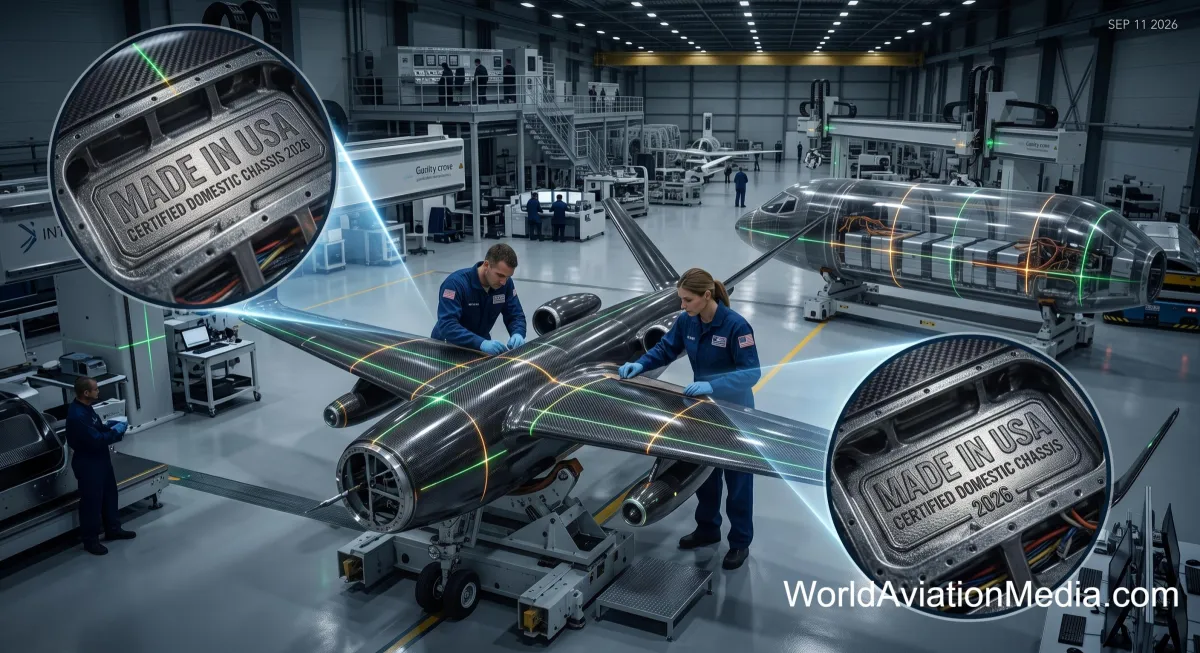
Heavy-Lift Cargo Drones & Offshore Logistics: Why 2026 is the Year of Autonomy
Key Takeaways: The New Era of Vertical Lift
Legacy Airframes, New Missions: The Robinson R44 "Airtruck" demonstrates that converting proven, type-certified airframes for remote flight provides a lower-risk, high-velocity path to achieving 1,000 lb payload capacities in offshore environments.
The Military Resupply Shift: Under the FAA’s eVTOL Integration Pilot Program (eIPP), Elroy Air’s Chaparral is validating the transition to autonomous "forward-resupply," a strategic priority for the Department of War to mitigate human risk in the "last tactical mile."
Shared Infrastructure as a Force Multiplier: The ACES consortium (Archer, BETA, and Macquarie Capital) is establishing an interoperable charging backbone across the "Texas Triangle," creating a non-proprietary network of 250 sites to support both electric and hybrid-electric heavy-lift platforms.
Regulatory Maturity: 2026 marks the leap from sandbox testing to Part 135 operations. While Amazon scales with 5 lb "Detect-and-Avoid" systems, heavy-lift platforms are leveraging these same regulatory pathways to replace crewed utility helicopters.
A New Economic Reality: The transition to autonomous logistics is driven by an unignorable ROI gap, where energy costs for large battery-only demonstrators have hit as low as $5 per flight, contrasting sharply with the $1,080/hour operating costs of traditional turbine utility aircraft.
Introduction: The High-Stakes Logistics Gap
For decades, the logistics of offshore energy and military resupply have relied on a singular, increasingly expensive, and high-risk variable: the human pilot. In the Gulf of Mexico, where helicopter fleets service thousands of oil and gas rigs, the safety profile of crewed flight is under constant pressure. The stakes were highlighted as recently as September 8, 2026, when National Air Traffic Services (NATS) suffered a massive system failure that disrupted thousands of flights, underscoring the fragility of our current manual-centric airspace infrastructure.
The year 2026 has emerged as the definitive turning point where uncrewed platforms transitioned from "experimental concepts" to "mission-critical assets." This shift is not merely a technological whim; it is a response to a profound human capital bottleneck. New data from September 2026 puts the cost of a private pilot certificate at an staggering $18,257—a barrier to entry that is strangling the supply of qualified aviators for hazardous utility roles. Furthermore, a recent House Report has called for urgent studies into brain injuries among Navy pilots, adding a layer of ethical and medical urgency to the quest for autonomy.
As we analyze the landscape in late 2026, the logistics gap—defined by the high cost of the "last tactical mile" and the liability of human crews in dangerous environments—is being closed by platforms like the Robinson R44 Airtruck and the Elroy Air Chaparral. We are witnessing the birth of the "Airtruck" era, where 1,000 lb payloads are moved by machines that no longer require a cockpit, a life-support system, or a human life to be put at risk. This is the story of how 2026 became the year we chose autonomy by design, rather than necessity.
Takeaway 1: The 1,000-Pound Milestone — Robinson’s R44 Airtruck
On September 8, 2026, the vertical lift industry reached a landmark achievement in Louisiana. Robinson Unmanned successfully demonstrated the R44 Airtruck, a remotely piloted variant of the globally ubiquitous R44 helicopter, performing precision landings on an offshore-style deck. This was not a test of "if" drones could fly, but "how" they could integrate into the existing industrial supply chain.
From a strategist’s perspective, the decision to use the R44 airframe is a masterclass in regulatory and technical risk mitigation. While competitors are spending billions on "clean-sheet" eVTOL designs that require years of new Type Certification, Robinson is leveraging an airframe with millions of flight hours. By removing the pilot, the Airtruck captures the 1,000 lb payload capacity necessary for the Oil & Gas sector while maintaining a mechanical platform that every technician in the world already understands.
Milestone Achievement: "The September 2026 flight of the Robinson R44 Airtruck in Louisiana confirms that 1,000 lb payloads can now be delivered to offshore environments with the precision of a crewed helicopter but without the human risk. By utilizing a modified version of a platform with a proven flight history, the industry has discovered the fastest path to heavy-lift commercialization."
The industrial implications are profound. Traditional aerospace supply chains are currently tightening; data from ePlane AI indicates that GE90 engine controls for the Boeing 777 have been on the "Hardest-to-Find" list for four consecutive months. While large commercial aviation struggles with the scarcity of components for aging fleets, the Airtruck model sidesteps the complexity of massive turbine engines. It utilizes simplified maintenance cycles and standard hardware that dominate the existing rotorcraft market. For an offshore operator, the Airtruck represents more than just a drone; it represents a way to maintain mission readiness without the liability of a human crew or the supply chain fragility of "bleeding-edge" proprietary hardware.
Takeaway 2: The Military Resupply Revolution — Elroy Air’s Chaparral
While Robinson dominates the commercial offshore narrative, Elroy Air is redefining the "forward-resupply" mission for the defense sector. On September 7, 2026, new footage was released showing the Chaparral autonomous cargo drone performing its first mission-profile flights under the FAA’s eVTOL Integration Pilot Program (eIPP).
The Chaparral is the cornerstone of what the Department of War is calling "Drone Dominance." Unlike remotely piloted systems that still require a 1-to-1 ratio of ground-based pilots to aircraft, the Chaparral is designed for true autonomy. It solves the "last tactical mile"—the most dangerous phase of resupply where human-crewed assets are most vulnerable to ground fire and environmental hazards. In these high-threat environments, "crewless" has moved from being a preference to a default requirement.
One of the Chaparral’s most significant advantages is its hybrid-electric propulsion. While purely electric platforms are limited by energy density, the Chaparral’s hybrid system allows it to travel longer distances into rugged terrain while maintaining a lower acoustic signature than a traditional turbine helicopter. This is critical for stealth in forward-deployed zones. As the Department of War obligates millions in fiscal 2026 funds toward uncrewed systems, the Chaparral serves as the primary example of how military necessity is driving the transition from manual flight to autonomous cargo delivery at scale.
Takeaway 3: The Infrastructure Backbone — Shared Charging Networks
The greatest hurdle to the drone revolution has always been the "proprietary moat"—the risk that every manufacturer would build its own charging station, creating a fragmented and inefficient network. In September 2026, this threat was largely neutralized by the expansion of the America's Consortium for Electric Skyways (ACES).
Founded by Archer Aviation, BETA Technologies, and Macquarie Capital, ACES is working in direct coordination with the Texas Department of Transportation (TxDOT). Their mission is to build a non-proprietary charging backbone across the "Texas Triangle," connecting the economic powerhouses of Dallas/Fort Worth, Austin, San Antonio, and Houston. The consortium has outlined a roadmap to electrify 250 air taxi and cargo sites over the next decade.
The inclusion of Macquarie Capital and TxDOT signals that this is no longer a niche project; it is a major infrastructure play. By building interoperable charging stations at airports and fixed-base operators (FBOs), ACES is ensuring that a Robinson Airtruck, an Elroy Chaparral, or an Archer Midnight can all "fill up" at the same station. This interoperability is the unsung hero of the autonomous logistics shift. It allows cargo to move seamlessly between urban hubs and rural communities, turning the state of Texas into the world's most advanced regulatory and physical sandbox for uncrewed aviation.
Takeaway 4: Regulatory Velocity — Moving Beyond Pilot Programs
For years, the FAA was seen as the "regulator of no." However, 2026 has witnessed a surge in what we call "Regulatory Velocity." The eVTOL Integration Pilot Program (eIPP) has successfully transitioned from the planning phase to active, daily flight testing in critical markets like Texas and Louisiana.
A key indicator of this shift is Amazon Prime Air’s massive expansion. By the end of 2026, Amazon plans to scale its drone delivery to 500 US cities using the MK30 drone. While the MK30 is designed for 5 lb shoebox deliveries, the technological DNA it is validating—specifically its "Detect-and-Avoid" (DAA) system—is the same foundation required for 1,000 lb heavy-lift drones. Amazon's operation under FAA Part 135 certification provides a blueprint for how heavy-lift platforms will eventually achieve wide-scale commercial integration.
The move toward autonomy is also being accelerated by safety data. While human pilots are subject to fatigue and the long-term effects of "brain injuries" mentioned in recent House reports on Navy aviators, autonomous systems provide a predictable, hazard-aware alternative. These "sandboxes" in Texas are proving that an autonomous system can not only respond to airspace hazards as well as a human but can do so without the physiological risks inherent to the cockpit.
Takeaway 5: Economic Displacement — The $5 Flight Reality?
The most compelling argument for the shift to uncrewed logistics is the bottom line. On August 17, 2026, a 25,000-lb technology demonstrator airplane—measuring 106 feet from wingtip to wingtip—completed a half-hour flight for just $5 in electricity. While this fixed-wing demonstrator is not a direct replacement for a rotary-wing Airtruck, it proves the physics of the "Economic Displacement" that is coming for the utility aviation sector.
Compare this to a traditional utility aircraft like the Daher Kodiak 100, a staple of regional logistics. The Kodiak carries an estimated variable operating cost of $1,080 per hour. When you factor in the rising pilot certification costs and the intensive MRO (Maintenance, Repair, and Overhaul) required for high-pressure turbines, the shift to electric and hybrid-electric autonomy becomes an economic mandate.
The Economic Comparison (Estimated Utility Flight):
Cost Factor | Traditional Crewed Utility (e.g., Kodiak) | Autonomous Heavy-Lift (e.g., Airtruck/Chaparral) |
Energy/Fuel Cost | $400 - $600/hr (Jet A) | $10 - $50/hr (Electric/Hybrid) |
Crew/Pilot Cost | $250+/hr | $0 (Autonomous/Ground Managed) |
Maintenance (MRO) | High (Complex Turbine Overhauls) | Reduced (Electric Motors/Simplified Hardware) |
Hourly Total | $1,080/hr | Estimated $150 - $300/hr |
As the aerospace aftermarket faces scarcity in engine controls and turbine parts, the move to autonomous heavy-lift isn't just a tech choice—it's capital efficiency in action.
Conclusion: A Thought-Provoking Horizon
The transition we are witnessing in 2026 is a fundamental shift from "crewed by necessity" to "autonomous by choice." The technical hurdles of vertical lift have been cleared; the 1,000 lb "Airtruck" is a flying reality, the ACES charging networks are being laid into the Texas soil, and the regulators have found a path forward through the eIPP and Part 135.
In this new era, the role of the traditional pilot is evolving from a "driver" to a "fleet manager." We are moving toward a world where a single operator on the ground oversee a swarm of Airtrucks delivering critical supplies to a dozen oil rigs or forward-deployed units simultaneously.
Closing Thought: If a 1,000 lb R44 no longer requires a cockpit or a pilot on board to deliver mission-critical cargo safely and at a fraction of the cost, what is the future of the traditional pilot's seat? Is the cockpit destined to become an expensive, hazardous relic of aviation's "manual" past?
5-Item Q&A Section
1. What is the main difference between the R44 Airtruck and traditional cargo drones? The R44 Airtruck is a "remotely piloted" conversion of a proven, type-certified helicopter airframe. Unlike "clean-sheet" drones built from scratch, the Airtruck leverages an airframe with millions of existing flight hours, allowing it to bypass many of the reliability and certification hurdles that face new eVTOL designs.
2. Can these drones actually carry industrial-scale weight? Yes. The Robinson R44 Airtruck successfully demonstrated a 1,000 lb payload capacity in its September 8, 2026, flights in Louisiana. This allows it to transport heavy industrial tools and relief supplies that were previously only movable via expensive, crewed helicopter flights.
3. Why is Texas the center of these current trials? Texas serves as a primary hub because of the eVTOL Integration Pilot Program (eIPP) and the ACES consortium. The state is testing the "Texas Triangle" routes (Dallas, Austin, San Antonio, Houston), supported by the Texas Department of Transportation (TxDOT) and private investment from Macquarie Capital to build shared, interoperable charging infrastructure.
4. What is the U.S. Army's role in this development? The U.S. Army is a primary driver through its focus on "Drone Dominance." By utilizing platforms like the Elroy Air Chaparral, the Department of War aims to automate "forward-resupply" to eliminate human risk in the hazardous "last tactical mile" of military logistics.
5. How soon will this replace human-crewed flights offshore? With successful demonstrations completed in late 2026 and infrastructure scaling in the Gulf region, commercial adoption is already underway. Full integration into standard offshore supply chains is expected to reach production scale by 2027 as Part 135 certifications become more common for heavy-lift platforms.
Keywords and Hashtags
Keywords: Robinson R44 Airtruck, Elroy Air Chaparral, heavy-lift drones, offshore logistics, autonomous cargo, vertical lift 2026, eVTOL integration, Department of War resupply, drone charging network, FAA Part 135.
Hashtags: #AAM #AutonomousAviation #DroneLogistics #HeavyLift #FutureOfFlight
