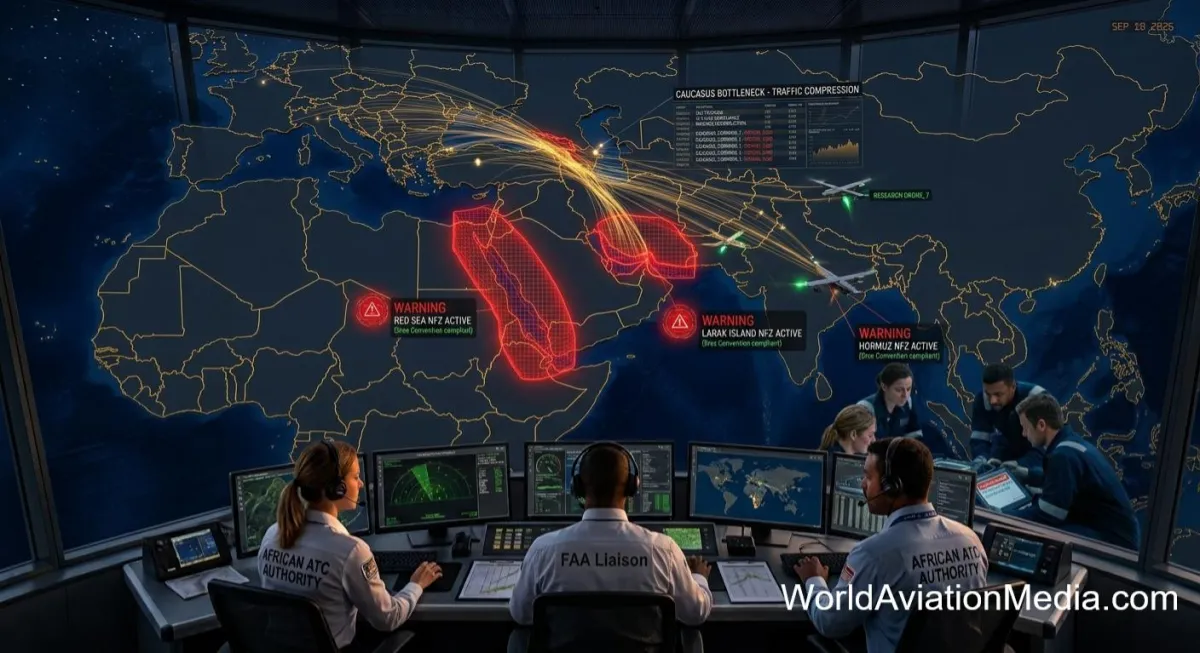
Global Aviation Crisis 2026: Analyzing the Impact of Red Sea Airspace Disruptions and Route Compression
KEY TAKEAWAYS
Operational Strain: Geopolitical and environmental factors have converged to create a "20% compression" of available airspace. This narrowing of corridors has stripped away the traditional "buffer" in global flight schedules, forcing long-haul networks into high-cycle intensity patterns that accelerate airframe and engine wear.
Financial Volatility: Tensions in the Strait of Hormuz and strikes on Iranian infrastructure have propelled oil futures toward $100 per barrel. Carriers like Virgin Atlantic have already implemented aggressive fuel surcharges to offset the dual burden of rising costs and increased fuel burn from diverted routings.
Infrastructure Vulnerability: Major hubs are operating with dangerously thin buffers. The "pincer effect" of natural disasters (Anak Krakatau) and man-made closures has left high-utilization airports in Jakarta, Sydney, and Dubai vulnerable to cascading delays.
Decarbonization Hurdles: Increased flight times directly contradict industry SAF (Sustainable Aviation Fuel) goals. While synthetic eSAF trials continue, the immediate necessity of flying longer, diverted paths is inflating the sector's carbon footprint.
Safety Risk Corridors: Technical anomalies are magnified in compressed airspace. Recent incidents involving aging airframes and engine flameouts highlight the risks of pushing maintenance-intensive fleets through saturated flight paths where diversion options are limited.
1. INTRODUCTION: THE FRAGILITY OF THE GLOBAL CORRIDOR
In September 2026, the global aviation industry has entered a period of unprecedented structural stress. The "20% compression" of the East-West air corridor is no longer a theoretical risk—it is a daily operational reality. This phenomenon describes a scenario where geopolitical conflict in West Asia and a surge in natural hazards across the Asia-Pacific have physically narrowed the available sky, funneling thousands of flights into restricted, overcrowded waypoints. This redistribution of traffic has created a systemic bottleneck that tests the structural and economic limits of modern aviation.
The strategic importance of this corridor, which links the EMEA and APAC regions, cannot be overstated. However, the volatility observed in early September has exposed the fragility of this link. Security concerns in the Red Sea have converged with environmental crises—specifically the catastrophic 25-hour continuous eruption of Mount Anak Krakatau and persistent transboundary haze from Indonesian peatland fires. This physical narrowing of the sky has an immediate economic corollary: it eliminates the "operational slack" airlines rely on for punctuality. As corridors shrink, the global network transitions from a fluid system to a brittle one, where a single localized disruption—such as a staffing shortage in Sydney or a radar failure on Larak Island—can trigger a global schedule collapse.
2. GEOPOLITICAL VOLATILITY AND AIRSPACE RESTRICTION
West Asian airspace is the essential pivot point for global long-haul connectivity. When security here degrades, the ripple effect is instantaneous and global. In September 2026, the strategic landscape shifted following precision strikes by U.S. and Israeli forces against Iranian radar, communication, and mine-laying infrastructure, particularly around Larak Island. These strikes have not only rendered certain sectors unmonitored but have also introduced the risk of GNSS (Global Navigation Satellite System) jamming and the use of long-range weapons in civilian corridors.
This geopolitical volatility has forced a mass exodus from traditional flight paths. Mainline carriers from China, India, and Southeast Asia have borne the brunt of these restrictions. To avoid conflict zones, long-haul flights between Asia and Europe are being rerouted into "safe" but highly congested corridors over the Caucasus and Central Asia. For a typical flight from Delhi or Shanghai to London, this adds significant mileage and flight time. The "20% compression" means that aircraft are funneled into narrower sectors, increasing the burden on Air Traffic Control (ATC) and narrowing the schedule buffers that usually allow for minor technical delays.
The impact on Chinese and Indian mainline carriers is particularly acute. These airlines operate high-frequency schedules out of hubs like Beijing, Delhi, and Mumbai—cities that are now acting as regional bottlenecks. When airspace restrictions coincide with peak travel periods, these hubs face immediate ground stops. The strategic consequence is a loss of asset utilization: aircraft that should be generating revenue are instead burning extra fuel on longer paths or sitting at gates waiting for a "slot" in the now-crowded sky.
3. THE ECONOMIC TOLL: FUEL, SURCHARGES, AND OIL VOLATILITY
Fuel management is the strategic linchpin of aviation, but the current routing instability has turned it into a source of extreme financial volatility. The primary driver is the escalating tension in the Strait of Hormuz, a chokepoint through which much of the world's jet fuel feedstock passes. Market analysts at Argus Media have warned that oil futures are poised to exceed $100 per barrel if the conflict in West Asia remains unresolved. For the aviation sector, this represents a double-edged sword: airlines are flying more miles due to rerouting while paying significantly more for every gallon consumed.
The financial fallout is already being passed to the consumer. Sir Richard Branson has explicitly linked the rise in oil prices and the subsequent fuel surcharges at Virgin Atlantic to the strikes on Iranian targets. This inflationary pressure is compounded by the fact that many airlines are seeing their fuel hedging strategies overwhelmed by the sheer volume of additional burn required for diverted routes. Furthermore, the market is seeing a broader shift in capital toward the defense sector—evidenced by Boeing's massive $131 billion F-15 Eagle Crest contract—suggesting that the aerospace industry's focus is pivoting toward military resilience as civil profitability margins are squeezed.
This financial instability is also driving shifts in airline ownership and strategy. The recent exit of Carl Icahn as a major shareholder in JetBlue signals a loss of investor confidence in carriers that lack the scale or fuel-efficiency to weather high oil prices. As "premium positioning" becomes the only way to sustain margins, low-cost carriers (LCCs) are increasingly exposed. The current environment does not just demand efficient flight paths; it demands an entirely new financial architecture capable of absorbing $100-per-barrel oil and the operational friction of a compressed sky.
4. OPERATIONAL CRUNCH: THIN BUFFERS AT GLOBAL HUBS
High-utilization airports are engineered for maximum throughput, leaving them with almost zero capacity to absorb external shocks. In September 2026, a single-day spike in disruptions hit 39 airports across Asia, revealing the catastrophic potential of a system with no "slack."
Table 1: Asia-Pacific Aviation Disruption Snapshot (September 2026 Spike)
Metric | Impact Data |
Total Impacted Airports | 39 |
Total Flights Affected | ~4,000 |
Total Delays | >3,600 |
Total Cancellations | >470 |
Primary Hubs Affected | Jakarta (CGK), Sydney (SYD), Delhi (DEL), Dubai (DXB) |
This "disruption spike" was exacerbated by a "pincer effect" in Southeast Asia. While the continuous eruption of Mount Anak Krakatau forced the closure of eight Indonesian airports, including the vital Soekarno-Hatta (CGK), transboundary haze from forest and peatland fires simultaneously reduced visibility across Malaysia, Singapore, and Brunei. At Soekarno-Hatta, the routine weather observation (METAR) actually carried the "VA" (Volcanic Ash) code, indicating that ash was observed at the field, forcing a total shutdown that affected 270,000 passengers.
The crisis in the air is being met with crises on the ground. In Australia, Airservices Australia is facing severe staffing shortages and "frequent failures" in air traffic control systems. This has led to critical flow restrictions at Sydney Airport. While the CEO of Airservices Australia has pushed back against airline claims of systemic failure, the reality is a dangerous convergence: natural hazards (ash and haze) are narrowing the physical sky, while human and infrastructure failures are narrowing the operational window. When a hub like CGK or SYD closes, the ripple effect through the rapid-turnaround networks of LCCs is immediate, turning a local weather event into a regional network failure.
5. CASCADING RISKS: TECHNICAL FAILURES AND SAFETY PROTOCOLS
When a global fleet is pushed to its limits by longer routings and higher cycle intensity, technical integrity begins to degrade. The "20% compression" means that when a failure occurs, the aircraft is often in a saturated sector with fewer diversion options and higher ATC workload.
Recent incidents provide a chilling look at these risks. On September 6, an Alaska Airlines 26-year-old Boeing 737-700 (AS671) experienced a rapid descent from 40,000 feet to 10,000 feet following an unspecified technical failure, forcing an emergency diversion to Fresno. While the crew followed standard pressurization protocols, the incident highlights the strain on older airframes that are being pushed through more cycles and longer flight durations than originally anticipated.
Even more illustrative is the NetJets Cessna 680A incident in Laredo, Texas. After a series of fuel pressure warnings and a vectoring delay that forced a 270-degree turn, both engines flamed out on short final. Investigators found a fractured fuel tube in the right engine and a starter/generator that was at 1,142.8 hours of a 1,200-hour overhaul limit. This case study perfectly encapsulates the "compression risk": a maintenance-heavy component nearing its limit, combined with an unexpected operational delay (vectoring), leads to a catastrophic loss of power.
The persistent threat of volcanic ash adds another layer of technical peril. As demonstrated by British Airways Flight 9 in 1982, ash is an invisible killer of jet engines. Composed of pulverized rock with a melting point lower than modern turbine temperatures (which can exceed 1,000°C), ash melts in the combustor and solidifies as glass on the turbine blades, choking airflow. Because ash is invisible to radar, "complete avoidance" is the only viable strategy. However, in a 20% compressed environment, "avoidance" further narrows the funnel, creating dangerous traffic densities and increasing the risk of mid-air proximity incidents.
6. STRATEGIC PIVOTS: SAF, CONNECTIVITY, AND THE FUTURE OF RESILIENCE
To survive the recurring disruption spikes of the late 2020s, the industry is pivoting toward radical resilience. The primary objective is to decouple aviation from geopolitical energy dependencies. Sustainable Aviation Fuel (SAF) and synthetic eSAF are central to this. American Airlines recently conducted a commercial flight using Infinium’s synthetic eSAF, while in Australia, Jet Zero Australia secured a A30 million (22 million) capital raise from Qantas and Airbus to develop a domestic SAF production campus in Queensland. These investments signal a move by carriers to fund fuel producers directly, securing supply in a market where traditional crude routings are increasingly hazardous.
Digital transformation is also serving as a buffer against chaos. American Airlines’ rollout of free, high-speed Wi-Fi sponsored by AT&T is more than a perk; it is a strategic tool for "premium positioning." In a world of constant rerouting and delays, providing passengers with the ability to manage their own re-bookings and professional lives in real-time is essential for maintaining brand loyalty.
Finally, the industry is looking at new management models to build stability in developing markets. The "Ethiopian model"—where Ethiopian Airlines takes a 49% stake in carriers like Malawian Airlines and provides technical management services—is being discussed for Namibia. This model allows developing nations to leverage established expertise in fleet planning and maintenance without the high cost of building sovereign infrastructure from scratch. However, it also triggers a "sovereignty debate" regarding the control of national airspace. As we move toward 2030, such modernization and strategic cooperation—underpinned by a desperate need for air traffic resilience—will be the only way to navigate the compressed skies of the future.
7. 5-ITEM Q&A SECTION
Q1: Why is the "20% compression" specifically dangerous for older aircraft? A: Older airframes, like the 26-year-old Boeing 737 involved in the Alaska Airlines emergency, are more susceptible to technical wear. In a compressed environment, these aircraft are subjected to higher cycle intensity and longer diverted routings. This pushes components—such as the HPT (High-Pressure Turbine) blades currently in short supply—toward their maintenance limits faster, increasing the risk of in-flight anomalies.
Q2: How did the Anak Krakatau eruption create a "pincer effect" for Asian aviation? A: The eruption provided a physical barrier (ash plumes up to 48,000 feet) that closed major airports like Soekarno-Hatta. Simultaneously, transboundary haze from Indonesian peatland fires reduced visibility and tightened operating minima at surrounding hubs in Malaysia and Singapore. This forced airlines to deal with both "no-fly" ash zones and "low-visibility" landing constraints at the few remaining open alternates.
Q3: What role did the Larak Island strikes play in route disruptions? A: The strikes on Iranian radar, communication, and mine-laying targets created "blind spots" in critical airspace. To ensure safety, international carriers diverted away from these unmonitored or hostile zones, funneling more traffic into the already saturated corridors over Central Asia and the Caucasus.
Q4: How does volcanic ash physically destroy a jet engine? A: Ash consists of pulverized rock and glass. It has a melting point lower than the operating temperature of a jet engine's combustor. When ingested, the ash melts, then travels to the cooler turbine sections where it solidifies as a ceramic-like coating. This chokes the airflow and causes an immediate flameout, as seen in the 1982 British Airways Flight 9 incident.
Q5: What is the significance of the NetJets starter/generator reaching 1,142.8 hours? A: It serves as a warning about "thin buffers." The component was nearly at its 1,200-hour overhaul limit. In a system under schedule pressure and rerouting delays, there is less time for preventative maintenance. When the aircraft was delayed by a 270-degree vectoring turn, the component failed, contributing to the dual engine flameout.
KEYWORDS & HASHTAGS
Keywords: Airspace Compression, Aviation Geopolitics, Red Sea Route, SAF Investment, Flight Disruptions 2026, Anak Krakatau Eruption, Jet Fuel Prices, eSAF, Air Traffic Control Staffing, HPT Blade Supply, Strait of Hormuz, Volcanic Ash Protocol, eSAF American Airlines, Qantas Jet Zero Australia, Boeing F-15 Contract.
Hashtags: #AviationCrisis2026 #GlobalFlightDisruptions #RedSeaAviation #SustainabilityInAir #AviationSafety #OilPrices #AnakKrakatau #SAF #AviationMRO #FutureOfAviation
