From FBOs to Vertiports: How Signature Aviation, UrbanV, and the FAA Are Solving AAM’s Ground Problem
Key Takeaways
FAA Draft Vertiport Standards Released: On October 22, 2026, the FAA published Draft Advisory Circular AC 150/5390-4, establishing proposed federal design standards for vertical lift infrastructure (open for public comment through January 11, 2027, targeting finalization in summer 2027).
Signature UrbanV Alliance (SUVA) Launches: On October 21–22, 2026, Signature Aviation and Italian vertiport operator UrbanV officially launched the Signature UrbanV Alliance (SUVA) to build and operate an OEM-agnostic U.S. vertiport network starting at existing Signature FBO terminals.
Throughput Over Battery Chemistry: While eVTOL OEMs (BETA Technologies, Joby, Archer) have proven 130–200+ mile flight envelopes, commercial viability hinges on ground turnaround times—specifically Pad Occupancy Time (POT) and megawatt-level fast charging.
The FBO Brownfield Advantage: Retrofitting existing Fixed-Base Operator (FBO) leasehold estates bypasses multi-year municipal zoning battles, providing immediate NEPA environmental baselines, secure perimeter fencing, and direct airport terminal transfers.
The Real eVTOL Bottleneck Isn’t in the Air—It’s on the Concrete
For the past five years, the Advanced Air Mobility (AAM) conversation has been dominated by battery specific energy (Wh/kg), tilt-rotor transition aerodynamics, and aircraft type certification timelines. By October 2026, the flight performance of electric vertical takeoff and landing (eVTOL) aircraft is no longer theoretical: Archer’s Midnight recently logged flights exceeding 200 miles at speeds up to 131 mph, and on October 21, 2026, U.S. Transportation Secretary Sean P. Duffy announced FAA authorization for BETA Technologies’ A250 eVTOL to conduct market survey and passenger demonstration flights.
Yet an air taxi with nowhere to land, recharge, and board passengers in under eight minutes is an economically stranded asset. During the third week of October 2026, two landmark announcements shifted the industry’s center of gravity from the airframe to the tarmac: the launch of the Signature UrbanV Alliance (SUVA) on October 21–22, and the FAA’s release of Draft Advisory Circular 150/5390-4 on October 22.
What is FAA Draft Advisory Circular 150/5390-4? Released on October 22, 2026, FAA Draft AC 150/5390-4 is the Federal Aviation Administration's comprehensive proposed guidance for the geometric design, load-bearing capacity, safety areas, charging infrastructure, and visual aids of vertical lift infrastructure (vertiports). Open for public comment until January 11, 2027, with final issuance targeted for summer 2027, it establishes the physical rulebook for U.S. AAM ground facilities.
Unpacking FAA Draft AC 150/5390-4: Moving Beyond Helicopter Pads
Until now, municipal planners and private airport developers operated under interim FAA engineering briefs that largely adapted legacy heliport rules (AC 150/5390-2D). However, powered-lift eVTOL aircraft behave very differently from conventional single-main-rotor helicopters during final approach, hover, and ground taxi.
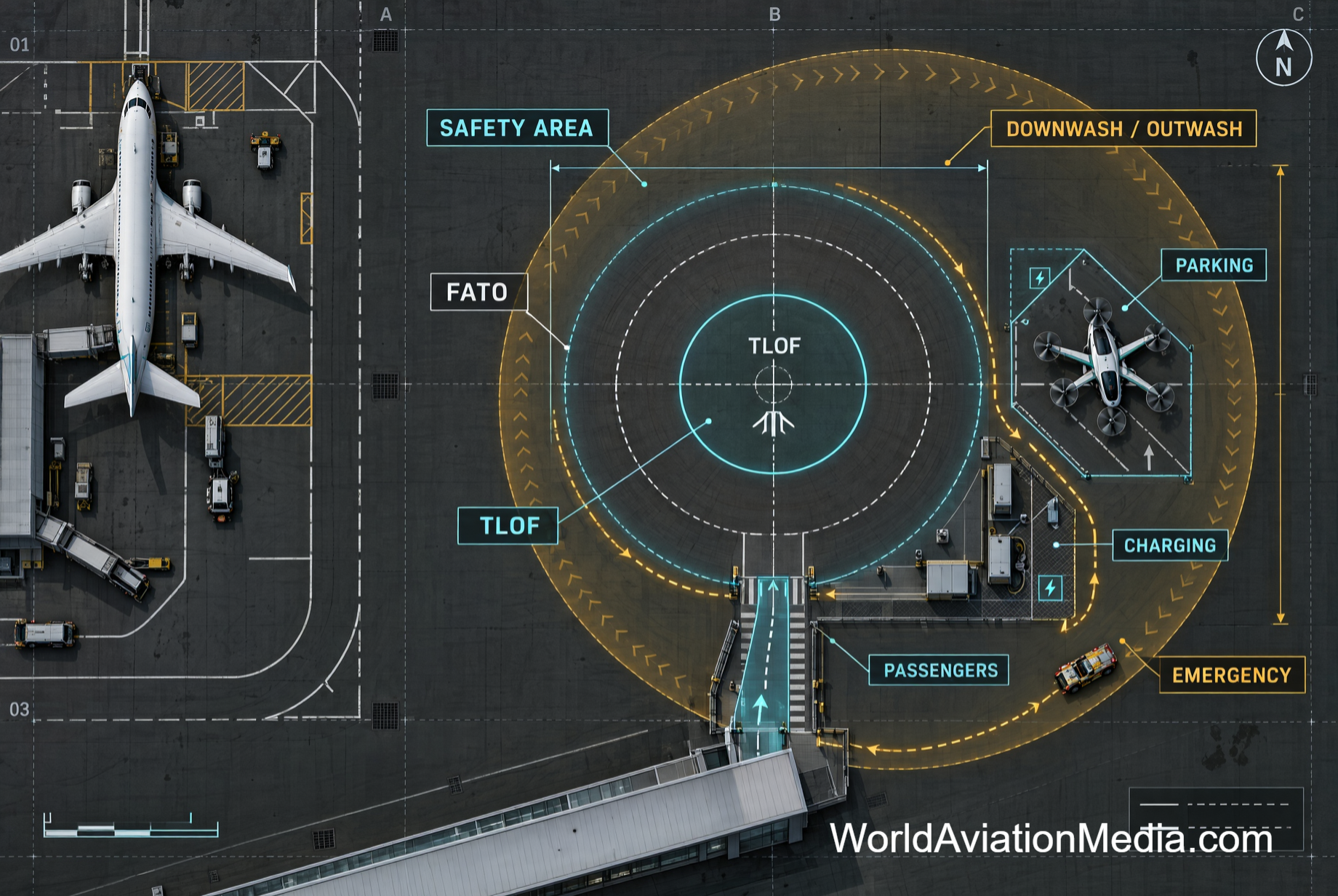
Draft AC 150/5390-4 addresses the unique physics and operational hazards of multi-rotor and vectored-thrust eVTOLs across four critical engineering domains:
TLOF, FATO, and Safety Area Geometry (D-Value Scaling): The draft circular refines dimensional ratios for the Touchdown and Liftoff Area (TLOF), Final Approach and Takeoff Area (FATO), and surrounding safety areas based on the aircraft's controlling dimension (D-value) and maximum takeoff weight. It accounts for the wider wingspans of winged eVTOLs (like BETA's Alia A250, Joby's S4, and Archer's Midnight) during ground taxi to parking stands.
Downwash and Outwash Velocity Mitigation: Because distributed electric propulsion (DEP) utilizes multiple smaller-diameter rotors operating at high disk loading during hover, eVTOLs generate concentrated high-velocity outwash wakes near ground level. Draft AC 150/5390-4 establishes clear buffer zones to protect ground handlers, adjacent parked business jets, and passenger walkways from rotor wash hazards.
High-Voltage Charging & Battery Thermal Runaway Fire Safety: Unlike Jet-A refueling, eVTOL turnarounds require liquid-cooled, megawatt-class DC fast chargers (such as BETA's multimodal charging cube architecture). The draft circular introduces guidance on electrical conduit routing, stand clearances, and thermal runaway suppression drainage to ensure a lithium-ion battery fault on a parking pad cannot propagate across the ramp.
Visual Glideslope and Autonomous Landing Aids: Standardized lighting arrays, surface markings, and obstruction-free approach/departure surfaces designed to support both human powered-lift pilots and future precision instrument approaches.
Inside the Signature UrbanV Alliance (SUVA)
Just 24 hours before the FAA dropped its draft circular, the commercial blueprint for deploying those standards took shape. Following their initial 2025 joint venture framework, Signature Aviation—the world's largest network of private aviation terminals (FBOs)—and UrbanV, the pioneering Italian vertiport developer and operator backed by Aeroporti di Roma, officially launched the Signature UrbanV Alliance (SUVA).
Strategic Pillar | Signature Aviation Contribution | UrbanV Contribution | Combined SUVA Value Proposition |
Real Estate Footprint | 200+ global FBO locations; prime airside leaseholds at top U.S. metro airports | European & global urban node development experience (Rome, Venice, Nice) | Immediate "hub-and-spoke" connectivity between major commercial airports and city centers |
Operational DNA | Decades of VIP passenger lounge management, line service, and ground handling | Purpose-built vertiport architectural design, passenger flow, and airside simulation | High-throughput, 5-to-8 minute eVTOL turnarounds integrated with private & commercial aviation |
OEM Agnosticism | Existing relationships with BETA, NetJets, and fleet operators | Multi-OEM charging and pad interface engineering | Open-access infrastructure serving multiple eVTOL manufacturers and airlines |
Rather than attempting to build speculative skyports atop downtown Manhattan or Miami skyscrapers—which require years of municipal zoning variances, grid substation upgrades, and community noise litigation—SUVA’s Phase 1 strategy is pragmatic: start at existing Signature FBO terminals and scale outward as commercial demand matures.
Why Private Terminals Are the Proving Ground for AAM Throughput
To understand why SUVA's brownfield FBO strategy is decisive, consider the unit economics of an eVTOL air taxi. Because an eVTOL carries only 4 to 6 passengers per flight, an operator cannot make money if the aircraft sits on the ground for 35 minutes between flights. Profitability requires high daily utilization, which is governed by Pad Occupancy Time (POT) and Gate Turnaround Time.
Existing Signature FBO terminals solve three existential infrastructure hurdles simultaneously:
Permitted Aviation Land & Airspace Integration: Signature's ramps are already inside controlled airport perimeters with established FAA airspace procedures, firefighting (ARFF) coverage, and TSA security screening protocols.
Grid Capacity & Multimodal Charging: Many Signature locations have already begun installing high-capacity electrical infrastructure to support electric ground support equipment (eGSE) and early electric aircraft chargers. Upgrading an FBO substation to handle 1-to-2 MW peak charging loads is exponentially faster than trenching high-voltage lines into a dense downtown business district.
The Natural First Customer: The earliest commercial adopters of 150-to-300 eVTOL seat tickets are business aviation travelers stepping off a Gulfstream G700 or Bombardier Global 7500 at Teterboro (TEB), Van Nuys (VNY), Dulles (IAD), or Palm Beach (PBI) who want an immediate 12-minute vertical hop to a downtown heliport or regional resort.
The Road to Summer 2027 and Commercial Entry
As industry stakeholders submit technical comments on FAA Draft AC 150/5390-4 ahead of the January 11, 2027 deadline, the alignment between regulatory standards and private capital is finally crystallizing. While municipal testbeds—such as Orlando’s proposed demonstration vertiport and New Mexico’s eIPP flights—validate airspace integration, the Signature UrbanV Alliance gives eVTOL manufacturers what they need most as they approach type certification in 2027: a standardized, multi-manufacturer national ground network ready to accept paying passengers on Day One.
5-Item Q&A Section
Q1: What is the Signature UrbanV Alliance (SUVA)? Launched on October 21–22, 2026, the Signature UrbanV Alliance (SUVA) is a joint venture between private aviation terminal operator Signature Aviation and vertiport developer UrbanV. SUVA develops and operates OEM-agnostic Advanced Air Mobility (AAM) vertiport infrastructure across the United States, beginning at existing Signature FBO terminals and expanding to urban and regional nodes.
Q2: What did the FAA announce regarding vertiport design standards in October 2026? On October 22, 2026, the FAA released Draft Advisory Circular 150/5390-4, its comprehensive proposed design standards for vertical lift infrastructure (vertiports). The draft is open for public comment through January 11, 2027, and the FAA targets publishing the final vertiport design guidelines in summer 2027.
Q3: Does FAA Draft AC 150/5390-4 approve specific vertiports for commercial operation? No. Draft AC 150/5390-4 is an initial regulatory proposal for engineering and geometric design standards, not an operational approval for any specific vertiport site. Individual vertiports still require site-specific airspace evaluation, environmental review, and local permitting.
Q4: Why are existing FBO terminals ideal for early eVTOL vertiports? Existing Fixed-Base Operator (FBO) terminals already possess secure airside real estate, FAA-integrated airspace access, fire rescue coverage, and high-net-worth passenger traffic. Starting at FBOs allows networks like SUVA to deploy charging pads and passenger lounges rapidly while bypassing the multi-year zoning and power-grid hurdles of downtown greenfield sites.
Q5: What did the FAA authorize for BETA Technologies’ A250 eVTOL in October 2026? In late October 2026, U.S. Transportation Secretary Sean P. Duffy announced that the FAA granted BETA Technologies’ A250 eVTOL a special airworthiness authorization to conduct market survey and demonstration flights, alongside clearing BETA's Alia eVTOL for passenger demonstration flights.
Keywords and Hashtags
Keywords: FAA Draft AC 150/5390-4 vertiport standards, Signature UrbanV Alliance SUVA, AAM ground infrastructure 2026, FBO vertiport integration, eVTOL turnaround time charging, BETA Technologies A250 FAA authorization, urban air mobility infrastructure.
Hashtags: #AdvancedAirMobility #Vertiports #SignatureAviation #UrbanV #eVTOL #FAARegulations #FutureOfFlight #BusinessAviation
