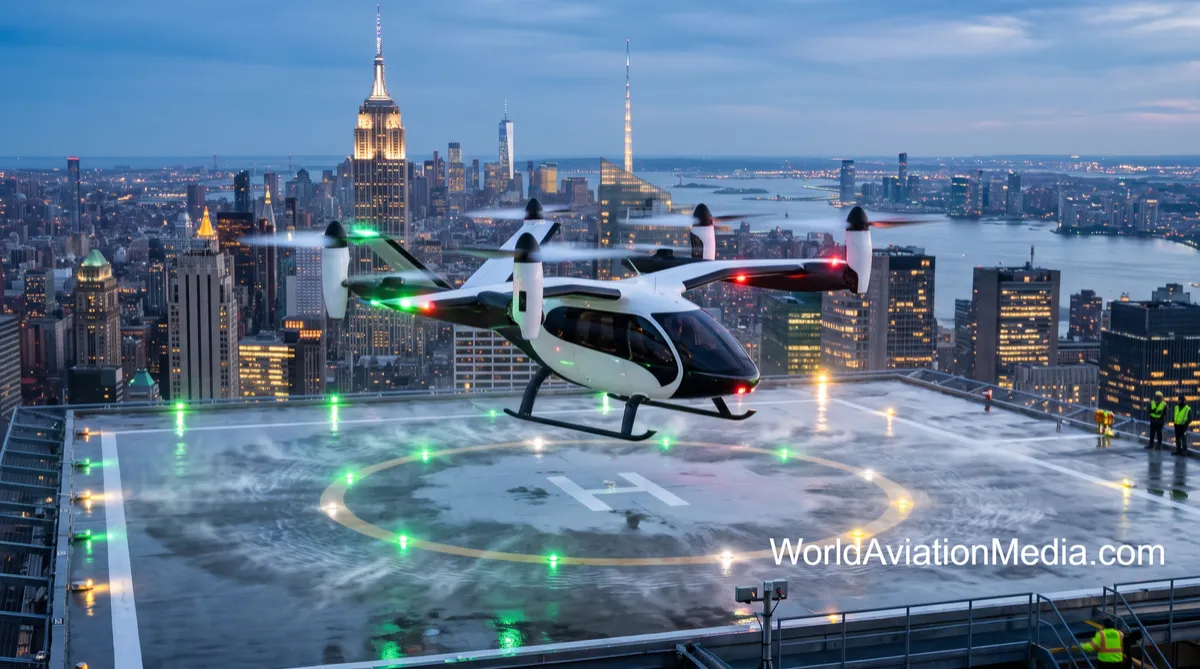
eVTOL Certification Bottlenecks: Why Air Taxi Pioneers Continue Facing Regulatory Hurdles in Commercial Passenger Transitions
Key Takeaways
The Shifting Regulatory Goalpost (Part 21.17(b)): The FAA's reclassification of electric Vertical Takeoff and Landing (eVTOL) air taxis from Part 23 small airplanes into the special "Powered-Lift" category under 14 CFR § 21.17(b) and the final SFAR (Special Federal Aviation Regulation) forced pioneers like Archer Aviation and Joby Aviation through an unprecedented, multi-year compliance crucible.
Software, Flight Control Laws, and Battery Thermal Runaway: Unlike conventional fixed-wing aircraft, tilt-propeller eVTOLs rely entirely on fly-by-wire distributed electric propulsion (DEP) computers to survive the high-risk transition phase between vertical hover and wing-borne cruise—demanding a 10-9 (one in a billion) catastrophic failure probability verification.
From Uncrewed Demonstrations to Type Inspection Authorization (TIA): While Archer Aviation continued advancing key FAA certification milestones and operational updates in late 2026 for its Midnight aircraft, crossing the threshold from conforming flight-test articles to paying commercial passengers requires exhausting every single systems integration lab (SIL) and iron-bird test requirement.
Dual-Track Revenue Strategies: To insulate balance sheets while final FAA passenger type certification completes, leading U.S. eVTOL OEMs are prioritizing defense contract deliveries (AFWERX Agility Prime) and early international launches in supportive regulatory sandboxes like the United Arab Emirates (GCAA).
Why Is Certifying an eVTOL Air Taxi Taking Longer Than Originally Projected?
When the Urban Air Mobility (UAM) investment wave peaked earlier in the decade, investor presentations routinely promised that electric Vertical Takeoff and Landing (eVTOL) air taxis would be shuttling everyday commuters between Manhattan heliports and JFK Airport by 2024 or 202As the industry closes out October 2026, not a single western winged, tilt-rotor eVTOL has yet carried a full load of non-essential, fare-paying commercial passengers in routine U.S. Part 135 scheduled airline service.
Even industry frontrunners like Archer Aviation—which advanced key FAA certification milestones in September and October 2026 ahead of its Q3 2026 operational disclosures—and arch-rival Joby Aviation have discovered that engineering a flyable electric aircraft is only half the battle. The true bottleneck governing the commercial transition of the Archer Midnight and Joby S4 is navigating the most rigorous, clean-sheet regulatory certification architecture the Federal Aviation Administration (FAA) has constructed in over half a century.
The 21.17(b) "Powered-Lift" Pivot and Its Cascading Impact
To understand why eVTOL certification timelines stretched into 2026 and 2027, aerospace analysts must examine the pivotal regulatory shift executed by the FAA. Initially, leading eVTOL developers structured their certification plans under 14 CFR Part 23 (standard normal-category small airplanes) supplemented by special conditions for vertical flight.
However, halfway through the development cycle, the FAA ruled that because winged eVTOLs take off like a helicopter using thrust-borne lift and cruise like an airplane using wing-borne lift, they must be certified as a special class of "Powered-Lift" aircraft under 14 CFR § 21.17(b), paired with a comprehensive Special Federal Aviation Regulation (SFAR) governing pilot licensing and operational rules. While this move ultimately aligned pilot training and airspace integration rules (including lowering fuel reserve requirements from 45 minutes to 20 minutes for daytime VFR urban flights), it required every eVTOL OEM to negotiate bespoke G-1 (Certification Basis) and G-2 (Means of Compliance) issue papers with the FAA before final Stage 4 (Testing & Analysis) credit flights could even be logged.
The Four Core Technical Bottlenecks in eVTOL Type Certification
For an aircraft like the Archer Midnight—which carries a pilot and four passengers using 12 propellers (six tilting forward rotors for cruise and six aft vertical-lift-only rotors)—passing FAA Stage 4 and Stage 5 certification requires conquering four uncompromising engineering hurdles:
Certification Bottleneck | Specific Regulatory & Engineering Challenge | Impact on Commercial Transition Timeline | How Archer & Industry Leaders Are Solving It |
1. Battery Thermal Runaway & Containment | Lithium-ion cylindrical or pouch cells must survive a single-cell or multi-cell thermal runaway event in flight without fire, toxic smoke ingress into the cabin, or structural loss of thrust. | Requires thousands of destructive drop tests, nail-penetration tests, and thermal propagation trials to satisfy FAA special conditions. | Archer utilizes proprietary cylindrical cell battery packs engineered in-house in San Jose with robust thermal fire-barriers and over-current fusing across six independent packs. |
Fly-by-Wire Transition Flight Control Laws | During the 30-to-60-second transition from vertical hover to 150-mph wing-borne flight, aerodynamic stall and rotor wake interaction create severe non-linear instabilities. | Flight control software (DO-178C Level A) must prove 10-9 reliability across every wind gust and motor-out failure scenario. | Extensive full-envelope unmanned and piloted transition flight campaigns coupled with high-fidelity "Iron Bird" hardware-in-the-loop labs. |
3. Bird Strike & Propeller Blade-Off Integrity | With 6 to 12 exposed high-RPM carbon-fiber rotors operating below 3,000 feet AGL (where 90% of bird strikes occur), a blade-shed event cannot puncture the pressurized/unpressurized cabin or sever adjacent motor wiring. | Mandates ballistic cannon bird-strike testing on spinning rotors and composite wing leading edges. | Redundant twelve-motor cross-wiring and shielded high-voltage bus architectures ensure the aircraft can land safely even if an entire rotor assembly is lost. |
Production Conformity & Supply Chain (Part 21) | Flight-test data only counts toward For-Credit FAA Type Inspection Authorization (TIA) if every single bolt, actuator, and chip on the test aircraft conforms 100% to final production drawings. | Any mid-test hardware tweak invalidates prior test points and forces re-testing. | Partnering with mature Tier-1 aerospace suppliers (Honeywell, Safran, Mecaer) for actuators and avionics rather than building 100% vertically in-house, plus Stellantis high-volume manufacturing in Covington, Georgia. |
Archer Aviation's Strategic Playbook: Why Tier-1 Outsourcing Matters
A defining strategic divergence in the eVTOL race has been vertical integration vs. Tier-1 supply chain leverage. While Joby Aviation opted to design and manufacture virtually every component internally, Archer Aviation deliberately constructed the Midnight airframe around flight-proven, pre-certified sub-components sourced from established aerospace titans—such as Honeywell (flight control actuators and thermal management), Safran (avionics and electrical components), and Garmin (G3000 flight deck architecture).
The logic behind Archer's approach was explicitly designed to compress FAA Stage 4 subsystem compliance testing: when an actuator or cockpit display already holds FAA Technical Standard Order (TSO) heritage on commercial airliners or helicopters, FAA Designated Engineering Representatives (DERs) can audit the component far faster than a first-of-a-kind proprietary black box. Combined with its newly completed high-volume manufacturing facility in Covington, Georgia—built in partnership with automotive giant Stellantis, which has injected hundreds of millions of dollars in capital and manufacturing automation expertise—Archer is positioning to scale quickly once the final FAA Type Certificate (TC) is signed.
International Launch Markets: The UAE Bridge to U.S. Operations
Because FAA type certification remains the gold standard—and therefore the slowest gatekeeper—in global aviation, eVTOL pioneers have structured a staggered geographic rollout for 2026–2027:
The Abu Dhabi & Dubai Commercial Sandbox: Under bilateral agreements and direct partnerships with the UAE General Civil Aviation Authority (GCAA), Abu Dhabi Investment Office (ADIO), and operators like Falcon Aviation and Air Chateau, Archer is leveraging regulatory validation tracks in the Middle East to stand up early vertiport ecosystems, pilot training academies, and initial air taxi corridors linking Abu Dhabi and Dubai while final U.S. FAA Type Inspection Authorization (TIA) flight hours accumulate.
U.S. Airline Integration (United Airlines & Southwest Airlines): Domestically, Archer holds a marquee order from United Airlines (for up to 200 Midnight aircraft to serve trunk airport-to-city-center shuttles in New York, Chicago, and San Francisco) and an infrastructure planning agreement with Southwest Airlines across California airports, alongside preparing air mobility networks ahead of major global sporting showcases like the 2028 Los Angeles Olympics.
5-Item Q&A Section (FAQ)
Q1: Why did the FAA classify eVTOL air taxis as "Powered-Lift" aircraft?
The FAA classified winged eVTOLs like Archer's Midnight and Joby's S4 under the special Powered-Lift category (14 CFR § 21.17(b)) because they combine characteristics of both helicopters (taking off and landing vertically using rotors) and fixed-wing airplanes (cruising on aerodynamic wings), requiring bespoke airworthiness and pilot training standards under a Special Federal Aviation Regulation (SFAR).
Q2: What is the biggest technical hurdle in certifying an eVTOL aircraft?
The two largest technical hurdles are proving battery pack thermal runaway containment (ensuring a lithium-ion cell failure cannot spread or disable flight power) and verifying the fly-by-wire flight control software to a 10-9 safety standard during the complex aerodynamic transition between vertical hover and forward wing-borne flight.
Q3: How many passengers can the Archer Midnight eVTOL carry, and what is its range?
The Archer Midnight is designed to carry one pilot and four passengers (plus carry-on luggage). It is optimized for rapid back-to-back urban commuter hops of 20 to 50 miles at speeds up to 150 mph, with a maximum range of up to 100 miles and a 10-to-12-minute battery fast-charge turnaround between flights.
Q4: How does EASA's eVTOL certification standard compare to the FAA's?
The European Union Aviation Safety Agency (EASA) created its SC-VTOL (Special Condition for VTOL) framework, which demands an extremely stringent 10-9 (one in a billion flight hours) catastrophic failure probability across all commercial passenger eVTOL designs, whereas the FAA's 21.17(b) framework harmonizes closely on high-consequence system safety while tailoring requirements to aircraft weight and architecture.
Q5: Who is manufacturing Archer Aviation's Midnight aircraft at scale?
Archer Aviation partnered with global automaker Stellantis to build and operate a high-volume eVTOL manufacturing facility in Covington, Georgia, capable of scaling production up to 650 aircraft per year across a 350,000-square-foot factory footprint.
Keywords and Hashtags
Keywords: eVTOL certification bottlenecks 2026, Archer Aviation FAA certification status, 14 CFR 21.17b powered-lift SFAR, Archer Midnight commercial transition, air taxi regulatory hurdles, eVTOL battery thermal runaway certification, Urban Air Mobility UAM timeline.
Hashtags: #eVTOL #ArcherAviation #UrbanAirMobility #AirTaxi #FAACertification #AdvancedAirMobility #ElectricAviation #FutureOfFlight
