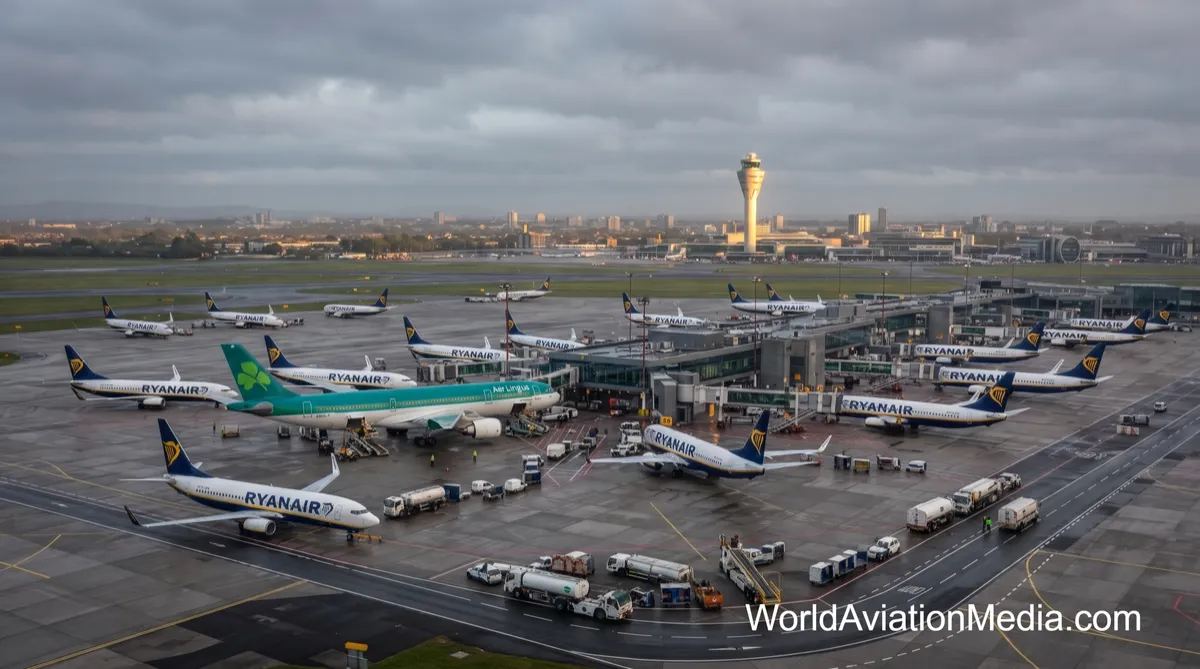
Dublin's 32-Million Passenger Cap Crisis: Analyzing the EU Court Ruling, Slot Cuts, and Ireland's Economic Fallout
Key Takeaways
Landmark CJEU Verdict: On October 15, 2026, the Court of Justice of the European Union (CJEU) ruled that Dublin Airport's legally binding 32-million annual passenger cap must be enforced by slot coordinators when allocating seasonal airline slots, even if it strips carriers of historic "grandfather" rights.
The 6-to-8 Million Passenger Chasm: With Dublin Airport handling 36.4 million passengers in 2025 and projecting 38 to 40 million in 2026, strict compliance requires shedding 6 to 8 million annual passengers—equivalent to erasing a mid-sized European airport overnight.
Legislative vs. Environmental Gridlock: Although Ireland enacted the Dublin Airport (Passenger Capacity) Act 2026 in July 2026 empowering Transport Minister Darragh O'Brien to revoke or lift the cap to 40 million, mandatory environmental assessments threaten prolonged judicial delays.
Ryanair and Transatlantic Exposure: Because Ryanair accounts for roughly 15 million of Dublin's passengers, mandatory slot reductions will disproportionately hammer short-haul UK/EU frequencies while freezing U.S. preclearance trans-Atlantic expansion.
The Day Europe's Top Court Grounded Dublin's Growth Engine
On October 15, 2026, the Court of Justice of the European Union (CJEU) delivered a judgment that sent shockwaves through executive suites from Swords to Chicago. Answering a reference from the Irish High Court dating back to December 2024, the Luxembourg-based tribunal ruled that a planning-mandated annual passenger cap—specifically Dublin Airport's 32-million-passenger ceiling—can and must be factored into technical capacity assessments by the airport slot coordinator under the EU Slot Regulation. More explosively, the CJEU confirmed that enforcing this legal ceiling takes precedence even if doing so requires revoking historic "grandfathered" slots previously operated by incumbent airlines.
The Dublin Airport 32-million passenger cap is a legacy municipal planning condition originally imposed by local planning authorities in 2007 and 2008 as a prerequisite for approving the construction of Terminal 2 and the extension of Terminal 1. At the time, planners feared that surface road infrastructure surrounding the airport—particularly the M50 motorway and local access roads in Fingal—would buckle without a rail or metro link. Nearly two decades later, Dublin still lacks an operational airport rail link, yet its modern dual-runway airfield and two terminals are physically capable of handling well over 40 million passengers per year.
"Europe's top court has ruled that Dublin Airport's controversial 32-million-passenger cap must be taken into account when allocating flight slots, even if it means airlines losing slots they previously held—putting the entire burden of action squarely on the Irish government." — Legal Analysis of the CJEU Judgment, October 15, 2026
The collision between 2007 road-traffic planning rules and 2026 global aviation demand has created an unprecedented regulatory crisis. An island nation whose economy is uniquely dependent on foreign direct investment (FDI), multinational tech and pharma headquarters, and inbound tourism now faces the prospect of artificially amputating up to 20% of its air connectivity.
The Mathematics of the Crisis: How Do You Erase 8 Million Passengers?
To grasp the severity of the CJEU ruling, one must examine the throughput arithmetic at Dublin Airport (DUB). In 2025, Dublin handled approximately 36.4 million passengers, already exceeding the statutory limit by 4.4 million due to higher load factors, larger aircraft gauges, and court injunctions that temporarily stayed slot cuts while the CJEU deliberated. For the full year 2026, unconstrained passenger throughput at Dublin was tracking toward 38 to 40 million passengers—putting the gateway 6 to 8 million passengers (19% to 25%) above its legal ceiling.
Under EU Regulation No 95/93 (the EU Slot Regulation), airlines hold historic precedence ("80/20 use-it-or-lose-it" grandfather rights) over their seasonal takeoff and landing slots. Airlines led by Ryanair, Aer Lingus, and Airlines for America (A4A)—representing Delta, United, American, and JetBlue—had argued before the Irish High Court that the Irish Aviation Authority (IAA) and Airport Coordination Limited (ACL) could only restrict slots based on physical runway, terminal, or airspace constraints, not an arbitrary passenger headcount condition attached to a 2007 building permit.
Following the Advocate General's advisory opinion in February 2026, the CJEU rejected the airlines' interpretation on October 15, 2026. The court established that legal and planning restrictions attached to an airport's operating mandate legitimately define the capacity available for slot allocation.
Metric / Stakeholder | Pre-Ruling Trajectory (2025–2026) | Mandatory Compliance Scenario (32M Cap) | Proposed DAA / Ministerial Target |
Annual Passenger Volume | 36.4M (2025 actual) / 38M–40M (2026 proj.) | Hard ceiling of 32.0M passengers | 40.0M passengers (August 2026 DAA request) |
Required Traffic Reduction | None (Protected by High Court stay) | 6M to 8M annual passengers removed (-19% to -25%) | Expansion of +3.6M over 2025 baseline |
Impact on Ryanair (~15M pax) | Base growth and winter sports charters | Severe pro-rata cuts to high-frequency UK/EU routes | Ability to deploy dense 197-seat B737-8200s |
Impact on US Carriers & Aer Lingus | Transatlantic growth via US Preclearance | Loss of seasonal summer widebody slots & ad-hoc charters | Unconstrained North Atlantic hub connectivity |
If the Irish High Court lifts its protective stay upon receiving the CJEU judgment and forces the slot coordinator to bring Dublin into immediate compliance for upcoming IATA scheduling seasons, ACL will have to execute a reverse-cascade of slot withdrawals. First, all ad-hoc charters (including Six Nations rugby flights, pilgrimage charters, and seasonal winter ski operations) and new-entrant requests vanish. Second, because historic slots alone generated 36.4 million passengers in 2025, the coordinator would be forced to apply a proportional reduction across historic slot portfolios.
With Ryanair alone accounting for approximately 15 million annual passengers at Dublin—nearly half the airport's total volume—any proportional clawback of validated slots will fall heavily on Ryanair's high-frequency short-haul trunk routes to London, Manchester, Birmingham, and continental Europe. Fewer seats on inelastic business and VFR (visiting friends and relatives) corridors inevitably translates into surging airfares for Irish consumers.
Political Hot Potato: The Dublin Airport (Passenger Capacity) Act 2026
Crucially, the CJEU did not rule that Dublin Airport must stay capped at 32 million forever; it ruled that as long as the cap remains the law of the land in Ireland, the slot coordinator must enforce it. As legal analysts immediately noted, the judgment places the political and economic blowback squarely at the feet of Taoiseach's cabinet and Transport Minister Darragh O'Brien.
Anticipating an adverse ruling from Luxembourg, the Irish Oireachtas enacted the Dublin Airport (Passenger Capacity) Act 2026 on July 16, 2026. Introduced by Minister O'Brien in June 2026, this emergency legislation grants the Minister for Transport statutory power to amend or revoke the 32-million passenger cap via ministerial order, bypassing the glacial pace of local county council planning appeals. Following the law's passage, airport operator daa formally petitioned Minister O'Brien on August 20, 2026, to raise the passenger limit to 40 million passengers annually.
Why, then, didn't Minister O'Brien simply sign the order on October 16, 2026? The trapdoor lies in European environmental law. Under the July 2026 Act and overarching EU Environmental Impact Assessment (EIA) and Habitats Directives, the Minister cannot unilaterally abolish a planning condition without first completing a rigorous environmental assessment covering noise contours, carbon emissions, and local air quality. Local resident groups in North County Dublin and environmental NGOs have already vowed to challenge any ministerial revocation order in the courts the moment it is signed.
The Secondary Airport Illusion and Economic Fallout
Critics of Dublin's expansion often ask why airlines cannot simply shift the excess 6 to 8 million passengers to Cork, Shannon, or Ireland West Airport Knock. Airline network planners view this argument as economically illiterate. Aviation demand is not a fungible commodity that can be piped 250 kilometers across an island; U.S. multinationals headquartered in Dublin's Silicon Docks and inbound tourists booking city breaks will not fly into Shannon and take a three-hour bus ride to the capital. When slots are cut at a constrained primary hub like Dublin, long-haul carriers do not reallocate widebodies to regional Irish fields—they redeploy those aircraft to Manchester, Edinburgh, Lisbon, or Copenhagen.
The next 90 days will define the trajectory of Irish aviation for a decade. If the Irish High Court enforces the CJEU ruling before Minister O'Brien can complete an legally watertight environmental assessment under the 2026 Act, Summer 2027 slot coordination at Dublin will become a bloodbath of capacity reductions, legal injunctions, and skyrocketing fares.
5. 5-Item Q&A Section (FAQ)
Q1: What did the EU Court of Justice (CJEU) rule regarding Dublin Airport on October 15, 2026?
The CJEU ruled that Dublin Airport's 32-million annual passenger planning cap is a legally binding capacity constraint that must be enforced during airline slot allocation, even if it requires cutting historic "grandfathered" slots held by airlines.
Q2: How many passengers above the 32-million cap is Dublin Airport operating in 2026?
After handling 36.4 million passengers in 2025, Dublin Airport's projected 2026 throughput of 38 to 40 million passengers leaves it 6 to 8 million passengers (19% to 25%) above the legal ceiling.
Q3: Can the Irish government remove the Dublin Airport passenger cap?
Yes. Under the Dublin Airport (Passenger Capacity) Act 2026 enacted in July 2026, Transport Minister Darragh O'Brien has the legal authority to amend or revoke the cap (daa has requested 40 million), but must first complete mandatory environmental assessments.
Q4: Why was the 32-million passenger cap placed on Dublin Airport in the first place?
The cap was imposed by planning authorities in 2007 and 2008 as a condition for approving Terminal 2 and the Terminal 1 extension due to concerns over surface road traffic congestion around the airport.
Q5: Which airlines are most affected by potential slot cuts at Dublin Airport?
Ryanair, which carries roughly 15 million passengers at Dublin (nearly half the airport's total), faces the largest volume of short-haul slot cuts, while Aer Lingus and U.S. carriers face severe constraints on transatlantic growth.
6. Metadata
Target SEO Keywords: Dublin Airport 32 million passenger cap, CJEU Dublin Airport ruling October 2026, Dublin Airport slot cuts, Dublin Airport Passenger Capacity Act 2026, Ryanair Dublin slots, daa 40 million passenger cap, EU Slot Regulation grandfather rights.
Hashtags: #DublinAirport #IrishAviation #CJEURuling #AirportSlots #Ryanair #AerLingus #AviationLaw
