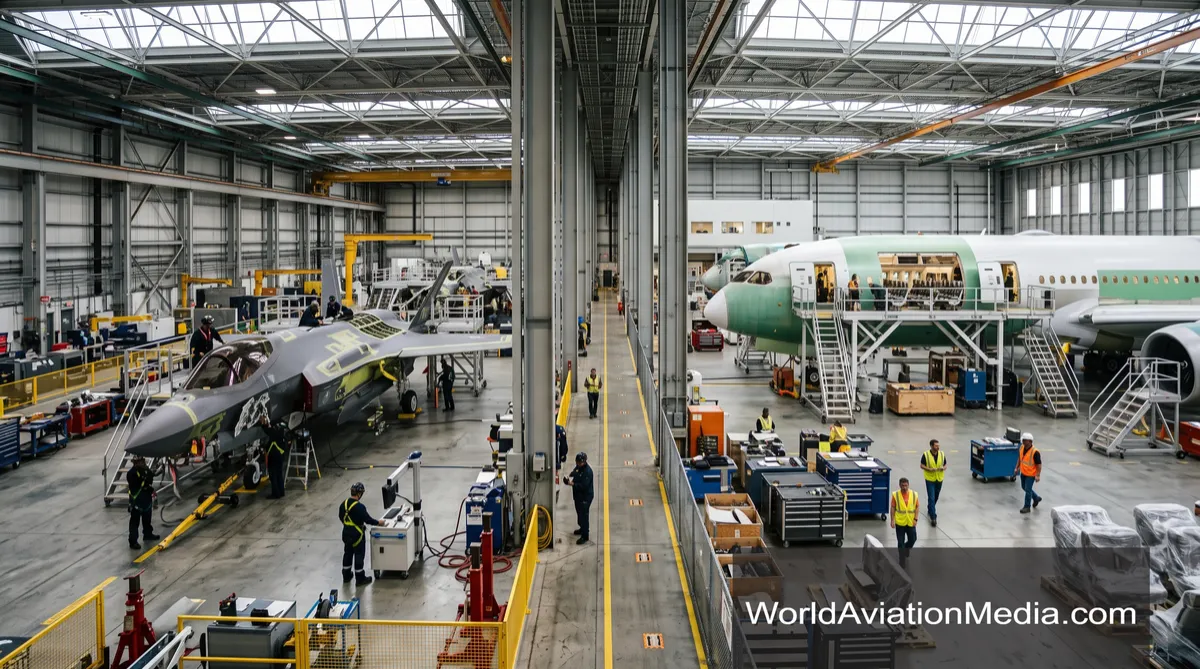
Defense vs. Commercial Capacity: Tier-1 Aerospace Suppliers and the Dual-Demand Squeeze
Key Takeaways
The Backlog Record: Global commercial aircraft order backlogs have reached historic highs (exceeding 16,600 aircraft), creating immense delivery pressure alongside surging widebody output ramps.
The Defense Imperative: Concurrently, Tier-1 aerospace manufacturers face strict Pentagon and allied mandates to accelerate F-35 Block 4 upgrade pathways, TR-3 technology insertions, and munitions production.
Capital & Supply Chain Friction: Raw material bottlenecks, skilled labor shortages, and machining capacity constraints force suppliers to balance high-volume commercial narrowbody production with high-security defense programs.
Strategic Resiliency: Industry leaders are deploying advanced automation, digital twin manufacturing, and dual-sourcing strategies to decouple commercial efficiency from defense-grade compliance demands.
Introduction
The global aerospace manufacturing ecosystem is currently navigating one of the most complex operational balancing acts in industrial history. Tier-1 and Tier-2 suppliers are caught in a massive dual-demand squeeze: on one side, commercial airlines are driving aircraft order backlogs to unprecedented heights, demanding accelerated production ramps for both single-aisle workhorses and recovering widebody twinjets. On the other side, geopolitical instability and defense modernization agendas require an urgent surge in military output, headlined by ongoing F-35 modernization blocks and critical tactical system upgrades.
The Macro Anatomy of the Commercial Delivery Ramp
Commercial aviation demand has rebounded with ferocious intensity. Order books across major OEMs have smashed long-term historical records, pushing total backlogs well past the 16,000-aircraft threshold. While single-aisle programs capture the lion's share of unit growth, international travel recovery has simultaneously triggered a vital widebody delivery ramp for long-haul twinjets.
For Tier-1 aerostructures, avionics, and engine suppliers, this translates into relentless pressure to scale output rates. However, the manufacturing ecosystem cannot simply flip a switch. Decades-long supply chains—recovering from structural shocks, localized labor deficits, and raw material cost volatility—are finding it exceptionally difficult to sustain month-on-month ramp targets without compromising quality control or triggering costly production bottlenecks.
The Defense Counterweight: F-35 Upgrades and Tactical Readiness
Simultaneously, the defense sector is placing immense demands on the exact same pool of specialized manufacturing capability, precision tooling, and engineering talent. The F-35 Lightning II program, alongside broader next-generation tactical aircraft and missile defense initiatives, is undergoing continuous technological evolution.
Integrating Technology Refresh 3 (TR-3) hardware, advanced electronic warfare suites, and comprehensive structural service-life upgrades requires rigorous, highly specialized manufacturing oversight. Defense contracts operate under stringent security protocols, strict mil-spec tolerances, and complex government acquisition rules. Shifting shop-floor capacity between commercial titanium composite machining and classified defense sub-assemblies introduces severe operational friction, requiring physical segmentation, segregated IT infrastructure, and specialized security clearances for personnel.
The Supply Chain Pinch Points: Alloys, Autoclaves, and Avionics
Where do these two massive demand vectors collide? At the component level.
Advanced Materials: Both commercial widebodies and modern stealth fighters rely heavily on high-grade aerospace-certified carbon composites, titanium forgings, and specialized superalloys. Limited global foundry capacity creates fierce competition for these critical raw materials.
Specialized Machining & Autoclaves: Large structural components—such as widebody wing spars and multi-axis F-35 bulkhead sections—require massive, capital-intensive autoclaves and high-precision CNC milling centers. Capital expenditure must be carefully weighed between commercial rate hikes and defense modernization contracts.
Engine and Avionics Sub-Tier Bottlenecks: Turbine blade casting, single-crystal growth technologies, and radiation-hardened microelectronics represent shared chokepoints where a delay in either sector cascades instantly across final assembly lines.
Strategic Adaptation: Digital Twins and Flexible Manufacturing
To survive and thrive under this dual-demand pressure, Tier-1 suppliers are fundamentally transforming their operational models. Leading manufacturers are leaning heavily into digital twin technologies, simulating shop-floor layouts, tool wear, and assembly flows before physical execution.
Furthermore, smart automation—such as robotic fastener insertion, automated non-destructive testing (NDT), and AI-driven quality inspection—is being deployed to offset skilled labor shortages. By decoupling human dependency from routine precision tasks, suppliers are carving out the operational headspace needed to manage simultaneous commercial rate ramps and high-priority defense upgrades without dropping the ball on quality or delivery timelines.
5-Item Q&A Section
Q1: What is driving the current capacity crunch for Tier-1 aerospace suppliers?
A: A combination of record-breaking commercial aircraft order backlogs exceeding 16,000 units and urgent, high-priority military modernization programs like F-35 block upgrades.
Q2: How do commercial and defense manufacturing requirements differ on the shop floor?
A: Defense manufacturing requires strict mil-spec tolerances, classified facility segmentation, and complex security protocols, whereas commercial manufacturing focuses primarily on high-volume rate acceleration and cost efficiency.
Q3: Which component categories represent the tightest shared supply chain bottlenecks?
A: Specialized titanium forgings, carbon composite autoclaves, turbine blade casting foundries, and high-reliability avionic microelectronics.
Q4: How are suppliers addressing skilled labor shortages while ramping production?
A: By deploying advanced automation, robotic assembly cells, AI-driven quality inspection, and digital twin manufacturing simulations.
Q5: What role do digital twins play in managing dual-demand pressures?
A: Digital twins allow manufacturers to simulate production lines, optimize tool allocation, and predict bottlenecks before committing physical capital to either commercial or defense lines.
SEO & AEO Optimization
Core User Intent: Explain how Tier-1 aerospace suppliers balance surging commercial aircraft backlogs with high-priority defense upgrades like the F-35.
Direct Answer Definition: The aerospace dual-demand squeeze refers to the industrial challenge where Tier-1 suppliers must simultaneously scale commercial widebody and narrowbody manufacturing rates while executing complex, high-security defense upgrades.
Keywords & Hashtags
Keywords: Tier-1 aerospace suppliers, commercial delivery ramps, F-35 upgrade capacity, aerospace manufacturing bottleneck, defense vs commercial aviation, widebody twinjet production.
Hashtags: #AerospaceManufacturing #DefenseAviation #SupplyChain #F35 #CommercialAviation #Industry40
