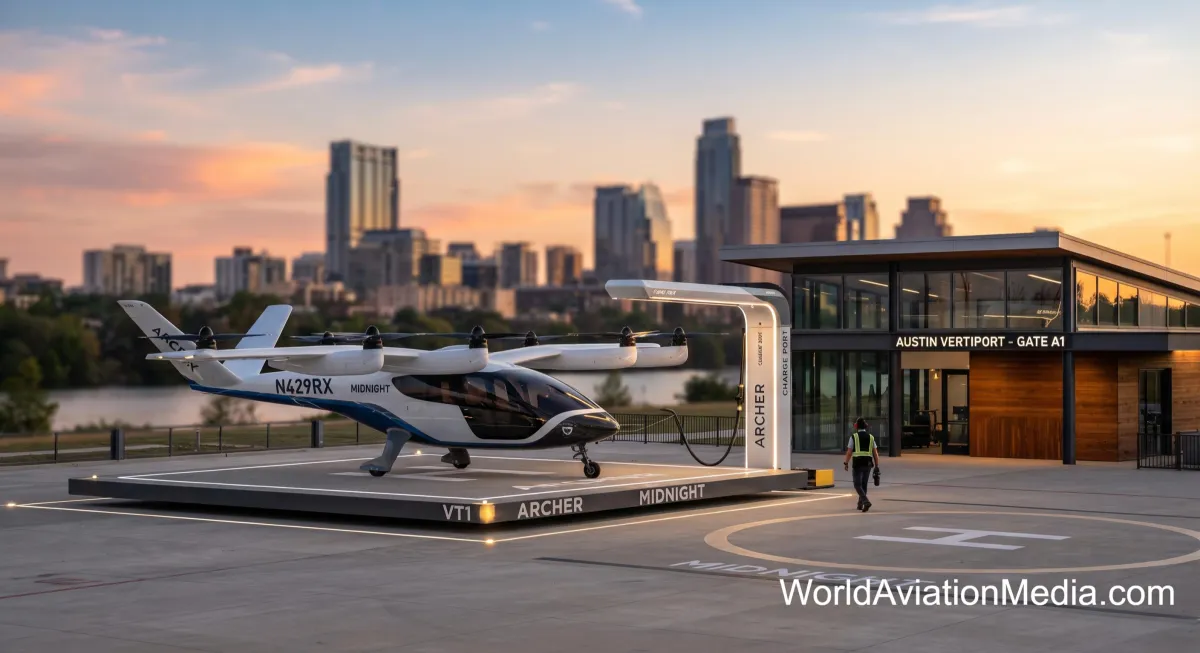
Building the Charging Standard: Why Archer and BETA’s Texas Collaboration is the "Supercharger" Moment for Air Taxis
Key Takeaways
The ACES Unified Standard: Archer Aviation and BETA Technologies have formed America’s Consortium for Electric Skyways (ACES) to deploy interoperable, manufacturer-agnostic charging infrastructure.
Project Nexus Integration: The collaboration directly supports the Texas Department of Transportation (TxDOT) and the White House eVTOL Integration Pilot Program (eIPP), which recently saw its first flights in North Texas by Joby Aviation.
A "Utility" Investment Model: Backed by Macquarie Capital, the infrastructure is being positioned as a shared utility rather than a proprietary "walled garden," mitigating massive capital expenditure barriers for new entrants.
The 250-Site Roadmap: ACES has unveiled a decade-long masterplan to electrify 250 vertiport sites at major airports and metropolitan hubs across Texas, Florida, and New York.
Operational Validation: Archer’s "No Roads" tour has demonstrated that its Midnight aircraft can reduce a 40-minute ground slog between Salinas and Hollister to a 12-minute-per-leg aerial commute at 125 mph.
Strategic De-risking: By standardizing charging, the industry is moving to insulate itself from the types of supply chain shocks currently crippling legacy aviation’s aftermarket, such as the critical shortage of GE90 engine control units.
Introduction: The Vertical Commute Hook
On September 4, 2026, the traditional 40-minute ground commute between Salinas and Hollister, California, was effectively rendered obsolete. Archer Aviation’s Midnight aircraft completed the journey in just 12 minutes per leg, cruising at 3,550 feet and reaching a top speed of 125 mph. While the "No Roads" tour serves as a high-impact demonstration of Advanced Air Mobility (AAM), the strategic reality of the industry is shifting from the flight deck to the ground.
The central hurdle for eVTOL (electric vertical takeoff and landing) scalability is not just the aircraft’s airworthiness, but the charging infrastructure's interoperability. Without a shared, non-proprietary network, the industry risks replicating the fragmented early days of electric vehicles, where competing plug standards limited regional throughput.
To solve this, Archer Aviation and BETA Technologies—nominally rivals—have joined forces under America’s Consortium for Electric Skyways (ACES). This strategic alignment, supported by Macquarie Capital and the Texas Department of Transportation (TxDOT), aims to build the "Supercharger" network for the skies. It is a move that transitions the sector from experimental flight testing to sustainable operational validation.
Takeaway 1: The Death of the Proprietary Plug
In the nascent years of the EV market, manufacturers attempted to use proprietary charging standards to lock customers into specific ecosystems. This "walled garden" approach eventually proved to be a logistical bottleneck. ACES is intentionally moving in the opposite direction. By committing to a manufacturer-agnostic infrastructure, Archer and BETA are ensuring that ground resources are utilized as a utility rather than a competitive tool.
From the perspective of a senior strategist, this is the most significant development in the sector. It removes a massive capital expenditure (CapEx) barrier for smaller players and regional operators. If every fleet operator were required to build their own dedicated charging pads, the capital requirements would stifle the market before it could reach critical mass.
"The aim is to establish a shared charging network that can be used by aircraft from multiple manufacturers and operators rather than relying on proprietary infrastructure."
Macquarie Capital’s involvement here is the key financial differentiator. By treating charging stations as a utility, Macquarie is investing in the long-term "real estate" of power delivery. This allows Archer and BETA to focus on aircraft production while Macquarie secures the energy foundations. For the operators, this shifts the burden from ownership to a service-based model, mitigating ground-level logistical throughput constraints. By standardizing the "plug," ACES is effectively de-risking the environment for the FAA and the Department of Energy, providing a clear, unified path for power grid integration.
Takeaway 2: Texas as the National Testing Ground
Texas has emerged as the premier laboratory for AAM in the United States. In March 2026, TxDOT was selected for the White House eVTOL Integration Pilot Program (eIPP), initiating "Project Nexus." This program is not merely a series of test hops; it is a full-scale integration of electric aircraft into one of the nation’s most complex airspaces.
Crucially, while Archer and BETA are building the "pipes" through the ACES consortium, they are joined in the Texas skies by major competitors. In early September 2026, Joby Aviation began a week of flights across North Texas, marking the first actual flights under the eIPP’s Project Nexus. This multi-manufacturer presence is essential for establishing the regulatory precedents required for Part 135 commercial certification.
The TxDOT masterplan focuses on the "Golden Triangle," connecting:
Dallas/Fort Worth (DFW): Serving as the northern logistics and commuter hub.
Austin (AUS): Connecting the tech corridor with rapid transit.
San Antonio (SAT): Integrating regional tourism and military transport.
Houston (HOU): Bridging the gap for energy-sector executives and medical transport.
Beyond the metropolitan hubs, the eIPP is focused on "rural connectivity." These routes are designed to bridge the connectivity gap in underserved areas of Texas, proving that eVTOLs are more than just "air taxis for the elite." For a strategist, the inclusion of rural communities is a masterclass in securing public and political acceptance, ensuring that the technology is seen as a state-wide infrastructure improvement rather than an urban luxury.
Takeaway 3: The 250-Site Masterplan
The ACES consortium is not stopping at a handful of test sites. They have outlined an ambitious decade-long goal to electrify 250 sites across major US airports and metropolitan areas. The initial phases focus on the "AAM Early Adopters" regions: Texas, Florida, and New York.
This masterplan targets existing high-traffic aviation hubs and strategic "Points of Interest" (POIs). Potential locations currently being scouted or developed include:
Primary Commercial Airports: Vertiports situated at DFW, JFK, and MIA to facilitate "last-mile" transfers for long-haul passengers.
Fixed-Base Operators (FBOs): Utilizing existing infrastructure like Signature Aviation or Atlantic Aviation to minimize site preparation time.
Metropolitan Vertiports: Such as the newly announced downtown Los Angeles vertiport, designed to bypass the most congested ground corridors in the country.
The financial backbone provided by Macquarie Capital ensures that these sites are not just theoretical plans. The investment reflects a belief that vertiports will become as essential as highway rest stops. By controlling the 250 most strategic sites, ACES is not just building a charging network; they are defining the "geography of flight" for the next century. This scale allows for significant bargaining power with utility companies to ensure the local power grids can handle the surge loads required for rapid charging.
Takeaway 4: Validating the "No Roads" Reality
Archer’s "No Roads" tour represents a pivotal transition from engineering R&D to operational validation. By flying in real-world environments with a pilot on board, Archer is generating the data necessary to convince skeptical regulators and the public that eVTOL travel is a viable daily reality.
The metrics from the Salinas-Hollister flight provide the baseline for what we can expect in the Texas rollout:
Time Efficiency: 12 minutes per leg for a 40+ mile roundtrip (compared to 40-60 minutes in a car).
Performance Metrics: Top speeds of 125 mph and a sustained cruise altitude of 3,550 feet.
Operational Tempo: More than 70 test flights were completed in August 2026 alone, including a piloted roundtrip between Salinas and Monterey.
The tour’s expansion into Northern California (San Jose, Oakland, San Francisco), Southern California (Los Angeles), Florida, and New York is the final dress rehearsal before sustained commercial operations begin in 2027. These flights are essential for gathering "noise footprint" data and testing the aircraft's response to different meteorological conditions. From a strategist's view, the "No Roads" tour is less about the flight itself and more about proving the aircraft can maintain a high "utilization rate"—the metric that ultimately determines the profitability of an air taxi fleet.
Takeaway 5: The Competition Paradox
The most striking element of the ACES consortium is the collaboration between Archer and BETA. In a typical industry, direct rivals fight for proprietary dominance. However, eVTOL is currently navigating a "Competition Paradox": rivals must collaborate on infrastructure to ensure the industry exists at all.
The urgency of this collaboration is highlighted by current crises in the legacy aviation aftermarket. As of September 2026, parts for the GE90 engine (the power behind the Boeing 777) have faced a severe supply chain crunch. Data from ePlane AI shows that GE90 FADEC units (specifically Part Numbers 105E70898G1, G2, and G3) and HMU control assemblies have been on the "Hardest-to-Find" list for four consecutive months. This scarcity has grounded fleets and driven maintenance costs to record highs.
Archer and BETA’s strategy is a direct response to this legacy vulnerability. By vertically integrating the charging infrastructure and standardizing it early, they are avoiding the "aftermarket shock" that occurs when a manufacturer controls a proprietary, single-source component that goes out of production or faces supply chain tightening. Shared infrastructure stabilizes the market; if one manufacturer faces a production delay, the charging network—the "utility"—remains a viable, revenue-generating asset for the others. In a nascent industry, "growing the pie" through shared standards is infinitely more valuable than fighting over a slice of a market that has not yet been certified.
Conclusion: The Question for the Skies
The ACES/TxDOT partnership is a blueprint for the future of global aviation. As we look toward the 2027 commercial launch, the conversation is moving past "Can it fly?" and toward "Will the public accept it?"
Acceptance hinges on two factors: noise and infrastructure. With Amazon expanding its Prime Air drone delivery to 500 cities by late 2026 using the MK30 drone—which claims to have "half the noise" of previous iterations—the "soundscape" of our cities is already changing. The Archer-BETA partnership ensures that as the air grows busier, it does so with a unified, quiet, and efficient backbone.
However, a strategic question remains for the next decade: As the ACES consortium scales to 250 sites, can the aging American power grid support the massive, localized energy demands of simultaneous rapid-charging aircraft, or will the "energy bottleneck" replace the "asphalt bottleneck" as the final barrier to a 12-minute commute?
Frequently Asked Questions
1. What is the eIPP? The eVTOL Integration Pilot Program (eIPP) is a White House-led initiative, coordinated with the FAA and state DOTs. It provides a regulatory framework for manufacturers to conduct real-world flight operations on city-to-city routes, informing future commercial air carrier standards.
2. Why are Archer and BETA working together? They are collaborating to create a universal, manufacturer-agnostic charging standard via the ACES consortium. This reduces the capital cost of building infrastructure and ensures that all eVTOL operators can use the same charging stations, much like a universal gas station.
3. Which Texas cities are included in the initial rollout? The "Project Nexus" routes connect the North Texas and "Golden Triangle" regions, specifically Dallas/Fort Worth, Austin, San Antonio, and Houston. It also includes planned routes to surrounding rural communities.
4. Is this charging network open to other manufacturers? Yes. The central pillar of ACES is its "manufacturer-agnostic" design. This means aircraft from competitors, including Joby Aviation (which is already flying in Texas), could potentially utilize the network if they adopt the unified charging standard.
5. How does eVTOL travel time compare to car travel? Operational validation flights have shown that a 40-minute ground commute can be reduced to just 12 minutes per leg of flight time. This represents a nearly 70% reduction in commute duration for congested regional corridors.
Keywords & Hashtags
Keywords: Advanced Air Mobility, eVTOL, Charging Infrastructure, ACES Consortium, Archer Aviation, BETA Technologies, Texas Department of Transportation, Project Nexus, eIPP, Electric Aircraft Charging.
Hashtags: #eVTOL #FutureOfFlight #AAM #TexasTech #SustainableAviation #ArcherAviation #BETATechnologies
