Boeing 737 MAX 10 FAA Certification: What Approval Means for Global Fleet Planning, Airline Backlogs, and 2027 Delivery Timelines
Key Takeaways
Regulatory Clearance Achieved: The U.S. Federal Aviation Administration (FAA) officially granted amended type certification to the Boeing 737 MAX 10 in October 2026, resolving years of regulatory delays tied to engine anti-ice systems, flight deck alerting requirements, and enhanced manufacturing oversight.
Massive Order Book Unlocks: Certification clears the path for Boeing to begin fulfilling a backlog of nearly 1,500 MAX 10 orders placed by anchor carriers, including United Airlines, Ryanair, Delta Air Lines, and Alaska Airlines, with initial commercial deliveries scheduled to commence in early 2027.
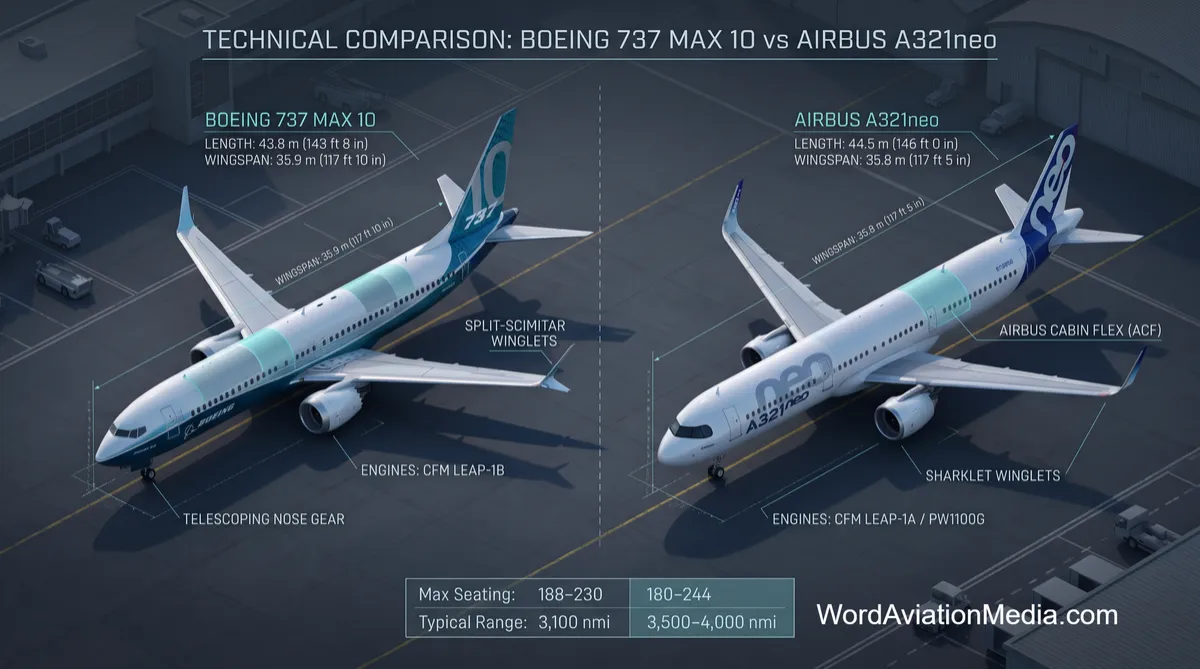
High-Density Narrowbody Competition: Seating up to 230 passengers in a single-class layout, the 737 MAX 10 gives Boeing a direct high-capacity contender against the Airbus A321neo on dense short-to-medium-haul trunk routes, though it trades off transcontinental range for superior seat-mile economics on sub-3,000-nautical-mile sectors.
Production Cap and Supply Chain Constraints: Despite type certification, airline fleet planners face a measured delivery ramp-up as Boeing navigates FAA quality management audits, Spirit AeroSystems reintegration milestones, and CFM International LEAP-1B engine supply bottlenecks.
What Does the FAA's Certification of the Boeing 737 MAX 10 Mean for Global Aviation?
The Federal Aviation Administration's certification of the Boeing 737 MAX 10 in late October 2026 marks a watershed moment for commercial aircraft manufacturing and global airline capacity planning. As the largest variant in the 737 single-aisle family, the MAX 10 (formally designated the 737-10) had been mired in an extended regulatory validation cycle for more than five years. With the amended type certificate now secured, Boeing is positioned to unlock billions of dollars in deferred pre-delivery payments and inventory liquidations, while airlines gain a critical tool to address persistent seat capacity shortages across high-density domestic and regional networks.
For global fleet strategists, the approval removes the largest wild card in narrowbody retirement and growth schedules through the end of the decade. Over the past three years, major carriers were forced to execute costly contingency measures—extending leases on aging Boeing 757-200s, Airbus A320ceo, and Boeing 737-800s, or converting near-term MAX 10 delivery slots into smaller 737 MAX 8 and MAX 9 variants. With entry into service (EIS) now firmly anchored for the first half of 2027, network planners can transition from defensive capacity preservation to structural upgauging.
Overcoming the Engineering and Regulatory Hurdles
To understand the delivery timeline post-certification, fleet analysts must examine the specific technical modifications required to bring the 737-10 across the regulatory finish line. Unlike earlier variants of the MAX family, the MAX 10 encountered three distinct certification barriers that fundamentally altered its engineering baseline:
The Engine Anti-Ice (EAI) Nacelle Redesign: During flight testing, regulators identified a vulnerability in the composite engine inlet cowling when the CFM LEAP-1B engine anti-ice system was operated in dry air for prolonged periods beyond five minutes. Potential overheating posed a structural degradation risk to the inlet ring. Rather than relying solely on crew procedural directives, the FAA mandated a permanent hardware fix, requiring Boeing to re-engineer the thermal distribution architecture and nacelle ducting before signing off on the type design.
Flight Crew Alerting System (EICAS) Congressional Exemptions and Enhancements: Under the Aircraft Certification, Safety, and Accountability Act of 2020, any narrowbody certified after December 2022 was required to incorporate a modern Engine Indicating and Crew Alerting System (EICAS). Because adding a full EICAS would have broken cockpit commonality with the 737 MAX 7, MAX 8, and MAX 9—forcing airlines into separate pilot type ratings—Congress granted a targeted statutory waiver. However, that waiver was contingent on Boeing retrofitting and integrating two vital safety enhancements: an enhanced Angle of Attack (AoA) synthetic airspeed integrity monitor (adding a third independent calculation channel) and a physical means for crews to silence erroneous stick-shaker and runaway stabilizer alerts.
Custom Semilevered Main Landing Gear: Because the MAX 10's fuselage is stretched to 43.8 meters (143 feet 8 inches)—some 2.2 meters longer than the MAX 9—the aircraft faced severe tail-strike risks during rotation at high takeoff weights. Boeing engineered an innovative telescoping, shrinking-link main landing gear that extends the oleo strut by 241 millimeters (9.5 inches) during takeoff rotation, then compresses internally during retraction so the wheels still fit inside the standard 737 wheel well without cutting into the structural wing carry-through box.
Backlog Breakdown: Which Airlines Stand to Gain First?
The 737 MAX 10 commands an active backlog of approximately 1,500 aircraft, representing roughly one-third of Boeing's entire unfilled narrowbody order book. Because these orders are heavily concentrated among top-tier global networks and ultra-low-cost carriers, the initial allocation of production slots in Renton, Washington, will dictate competitive dynamics across both North America and Europe.
Airline / Customer | Approximate MAX 10 Order Commitment | Primary Fleet Replacement / Mission Profile | Expected Initial Delivery Window |
United Airlines | 250+ Units (Adjusted after MAX 9 conversions) | Replacing aging 757-200s and upgauging hub-to-hub trunk routes (ORD, DEN, EWR) | Q1–Q2 2027 |
Ryanair Group | 150 Firm + 150 Options | High-density 228-seat European leisure and slot-constrained primary airport operations | Q1–Q2 2027 |
Delta Air Lines | 100 Firm + 30 Options | Replacing Boeing 757-200 and older 737-800 fleets on domestic high-yield trunks | Mid-to-Late 2027 |
Alaska Airlines | 85+ Units | West Coast transcontinental corridors and high-density Hawaii leisure markets | Mid-2027 |
WestJet | 65+ Units | Canadian transcontinental trunk routes and winter sun-destination flying | Late 2027 |
For United Airlines, the launch customer in North America, the MAX 10 is the centerpiece of its "United Next" upgrading strategy. Having temporarily shifted a portion of its near-term deliveries to the MAX 9 during the height of certification delays, United is now working with Boeing to re-sequence its 2027 and 2028 Skyline back toward the 737-10. The aircraft allows United to deploy nearly 190 to 200 seats in a multi-class domestic configuration (complete with seatback entertainment and expanded overhead bins) while burning 20% less fuel per seat than the legacy aircraft it replaces.
In Europe, Ryanair views the MAX 10 as its primary engine for growing annual traffic toward 300 million passengers over the next decade. Configured at near-maximum density (228 seats), the MAX 10 provides Ryanair with 31 additional seats per departure compared to its current 197-seat 737-8200 "Gamechanger" fleet. At slot-capped airports like London Stansted, Dublin, Madrid, and Milan Bergamo, upgrading aircraft size is the only viable mechanism to expand passenger volume without acquiring scarce new landing slots.
Boeing 737 MAX 10 vs. Airbus A321neo: The Operational Trade-Off
While industry headlines frequently frame the MAX 10 as a direct one-for-one competitor to the Airbus A321neo, airline fleet economists evaluate the two aircraft through a more nuanced operational lens.
The Airbus A321neo (and its long-range variants, the A321LR and A321XLR) dominates the upper end of the narrowbody sector in both payload-range capability and maximum seating capacity (up to 244 seats). Powered by either the Pratt & Whitney PW1100G-JM geared turbofan or the CFM LEAP-1A engines with larger fan diameters than the 737's underwing clearance allows, the A321neo boasts superior takeoff thrust on hot-and-high runways and transoceanic range extending up to 4,700 nautical miles in the XLR variant.
However, the Boeing 737 MAX 10 holds two decisive advantages that explain why major airlines continue to order it in bulk despite its shorter 3,100-nautical-mile (5,740 km) range:
Lower Structural Empty Weight and Trip Cost: The MAX 10's operating empty weight is roughly 3.5 to 4 metric tons lighter than a comparably equipped A321neo. On sectors under 2,000 nautical miles—which account for over 85% of global narrowbody departures—carrying less structural deadweight translates directly into lower trip fuel burn and reduced weight-based navigation and landing fees.
Delivery Slot Availability and Fleet Commonality: With the Airbus A321neo family effectively sold out until 2031–2032, airlines that already operate large Boeing 737 fleets cannot afford a six-year wait for capacity, nor the tens of millions of dollars in transition costs required to establish new spare parts pools, simulator bays, and maintenance tooling for an Airbus fleet.
Manufacturing Realities and the 2027–2029 Delivery Ramp
Securing an FAA type certificate authorizes design compliance, but scaling production requires Production Certificate (PC) expansion from the regulator. Throughout 2025 and 2026, the FAA maintained rigorous on-site quality surveillance at Boeing's Renton assembly facility and Spirit AeroSystems' fuselage plant in Wichita, Kansas.
Boeing already holds approximately 30 to 35 pre-built 737-10 airframes in storage or flight-test status that must undergo post-certification modification work—including the installation of the production-standard engine anti-ice hardware and cockpit alerting software packages—before handover. While these stored airframes will provide an initial burst of deliveries in the first two quarters of 2027, sustained output relies on Renton's transition of its fourth production line (the former 737 Classic/P-8 Poseidon space and North Line expansion) to handle the complex landing gear installation of the 737-10. Fleet planners are currently modeling a conservative ramp rate, expecting MAX 10 deliveries to account for 15% of total 737 shipments in 2027 before climbing toward 30–35% by late 2028.
5-Item Q&A Section (FAQ)
Q1: When will the first commercial Boeing 737 MAX 10 be delivered to airlines?
Following the FAA's type certification in late October 2026, the first commercial deliveries of the Boeing 737 MAX 10 are scheduled to begin in the first half of 2027, once final production conformity inspections and operator training programs are completed.
Q2: How many passengers can the Boeing 737 MAX 10 carry?
The Boeing 737 MAX 10 can accommodate between 188 and 204 passengers in a standard two-class domestic layout, and up to a certified maximum of 230 passengers in a high-density, single-class configuration utilized by low-cost carriers.
Q3: Why was the Boeing 737 MAX 10 certification delayed until 2026?
Certification was delayed due to heightened FAA regulatory scrutiny following earlier MAX family incidents, the need to re-engineer the CFM LEAP-1B engine anti-ice nacelle structure to prevent thermal damage in dry air, and the integration of enhanced angle-of-attack and crew alerting software mandated by Congress.
Q4: How does the Boeing 737 MAX 10 compare in range to the Airbus A321neo?
The Boeing 737 MAX 10 has a maximum range of 3,100 nautical miles (5,740 km), which is sufficient for U.S. transcontinental and intra-European routes, whereas the standard Airbus A321neo offers up to 4,000 nautical miles (7,400 km) and the A321XLR reaches 4,700 nautical miles (8,700 km).
Q5: Do Boeing 737 MAX 8 pilots need a separate type rating to fly the MAX 10?
No. The 737 MAX 10 retains a common pilot type rating with the entire 737 MAX family (MAX 7, MAX 8, and MAX 9), requiring only short computer-based differences training covering the stretched fuselage handling characteristics and the semilevered main landing gear.
Keywords and Hashtags
Keywords: Boeing 737 MAX 10 certification, 737-10 delivery timeline 2027, Boeing MAX 10 order backlog, 737 MAX 10 vs Airbus A321neo, FAA Boeing 737 MAX 10 approval, United Airlines 737 MAX 10 fleet planning, narrowbody aircraft delivery slots.
Hashtags: #Boeing737MAX10 #FAACertification #FleetPlanning #CommercialAviation #AircraftBacklog #NarrowbodyMarket #AerospaceManufacturing #AviationEconomics
