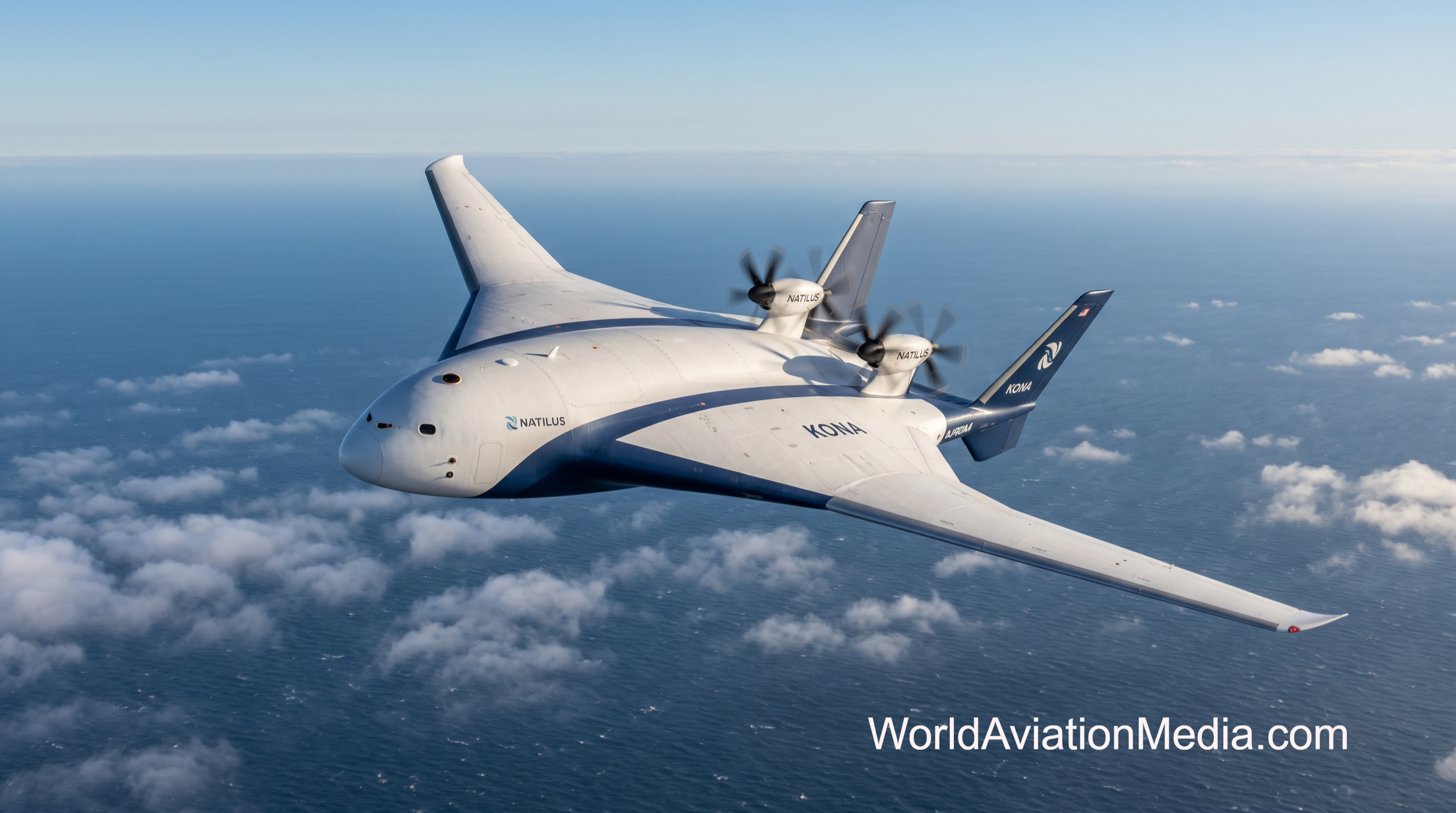
Blended-Wing-Body Goes Tactical: Why the U.S. Air Force Is Backing Natilus’ Optionally Piloted ‘Kona’ Freighter
Key Takeaways
First U.S. Defense Contract for Natilus: In October 2026, the U.S. Air Force awarded San Diego-based Natilus a $3.5 million contract to accelerate development and flight testing of its optionally piloted ‘Kona’ blended-wing-body (BWB) tactical cargo aircraft.
Filling the C-130 vs. Cessna Capability Gap: Featuring an 85-foot wingspan, a 19,000-lb Maximum Takeoff Weight (MTOW), and twin Pratt & Whitney PT6 turboprops, Kona carries over 8,000 pounds of payload across 800 nautical miles—bridging the gap between modified light Cessnas and heavy C-130J transports.
Contested Logistics & Optional Crewing: Designed for a late 2027 or early 2028 first flight, Kona pairs a 50% drag reduction and massive internal volume with an optionally piloted flight deck—flying with a human pilot in civil FAA airspace and autonomously in contested Indo-Pacific zones.
Demonstrator Hardware Already in Assembly: Natilus has already built the full-scale demonstrator's vertical tails and flight control surfaces, received its automated cargo loading system from Raytheon, and placed orders for PT6 engines.
The Indo-Pacific Logistics Dilemma: Why the Tube-and-Wing Status Quo Is Vulnerable
When U.S. Air Force strategists wargame a high-intensity conflict in the Indo-Pacific theater, their primary anxiety is rarely fighter kinematics—it is contested logistics. Under the doctrine of Agile Combat Employment (ACE), the Air Force plans to disperse F-35s, F-15EXs, and Collaborative Combat Aircraft (CCA) across dozens of austere island airfields to prevent adversarial ballistic missile salvos from wiping out main operating bases.
However, dispersed fighters cannot fly without a continuous lifeline of F135 spare engine modules, AIM-120D missiles, mobile radar components, and fuel bladders. Today, the Air Force faces a glaring airlift capability gap:
Too Big & High-Value: Sending a $85 million Lockheed Martin C-130J Super Hercules or a C-17 Globemaster III with a multi-person crew into a contested, short-runway island strip inside enemy surface-to-air missile range risks a catastrophic loss of personnel and strategic airlift capacity.
Too Small: While the Air Force is testing autonomous Cessna 208B Caravans, a Caravan’s narrow fuselage and ~3,000-lb useful cargo limit cannot accommodate bulky palletized military hardware or spare fighter engines.
On October 21, 2026, the U.S. Air Force moved to close that exact gap, awarding San Diego-based aerospace developer Natilus a $3.5 million defense contract to advance its ‘Kona’ optionally piloted Blended-Wing-Body (BWB) regional freighter toward a first flight in late 2027 or early 2028.
What is the Natilus Kona blended-wing-body freighter? The Natilus Kona is an optionally piloted, twin-turboprop blended-wing-body (BWB) cargo aircraft with an 85-foot wingspan and a 19,000-pound maximum takeoff weight. Powered by Pratt & Whitney PT6 engines, it is designed to carry over 8,000 pounds of payload across an 800-nautical-mile range, offering dramatically greater internal volume and aerodynamic efficiency than conventional tube-and-wing aircraft.
Inside the Physics of a Tactical Blended-Wing-Body (BWB)
While the U.S. Air Force is separately funding JetZero’s massive Z4 jet-powered BWB demonstrator at the strategic tanker/airlifter scale, Natilus is pioneering the BWB layout at the tactical Part 23 commuter/utility scale.
How does a Blended-Wing-Body differ from a conventional airplane or a pure flying wing like the B-2 Spirit bomber?
Whole-Body Aerodynamic Lift: On a conventional "tube-and-wing" aircraft (like a Cessna Caravan, ATR 72, or C-130), the cylindrical fuselage acts largely as dead aerodynamic drag; only the wings generate lift. On the Natilus Kona, the wide, flattened center fuselage is sculpted as an airfoil that blends smoothly into outboard wings. The entire aircraft body generates lift, increasing the lift-to-drag (L/D) ratio and cutting fuel consumption by up to 30% to 50%.
Double the Internal Cargo Volume: Because the center body is wide and rectangular rather than a narrow circular tube, Kona accommodates standardized commercial LD3 containers and military 463L/modular cargo pallets side-by-side without wasted curvature space—delivering an 8,000+ pound payload capacity inside a 19,000-lb MTOW envelope.
Austere Short-Field Performance: High total wing surface area translates into low wing loading. Combined with the high static thrust of twin Pratt & Whitney PT6 turboprops (which Natilus selected over earlier conceptual hydrogen-electric powertrains to ensure rapid military and FAA certification), Kona can operate out of short, rough, or damaged runways.
"Bigger Than a Cessna, Smaller Than a C-130": The Kona Spec Sheet
In briefings following the October 2026 contract announcement, Natilus co-founder and CEO Aleksey Matyushev and VP of Business Development Dennis Giblin outlined how Kona’s physical dimensions hit the tactical sweet spot between light utility planes and four-engine tactical airlifters.
Aircraft Platform | Configuration | Max Takeoff Weight (MTOW) | Max Payload | Range (Typical) | Crewing Architecture |
Cessna 208B Grand Caravan | Single-Engine Tube-and-Wing | ~8,800 lbs | ~3,000 – 3,300 lbs | ~750 – 900 nm | Piloted or Retrofitted Autonomous (RAS) |
Natilus Kona | Twin-PT6 Blended-Wing-Body | 19,000 lbs | 8,000+ lbs | 800 nm | Optionally Piloted (Human or Autonomous) |
Lockheed Martin C-130J-30 | 4-Engine Tactical Transport | 164,000 lbs | ~44,000 lbs | 1,800+ nm | 3-Person Crew (2 Pilots + 1 Loadmaster) |
"We do have our own homegrown autonomy software stack. However, we also have optionality to partner with folks that are already looking at this in a serious way... And so, we have a couple different paths towards achieving autonomous flight." — Dennis Giblin, Natilus, October 2026
Why "Optionally Piloted" Is the Master Key to Dual-Use Certification
One of the smartest strategic decisions embedded in the Kona program is its optionally piloted architecture. As Giblin noted, the U.S. Air Force’s requirements can be met "without fundamentally changing the underlying aircraft," allowing defense flight demonstrations to directly feed engineering compliance data into Natilus’s parallel FAA Part 23 civil certification program.
In Commercial Domestic Airspace: When operating for regional feeder cargo airlines inside U.S. and European controlled airspace, a single human pilot can sit in the cockpit and fly the aircraft under existing FAA rules from Day One, bypassing years of regulatory delays over unmanned traffic integration.
In Contested Military Airspace: When deployed by the U.S. Air Force to resupply a forward operating base under missile threat in the First Island Chain, the cockpit stays empty. Kona flies the mission autonomously using either Natilus’s internal autonomy stack or a third-party certifiable autonomy suite.
From Paper to Metal: Demonstrator Assembly Progress Toward 2028
Unlike many conceptual rendering startups, Natilus is already cutting and assembling full-scale hardware for the Kona flight demonstrator. As of late October 2026:
The twin vertical tails and flight control surfaces are already manufactured and complete.
The specialized internal cargo loading system was delivered to Natilus by Raytheon in October 2026.
Purchase orders have been placed for proven Pratt & Whitney PT6 turboprop engines.
The $3.5 million Air Force infusion directly accelerates completion of the remaining primary structures—the center-body fuselage and outboard wing shipset—putting Kona firmly on schedule to roll out and achieve first flight in late 2027 or early 2028.
5-Item Q&A Section
Q1: Why did the U.S. Air Force award a contract to Natilus in October 2026? In October 2026, the U.S. Air Force awarded Natilus a $3.5 million contract to de-risk and accelerate flight testing of its optionally piloted ‘Kona’ blended-wing-body (BWB) freighter. The Air Force is evaluating Kona to fill a tactical cargo capability gap between small modified Cessnas (~3,000 lb payload) and large C-130J transports for contested logistics missions.
Q2: What are the specifications of the Natilus Kona aircraft? The Natilus Kona has an 85-foot wingspan, a 19,000-pound maximum takeoff weight (MTOW), and is powered by twin Pratt & Whitney PT6 turboprop engines. It can carry more than 8,000 pounds of payload over an 800-nautical-mile range.
Q3: When will the Natilus Kona make its first flight? Backed by private venture capital and the October 2026 U.S. Air Force contract, the full-scale Natilus Kona demonstrator is scheduled to make its first flight in late 2027 or early 202Its vertical tails, flight control surfaces, and Raytheon-supplied cargo loading system are already built.
Q4: How does Kona’s "optionally piloted" design work? Kona is built with a cockpit so that commercial cargo operators can fly it with a human pilot under standard FAA civil regulations, while the U.S. Air Force can operate the exact same airframe completely uncrewed (autonomously) when flying into dangerous, contested combat zones.
Q5: Did Natilus switch from hydrogen to conventional engines on the Kona? Yes. While Natilus explored ZeroAvia's ZA600 hydrogen-electric propulsion in 2023 for future variants, the company selected proven Pratt & Whitney PT6 turboprop engines for the baseline Kona to ensure near-term reliability, austere military fieldability, and a streamlined FAA certification path.
Keywords and Hashtags
Keywords: Natilus Kona US Air Force contract, blended wing body freighter 2026, optionally piloted cargo aircraft, Natilus Kona specs 8000 lb payload, contested logistics Indo-Pacific USAF, Pratt & Whitney PT6 BWB aircraft, Raytheon cargo loading system Natilus.
Hashtags: #BlendedWingBody #Natilus #USAirForce #MilitaryLogistics #CargoAircraft #AerospaceDesign #FutureOfFlight #DefenseInnovation
