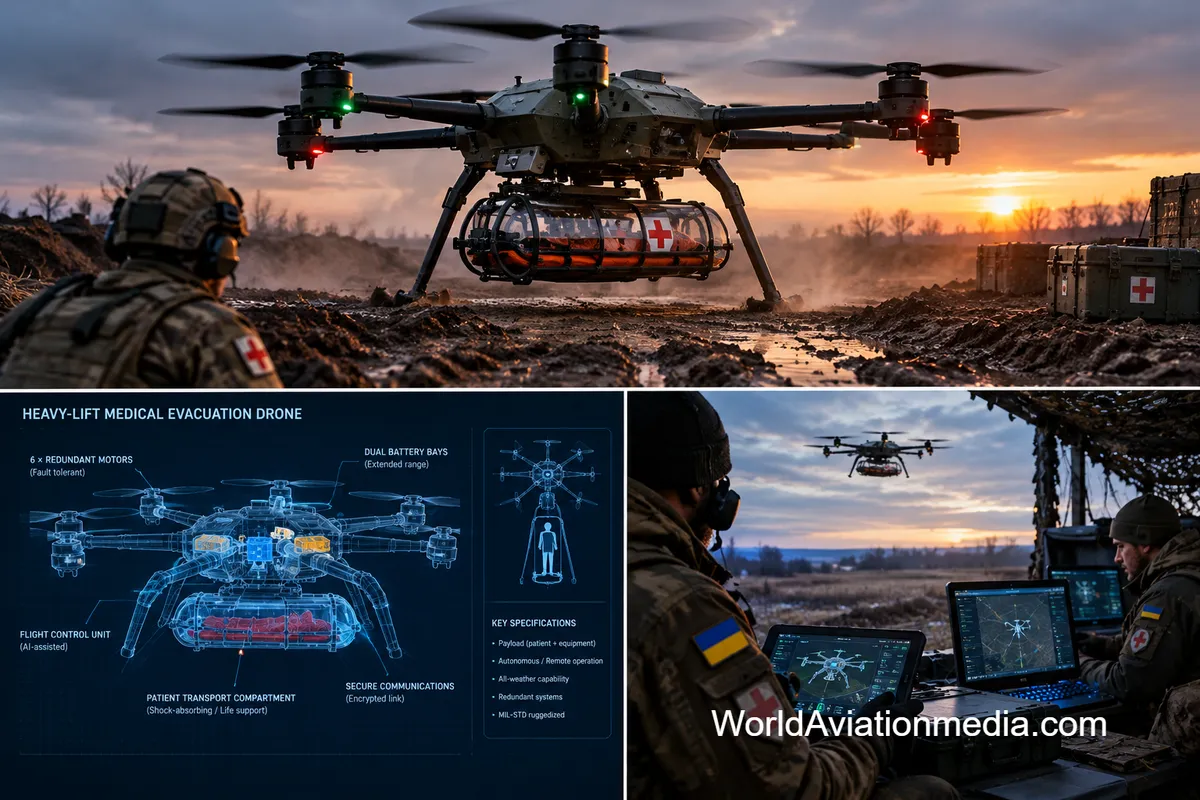
Battlefield Medevac by Hexacopter: How Ukraine's Drone CASEVAC Changes Unmanned Doctrine
Key Takeaways
A Historic Milestone: The Armed Forces of Ukraine successfully executed frontline casualty evacuation (CASEVAC) missions using the Gurzuf Defence Audag-6 heavy-lift heavy-payload hexacopter.
Overcoming EW Hurdles: Operating heavy-lift medical transport drones under intense Russian electronic warfare (EW) jamming required robust frequency-hopping navigation and autonomous fail-safes.
Removing Human Risk: Unmanned CASEVAC protects combat medics from direct small-arms fire, artillery shrapnel, and drone-dropped munitions during golden-hour extractions.
Doctrinal Shifts: The operational success of the Audag-6 signals the transition of heavy multirotors from tactical logistics and munition drops to critical life-support medical transport.
Removing the Medic from the Kill Zone
In modern near-peer high-intensity conflict, the "golden hour" for wounded soldiers has become an elusive ideal. Frontline positions saturated with loitering munitions, FPV suicide drones, and artillery shrapnel make traditional armored vehicle or stretcher-bearer CASEVAC missions suicidal. Recognizing this lethal bottleneck, the Armed Forces of Ukraine achieved a historic technological milestone by conducting active battlefield casualty evacuations utilizing heavy-lift unmanned multirotors—specifically featuring platforms like the Gurzuf Defence Audag-6 hexacopter.
This operational breakthrough transforms heavy drones from logistical supply drops and munition delivery platforms into life-saving medical evacuation assets. By pulling wounded personnel out of isolated trenches and contested gray zones without risking the lives of human flight crews or ground medics, unmanned CASEVAC is rewriting frontline military doctrine.
Engineering the Audag-6 for High-Threat Environments
Building a drone capable of lifting an adult human body out of a combat zone requires overcoming severe aerodynamic and engineering constraints. The Gurzuf Defence Audag-6 is a specialized heavy-lift hexacopter designed with redundant brushless propulsion systems, high-capacity lithium-polymer battery arrays, and a stabilized stretcher-slingshot containment pod.
Operating this hardware in Ukraine’s electronic warfare environment, however, presents immense technical hurdles:
Resilient Guidance Systems: Because Russian electronic warfare units blanket the front lines with GPS spoofing and broadband signal jamming, the Audag-6 integrates inertial navigation systems (INS) and autonomous optical terrain-matching guidance to complete missions without satellite links.
Acoustic and Thermal Signature Reduction: To prevent enemy targeting, the platform utilizes carbon-composite airframe damping and low-noise propeller geometries, minimizing acoustic detection during night extractions.
Automated Pilot-Assist Return: If communication links are severed entirely, the hexacopter executes pre-programmed waypoint return-to-base routines to ensure wounded personnel reach aid stations safely.
"The successful deployment of heavy-lift hexacopters for frontline casualty evacuation marks a watershed moment in unmanned warfare, shifting drones from tools of destruction to instruments of preservation." — Defense Technology Review, 2026
Doctrinal Implications for Global Militaries
The successful integration of drone CASEVAC forces defense planners worldwide to re-examine combat medical protocols. For decades, military medical doctrine assumed that helicopter air ambulance (MEDEVAC) services would operate with air superiority. In contested environments where crewed helicopters are prime targets for man-portable air-defense systems (MANPADS) and electronic detection, heavy-lift hexacopters offer a low-cost, expendable alternative.
As manufacturing supply chains scale production of platforms like the Audag-6, unmanned medical evacuation will transition from an ad-hoc frontline innovation into a standard component of mechanized infantry brigades across the globe.
5-Item Q&A Section (FAQ)
Q1: What milestone did the Armed Forces of Ukraine achieve regarding drone medical evacuation?
Ukraine successfully conducted frontline casualty evacuation (CASEVAC) missions using heavy-lift hexacopters like the Gurzuf Defence Audag-6.
Q2: What are the main engineering challenges of using drones for human transport in combat?
Developers must overcome heavy payload requirements, battery endurance limits, and intense electronic warfare jamming.
Q3: How does the Audag-6 navigate under heavy electronic warfare jamming?
The platform utilizes inertial navigation systems (INS) and autonomous optical terrain-matching guidance to operate when GPS signals are jammed.
Q4: Why is unmanned CASEVAC crucial in modern high-intensity conflict?
It removes human medical crews and armored vehicles from immediate artillery and FPV drone kill zones during the critical golden hour.
Q5: How will this impact global military doctrine?
It signals a shift toward utilizing expendable, heavy-lift unmanned systems for frontline logistics and life-saving medical transport in contested skies.
Metadata
Target SEO Keywords: Ukraine drone CASEVAC Audag-6, Gurzuf Defence heavy lift hexacopter, military medical evacuation drones, unmanned frontline CASEVAC, electronic warfare resistant drones.
Hashtags: #DefenseTech #MilitaryDrones #UkraineWar #MEDEVAC #UnmannedSystems #Innovation
