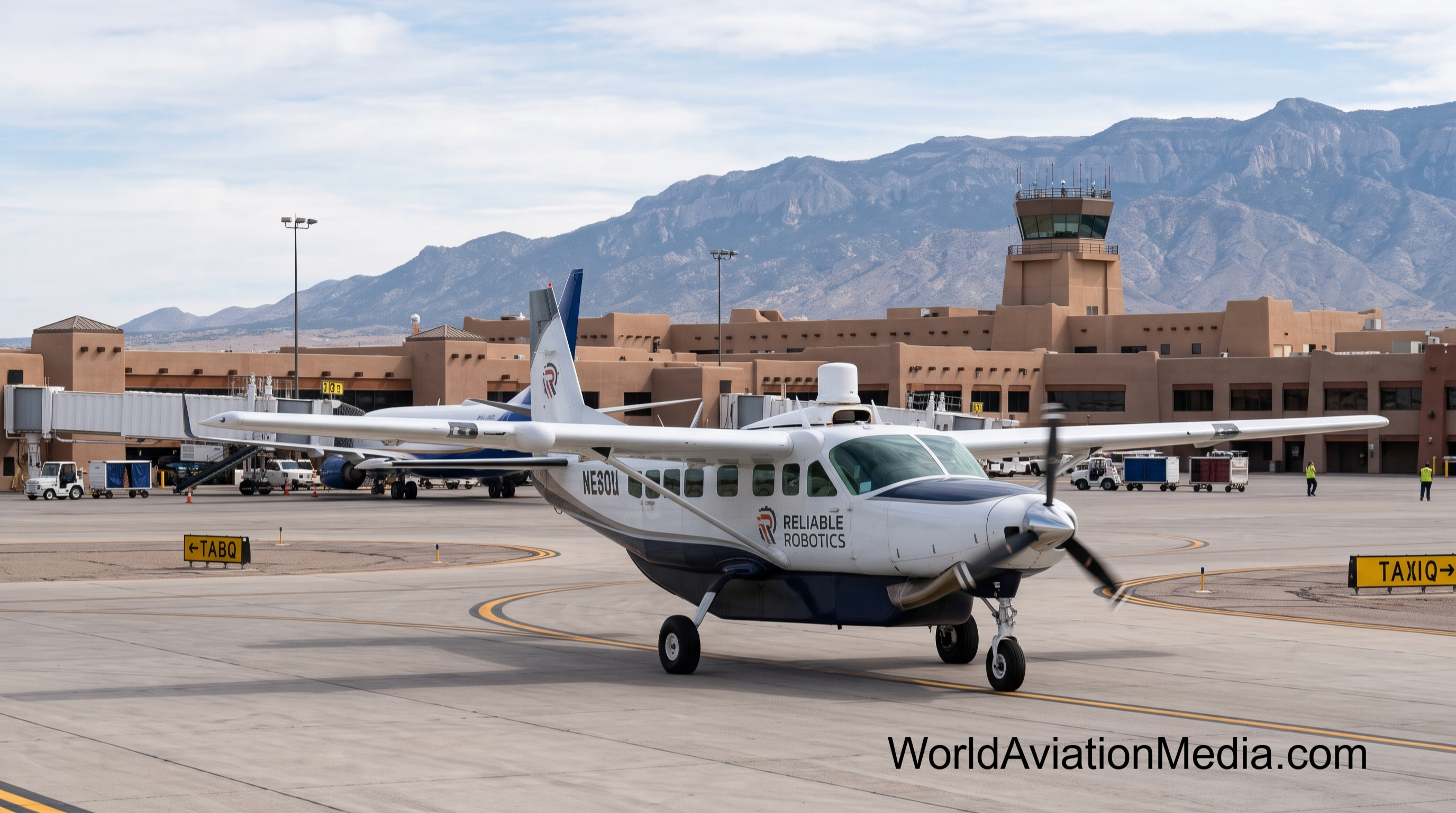
Autonomy in Class C Airspace: Lessons from Reliable Robotics’ Uncrewed Cessna Caravan Flights at Albuquerque Sunport
Key Takeaways
Historic Class C Airport Campaign: In October 2026, Reliable Robotics completed a landmark two-day automated flight campaign out of Albuquerque International Sunport (KABQ), operating a Cessna 208B Grand Caravan seamlessly alongside commercial airliners and military traffic in busy Class C airspace.
Commanded from 700 Miles Away: Equipped with the Reliable Autonomy System (RAS), the aircraft executed fully automated gate-to-gate taxi, takeoff, and landing sequences under the command of a remote pilot stationed more than 700 miles away in Mountain View, California (with an onboard safety pilot monitoring during the demo).
FAA eIPP & Certification Momentum: Conducted under the DOT/FAA Advanced Air Mobility Integration Pilot Program (eIPP), the flights build on an FAA-accepted certification plan and a newly expanded $275 million Series D round (pushing total funding past $380M at a $1B+ valuation).
Retrofit Pragmatism Beats Clean-Sheet Delay: By retrofitting proven Part 23 turboprops and integrating directly with existing Air Traffic Control (ATC) voice and ACAS X protocols, Reliable Robotics is scaling commercial regional cargo faster than clean-sheet eVTOL cargo concepts.
Gate-to-Gate in Active Airline Traffic: What Happened in Albuquerque
For years, skeptics of autonomous aviation have argued that uncrewed cargo aircraft might work over sparsely populated desert test ranges, but would falter the moment they had to merge into a busy commercial airport pattern alongside Boeing 737s, Airbus A320s, and military fighters. On October 21, 2026, Reliable Robotics dismantled that argument at Albuquerque International Sunport (KABQ).
Operating under the U.S. Department of Transportation and Federal Aviation Administration’s Advanced Air Mobility Integration Pilot Program (eIPP)—which selected Reliable Robotics and the City of Albuquerque in March 2026 following a June 2026 facility visit by Transportation Secretary Sean P. Duffy—the company executed a two-day automated cargo flight demonstration inside active Class C airspace.
How did Reliable Robotics operate its autonomous Cessna Caravan at Albuquerque Sunport? Reliable Robotics outfitted a Cessna 208B Grand Caravan with its Reliable Autonomy System (RAS), enabling fully automated gate-to-gate taxiing, takeoff, cruise, and landing. The flight was commanded by a remote pilot sitting at a control console more than 700 miles away at company headquarters in Mountain View, California, while an onboard safety pilot observed operations and handled standard ATC communications during the public demonstration.
Inside the Reliable Autonomy System (RAS): Why Retrofitting Wins
While dozens of venture-backed startups have spent billions attempting to certify both a brand-new electric airframe and a brand-new autonomous flight control system simultaneously, Reliable Robotics took a decoupled, pragmatic engineering approach: put world-class, certifiable automation onto the most reliable regional cargo workhorse in history—the Cessna 208B Grand Caravan.
Why does retrofitting a legacy turboprop beat clean-sheet eVTOLs to commercial airport integration?
Zero Airframe or Propulsion Unknowns: The Cessna Caravan and its Pratt & Whitney PT6A turboprop engine have logged tens of millions of flight hours in global feeder cargo service (FedEx, DHL, regional operators). Ground handlers at Albuquerque Sunport already know how to tow, load, de-ice, and refuel a Caravan.
No NAS Infrastructure Overhaul Required: According to Reliable Robotics, the RAS architecture integrates directly into the U.S. National Airspace System (NAS) without requiring the FAA to rewrite air traffic control procedures or install custom ground beacons. The remote pilot interacts with ATC using standard VHF radio voice/data relays and executes standard Instrument Flight Rules (IFR) clearances.
Continuous Engagement Autopilot & ACAS X: Unlike traditional autopilots that disengage during turbulence, approach minimums, or sensor discrepancies—handing control back to a startled human pilot—RAS is engineered as a continuous engagement autopilot with redundant actuators and high-integrity flight computers. It is paired with a Detect and Avoid (DAA) architecture built on ACAS X, for which Reliable collected FAA validation data earlier in April 2026.
"By encoding decades of historical aviation expertise into these systems, Reliable will responsibly define the next era of flight without compromising on safety." — Reliable Robotics Official Statement, October 2026
The Certifiable Path: How Remote Supervision Differs from "Black-Box AI"
A critical takeaway from the KABQ Class C demonstration is the distinction between autonomy (how the aircraft flies) and command (who makes strategic airspace decisions).
In the Reliable Robotics architecture, the remote pilot in Mountain View does not fly the airplane with a joystick. Latency over a 700-mile satellite and cellular command-and-control (C2) link makes manual stick-and-rudder remote piloting hazardous during a crosswind flare. Instead, the onboard Reliable Autonomy System executes all inner-loop flight controls—auto-taxiing along centerline markings, advancing the throttle, rotating, tracking the ILS/RNAV glideslope, and flaring to touchdown—entirely onboard the aircraft.
The remote pilot acts as an airspace manager: receiving clearances from Albuquerque Approach Control, verifying taxi routing, and uploading validated flight plan amendments to the aircraft's flight management computer. If the C2 communication link between California and New Mexico were ever severed mid-flight, the aircraft does not fall out of the sky; the onboard RAS autonomously executes its pre-programmed lost-link contingency routing and lands safely at the designated runway.
Because the onboard control laws are fully deterministic—rather than relying on unpredictable generative machine learning—the FAA has formally accepted Reliable Robotics’ certification plan, including the critical Means of Compliance (MoC) for continuous autopilot engagement.
A $1 Billion Unicorn Backed by Wall Street and the U.S. Air Force
The operational success at Albuquerque Sunport was matched in the third week of October 2026 by a massive show of financial strength. On October 20, 2026—just 24 hours before announcing the Sunport eIPP flight completion—Reliable Robotics disclosed $115 million in new capital (including a $25 million facility from Silicon Valley Bank), bringing its Series D round to $275 million (following April's $160 million tranche led by Nimble Partners with RTX Ventures). Total equity and debt funding now exceeds $380 million, pushing the company's valuation solidly past $1 billion.
Milestone / Program | Date | Partner / Investor | Strategic Impact |
USAF RAS Contract | Oct 2025 / Feb 2026 | U.S. Air Force ($17.4M Award) | Purchase, integration, and testing of RAS on Cessna 208B for Agile Combat Employment (ACE) logistics |
FAA eIPP Selection | March 2026 | DOT / FAA & City of Albuquerque | Selected for first commercial regional air cargo UAS integration program in the U.S. |
DAA / ACAS X Validation | April 2026 | Federal Aviation Administration | Flight-test validation data delivered to finalize FAA DAA certification standards |
Series D Expansion | Oct 20, 2026 | Nimble Partners, RTX Ventures, SVB ($275M total Series D) | Expands valuation over $1B; funds fleet acquisition, production scaling, and FAA certification evidence |
KABQ Class C Demo | Oct 21, 2026 | Albuquerque International Sunport | Proved gate-to-gate automated operations in mixed commercial/military Class C airspace from 700+ miles away |
Dual-Use Payoff: Solving Regional Cargo and Military Contested Logistics
With $275 million in fresh Series D capital and a proven Class C airport operational template, Reliable Robotics is simultaneously unlocking two massive markets:
Underserved Rural & Regional E-Commerce: Across states like New Mexico, Alaska, and the Mountain West, dozens of regional communities lack next-day air cargo frequency because regional pilot shortages make flying a 9-ton turboprop twice a day uneconomical. Removing the cockpit crew dependency allows feeder cargo airlines to operate high-frequency point-to-point routes profitably.
USAF Agile Combat Employment (ACE): Under its $17.4 million U.S. Air Force purchase agreement, Reliable is delivering automated Cessna 208B capability to move critical spare parts, munitions, and medical supplies between dispersed Indo-Pacific hubs without risking aircrew lives—and since RAS is aircraft-agnostic, the same architecture can scale up to multi-engine tactical transports and tankers.
5-Item Q&A Section
Q1: What did Reliable Robotics achieve at Albuquerque International Sunport in October 2026? In October 2026, Reliable Robotics completed a two-day automated cargo flight campaign at Albuquerque International Sunport (KABQ) in active Class C airspace. A modified Cessna 208B Grand Caravan performed fully automated gate-to-gate taxi, takeoff, and landing sequences while commanded by a remote pilot located over 700 miles away in Mountain View, California.
Q2: What program authorized the automated flights in New Mexico? The flights were conducted in partnership with the City of Albuquerque under the U.S. Department of Transportation and Federal Aviation Administration’s Advanced Air Mobility Integration Pilot Program (eIPP), which selected Reliable Robotics in March 2026 to pioneer commercial regional air cargo operations by a large UAS.
Q3: How much funding has Reliable Robotics raised as of October 2026? On October 20, 2026, Reliable Robotics announced $115 million in additional capital (including a $25 million loan from Silicon Valley Bank), bringing its Series D financing round to $275 million and its total raised capital past $380 million at a valuation exceeding $1 billion.
Q4: Does the Reliable Autonomy System (RAS) require changes to Air Traffic Control? No. The Reliable Autonomy System is aircraft-agnostic and integrates directly into the existing U.S. National Airspace System (NAS) without requiring changes to how Air Traffic Control (ATC) operates. It pairs continuous autopilot engagement with an ACAS X-based Detect and Avoid (DAA) system and standard ATC communications.
Q5: How is the U.S. Air Force working with Reliable Robotics? Following an October 2025 award and February 2026 purchase agreement valued at $17.4 million, the U.S. Air Force contracted Reliable Robotics to purchase, integrate, and test the Reliable Autonomy System onboard a Cessna 208B Caravan for military logistics and Agile Combat Employment (ACE) missions.
Keywords and Hashtags
Keywords: Reliable Robotics Albuquerque Sunport, autonomous Cessna Caravan Class C airspace, Reliable Autonomy System RAS, FAA eIPP autonomous cargo, remote pilot Mountain View KABQ, Reliable Robotics Series D $275M unicorn, ACAS X Detect and Avoid FAA.
Hashtags: #AutonomousAviation #ReliableRobotics #CessnaCaravan #AirCargo #AlbuquerqueSunport #FAAeIPP #FutureFlight #AerospaceAutonomy
