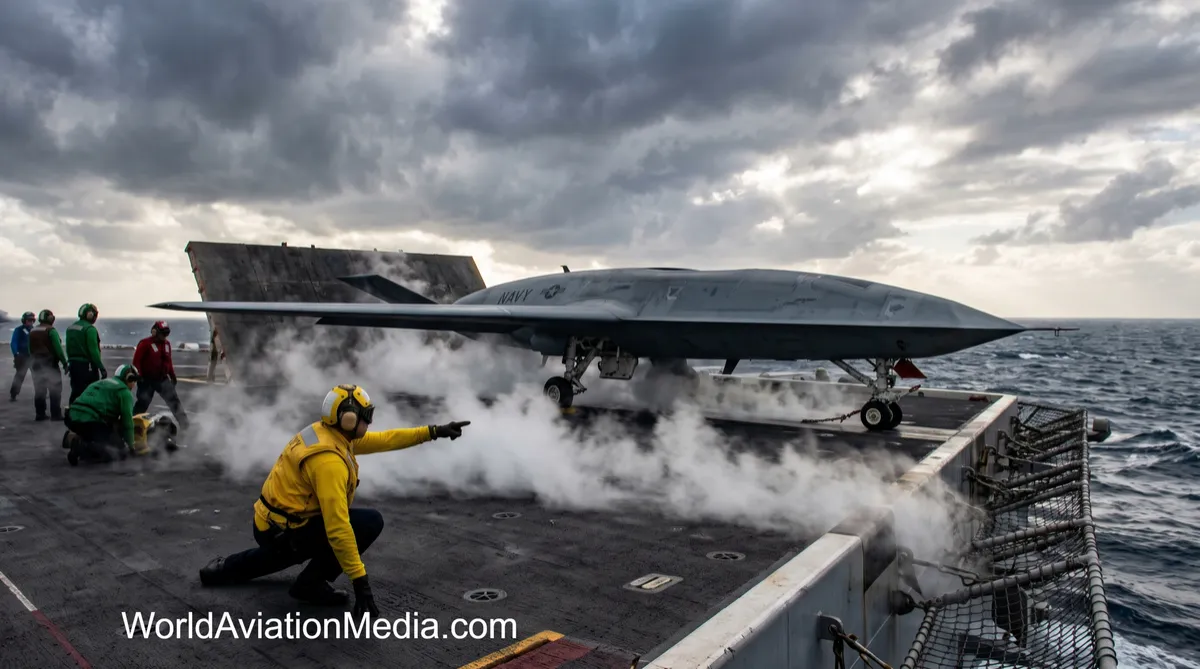
Autonomous Naval Warfare: The Strategic Implications of the U.S. Navy Controlling the MQ-25 Stingray Drone Remotely from Aircraft Carriers at Sea
Key Takeaways
Historic Sea-Based Command Milestone: In October 2026, the U.S. Navy successfully executed the first live control-link tests of the Boeing MQ-25A Stingray unmanned aerial tanker directly from a nuclear-powered aircraft carrier at sea, the USS Ronald Reagan (CVN 76).
The MD-5C Unmanned Carrier Aviation Mission Control System (UMCS): Utilizing Lockheed Martin's MDCX software integrated into the MD-5C control station architecture, carrier air wing operators demonstrated seamless C4I (Command, Control, Communications, Computers, and Intelligence) handoffs between shore stations and afloat combat hubs.
Liberating the F/A-18E/F Super Hornet Fleet: By taking over the carrier air wing's organic aerial refueling mission, the MQ-25A frees up 20% to 30% of frontline F/A-18E/F Super Hornets currently tied down as "buddy tankers", preserving valuable airframe fatigue life and returning strike fighters to lethal combat duties.
Outranging Anti-Access/Area-Denial (A2/AD) Threats: Capable of delivering ~15,000 pounds of fuel at a 500-nautical-mile radius, the Stingray nearly doubles the unrefueled combat strike radius of F-35C Lightning IIs and Super Hornets, allowing U.S. carrier strike groups to operate outside the primary engagement zones of adversary anti-ship ballistic missiles.
Why Is Carrier-Based Remote Control of the MQ-25 Stingray a Game Changer?
In late October 2026, the United States Navy crossed a historic threshold in naval aviation history aboard the Nimitz-class nuclear aircraft carrier USS Ronald Reagan (CVN 76). For the first time, naval air vehicle operators stationed inside a dedicated Unmanned Carrier Aviation Mission Control System (UMCS) room below the flight deck established a live command-and-control (C2) link with a Boeing MQ-25A Stingray unmanned aircraft system.
While unmanned drones have operated from land bases for decades, integrating a 45,000-pound, jet-powered autonomous aircraft into the hyper-dense, electromagnetic-saturated, pitching deck environment of a nuclear aircraft carrier represents one of the most complex systems engineering challenges in military history. Designed as the world's first operational carrier-based unmanned aircraft, the MQ-25A Stingray is far more than an aerial gas station. As Acting Navy Secretary Hung Cao emphasized following the October 2026 test, the successful validation of the shipboard MD-5C control architecture lays the foundational digital nervous system for the U.S. Navy's future Air Wing of the Future—where up to 60% of carrier-based aircraft will eventually be unmanned Collaborative Combat Aircraft (CCAs).
Inside the MD-5C Control Station and MDCX Software Architecture
Controlling an autonomous jet from a moving aircraft carrier at sea requires overcoming severe physical and cyber-electromagnetic obstacles: satellite latency, multi-path radar interference off the ocean surface, strict Emissions Control (EMCON) in contested waters, and seamless handoffs between deck handlers and tactical mission commanders.
The breakthrough demonstrated aboard USS Ronald Reagan centered on the MD-5C Ground Control Station, which bridges the Navy's overarching shipboard C4I network with hardware and Multi-Domain Combat System (MDCX) software developed by Lockheed Martin Skunk Works:
Open-Architecture Interoperability: Built strictly to the U.S. military's Unmanned Aircraft System Control Segment (UCS) open architecture standards, the MD-5C station is designed not just for the Boeing MQ-25A, but as a common, vendor-agnostic control hub capable of commanding future carrier-launched autonomous strike and reconnaissance drones.
Splitting Deck Handling from Airborne Mission Control: On the flight deck during launch and recovery cycles, an Aviation Boatswain's Mate (Handler) and Deck Operator use a ruggedized, body-worn deck control device to taxi the MQ-25A into the catapult shuttle and clear the landing area after trap—responding directly to the visual hand signals of the "Yellow Shirts." Once airborne, control transitions instantaneously via encrypted Line-of-Sight (LOS) and Beyond-Line-of-Sight (BLOS) data links to the Air Vehicle Pilots (Warrant Officers Series 7371) seated at the MD-5C consoles deep inside the carrier's superstructure.
Tactical Impact: Extending the Reach of the Carrier Air Wing (CVW)
To appreciate the strategic urgency behind the MQ-25A program, defense analysts look to the Western Pacific and the proliferation of long-range Anti-Access/Area-Denial (A2/AD) weapons, such as the DF-21D and DF-26 anti-ship ballistic missiles. To ensure carrier survivability in a high-end peer conflict, a U.S. Carrier Strike Group (CSG) can no longer steam within 400 nautical miles of a hostile coastline to launch strikes.
Carrier Strike Metric | Current Baseline (F/A-18E/F Buddy Tanking) | Future Baseline with MQ-25A Stingray Integration | Operational & Strategic Advantage |
Unrefueled Combat Strike Radius (F/A-18E/F / F-35C) | ~450 – 550 Nautical Miles | ~450 – 550 Nautical Miles (Base) | Limited stand-off margin against modern A2/AD missile rings |
Refueled Combat Strike Radius | ~700 Nautical Miles | 800 – 950+ Nautical Miles | Doubles effective contested engagement footprint |
Fuel Offload Available at 500 nm from Carrier | ~6,000 – 8,000 lbs (via Cobham ARS buddy pod) | 15,000+ lbs per MQ-25A sortie | Enables multiple strike fighters to refuel deep in theater |
Percentage of Super Hornet Sorties Tied to Tanking | 20% to 30% of all daily sorties | Near 0% (Freed for Strike/Fleet Air Defense) | Returns 8 to 12 fighters per air wing to combat lethality |
Secondary Mission Utility | Fighter Radar/EW only | Maritime ISR (EO/IR & ESM passive sensors) | Persistent eyes-forward surveillance without risking pilots |
Since the retirement of the dedicated Grumman KA-6D Intruder tanker in 1997 and the Lockheed S-3B Viking in 2009, the U.S. Navy has relied entirely on "buddy tanking"—strapping up to five external fuel tanks and an aerial refueling store (ARS) hose-and-drogue pod onto combat-coded F/A-18E/F Super Hornets. This stopgap policy has exacted a brutal toll on the fleet: nearly one-third of all Super Hornet flight hours have been consumed hauling fuel rather than training for air combat, burning through expensive airframe structural life hours (rising from 6,000 to 10,000 hours via Service Life Modification programs) at an unsustainable rate.
Program Timeline: From 2026 Carrier Integration to 2029 Fleet Deliveries
While the October 2026 control-link test aboard USS Ronald Reagan validates the shipboard command architecture, the MQ-25A program still faces a disciplined developmental testing schedule before achieving full Initial Operational Capability (IOC).
Following structural manufacturing adjustments on the Engineering and Manufacturing Development (EMD) static test articles, first flight of the production-representative EMD aircraft (T-2 / E-1) leads into formal sea trials—where the MQ-25A will execute live steam and electromagnetic (EMALS) catapult launches and arrested wire recoveries aboard both Nimitz-class and Gerald R. Ford-class carriers. Current Department of the Navy procurement schedules project formal operational deliveries to Fleet Replacement Squadron VUQ-10 (Unmanned Carrier-Launched Multi-Role Squadron 10) at NAS Point Mugu, California, and operational fleet deployments beginning by 2029, toward a total program of record of 76 aircraft.
5-Item Q&A Section (FAQ)
Q1: What is the primary mission of the U.S. Navy's MQ-25 Stingray drone?
The primary mission of the Boeing MQ-25A Stingray is carrier-based autonomous aerial refueling. It is designed to offload approximately 15,000 pounds of fuel at a range of 500 nautical miles from the aircraft carrier, extending the combat reach of F/A-18 Super Hornets, EA-18G Growlers, and F-35C Lightning II fighters.
Q2: How is the MQ-25 Stingray controlled from an aircraft carrier?
The MQ-25A is controlled from a dedicated shipboard control room using the MD-5C Unmanned Carrier Aviation Mission Control System (UMCS), which integrates the Navy's C4I network with Lockheed Martin's MDCX software architecture, alongside deck-based handheld controllers for taxiing.
Q3: Which aircraft carrier conducted the first remote control link test of the MQ-25 in October 2026?
The nuclear-powered aircraft carrier USS Ronald Reagan (CVN 76) successfully conducted the first shipboard control-link test with the MQ-25A Stingray system in late October 2026.
Q4: How does the MQ-25 Stingray help the F/A-18 Super Hornet fleet?
Currently, 20% to 30% of F/A-18E/F Super Hornet sorties are used as "buddy tankers" to refuel other jets. By taking over the refueling workload, the MQ-25A frees those Super Hornets for combat strike missions and preserves their airframe structural lifespan.
Q5: Who flies the MQ-25 Stingray in the U.S. Navy?
The U.S. Navy created a specialized officer designation—Aerial Vehicle Pilots (AVPs), holding Warrant Officer specialty 7371—who are trained exclusively to operate the MQ-25A Stingray and future carrier-based unmanned systems from the MD-5C mission control consoles.
Keywords and Hashtags
Keywords: MQ-25 Stingray carrier testing, US Navy unmanned aerial refueling, USS Ronald Reagan MQ-25 control test, MD-5C Unmanned Carrier Aviation Mission Control System, Boeing MQ-25A delivery timeline 2029, carrier air wing of the future, autonomous naval warfare.
Hashtags: #MQ25Stingray #USNavy #NavalAviation #AutonomousDrones #AircraftCarrier #MilitaryTech #BoeingDefense #LockheedMartin
