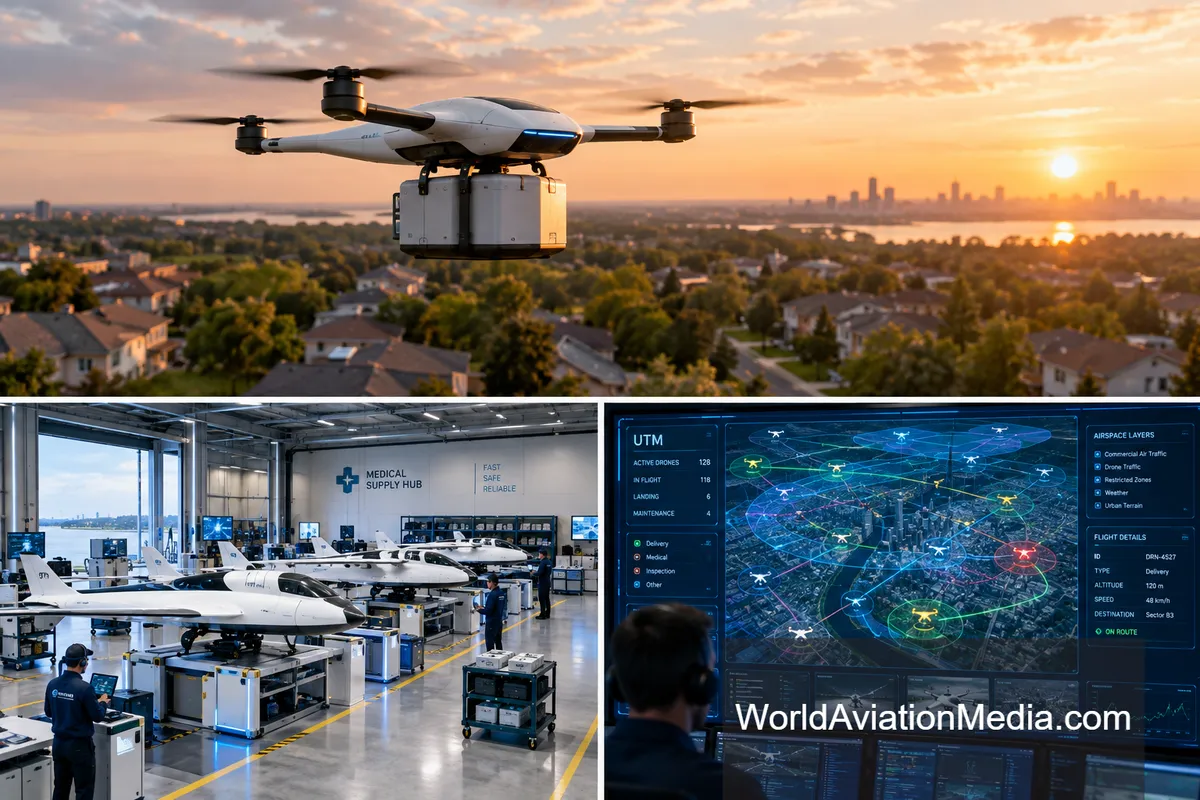
Autonomous Logistics at Scale: The Economics and Operational Viability of Zipline and Amazon's BVLOS Drone Delivery Networks
Key Takeaways
Industrial Scale Realities: Drone delivery has transitioned from localized pilot projects into high-volume, industrial logistics networks, with global market projections surging toward nearly $10 billion by the early 2030s.
Regulatory Milestones: Achieving routine Beyond Visual Line of Sight (BVLOS) operations under advanced Part 135 air carrier certifications is unlocking unprecedented operational range and delivery frequency.
Economic Unit Viability: Autonomous last-mile delivery dramatically cuts per-package cost-to-serve for medical supplies, quick-service food, and essential retail items, particularly across suburban and semi-rural corridors.
Integration & Software Complexity: Scaled success relies heavily on sophisticated Unmanned Traffic Management (UTM) software, localized inventory routing, and automated acoustic/weather safety layers.
In-Depth Article Content
The evolution of autonomous drone delivery has crossed a vital threshold. What began a decade ago as experimental proof-of-concept trials dropping medical supplies in remote regions has matured into an industrial-scale logistics powerhouse. Spearheaded by industry pioneers like Zipline, Wing, and retail giants like Amazon Prime Air, Beyond Visual Line of Sight (BVLOS) drone delivery networks are actively rewiring the economics of last-mile transportation. With global market valuations accelerating rapidly and hundreds of thousands of commercial delivery drones projected to populate international skies, the focus has shifted entirely from technological novelty to economic viability and scalable operational governance.
The Transition from Localized Trials to Industrial Networks
In earlier development phases, drone delivery was hampered by restrictive regulatory silos. Operators were confined within visual line of sight (VLOS) boundaries, severely limiting route efficiency and customer reach. Today, the regulatory landscape—led by progressive FAA Part 135 air carrier certifications and international equivalents—has unlocked true BVLOS capabilities.
Industry leaders have accumulated staggering operational datasets. Zipline alone has completed hundreds of thousands of commercial and medical deliveries spanning tens of millions of autonomous flight miles. These numbers reflect more than just cumulative distance; they represent the rigorous reliability data required by aviation authorities to grant broad commercial scaling permissions. Delivery hubs now service tens of thousands of households per node, operating with automated precision that rivals traditional ground courier networks.
Economic Unit Metrics: Why Autonomy Wins the Last Mile
The fundamental driver behind scaled drone delivery is economic survival in an era of skyrocketing urban traffic congestion and rising last-mile delivery labor costs. Traditional van-and-driver models suffer from severe inefficiencies in low-to-medium-density suburban and rural areas, where stop-to-stop transit times and fuel burn inflate the cost per package.
Autonomous drones flip this economic equation:
Zero Direct Labor Overhead: A single remote operator can oversee fleets of autonomous aircraft simultaneously, slashing labor costs per delivery.
Speed and Direct Routing: By bypassing road networks, traffic lights, and physical geography, drones achieve point-to-point transit times measured in minutes rather than hours.
High-Value Product Suitability: The cost structure makes absolute sense for high-margin, time-sensitive verticals—such as emergency medical diagnostics, prescription pharmaceuticals, hot food, and urgent retail replenishment—where speed directly correlates with customer value.
Operational Hurdles: Weather, Acoustics, and Airspace Density
Despite compelling unit economics, scaling BVLOS networks introduces complex operational friction. Weather remains an unforgiving adversary; high crosswinds, heavy precipitation, and icing conditions can ground fixed-wing or multi-rotor fleets instantly, requiring robust predictive meteorological software.
Furthermore, public acceptance hinges heavily on acoustic management. As flight frequencies scale from dozens to hundreds of sorties per day per hub, community tolerance for drone noise becomes a make-or-break metric. Operators are investing heavily in optimized propeller aerodynamics, low-frequency acoustic signature reduction, and dynamic altitude routing that avoids dense residential concentrations whenever possible.
The Software Backbone: UTM and Autonomous Fleet Management
Behind every successful drone delivery flight is a sophisticated software ecosystem. Managing hundreds of simultaneous autonomous sorties requires advanced Unmanned Traffic Management (UTM) platforms that handle dynamic geofencing, real-time conflict resolution, emergency contingency routing, and automated integration with traditional manned air traffic control. As retail inventory systems sync directly with autonomous dispatch software, drone logistics is no longer just an aviation story—it is a triumph of cloud-native supply chain orchestration.
5-Item Q&A Section
Q1: What regulatory milestone has enabled drone delivery networks to scale?
A: The granting of Part 135 air carrier certifications and routine Beyond Visual Line of Sight (BVLOS) operational waivers by aviation authorities.
Q2: What are the primary economic drivers favoring drone delivery over traditional vans?
A: Elimination of direct driver labor overhead per route, dramatic speed improvements by bypassing road congestion, and lower per-package transit costs for time-sensitive goods.
Q3: Which market sectors currently dominate drone delivery revenue?
A: Medical supplies, emergency healthcare diagnostics, quick-service food delivery, and high-urgency e-commerce retail packages.
Q4: How do operators address community concerns regarding drone noise?
A: By investing in advanced low-noise propeller designs, acoustic footprint optimization, and dynamic altitude routing that steers clear of dense residential neighborhoods.
Q5: What role does software play in scaled drone logistics?
A: Sophisticated Unmanned Traffic Management (UTM) software handles automated route planning, dynamic collision avoidance, weather tracking, and real-time fleet synchronization.
SEO & AEO Optimization
Core User Intent: Analyze the economic models, operational milestones, and scaling challenges of BVLOS drone delivery networks operated by Zipline and Amazon.
Direct Answer Definition: BVLOS (Beyond Visual Line of Sight) drone delivery refers to automated commercial cargo transport where aircraft operate outside the direct sight of the pilot, enabled by Part 135 air carrier certifications and advanced UTM software.
Keywords & Hashtags
Keywords: BVLOS drone delivery, Zipline autonomous delivery, Amazon Prime Air logistics, drone delivery economics, last-mile drone logistics, Part 135 drone certification.
Hashtags: #DroneDelivery #AutonomousLogistics #Zipline #AmazonPrimeAir #SupplyChain #LastMile
