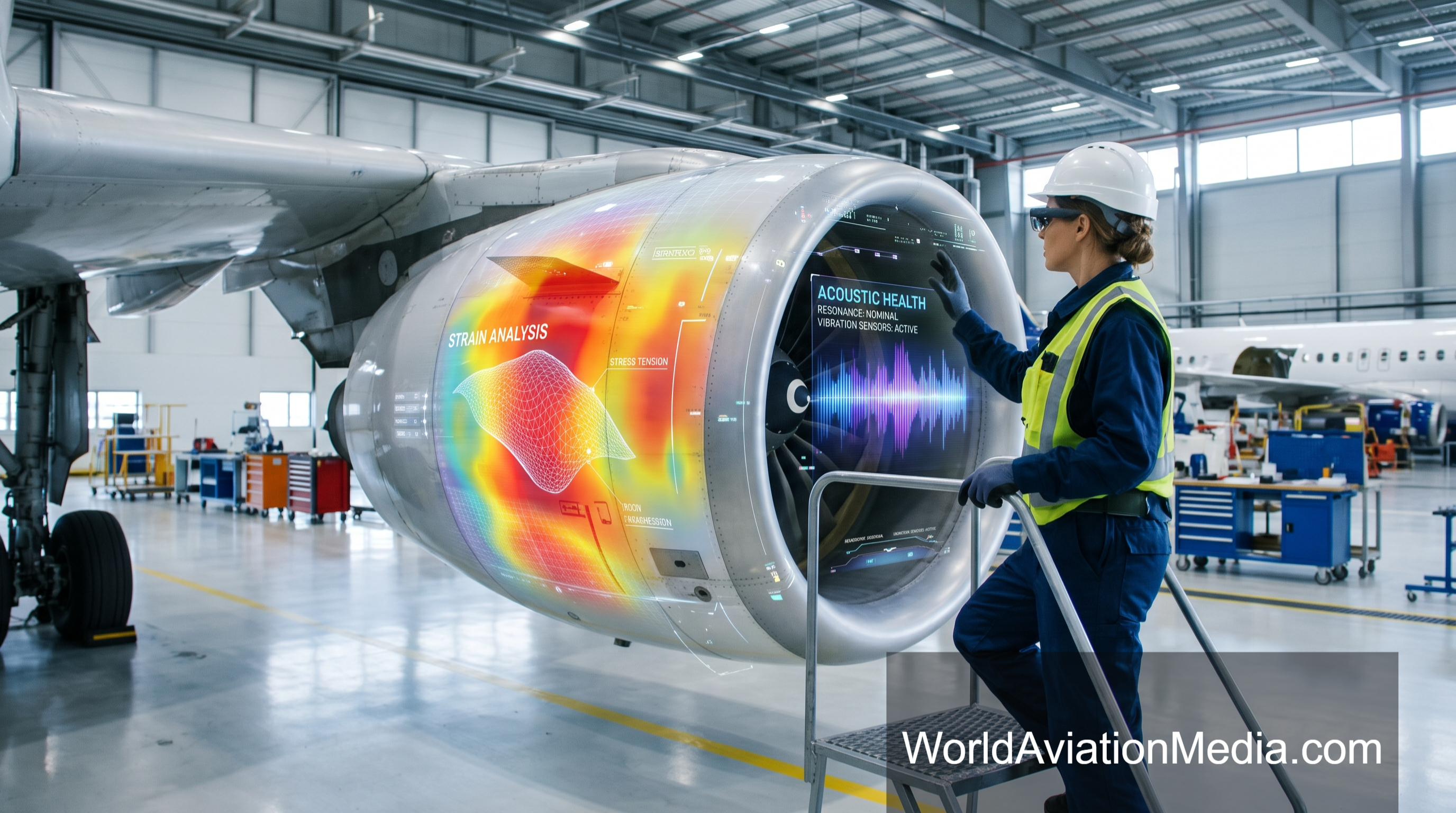
Aircraft That ‘Feel Pain’ and ‘Hear Cracks’: How NASA-Backed Acoustic and Tactile AI Will Revolutionize MRO
Key Takeaways
From Scheduled Inspections to Autonomous Self-Diagnosis: Aerospace Maintenance, Repair, and Overhaul (MRO) is transitioning from calendar-based manual inspections to continuous, AI-driven Structural Health Monitoring (SHM) where airframes actively detect their own micro-fractures and mechanical wear.
NASA-Backed AstraQua Smart Sensor Networks: Backed by a NASA SBIR Phase II definitive contract (SIDEGUARD: Sensor/Side-Channel Augmented Graph-Evidence Health monitoring), AstraQua Inc. is pioneering embedded structural and side-channel sensor graphs that give aerospace structures a digital nervous system capable of "feeling" mechanical stress and anomalies in real time.
University of Cincinnati’s Acoustic Pre-Flight AI: Researchers at the University of Cincinnati have developed an acoustic pre-flight diagnostic AI that listens to the subtle harmonic signatures of drone motors, bearings, and carbon-fiber rotor blades during a brief spin-up, spotting invisible micro-cracks and imbalances before takeoff.
Migration to Commercial Airliners: What begins on Group 3–5 UAS and eVTOL fleets provides a rapid certification bridge to Part 25 commercial narrowbodies and widebodies, promising to slash AOG (Aircraft on Ground) delays and heavy C-check downtime by up to 35%.
The $90 Billion MRO Blind Spot: Why Calendar-Based Inspections Are Showing Their Age
Every year, the global commercial airline and defense aviation industries spend well over $90 billion on Maintenance, Repair, and Overhaul (MRO). Despite decades of digital avionics progress, a surprising portion of structural airframe and rotating-component inspection still relies on 20th-century schedules: an aircraft flies a set number of hours or cycles, enters a hangar for an A-, C-, or D-check, and human technicians spend hundreds of hours with flashlights, ultrasonic wands, and eddy-current probes hunting for fatigue cracks or delamination.
This paradigm suffers from two expensive flaws:
Unscheduled AOG Surprises: If a composite control surface delaminates from hail impact or a high-speed bearing degrades between scheduled checks, the result is an expensive Aircraft on Ground (AOG) gate cancellation—or worse, an in-flight failure.
Over-Maintenance Downtime: Conversely, disassembling perfectly healthy aircraft components simply because a calendar threshold expired pulls revenue-generating jets out of service for weeks.
In late 2026, two converging breakthroughs—AstraQua’s NASA-backed tactile/side-channel graph health networks and the University of Cincinnati’s acoustic pre-flight diagnostic AI—are giving aircraft two biological survival instincts: the ability to "feel pain" across their structures and "hear cracks" in their propulsion systems.
What is acoustic and tactile AI in aviation MRO? Acoustic and tactile AI in aviation Maintenance, Repair, and Overhaul (MRO) combines embedded structural strain/piezoelectric sensors ("tactile skin") and high-frequency microphone arrays ("acoustic listening") with machine learning algorithms. These systems continuously analyze vibration, ultrasonic stress waves, and acoustic harmonics to detect microscopic cracks, composite delamination, and bearing wear before human inspectors can see them.
Aircraft That 'Feel Pain': Inside AstraQua’s NASA Phase II Breakthrough
In October 2026, federal contracting disclosures highlighted a pivotal NASA Small Business Innovation Research (SBIR) Phase II definitive contract awarded to AstraQua Inc. for its SIDEGUARD architecture (Sensor/Side-Channel Augmented Graph-Evidence Health) alongside NASA ARMD's broader push into electrified propulsion and structural health sensing.
To understand how an airframe "feels pain," consider how the human nervous system operates. When you sprain an ankle or suffer a hairline bone fracture, nociceptors immediately transmit localized electrical signals to your brain, prompting you to shift your weight to prevent a catastrophic break.
AstraQua’s sensor-augmented graph-evidence architecture brings this exact capability to aerospace structures and avionics hardware:
Multi-Modal Side-Channel & Structural Sensing: Instead of adding heavy, single-purpose wiring harnesses for every individual failure mode, the system fuses primary structural strain, vibration, and thermal telemetry with "side-channel" physical signals (such as subtle variations in electrical power draw, impedance changes across composite skins, and piezoelectric ultrasonic propagation).
Graph-Evidence Machine Learning: Traditional threshold sensors trigger false alarms whenever an aircraft hits severe clear-air turbulence. By mapping the aircraft's sensors as an interconnected mathematical Graph Neural Network (GNN), AstraQua’s software evaluates how stress waves propagate from node to node across a wing spar, eVTOL motor mount, or spacecraft bulkhead.
Pinpointing the Exact Micro-Fracture: If a fastener loosens or a carbon-fiber rib suffers subsurface delamination, the local mechanical impedance changes. The graph-evidence engine isolates the exact spatial coordinates of the anomaly, estimates remaining useful life (RUL), and flags the exact panel for line maintenance before the aircraft even touches down.
Aircraft That 'Hear Cracks': The University of Cincinnati’s Acoustic Drone Diagnostics
While embedded tactile sensors protect primary airframes, rotating propulsion assemblies—propellers, lift rotors, gearboxes, and electric motor bearings—present a different challenge, particularly on Unmanned Aerial Systems (UAS) and distributed electric propulsion (DEP) aircraft where weight limits preclude heavy onboard vibration rigs.
Researchers at the University of Cincinnati (UC) solved this problem by training artificial intelligence to do what master mechanics have tried to do by ear for a century—only at ultrasonic precision.
How does the University of Cincinnati's acoustic pre-flight diagnostic system work?
The 15-Second Spin-Up Signature: Prior to takeoff, a drone or electric aircraft runs its rotors through a standardized, brief RPM throttle sweep on the pad.
Spectral & Harmonic Feature Extraction: An array of acoustic sensors captures the sound wave envelope generated by the blades slicing the air and the internal hum of the stator coils and bearings.
AI Anomaly Classification: When a composite propeller blade has a hairline stress crack, an internal void, or 0.5 grams of leading-edge erosion—or when a motor bearing race develops microscopic pitting—its aeroelastic flutter and harmonic frequency shift by fractions of a kilohertz. While completely imperceptible to the human ear amidst background airport noise, the UC machine learning model filters out ambient wind and flags the damaged rotor with high precision before the aircraft leaves the ground.
The Migration Path: From Drones and eVTOLs to Boeing and Airbus Fleets
Why are these acoustic and tactile AI breakthroughs debuting on drones, eVTOLs, and NASA testbeds before commercial Boeing 737s or Airbus A350s? The answer is regulatory velocity and operational necessity.
MRO Diagnostic Layer | Legacy Airline MRO Approach | Acoustic & Tactile AI MRO Approach | Quantifiable Operational Impact |
Pre-Flight Rotor/Engine Check | Visual walk-around by pilot or ramp mechanic with flashlight | UC Acoustic AI: Automated harmonic spectral scan during engine/rotor spin-up | Detects subsurface blade cracks & bearing wear prior to dispatch |
Composite Airframe Inspection | Scheduled hangar C-Check using manual ultrasonic tap/probe testing | AstraQua Tactile/Graph AI: Continuous in-flight structural & side-channel graph monitoring | Eliminates blind spots from bird strikes, hail, or hard landings |
Avionics & Actuator Health | Wait for Built-In Test Equipment (BITE) fault code after failure occurs | SIDEGUARD Side-Channel Evidence: Detects subtle power/impedance drift weeks prior to failure | Converts unscheduled gate AOGs into planned overnight swaps |
Uncrewed aircraft (like Reliable Robotics' remote cargo planes or military Group 3–5 UAS) and high-turnover eVTOL air taxis do not have a flight engineer walking around the aircraft with a wrench at every outstation. For an automated vertiport or remote military strip to function, pre-flight airworthiness verification must be automated.
Once acoustic arrays and graph-based tactile sensors log hundreds of thousands of validated diagnostic hours across UAS and Advanced Air Mobility fleets, their migration to Part 25 commercial airliners is inevitable:
Automated Gate Acoustic Arrays: Microphones mounted on airport jet bridges or runway hold-short bars can passively record the acoustic signature of a CFM LEAP or Pratt & Whitney GTF turbofan as it spools up, instantly alerting airline MRO control centers to fan-blade rub or high-pressure compressor stage wear.
Condition-Based Structural Credits: As the FAA and EASA validate Structural Health Monitoring (SHM) data under MSG-3 maintenance frameworks, airlines equipped with AstraQua-style continuous tactile sensor networks will earn regulatory credit to extend intervals between invasive structural teardowns—keeping aircraft in the air earning revenue while elevating safety margins to unprecedented levels.
5-Item Q&A Section
Q1: How does AstraQua’s NASA-backed technology help aircraft "feel pain"?
Under a NASA SBIR Phase II contract (SIDEGUARD: Sensor/Side-Channel Augmented Graph-Evidence Health), AstraQua Inc. combines structural sensors and side-channel physical telemetry with Graph Neural Network (GNN) machine learning. This creates a digital nervous system that tracks how mechanical stress, vibration, and electrical anomalies propagate across an airframe, pinpointing microscopic damage in real time.
Q2: How does the University of Cincinnati’s acoustic AI detect drone damage before flight? The University of Cincinnati’s acoustic diagnostic system uses microphone sensors and machine learning to analyze the sound frequencies and harmonic signatures produced by a drone's motors and propellers during a brief pre-flight spin-up. Microscopic cracks in rotor blades or worn motor bearings alter these acoustic harmonics, allowing the AI to halt a flight before an in-air failure occurs.
Q3: Why is acoustic and tactile AI critical for eVTOLs and autonomous cargo aircraft? Autonomous cargo planes and high-frequency eVTOL air taxis operate with rapid turnarounds and often without dedicated on-site maintenance mechanics at every landing pad. Automated acoustic and structural sensing replaces manual visual walk-arounds with continuous, objective digital airworthiness verification.
Q4: How can these technologies reduce commercial airline MRO costs?
By shifting airlines from rigid calendar-based teardown inspections to real-time Condition-Based Maintenance (CBM), acoustic and tactile AI prevents unscheduled Aircraft on Ground (AOG) gate cancellations, reduces unnecessary disassembly during heavy C-checks, and identifies composite delamination from hail or ground equipment strikes immediately.
Q5: What is side-channel health monitoring in aerospace systems?
Side-channel health monitoring—a core component of AstraQua’s NASA SIDEGUARD research—analyzes secondary physical phenomena (such as micro-fluctuations in electrical current draw, electromagnetic emissions, thermal gradients, and structural impedance) to diagnose early degradation in actuators, avionics, and airframe joints without adding heavy redundant hardware.
Keywords and Hashtags
Keywords: NASA AstraQua SIDEGUARD sensor Phase II, University of Cincinnati acoustic drone AI, Structural Health Monitoring SHM aviation, predictive maintenance AI MRO 2026, tactile aircraft skin sensors, condition-based maintenance commercial airlines, eVTOL automated pre-flight inspection.
Hashtags: #AviationMRO #PredictiveMaintenance #AerospaceAI #NASA #StructuralHealthMonitoring #DroneTechnology #SmartMaterials #FutureOfAviation
