After the Stamp: Inside Boeing’s 737 MAX 10 Delivery Ramp and the Battle for Narrowbody Parity
Key Takeaways
Historic Certification Milestone: On October 20, 2026, the Federal Aviation Administration (FAA) granted an amended type certificate for the Boeing 737 MAX 10, ending a nine-year certification cycle for the largest variant in the 737 family.
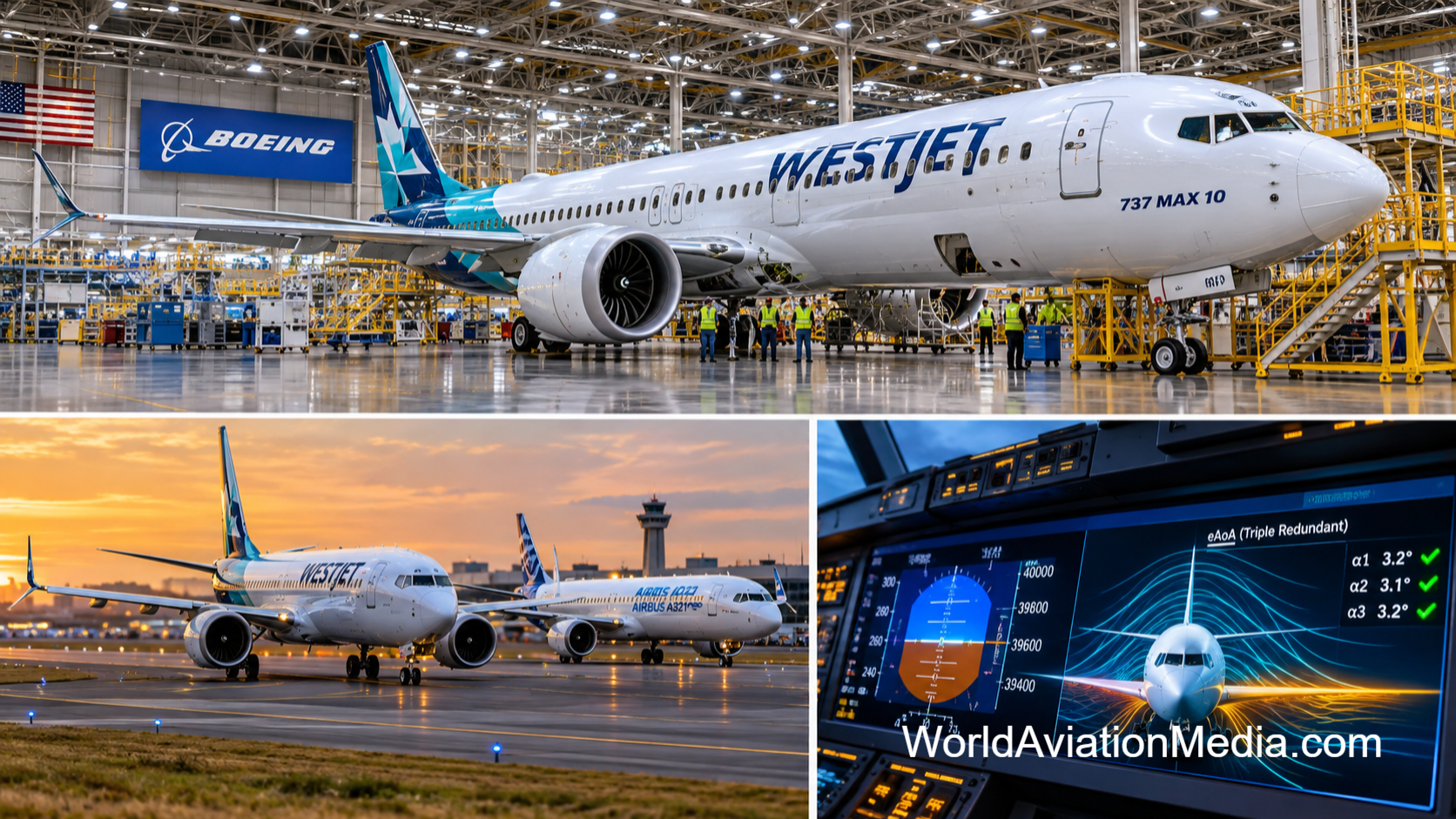
Mandatory Safety Enhancements: Approval required the integration of an enhanced, synthetic Angle of Attack (AoA) sensor system and updated flight-control software mandated by the Aircraft Certification, Safety, and Accountability Act—upgrades that will now be retrofitted across the active MAX fleet.
Rapid Inventory Liquidation: Boeing is transitioning stored MAX 10 airframes and fresh assemblies from its Everett North Line into customer delivery streams, led by launch operators United Airlines and WestJet.
Narrowbody Market Recalibration: Capable of seating up to 230 passengers (and 185–210 in dual-class configurations) over a 3,100-nautical-mile range, the MAX 10 provides high-density seat economics designed to defend domestic trunk routes against the Airbus A321neo.
The Nine-Year Wait Ends: What FAA Certification Actually Unlocks
When the Federal Aviation Administration (FAA) issued the amended type certificate for the Boeing 737 MAX 10 on October 20, 2026, it closed one of the most protracted and scrutinized regulatory chapters in modern commercial aviation history. Launched nearly nine years ago as Boeing's tactical response to the surging market share of the Airbus A321neo, the stretched 737-10 became the focal point of post-crisis regulatory reform, congressional intervention, and engineering redesigns.
"We are delighted to complete the 737 MAX family and provide our customers the most-efficient and flexible single-aisle airplane portfolio in the industry." — Boeing Commercial Airplanes Official Statement
What is the Boeing 737 MAX 10? The Boeing 737 MAX 10 (officially designated the 737-10) is the largest, highest-capacity variant of Boeing’s fourth-generation narrowbody aircraft family. Measuring 143 feet 8 inches in length, the aircraft accommodates up to 230 passengers in a high-density single-class layout—or 185 to 210 passengers in standard two-class airline configurations—with a maximum range of 3,100 nautical miles (5,740 kilometers).
Securing the FAA stamp required Boeing to satisfy stringent requirements under the Aircraft Certification, Safety, and Accountability Act, alongside direct recommendations from the National Transportation Safety Board (NTSB). Central to the final approval was the implementation of a third, synthetic Angle of Attack (AoA) system known as the Enhanced Angle of Attack (eAoA) architecture, alongside flight-control software refinements and engine anti-ice structural modifications. Because the MAX 10 has cleared certification, this enhanced AoA system becomes standard equipment on all newly manufactured MAX aircraft and triggers a fleet-wide retrofit mandate for in-service MAX 8 and MAX 9 airframes.
Inside the Everett "North Line" and the Inventory Burn-Down
For Boeing CEO Kelly Ortberg and the leadership at Boeing Commercial Airplanes (BCA), type certification is only the halfway mark. The immediate operational challenge is converting accumulated factory inventory into free cash flow without disrupting the delicate production rhythm established across Renton and Everett.
To accommodate the sheer volume of MAX backlog while addressing quality management mandates, Boeing established the "North Line"—a fourth 737 assembly line housed inside the massive Everett, Washington factory historically reserved for widebody programs. In July 2026, the first MAX 10 fuselage entered assembly on the North Line, earmarked specifically for Canadian carrier WestJet.
Transitioning parked MAX 10 airframes—commonly referred to in financial filings as "shadow factory" inventory—into revenue service requires a structured four-stage delivery protocol:
Airworthiness Directive & AoA Verification: Confirming all pre-built stored airframes reflect the final October 20, 2026 certified baseline, including the updated flight-control computers and synthetic AoA architecture.
De-preservation and Systems Awakening: Flushing hydraulic lines, cycling CFM International LEAP-1B engines, and replacing time-expired elastomer seals on aircraft that completed final assembly prior to certification.
Customer Interior Reconfiguration: Installing airline-specific Buyer-Furnished Equipment (BFE), including next-generation lie-flat or domestic first-class seating, expanded Boeing Sky Interior overhead bins, and high-speed satellite connectivity antennas (such as Starlink arrays).
FAA Ticket Issuance & Acceptance Flights: Conducting individual aircraft conformity inspections with FAA designated airworthiness representatives before customer flight crews execute acceptance checks at Boeing Field.
Fleet Integration: How United Airlines and WestJet Will Deploy the 737-10
No two carriers have waited more anxiously for the 737-10 than United Airlines and WestJet. For both operators, the aircraft is the linchpin of a "gauge-up" strategy—increasing the average number of seats per departure to overcome pilot constraints, slot restrictions at congested hubs, and rising airport landing fees.
United Airlines' Hub-to-Hub Gauge Strategy: United has built its domestic network transformation around replacing aging 150-to-175-seat narrowbodies (such as the Boeing 757-200 and older Airbus A320ceo/737-800 units) with 200-plus-seat gauge aircraft. While United hedged its bets during the MAX 10's certification delays by converting portions of its order book to the 737 MAX 9 and acquiring Airbus A321neos, the MAX 10 remains essential for fleet commonality. Pilots already type-rated on the 737 NG and MAX families can transition to the 737-10 with minimal simulator differences training, allowing United to deploy the jet seamlessly across high-density trunk corridors out of Denver (DEN), Chicago O'Hare (ORD), Newark (EWR), and Houston (IAH).
WestJet’s Low-Unit-Cost Expansion: For WestJet, whose fleet is overwhelmingly standardized around the Boeing 737 architecture, the MAX 10 offers widebody-style seat economics without the capital complexity of maintaining a separate fleet type. By deploying the 737-10 on transcontinental Canadian routes (Calgary and Vancouver to Toronto and Montreal) and high-demand leisure routes to Hawaii, Mexico, and the Caribbean, WestJet captures Boeing's headline claim: the lowest seat-mile operating cost of any single-aisle aircraft in commercial service.
Head-to-Head: Boeing 737 MAX 10 vs. Airbus A321neo
Does the arrival of the 737 MAX 10 end the Airbus A321neo's dominance in the upper-narrowbody segment? The answer lies in mission profile segmentation rather than a head-to-head knockout.
Specification / Metric | Boeing 737 MAX 10 (737-10) | Airbus A321neo (ACF / Standard) | Airbus A321XLR |
Max Certified Seating | 230 passengers | 244 passengers | 244 passengers |
Typical 2-Class Layout | 185–210 passengers | 190–220 passengers | 170–200 passengers |
Maximum Range | 3,100 nm (5,740 km) | 4,000 nm (7,400 km) | 4,700 nm (8,700 km) |
Maximum Takeoff Weight (MTOW) | ~197,900 lbs (89.8 tonnes) | ~213,800 lbs (97 tonnes) | ~222,600 lbs (101 tonnes) |
Powerplant | CFM International LEAP-1B | Pratt & Whitney GTF / CFM LEAP-1A | Pratt & Whitney GTF / CFM LEAP-1A |
Landing Gear Architecture | Levered semi-levered main gear | Standard twin-wheel bogie | Reinforced twin-wheel bogie |
To stretch the 737 fuselage by 66 inches over the MAX 9 without sacrificing rotation angle on takeoff (which would risk tail strikes), Boeing engineered an innovative semi-levered main landing gear. During rotation, a telescoping link extends the main gear by 9.5 inches, raising the tail clearance limit while still allowing the gear assembly to retract into the original wheel well envelope during flight.
However, the physics of the 737's wing box and engine ground clearance limit the MAX 10's fuel capacity and maximum takeoff weight compared to the taller Airbus A321neo. Consequently, the A321neo—and particularly the long-range A321LR and A321XLR variants—retains a clear monopoly on thin transatlantic and long-haul single-aisle routes exceeding 3,200 nautical miles.
Where the MAX 10 counterpunches is structural weight efficiency on short-to-medium-haul routes. Over stage lengths between 800 and 2,500 nautical miles—which represent over 85% of North American, European, and intra-Asian narrowbody departures—the MAX 10 carries less dead structural weight than the A321neo. That lower empty weight translates into approximately 5% lower trip fuel burn on domestic sectors, making the MAX 10 a formidable profit generator for airlines that do not require 4,000-nautical-mile transoceanic range.
Strategic Implications for the 777-9 and Clean-Sheet Horizons
With the 737 MAX family now fully certified from the MAX 8 through the MAX 10 (leaving only the niche, shorter-fuselage MAX 7 to wrap up final paperwork), Boeing’s regulatory engineering bandwidth shifts decisively toward the widebody 777-9 (777X) program. As industry analysts note, the 777-9 still faces several quarters of flight testing and Extended Operations (ETOPS) validation before entering commercial service. However, the collaborative compliance framework forged between Boeing's new leadership and the FAA during the final stages of the MAX 10 campaign establishes a critical blueprint for clearing the 777-9—and eventually freeing capital for Boeing's long-awaited next clean-sheet airplane in the 2030s.
5-Item Q&A Section
Q1: When did the FAA certify the Boeing 737 MAX 10? The Federal Aviation Administration (FAA) officially issued an amended type certificate for the Boeing 737 MAX 10 on Tuesday, October 20, 2026, concluding a nearly nine-year development and regulatory review process.
Q2: How many passengers can the Boeing 737 MAX 10 carry? The Boeing 737 MAX 10 is certified to carry a maximum of 230 passengers in a high-density single-class configuration. In a standard two-class airline configuration featuring First/Business Class and Economy, its optimal seating capacity is between 185 and 210 passengers.
Q3: What new safety upgrades were required for 737 MAX 10 certification? To comply with the Aircraft Certification, Safety, and Accountability Act and NTSB recommendations, the FAA required Boeing to equip the MAX 10 with an enhanced Angle of Attack (eAoA) system (adding a third, synthetic pitch sensor input) alongside updated flight-control laws. This system will now be installed on all new-build MAX aircraft and retrofitted onto existing in-service MAX jets.
Q4: How does the Boeing 737 MAX 10 compare to the Airbus A321neo? The Boeing 737 MAX 10 has a maximum range of 3,100 nautical miles and seats up to 230 passengers, whereas the Airbus A321neo offers up to 4,000 nautical miles of range (4,700 nm on the A321XLR) and seats up to 244 passengers. While the A321neo dominates long-range transoceanic narrowbody routes, the lighter MAX 10 delivers lower trip and seat-mile costs on short-to-medium domestic trunk routes under 3,000 nautical miles.
Q5: Where is Boeing building the 737 MAX 10? In addition to its primary narrowbody complex in Renton, Washington, Boeing builds the 737 MAX 10 on its "North Line" inside the Everett, Washington assembly plant—a fourth 737 production line created to accelerate deliveries to launch customers like WestJet and United Airlines.
Keywords and Hashtags
Keywords: Boeing 737 MAX 10 certification, FAA 737-10 type certificate October 2026, Boeing 737 MAX 10 vs Airbus A321neo, Boeing Everett North Line MAX 10, Enhanced Angle of Attack sensor 737 MAX, United Airlines 737 MAX 10 delivery, WestJet 737-10 fleet.
Hashtags: #Boeing737MAX10 #AviationNews #FAACertification #NarrowbodyAircraft #UnitedAirlines #WestJet #CommercialAviation #AerospaceEngineering
