Aerodynamic Drag Reduction: A Deep Dive into Commercial Flight Testing of Fuselage "Shark Skin" Technologies and Laminar Flow Innovations
Key Takeaways
Biomimicry Scales Across Widebody Fleets: Developed jointly by Lufthansa Technik and chemical giant BASF, the AeroSHARK surface film—featuring microscopic 50-micrometer riblet grooves modeled on shark skin—expanded commercial testing onto the Airbus A330 platform in late 2026 after proving itself on Boeing 777 fleets.
Targeting Viscous Skin Friction Drag: Because fuselage skin friction accounts for roughly 45% to 50% of total aerodynamic drag on a long-haul airliner during cruise, micro-textured riblet films dampen turbulent boundary-layer vortices, reducing local skin friction by up to 8% on treated zones and cutting total aircraft fuel burn by 1% to 1.2% per flight.
Compounding Multi-Year ROI: While a 1% fuel reduction appears modest in isolation, over a six-year service life of an AeroSHARK installation, a single widebody aircraft saves roughly 300 to 400 metric tons of jet fuel and eliminates over 1,000 metric tons of CO2 emissions without requiring any engine or structural modifications.
Next-Generation Laminar Flow Integration: Alongside passive riblet films, airframe manufacturers are coupling composite gapless wing skins, supercritical transonic airfoils, and Hybrid Laminar Flow Control (HLFC) suction systems to achieve double-digit drag reductions on next-decade aircraft architectures.
How Do Microscopic "Shark Skin" Films Reduce Commercial Aircraft Fuel Burn?
In the relentless pursuit of aviation decarbonization and operating margin protection, airline engineering departments face a fundamental physical barrier: as long as commercial airliners rely on combustion propulsion, aerodynamic drag remains the primary force that engines must burn fuel to overcome during cruise. Every 1% reduction in an aircraft's total drag coefficient (CD) yields a directly proportional reduction in required thrust and specific fuel consumption.
Historically, aerodynamicists focused on large-scale geometric enhancements—such as Airbus Sharklets (which reduce induced vortex drag by ~4% on long sectors) or Boeing's swept raked wingtips. In 2026, however, the frontier of retrofit aerodynamics has moved to the microscopic scale. In September 2026, Lufthansa Group and Lufthansa Technik expanded the certification and flight-testing campaign of their next-generation AeroSHARK biomimetic surface technology onto the Airbus A330 fleet (debuting with leisure subsidiary Discover Airlines), following successful multi-year deployments on SWISS Boeing 777-300ERs and Lufthansa Cargo 777Fs.
The Fluid Dynamics of Skin Friction and Riblet Biomimicry
To understand why pasting a transparent polymer film onto an aluminum or composite fuselage saves hundreds of tons of kerosene, one must decompose total aircraft drag into its two primary components: Induced Drag (the byproduct of generating lift at the wings) and Parasite Drag (composed of form drag, wave drag, and viscous skin friction drag).
During high-altitude transonic cruise (Mach 0.80 to Mach 0.85), viscous skin friction drag across the expansive wetted surface area of the fuselage and engine nacelles represents the single largest parasite drag penalty on a widebody airliner. Even though an aircraft fuselage looks mirror-smooth to the naked eye, at high Reynolds numbers the airflow immediately adjacent to the aircraft skin—the boundary layer—rapidly transitions from smooth laminar flow into chaotic turbulent flow. Within this turbulent boundary layer, miniature high-velocity streamwise vortices (eddies) scrub laterally against the aircraft skin, transferring momentum and creating high viscous shear stress.
Nature solved this exact fluid dynamics problem millions of years ago. Fast-swimming pelagic sharks possess dermal denticles covered in microscopic, flow-aligned longitudinal ridges known as riblets. Co-developed by Lufthansa Technik and coatings specialist BASF, the AeroSHARK film replicates this biological structure using millions of prism-shaped grooves measuring just 50 micrometers in height and 50 to 100 micrometers in spacing:
Lifting Turbulent Vortices: Because the cross-sectional diameter of the chaotic micro-vortices in the boundary layer is slightly wider than the 50-micrometer riblet spacing, the vortices are physically prevented from settling down into the troughs between the riblet peaks.
Reducing Wetted Shear Area: By keeping the swirling vortices suspended on the tips of the microscopic riblets and damping cross-flow momentum transfer, the film reduces the effective surface area exposed to high-shear turbulent scrubbing, lowering local skin friction drag on treated panels by up to 5% to 8%.
Breakdown of Commercial Aircraft Drag Reduction Technologies (2026 State of the Art)
Aerodynamic Technology | Primary Drag Type Targeted | Typical Whole-Aircraft Fuel / Drag Reduction | Retrofit vs. Line-Fit Capability | Key Commercial Examples (2026) |
Biomimetic Riblet Film (AeroSHARK) | Viscous Skin Friction Drag (Turbulent Boundary Layer) | 1.0% – 1.2% (Current fuselage/nacelle coverage); up to 3% with wing coverage | Retrofit via STC (Applied in 500x500mm patches during maintenance checks) | Boeing 777-300ER, 777F, Airbus A330-300 (Discover Airlines / Lufthansa) |
Blended Winglets / Sharklets / Raked Wingtips | Lift-Induced Vortex Drag | 3.5% – 5.0% on medium-to-long-haul sectors | Retrofit (narrowbodies) & Line-fit (widebodies) | Airbus A320neo Sharklets, Boeing 787 Raked Wingtips, 737 MAX Split-Scimitar |
Supercritical Airfoils & Optimized Wing Sweep | Transonic Wave Drag (Shockwave Formation) | 8.0% – 12.0% vs. legacy 2nd-gen airfoils | Clean-Sheet Line-Fit Only | Boeing 787-9 Dreamliner, Airbus A350 XWB (32°–35° sweep) |
Large-Panel Gapless Composite Skins | Parasite Excrescence & Form Drag | 2.0% – 3.5% (Eliminates thousands of lap joints and protruding rivets) | Clean-Sheet Line-Fit Only | Boeing 787 one-piece barrel fuselage, Airbus A350 carbon panels |
Natural & Hybrid Laminar Flow Control (NLF / HLFC) | Delayed Laminar-to-Turbulent Transition | 5.0% – 10.0% potential across wings and empennage | Future Line-Fit Demonstrators | Airbus BLADE demonstrator, Boeing ecoDemonstrator HLFC vertical tails |
Overcoming Certifiability and Operational Durability Hurdles
For decades, aerospace engineers knew from wind-tunnel experiments (dating back to NASA Langley tests and Bechert et al.'s seminal 1997 fluid mechanics studies) that riblets reduced drag. The reason commercial airlines did not wrap their fleets in shark skin thirty years ago came down to operational durability and maintenance economics.
An airliner flying 4,500 hours per year endures extreme environmental punishment: temperature swings from +50°C on a Middle Eastern tarmac to -60°C at 38,000 feet, intense stratospheric ultraviolet (UV) radiation, high-speed rain and hailstone erosion, and corrosive hydraulic fluid (Skydrol) and de-icing glycol exposure. Early experimental films yellowed, cracked, peeled, or clogged with dirt within months, and removing them during heavy C-checks required hundreds of man-hours of chemical stripping.
The current generation of AeroSHARK being tested and certified for the Airbus A330 solved these maintenance bottlenecks:
UV and Erosion Resilience: The proprietary fluoropolymer/polyurethane elastomer matrix retains sharp 50-micrometer riblet geometry across a six-year operational lifecycle (matching the interval between heavy airframe overhaul paint strips).
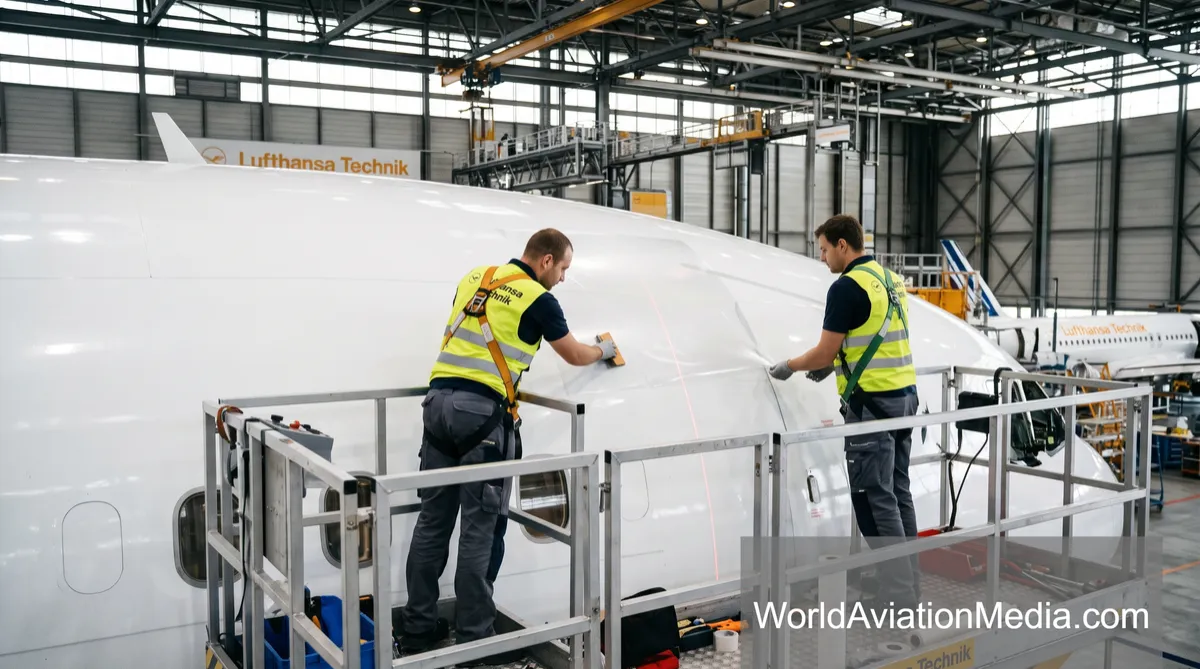
Modular "Patch" Application: Rather than wrapping the fuselage in giant continuous sheets, mechanics apply roughly 800 to 950 square meters of transparent film in pre-cut, self-adhesive patches aligned precisely with the local aerodynamic streamlines calculated by Computational Fluid Dynamics (CFD). Windows, static ports, doors, and antenna cutouts remain completely unobstructed.
EASA & FAA Supplemental Type Certification (STC): To obtain an STC, Lufthansa Technik had to prove that adding ~120 kilograms of film did not alter the aircraft's flutter characteristics, lightning strike protection dissipation, ice accretion behavior, or emergency evacuation slide interaction.
The Next Horizon: Wing Riblets and Active Laminar Flow
Currently, first-generation AeroSHARK installations cover approximately 40% of the aircraft's wetted surface (primarily the upper and side fuselage barrels and engine nacelles), yielding a verified 1% reduction in fuel consumption and CO2 emissions on every flight. Lufthansa Technik and BASF are already flight-testing Stage 2 expansions that extend the riblet film across the upper surfaces of the wings and horizontal stabilizers—where airflow velocities are highest—which is projected to push total fuel savings toward 2.5% to 3.0% per aircraft.
Simultaneously, airframe OEMs are advancing Natural Laminar Flow (NLF) and Hybrid Laminar Flow Control (HLFC). Whereas shark-skin riblets reduce the drag of flow that has already turned turbulent, laminar flow technologies aim to prevent the boundary layer from turning turbulent in the first place—using laser-perforated titanium leading edges and micro-suction compressors to draw off unstable boundary-layer air across the vertical fin and wings.
5-Item Q&A Section (FAQ)
Q1: How does "shark skin" film reduce fuel consumption on commercial airplanes?
Known commercially as AeroSHARK, the transparent surface film features millions of microscopic grooves (riblets) measuring 50 micrometers tall that mimic real shark skin. These flow-aligned grooves lift tiny turbulent eddies off the aircraft surface, reducing viscous skin friction drag and cutting fuel burn by roughly 1% to 3% per flight.
Q2: Which airlines and aircraft types are currently using AeroSHARK technology in 2026?
AeroSHARK is deployed across the Boeing 777-300ER fleet of SWISS, the Boeing 777F freighter fleet of Lufthansa Cargo, All Nippon Airways (ANA), and—as of late 2026—is undergoing certification and commercial testing on the Airbus A330 platform with Lufthansa Group carrier Discover Airlines.
Q3: How long does an AeroSHARK fuselage film installation last before needing replacement?
The modern polymer riblet film developed by Lufthansa Technik and BASF is engineered to withstand extreme UV radiation, temperature swings from -60°C to +50°C, and high-altitude erosion for at least six years, aligning with an aircraft's standard heavy maintenance D-check and repainting cycle.
Q4: What is the difference between skin friction drag and induced drag on an airliner?
Induced drag is created at the wingtips as a byproduct of generating aerodynamic lift (mitigated by winglets and high-aspect-ratio wings), whereas skin friction drag is caused by the viscous shearing of air molecules scrubbing along the outer surface of the fuselage, wings, and tail during cruise (mitigated by smooth composite skins and riblet films).
Q5: How much fuel and carbon emissions does a 1% drag reduction save on a long-haul jet?
On a single long-haul widebody aircraft like a Boeing 777-300ER or Airbus A330, a 1% reduction in aerodynamic drag saves approximately 300 to 400 metric tons of jet fuel and prevents 950 to 1,200 metric tons of CO2 emissions every single year of operation.
Keywords and Hashtags
Keywords: AeroSHARK shark skin aircraft film, aerodynamic drag reduction commercial aviation, Lufthansa Technik Airbus A330 AeroSHARK 2026, skin friction drag riblet coatings, laminar flow technology aircraft, aviation fuel efficiency innovations, boundary layer turbulence control.
Hashtags: #AeroSHARK #Aerodynamics #AviationSustainability #LufthansaTechnik #Biomimicry #FluidDynamics #FuelEfficiency #AerospaceEngineering
